Prior-guided Fusion of Multimodal Features for Change Detection from Optical-SAR Images
Pith reviewed 2026-05-10 19:52 UTC · model grok-4.3
The pith
STSF-Net fuses optical and SAR features using semantic priors to reduce pseudo-changes in multimodal detection.
A machine-rendered reading of the paper's core claim, the machinery that carries it, and where it could break.
Core claim
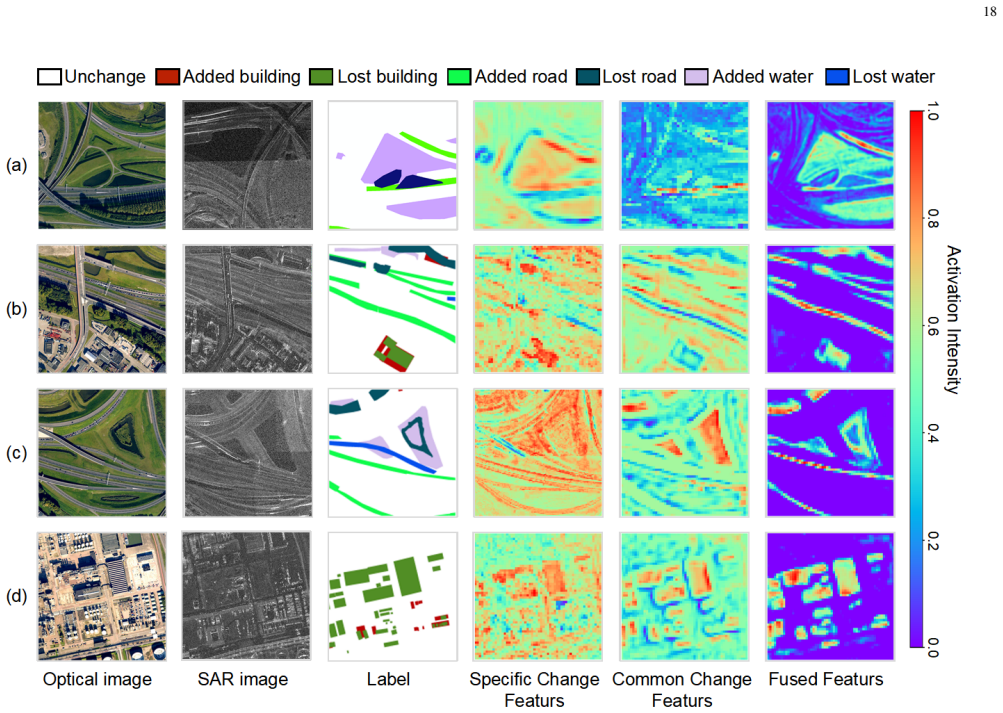
STSF-Net jointly models modality-specific and spatio-temporal common features to enhance change representations, while an optical-SAR fusion strategy adaptively adjusts feature importance using semantic priors from pre-trained foundational models.
What carries the argument
The prior-guided adaptive fusion that weights optical and SAR features according to semantic priors extracted from pre-trained models.
If this is right
- Modality-specific features surface genuine semantic changes while common features suppress sensor-induced false positives.
- Adaptive weighting driven by external semantic priors improves multiclass change maps on very-high-resolution data.
- The open Delta-SN6 dataset supplies the first public VHR fully polarimetric SAR plus optical multiclass change benchmark.
Where Pith is reading between the lines
- If the priors generalize across sensors, the same guidance mechanism could transfer to other multimodal remote-sensing tasks such as segmentation or object detection.
- The approach implicitly suggests that large vision models can supply stable semantic context even when the target domain is satellite imagery.
- Future work could test whether the fusion strategy still works when the pre-trained model is trained only on optical data rather than mixed sources.
Load-bearing premise
Semantic priors taken from pre-trained foundational models stay reliable and unbiased when used to steer fusion of optical and SAR data for change detection.
What would settle it
Removing the semantic-prior guidance or swapping it for a different pre-trained model produces no mIoU gain on Delta-SN6 or BRIGHT.
Figures


read the original abstract
Multimodal change detection (MMCD) identifies changed areas in multimodal remote sensing (RS) data, demonstrating significant application value in land use monitoring, disaster assessment, and urban sustainable development. However, literature MMCD approaches exhibit limitations in cross-modal interaction and exploiting modality-specific characteristics. This leads to insufficient modeling of fine-grained change information, thus hindering the precise detection of semantic changes in multimodal data. To address the above problems, we propose STSF-Net, a framework designed for MMCD between optical and SAR images. STSF-Net jointly models modality-specific and spatio-temporal common features to enhance change representations. Specifically, modality-specific features are exploited to capture genuine semantic change signals, while spatio-temporal common features are embedded to suppress pseudo-changes caused by differences in imaging mechanisms. Furthermore, we introduce an optical and SAR feature fusion strategy that adaptively adjusts feature importance based on semantic priors obtained from pre-trained foundational models, enabling semantic-guided adaptive fusion of multi-modal information. In addition, we introduce the Delta-SN6 dataset, the first openly-accessible multiclass MMCD benchmark consisting of very-high-resolution (VHR) fully polarimetric SAR and optical images. Experimental results on Delta-SN6, BRIGHT, and Wuhan-Het datasets demonstrate that our method outperforms the state-of-the-art (SOTA) by 3.21%, 1.08%, and 1.32% in mIoU, respectively. The associated code and Delta-SN6 dataset will be released at: https://github.com/liuxuanguang/STSF-Net.
Editorial analysis
A structured set of objections, weighed in public.
Referee Report
Summary. The paper proposes STSF-Net for multimodal change detection (MMCD) between optical and SAR images. It jointly extracts modality-specific features to capture genuine semantic changes and spatio-temporal common features to suppress pseudo-changes arising from differing imaging mechanisms. A central component is an adaptive optical-SAR feature fusion module that re-weights features using semantic priors extracted from pre-trained foundational models. The authors also release the Delta-SN6 dataset (first open multiclass VHR optical-SAR MMCD benchmark) and report mIoU gains of 3.21%, 1.08%, and 1.32% over prior SOTA on Delta-SN6, BRIGHT, and Wuhan-Het, respectively, with code and data to be released.
Significance. If the reported gains prove robust and causally attributable to the prior-guided fusion, the work would offer a practical advance in handling cross-modal discrepancies in RS change detection, with direct relevance to land-use monitoring and disaster assessment. The public release of the Delta-SN6 benchmark and associated code constitutes a clear positive contribution to the community, independent of the algorithmic novelty.
major comments (2)
- [§3.3] §3.3 (Semantic Prior-Guided Fusion): The description of prior extraction and adaptive weighting presupposes that semantic priors transferred from general pre-trained foundational models remain accurate and unbiased on VHR SAR-optical pairs, yet no quantitative validation (e.g., prior accuracy metrics, domain-shift analysis, or error propagation study) is provided. This assumption is load-bearing for the central claim that the fusion strategy, rather than other architectural elements, drives the observed mIoU improvements.
- [§4] §4 (Experiments, Tables 2–4): The ablation studies do not isolate the contribution of the semantic-prior component from the modality-specific and spatio-temporal branches; consequently the small reported gains (1–3 % mIoU) cannot be confidently attributed to the proposed fusion rather than to increased model capacity or implementation details. In addition, no statistical significance tests or multi-run standard deviations are reported.
minor comments (2)
- [Abstract] Abstract: the phrasing 'literature MMCD approaches exhibit limitations' is grammatically awkward; rephrase to 'existing MMCD approaches in the literature exhibit limitations'.
- [§2] §2 (Related Work): several citations to foundational-model papers are present but lack discussion of their specific pre-training domains (natural images vs. remote-sensing), which is relevant to the domain-shift concern.
Simulated Author's Rebuttal
We thank the referee for the constructive feedback and for recognizing the value of the Delta-SN6 benchmark. We address each major comment below with clarifications and planned revisions.
read point-by-point responses
-
Referee: [§3.3] §3.3 (Semantic Prior-Guided Fusion): The description of prior extraction and adaptive weighting presupposes that semantic priors transferred from general pre-trained foundational models remain accurate and unbiased on VHR SAR-optical pairs, yet no quantitative validation (e.g., prior accuracy metrics, domain-shift analysis, or error propagation study) is provided. This assumption is load-bearing for the central claim that the fusion strategy, rather than other architectural elements, drives the observed mIoU improvements.
Authors: We agree that the manuscript lacks explicit quantitative validation of the transferred semantic priors on the target VHR optical-SAR domain. The priors are obtained from general pre-trained models and used only to modulate adaptive weights within the fusion module; the network is trained end-to-end and can therefore compensate for moderate prior inaccuracies. Nevertheless, to strengthen attribution of the reported gains specifically to the prior-guided mechanism, we will add in the revision: (i) prior accuracy metrics computed on a held-out subset of optical-SAR pairs, (ii) a domain-shift analysis comparing prior quality on optical versus SAR inputs, and (iii) a sensitivity study that perturbs the priors and measures downstream mIoU change. These additions will be placed in §3.3 and an accompanying appendix. revision: yes
-
Referee: [§4] §4 (Experiments, Tables 2–4): The ablation studies do not isolate the contribution of the semantic-prior component from the modality-specific and spatio-temporal branches; consequently the small reported gains (1–3 % mIoU) cannot be confidently attributed to the proposed fusion rather than to increased model capacity or implementation details. In addition, no statistical significance tests or multi-run standard deviations are reported.
Authors: We concur that the current ablation tables do not isolate the semantic-prior guidance from the modality-specific and spatio-temporal branches, nor do they quantify run-to-run variability. In the revised manuscript we will augment Tables 2–4 with a dedicated ablation that disables the prior input (replacing it with uniform or learned non-prior weights while preserving parameter count) and with results averaged over five random seeds together with standard deviations. We will also report paired statistical significance tests (Wilcoxon signed-rank) between the full model and the ablated variant. These changes will allow clearer attribution of the 1–3 % mIoU gains to the prior-guided fusion component. revision: yes
Circularity Check
No circularity: new architecture with external priors and held-out empirical results
full rationale
The paper proposes STSF-Net as a novel multimodal fusion network that extracts modality-specific and spatio-temporal common features, then applies an adaptive fusion module guided by semantic priors from external pre-trained foundational models. Performance is reported via mIoU gains on three independent test datasets (Delta-SN6 introduced here, plus BRIGHT and Wuhan-Het). No equations, derivations, or 'predictions' are presented that reduce by construction to quantities fitted from the same data or defined in terms of the target outputs. No self-citation chains, uniqueness theorems, or ansatzes imported from prior author work are invoked as load-bearing justification. The central claims rest on architectural design choices and standard supervised evaluation, which are self-contained against external benchmarks.
Axiom & Free-Parameter Ledger
free parameters (1)
- Adaptive fusion parameters
axioms (1)
- domain assumption Semantic priors from pre-trained foundational models are transferable to optical-SAR remote sensing images for guiding feature fusion.
Lean theorems connected to this paper
-
IndisputableMonolith/Foundation/RealityFromDistinction.leanreality_from_one_distinction unclear?
unclearRelation between the paper passage and the cited Recognition theorem.
STSF-Net jointly models modality-specific and spatio-temporal common features... semantic priors obtained from pre-trained foundational models... PGFFM... SAM2-based Semantic Priors Generator
-
IndisputableMonolith/Cost/FunctionalEquation.leanwashburn_uniqueness_aczel unclear?
unclearRelation between the paper passage and the cited Recognition theorem.
Prior-Guided Feature Fusion Module... M_i_diff = σ(F(∥P_i_opt - P_i_sar∥_2))
What do these tags mean?
- matches
- The paper's claim is directly supported by a theorem in the formal canon.
- supports
- The theorem supports part of the paper's argument, but the paper may add assumptions or extra steps.
- extends
- The paper goes beyond the formal theorem; the theorem is a base layer rather than the whole result.
- uses
- The paper appears to rely on the theorem as machinery.
- contradicts
- The paper's claim conflicts with a theorem or certificate in the canon.
- unclear
- Pith found a possible connection, but the passage is too broad, indirect, or ambiguous to say the theorem truly supports the claim.
Reference graph
Works this paper leans on
-
[1]
J. F. Brown, H. J. Tollerud, C. P. Barber, Q. Zhou, J. L. Dwyer, J. E. V ogelmann, T. R. Loveland, C. E. Woodcock, S. V . Stehman, Z. Zhu, B. W. Pengra, K. Smith, J. A. Horton, G. Xian, R. F. Auch, T. L. Sohl, K. L. Sayler, A. L. Gallant, D. Zelenak, R. R. Reker, and J. Rover, “Lessons learned implementing an operational continuous united states national ...
work page 2020
-
[2]
Cross-modal feature interaction network for heterogeneous change detection,
Z. Yang, X. Wang, H. Lin, M. Li, and M. Lin, “Cross-modal feature interaction network for heterogeneous change detection,”Geo-spat. Inf. Sci., vol. 28, no. 5, pp. 2358–2379, 2025
work page 2025
-
[3]
Land cover change detection with hyperspectral remote sensing images: A survey,
Z. Lv, M. Zhang, W. Sun, T. Lei, J. A. Benediktsson, and T. Liu, “Land cover change detection with hyperspectral remote sensing images: A survey,”Inf. Fusion, vol. 123, p. 103257, 2025
work page 2025
-
[4]
A. A. Nielsen, “The regularized iteratively reweighted mad method for change detection in multi- and hyperspectral data,”IEEE Trans. Image Process., vol. 16, no. 2, pp. 463–478, 2007
work page 2007
-
[5]
Unsupervised land-use change detection using multi-temporal poi embedding,
Y . Yao, Q. Zhu, Z. Guo, W. Huang, Y . Zhang, X. Yan, A. Dong, Z. Jiang, H. Liu, and Q. Guan, “Unsupervised land-use change detection using multi-temporal poi embedding,”International Journal of Geographical Information Science, vol. 37, no. 11, pp. 2392–2415, 2023
work page 2023
-
[6]
From single- to multi-modal remote sensing imagery interpretation: a survey and taxonomy,
X. Sun, Y . Tian, W. Lu, P. Wang, R. Niu, H. Yu, and K. Fu, “From single- to multi-modal remote sensing imagery interpretation: a survey and taxonomy,”Sci. China Inf. Sci., vol. 66, no. 4, p. 140301, 2023
work page 2023
-
[7]
Deep learning in multimodal remote sensing data fusion: A compre- hensive review,
J. Li, D. Hong, L. Gao, J. Yao, K. Zheng, B. Zhang, and J. Chanussot, “Deep learning in multimodal remote sensing data fusion: A compre- hensive review,”Int. J. Appl. Earth Obs. Geoinf., vol. 112, p. 102926, 2022
work page 2022
-
[8]
Multimodal sentiment analy- sis—a comprehensive survey from a fusion methods perspective,
K. Zhao, M. Zheng, Q. Li, and J. Liu, “Multimodal sentiment analy- sis—a comprehensive survey from a fusion methods perspective,”IEEE Access, vol. 13, pp. 64 556–64 583, 2025
work page 2025
-
[9]
Gccd: A generative cross-domain change detection network,
M. Zhang, C. Guo, Y . Zhang, H. Liu, and W. Li, “Gccd: A generative cross-domain change detection network,”IEEE Trans. Geosci. Remote Sens., vol. 62, pp. 1–10, 2024
work page 2024
-
[10]
S. Dong, L. Wang, B. Du, and X. Meng, “Changeclip: Remote sensing change detection with multimodal vision-language representation learn- ing,”ISPRS J. Photogramm. Remote Sens., vol. 208, pp. 53–69, 2024
work page 2024
-
[11]
Transformer-based multimodal change detection with multitask consistency constraints,
B. Liu, H. Chen, K. Li, and M. Y . Yang, “Transformer-based multimodal change detection with multitask consistency constraints,”Inf. Fusion, vol. 108, p. 102358, 2024
work page 2024
-
[12]
Remote sens- ing spatiotemporal vision–language models: A comprehensive survey,
C. Liu, J. Zhang, K. Chen, M. Wang, Z. Zou, and Z. Shi, “Remote sens- ing spatiotemporal vision–language models: A comprehensive survey,” IEEE Geosci. Remote Sens. Mag., pp. 2–42, 2025
work page 2025
-
[13]
K. K. Owen and D. W. Wong, “An approach to differentiate informal settlements using spectral, texture, geomorphology and road accessibility metrics,”Appl. Geogr., vol. 38, pp. 107–118, 2013
work page 2013
-
[14]
K. Bousmalis, G. Trigeorgis, N. Silberman, D. Krishnan, and D. Erhan, “Domain separation networks,” inProceedings of the 30th International Conference on Neural Information Processing Systems, ser. NIPS’16. Red Hook, NY , USA: Curran Associates Inc., 2016, p. 343–351
work page 2016
-
[15]
Freefusion: Infrared and visible image fusion via cross reconstruction learning,
W. Zhao, H. Cui, H. Wang, Y . He, and H. Lu, “Freefusion: Infrared and visible image fusion via cross reconstruction learning,”IEEE Trans. Pattern Anal. Mach. Intell., vol. 47, no. 9, pp. 8040–8056, 2025
work page 2025
-
[16]
J. Qu, J. Ren, W. Dong, S. Xiao, and Y . Li, “Cycle-based fre- quency disentanglement diffusion model with self-training for cross- domain hyperspectral-rgb change detection,”IEEE Trans. Image Pro- cess., vol. 34, pp. 8130–8144, 2025
work page 2025
-
[17]
Iterative robust graph for unsupervised change detection of heterogeneous remote sensing images,
Y . Sun, L. Lei, D. Guan, and G. Kuang, “Iterative robust graph for unsupervised change detection of heterogeneous remote sensing images,”IEEE Trans. Image Process., vol. 30, pp. 6277–6291, 2021
work page 2021
-
[18]
W. Jing, H. Bai, B. Song, W. Ni, J. Wu, and Q. Wang, “Hetecd: Feature consistency alignment and difference mining for heterogeneous remote sensing image change detection,”ISPRS J. Photogramm. Remote Sens., vol. 223, pp. 317–327, 2025
work page 2025
-
[19]
Q. Liu, K. Ren, X. Meng, and F. Shao, “Domain adaptive cross reconstruction for change detection of heterogeneous remote sensing images via a feedback guidance mechanism,”IEEE Trans. Geosci. Remote Sens., vol. 61, pp. 1–16, 2023
work page 2023
-
[20]
W. Zhou, A. Troy, and M. Grove, “Object-based land cover classification and change analysis in the baltimore metropolitan area using multitem- poral high resolution remote sensing data,”Sensors, vol. 8, no. 3, pp. 1613–1636, 2008
work page 2008
-
[21]
Change alignment-based graph structure learning for unsupervised heterogeneous change detection,
K. Xiao, Y . Sun, G. Kuang, and L. Lei, “Change alignment-based graph structure learning for unsupervised heterogeneous change detection,” IEEE Geosci. Remote Sens. Lett., vol. 20, pp. 1–5, 2023
work page 2023
-
[22]
Nonlocal patch similarity based heterogeneous remote sensing change detection,
Y . Sun, L. Lei, X. Li, H. Sun, and G. Kuang, “Nonlocal patch similarity based heterogeneous remote sensing change detection,”Pattern Recogn., vol. 109, p. 107598, 2021
work page 2021
-
[23]
Heterogeneous image change detection based on two-stage joint feature learning,
T. Han, Y . Tang, and Y . Chen, “Heterogeneous image change detection based on two-stage joint feature learning,” inProceedings of the IEEE International Geoscience and Remote Sensing Symposium, 2022, pp. 3215–3218
work page 2022
-
[24]
A feature space constraint-based method for change detection in heterogeneous images,
N. Shi, K. Chen, G. Zhou, and X. Sun, “A feature space constraint-based method for change detection in heterogeneous images,”Remote Sens., vol. 12, p. 3057, 09 2020
work page 2020
-
[25]
Change detection with cross-domain remote sensing images: A systematic review,
J. Chen, D. Hou, C. He, Y . Liu, Y . Guo, and B. Yang, “Change detection with cross-domain remote sensing images: A systematic review,”IEEE J. Sel. Top. Appl. Earth Obs. Remote Sens., vol. 17, pp. 11 563–11 582, 2024
work page 2024
-
[26]
Deep learning in remote sensing applications: A meta-analysis and review,
L. Ma, Y . Liu, X. Zhang, Y . Ye, G. Yin, and B. A. Johnson, “Deep learning in remote sensing applications: A meta-analysis and review,” ISPRS J. Photogramm. Remote Sens., vol. 152, pp. 166–177, 2019
work page 2019
-
[27]
W. Wang, C. Li, P. Ren, X. Lu, J. Wang, G. Ren, and B. Liu, “Dual- branch feature fusion network based cross-modal enhanced cnn and transformer for hyperspectral and lidar classification,”IEEE Geosci. Remote Sens. Lett., vol. 21, pp. 1–5, 2024
work page 2024
-
[28]
Change de- tection in heterogeneous images based on multiple pseudo-homogeneous image pairs,
H. Zhuang, J. Guo, M. Hao, S. Du, K. Zhang, and X. Wang, “Change de- tection in heterogeneous images based on multiple pseudo-homogeneous image pairs,”Int. J. Appl. Earth Obs. Geoinf., vol. 136, p. 104321, 2025
work page 2025
-
[29]
X. Jiang, G. Li, Y . Liu, X.-P. Zhang, and Y . He, “Change detection in heterogeneous optical and sar remote sensing images via deep homogeneous feature fusion,”IEEE J. Sel. Top. Appl. Earth Obs. Remote Sens., vol. 13, pp. 1551–1566, 2020
work page 2020
-
[30]
Sar-to-optical image translation based on improved cgan,
X. Yang, J. Zhao, Z. Wei, N. Wang, and X. Gao, “Sar-to-optical image translation based on improved cgan,”Pattern Recogn., vol. 121, p. 108208, 2022
work page 2022
-
[31]
Unpaired image-to-image translation using cycle-consistent adversarial networks,
J.-Y . Zhu, T. Park, P. Isola, and A. A. Efros, “Unpaired image-to-image translation using cycle-consistent adversarial networks,” inProceedings of 2017 IEEE/CVF International Conference on Computer Vision, 2017, pp. 2242–2251
work page 2017
-
[32]
A deep translation (gan) based change detection network for optical and sar remote sensing images,
X. Li, Z. Du, Y . Huang, and Z. Tan, “A deep translation (gan) based change detection network for optical and sar remote sensing images,” ISPRS J. Photogramm. Remote Sens., vol. 179, pp. 14–34, 2021
work page 2021
-
[33]
Unsupervised change detection from heterogeneous data based on image translation,
Z.-G. Liu, Z.-W. Zhang, Q. Pan, and L.-B. Ning, “Unsupervised change detection from heterogeneous data based on image translation,”IEEE Trans. Geosci. Remote Sens., vol. 60, pp. 1–13, 2022
work page 2022
-
[34]
M. Jiang, X. Zhang, Y . Sun, W. Feng, Q. Gan, and Y . Ruan, “Afs- net: attention-guided full-scale feature aggregation network for high- resolution remote sensing image change detection,”GISci. Remote Sens., vol. 59, no. 1, pp. 1882–1900, 2022
work page 1900
-
[35]
Z. Lv, P. Zhong, W. Wang, Z. You, and N. Falco, “Multiscale attention network guided with change gradient image for land cover change detection using remote sensing images,”IEEE Geosci. Remote Sens. Lett., vol. 20, pp. 1–5, 2023
work page 2023
-
[36]
Q. Guo, J. Zhang, S. Zhu, C. Zhong, and Y . Zhang, “Deep multiscale siamese network with parallel convolutional structure and self-attention for change detection,”IEEE Trans. Geosci. Remote Sens., vol. 60, pp. 1–12, 2022
work page 2022
-
[37]
J. Li, S. Zhu, Y . Gao, G. Zhang, and Y . Xu, “Change detection for high-resolution remote sensing images based on a multi-scale attention siamese network,”Remote Sens., vol. 14, no. 14, 2022
work page 2022
-
[38]
H. Zheng, M. Gong, T. Liu, F. Jiang, T. Zhan, D. Lu, and M. Zhang, “Hfa-net: High frequency attention siamese network for building change detection in vhr remote sensing images,”Pattern Recogn., vol. 129, p. 108717, 2022
work page 2022
-
[39]
Q. Shi, M. Liu, S. Li, X. Liu, F. Wang, and L. Zhang, “A deeply supervised attention metric-based network and an open aerial image 20 dataset for remote sensing change detection,”IEEE Trans. Geosci. Remote Sens., vol. 60, pp. 1–16, 2022
work page 2022
-
[40]
Y . Han, J. Li, Y . Qu, L. Wang, X. Pan, and X. Huang, “Hfnet: Semantic and differential heterogenous fusion network for remote sensing image change detection,”J. Geovisual. Spat. Anal., vol. 9, no. 1, p. 1, nov 2024
work page 2024
-
[41]
A bayesian meta-learning-based method for few-shot hyperspectral image classification,
J. Zhang, L. Liu, R. Zhao, and Z. Shi, “A bayesian meta-learning-based method for few-shot hyperspectral image classification,”IEEE Trans. Geosci. Remote Sens., vol. 61, pp. 1–13, 2023
work page 2023
-
[42]
Z. Lv, J. Liu, W. Sun, T. Lei, J. A. Benediktsson, and X. Jia, “Hi- erarchical attention feature fusion-based network for land cover change detection with homogeneous and heterogeneous remote sensing images,” IEEE Trans. Geosci. Remote Sens., vol. 61, pp. 1–15, 2023
work page 2023
-
[43]
Transformer-based multimodal change detection with multitask consistency constraints,
B. Liu, H. Chen, K. Li, and M. Y . Yang, “Transformer-based multimodal change detection with multitask consistency constraints,”Inf. Fusion, vol. 108, p. 102358, Aug. 2024
work page 2024
-
[44]
X. Liu, C. Dai, L. Ding, Z. Zhang, Y . Li, X. Zuo, M. Li, H. Wang, and Y . Miao, “Gstm-scd: Graph-enhanced spatio-temporal state space model for semantic change detection in multi-temporal remote sensing images,” ISPRS J. Photogramm. Remote Sens., vol. 230, pp. 73–91, 2025
work page 2025
-
[45]
Exploring foundation models in remote sensing image change detection: A comprehensive survey,
Z. Yu, T. Li, Y . Zhu, and R. Pan, “Exploring foundation models in remote sensing image change detection: A comprehensive survey,” 2024
work page 2024
-
[46]
Adapting segment anything model for change detection in vhr remote sensing images,
L. Ding, K. Zhu, D. Peng, H. Tang, K. Yang, and L. Bruzzone, “Adapting segment anything model for change detection in vhr remote sensing images,”IEEE Trans. Geosci. Remote Sens., vol. 62, pp. 1–11, 2024
work page 2024
-
[47]
Scd-sam: Adapting segment anything model for semantic change detection in remote sensing imagery,
L. Mei, Z. Ye, C. Xu, H. Wang, Y . Wang, C. Lei, W. Yang, and Y . Li, “Scd-sam: Adapting segment anything model for semantic change detection in remote sensing imagery,”IEEE Trans. Geosci. Remote Sens., vol. 62, pp. 1–13, 2024
work page 2024
-
[48]
S. Dong, Y . Hu, L. Wang, G. Chen, and X. Meng, “Peftcd: Leveraging vision foundation models with parameter-efficient fine-tuning for remote sensing change detection,” 2025
work page 2025
-
[49]
Spacenet 6: Multi-sensor all weather mapping dataset,
J. Shermeyer, D. Hogan, J. Brown, A. Van Etten, N. Weir, F. Paci- fici, R. H ¨ansch, A. Bastidas, S. Soenen, T. Bacastow, and R. Lewis, “Spacenet 6: Multi-sensor all weather mapping dataset,” in2020 IEEE/CVF Conference on Computer Vision and Pattern Recognition Workshops, 2020, pp. 768–777
work page 2020
-
[50]
Unsu- pervised image regression for heterogeneous change detection,
L. T. Luppino, F. M. Bianchi, G. Moser, and S. N. Anfinsen, “Unsu- pervised image regression for heterogeneous change detection,”IEEE Trans. Geosci. Remote Sens., vol. 57, no. 12, pp. 9960–9975, 2019
work page 2019
-
[51]
A fractal projection and markovian segmentation-based approach for multimodal change detection,
M. Mignotte, “A fractal projection and markovian segmentation-based approach for multimodal change detection,”IEEE Trans. Geosci. Remote Sens., vol. 58, no. 11, pp. 8046–8058, 2020
work page 2020
-
[52]
Wuhan dataset: A high-resolution dataset of spatiotemporal fusion for remote sensing images,
X. Zhang, L. Xie, S. Li, F. Lei, L. Cao, and X. Li, “Wuhan dataset: A high-resolution dataset of spatiotemporal fusion for remote sensing images,”IEEE Geosci. Remote Sens. Lett., vol. 21, pp. 1–5, 2024
work page 2024
-
[53]
H. Chen, J. Song, O. Dietrich, C. Broni-Bediako, W. Xuan, J. Wang, X. Shao, Y . Wei, J. Xia, C. Lan, K. Schindler, and N. Yokoya, “BRIGHT: a globally distributed multimodal building damage assessment dataset with very-high-resolution for all-weather disaster response,”Earth Sys- tem Science Data, vol. 17, no. 11, pp. 6217–6253, 2025
work page 2025
-
[54]
Encoder- decoder with atrous separable convolution for semantic image segmenta- tion,
L.-C. Chen, Y . Zhu, G. Papandreou, F. Schroff, and H. Adam, “Encoder- decoder with atrous separable convolution for semantic image segmenta- tion,” inProceedings of 2018 European Conference on Computer Vision. Cham: Springer International Publishing, 2018, pp. 833–851
work page 2018
-
[55]
H. Chen, C. Wu, B. Du, L. Zhang, and L. Wang, “Change detection in multisource vhr images via deep siamese convolutional multiple-layers recurrent neural network,”IEEE Trans. Geosci. Remote Sens., vol. 58, no. 4, pp. 2848–2864, 2020
work page 2020
-
[56]
Learning from multimodal and multitemporal earth observation data for building damage mapping,
B. Adriano, N. Yokoya, J. Xia, H. Miura, W. Liu, M. Matsuoka, and S. Koshimura, “Learning from multimodal and multitemporal earth observation data for building damage mapping,”ISPRS J. Photogramm. Remote Sens., vol. 175, pp. 132–143, 2021
work page 2021
-
[57]
Z. Zheng, Y . Zhong, J. Wang, A. Ma, and L. Zhang, “Building damage assessment for rapid disaster response with a deep object-based semantic change detection framework: From natural disasters to man- made disasters,”Remote Sens. Environ., vol. 265, p. 112636, 2021
work page 2021
-
[58]
Y . Feng, H. Xu, J. Jiang, H. Liu, and J. Zheng, “Icif-net: Intra-scale cross-interaction and inter-scale feature fusion network for bitemporal remote sensing images change detection,”IEEE Trans. Geosci. Remote Sens., vol. 60, pp. 1–13, 2022
work page 2022
-
[59]
Simple multiscale unet for change detection with heterogeneous remote sensing images,
Z. Lv, H. Huang, L. Gao, J. A. Benediktsson, M. Zhao, and C. Shi, “Simple multiscale unet for change detection with heterogeneous remote sensing images,”IEEE Geosci. Remote Sens. Lett., vol. 19, pp. 1–5, 2022
work page 2022
-
[60]
Dual- tasks siamese transformer framework for building damage assessment,
H. Chen, E. Nemni, S. Vallecorsa, X. Li, C. Wu, and L. Bromley, “Dual- tasks siamese transformer framework for building damage assessment,” inProceedings of 2022 IEEE International Geoscience and Remote Sensing Symposium, 2022, pp. 1600–1603
work page 2022
-
[61]
J. Long, M. Li, X. Wang, and A. Stein, “Semantic change detection using a hierarchical semantic graph interaction network from high-resolution remote sensing images,”ISPRS J. Photogramm. Remote Sens., vol. 211, pp. 318–335, 2024
work page 2024
-
[62]
D. Wang, G. Ma, H. Zhang, X. Wang, and Y . Zhang, “Refined change detection in heterogeneous low-resolution remote sensing images for disaster emergency response,”ISPRS J. Photogramm. Remote Sens., vol. 220, pp. 139–155, 2025
work page 2025
-
[63]
Sigma: Siamese mamba network for multi-modal semantic segmentation,
Z. Wan, P. Zhang, Y . Wang, S. Yong, S. Stepputtis, K. Sycara, and Y . Xie, “Sigma: Siamese mamba network for multi-modal semantic segmentation,” 2025
work page 2025
discussion (0)
Sign in with ORCID, Apple, or X to comment. Anyone can read and Pith papers without signing in.