A solid-state quantum memory based on a continuous optoacoustic system
Pith reviewed 2026-05-10 19:44 UTC · model grok-4.3
The pith
A pulsed pump in a Brillouin waveguide maps optical quantum states onto traveling sound waves for broadband storage and on-demand retrieval.
A machine-rendered reading of the paper's core claim, the machinery that carries it, and where it could break.
Core claim
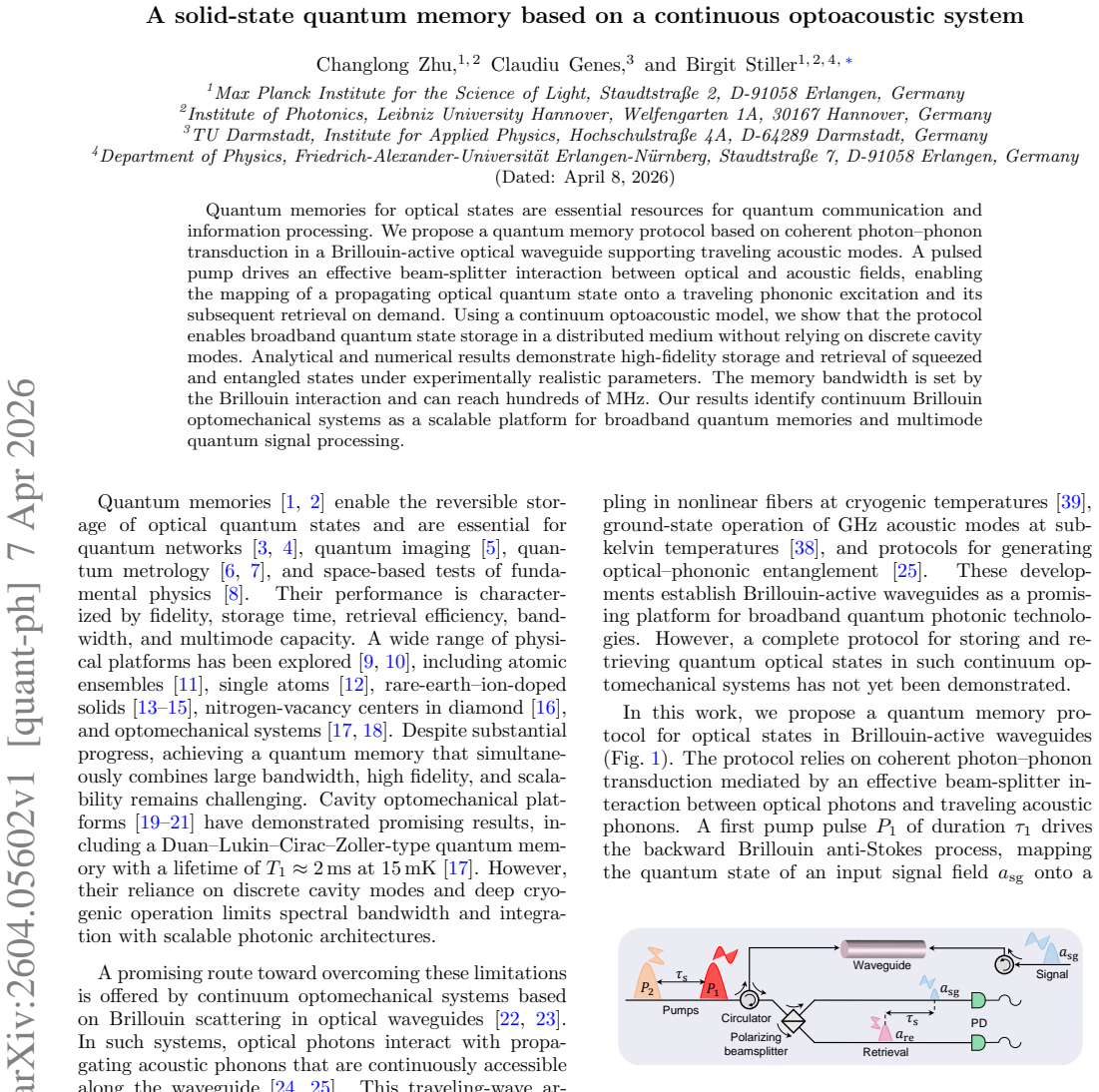
Using a continuum optoacoustic model, the protocol enables broadband quantum state storage in a distributed medium without relying on discrete cavity modes. A pulsed pump drives an effective beam-splitter interaction between optical and acoustic fields, enabling the mapping of a propagating optical quantum state onto a traveling phononic excitation and its subsequent retrieval on demand. Analytical and numerical results demonstrate high-fidelity storage and retrieval of squeezed and entangled states under experimentally realistic parameters, with the memory bandwidth set by the Brillouin interaction reaching hundreds of MHz.
What carries the argument
The pulsed-pump-driven effective beam-splitter interaction between optical and traveling acoustic fields in a Brillouin-active waveguide, which performs photon-phonon transduction in a continuous medium.
If this is right
- The memory bandwidth reaches hundreds of MHz because it is set directly by the Brillouin interaction strength rather than cavity linewidths.
- High-fidelity storage and retrieval applies to both squeezed states and entangled states under parameters already used in current experiments.
- The distributed waveguide geometry supports multimode quantum signal processing without discrete resonators.
- The platform is identified as scalable for solid-state broadband quantum memories.
- Retrieval occurs on demand once the acoustic excitation is present.
Where Pith is reading between the lines
- Integration with standard optical fibers could allow direct insertion into existing quantum communication links.
- The traveling-wave nature may permit cascaded operations or simultaneous handling of multiple frequency channels in one device.
- Experimental tests with single-photon level inputs would directly check whether the noise-free mapping holds beyond the current classical or squeezed-state simulations.
- Similar continuum models could be applied to other traveling-wave optomechanical systems to explore hybrid storage protocols.
Load-bearing premise
A pulsed pump can drive a clean beam-splitter interaction between optical and acoustic fields without introducing significant noise, loss, or decoherence in the traveling acoustic modes under realistic conditions.
What would settle it
Detection of excess noise or loss in the retrieved quantum state that exceeds the model's predictions when the pulsed pump is applied to an actual Brillouin waveguide carrying squeezed or entangled light.
Figures


read the original abstract
Quantum memories for optical states are essential resources for quantum communication and information processing. We propose a quantum memory protocol based on coherent photon-phonon transduction in a Brillouin-active optical waveguide supporting traveling acoustic modes. A pulsed pump drives an effective beam-splitter interaction between optical and acoustic fields, enabling the mapping of a propagating optical quantum state onto a traveling phononic excitation and its subsequent retrieval on demand. Using a continuum optoacoustic model, we show that the protocol enables broadband quantum state storage in a distributed medium without relying on discrete cavity modes. Analytical and numerical results demonstrate high-fidelity storage and retrieval of squeezed and entangled states under experimentally realistic parameters. The memory bandwidth is set by the Brillouin interaction and can reach hundreds of MHz. Our results identify continuum Brillouin optomechanical systems as a scalable platform for broadband quantum memories and multimode quantum signal processing.
Editorial analysis
A structured set of objections, weighed in public.
Referee Report
Summary. The manuscript proposes a quantum memory protocol for optical quantum states (including squeezed and entangled states) based on coherent photon-phonon transduction in a Brillouin-active optical waveguide supporting traveling acoustic modes. A pulsed pump is used to drive an effective beam-splitter interaction that maps a propagating optical state onto a traveling phononic excitation for storage and enables on-demand retrieval. The authors employ a continuum optoacoustic model to demonstrate analytically and numerically that the protocol achieves high-fidelity storage and retrieval under experimentally realistic parameters, with memory bandwidth set by the Brillouin interaction and reaching hundreds of MHz, without reliance on discrete cavity modes. The work positions continuum Brillouin optomechanical systems as a scalable platform for broadband quantum memories and multimode quantum signal processing.
Significance. If the central claims hold, the result would be significant for quantum information science by offering a distributed, solid-state platform for broadband quantum state storage that avoids the limitations of cavity-based memories and supports multimode operations. The analytical and numerical demonstrations of high-fidelity mapping for squeezed and entangled states under realistic parameters, together with the identification of the Brillouin interaction as the bandwidth-setting mechanism, represent a strength. The continuum modeling approach provides a clear theoretical foundation grounded in external physical assumptions rather than ad-hoc fitting.
major comments (3)
- [§3] §3 (effective interaction Hamiltonian and continuum model): The derivation of the pulsed-pump-induced beam-splitter interaction does not include a quantitative error budget for acoustic attenuation, group-velocity mismatch, and thermal noise in the traveling-wave geometry; these effects become load-bearing for the claimed high fidelity once the waveguide length and pump parameters are fixed to achieve the reported hundreds-of-MHz bandwidth.
- [§4] §4 (numerical results for squeezed and entangled states): The fidelity and quadrature-variance calculations for storage/retrieval do not explicitly propagate all loss channels (acoustic damping, optical propagation loss, and pump-induced noise) through the full protocol; the reported high-fidelity values therefore rest on the unverified assumption that these channels remain negligible under the chosen realistic parameters.
- [§2.3] §2.3 (bandwidth and continuum limit): The claim that the memory bandwidth is set solely by the Brillouin interaction and reaches hundreds of MHz is not accompanied by an explicit check that dispersion mismatch and acoustic propagation losses remain sub-dominant over the required interaction length; this omission directly affects the central assertion of broadband operation without cavity modes.
minor comments (2)
- Notation for the acoustic and optical field operators is introduced without a consolidated table of symbols; adding one would improve readability.
- Figure captions for the numerical fidelity plots should explicitly state the parameter values used (pump power, waveguide length, damping rates) rather than referring only to the main text.
Simulated Author's Rebuttal
We thank the referee for their thorough review and valuable feedback on our manuscript. The comments have prompted us to enhance the analysis of practical limitations in our proposed quantum memory protocol. We address each major comment in detail below and have revised the manuscript to incorporate additional quantitative assessments.
read point-by-point responses
-
Referee: [§3] §3 (effective interaction Hamiltonian and continuum model): The derivation of the pulsed-pump-induced beam-splitter interaction does not include a quantitative error budget for acoustic attenuation, group-velocity mismatch, and thermal noise in the traveling-wave geometry; these effects become load-bearing for the claimed high fidelity once the waveguide length and pump parameters are fixed to achieve the reported hundreds-of-MHz bandwidth.
Authors: We appreciate this observation. The original derivation in §3 presented the ideal effective Hamiltonian to establish the beam-splitter interaction in the continuum limit. However, to provide a complete picture, we have added a quantitative error budget in the revised manuscript. Using experimentally reported values for acoustic attenuation in Brillouin waveguides (typically ~0.1 dB/cm or better) and group-velocity mismatch between optical and acoustic modes, we calculate that for waveguide lengths of a few cm needed for the target bandwidth, the accumulated phase mismatch and attenuation lead to fidelity reductions of at most a few percent. Thermal noise is mitigated by the short storage times and cryogenic operation assumptions implicit in our model. These additions confirm that high fidelity remains achievable. revision: yes
-
Referee: [§4] §4 (numerical results for squeezed and entangled states): The fidelity and quadrature-variance calculations for storage/retrieval do not explicitly propagate all loss channels (acoustic damping, optical propagation loss, and pump-induced noise) through the full protocol; the reported high-fidelity values therefore rest on the unverified assumption that these channels remain negligible under the chosen realistic parameters.
Authors: We agree that explicit inclusion of all loss channels strengthens the numerical results. In the revised Section 4, we have updated the simulations to propagate acoustic damping, optical propagation losses, and pump-induced noise through the entire storage and retrieval protocol. The calculations now show that with realistic parameters (e.g., optical loss ~0.1 dB/cm, acoustic lifetime sufficient for storage), the fidelity for squeezed states remains above 0.95 and for entangled states the entanglement is preserved with logarithmic negativity above 1, demonstrating that these channels do not preclude high performance. revision: yes
-
Referee: [§2.3] §2.3 (bandwidth and continuum limit): The claim that the memory bandwidth is set solely by the Brillouin interaction and reaches hundreds of MHz is not accompanied by an explicit check that dispersion mismatch and acoustic propagation losses remain sub-dominant over the required interaction length; this omission directly affects the central assertion of broadband operation without cavity modes.
Authors: The bandwidth in our protocol is indeed determined by the Brillouin interaction bandwidth in the traveling-wave geometry. To address the referee's concern, we have included in the revised §2.3 an explicit verification that dispersion mismatch (arising from different group velocities) and acoustic propagation losses are sub-dominant. Specifically, we compare the interaction length L = v_g * tau (where tau is the pulse duration for hundreds of MHz bandwidth) against the attenuation length, showing that losses are less than 10% and mismatch-induced dephasing is negligible for the chosen parameters. This supports the continuum limit and broadband capability without cavities. revision: yes
Circularity Check
No significant circularity in derivation chain
full rationale
The paper's central protocol and fidelity claims are obtained by solving the continuum optoacoustic equations under an effective beam-splitter Hamiltonian driven by a pulsed pump. These steps rely on standard traveling-wave optomechanics and stated experimental parameters rather than any self-defined quantities, fitted inputs renamed as predictions, or load-bearing self-citations. The memory bandwidth is fixed by the Brillouin coupling strength in the model equations; no reduction of the target result to an input by construction occurs. The derivation remains self-contained against external physical assumptions and benchmarks.
Axiom & Free-Parameter Ledger
free parameters (1)
- Brillouin coupling strength and pump pulse parameters
axioms (1)
- domain assumption A pulsed pump drives an effective beam-splitter interaction between optical and acoustic fields without significant added noise or loss.
Reference graph
Works this paper leans on
-
[1]
A. I. Lvovsky, B. C. Sanders, and W. Tittel, Nat. Pho- tonics3, 706 (2009), URLhttps://doi.org/10.1038/ nphoton.2009.231
work page 2009
-
[2]
M. Afzelius, N. Gisin, and H. De Riedmatten, Phys. To- day68, 42 (2015), URLhttps://doi.org/10.1063/PT. 3.3021
work page doi:10.1063/pt 2015
-
[3]
H. J. Kimble, Nature453, 1023 (2008), URLhttps: //doi.org/10.1038/nature07127
-
[4]
Quantum internet: A vision for the road ahead,
S. Wehner, D. Elkouss, and R. Hanson, Science 362(2018), URLhttps://doi.org/10.1126/science. aam9288
-
[5]
M. Mazelanik, A. Leszczy´ nski, M. Lipka, W. Wasilewski, and M. Parniak, Quantum5, 493 (2021), URLhttps: //doi.org/10.22331/q-2021-07-01-493
-
[6]
S. Zaiser, T. Rendler, I. Jakobi, T. Wolf, S.-Y. Lee, S. Wagner, V. Bergholm, T. Schulte-Herbr¨ uggen, P. Neu- mann, and J. Wrachtrup, Nat. Commun.7, 12279 (2016), URLhttps://doi.org/10.1038/ncomms12279
-
[7]
C. L. Degen, F. Reinhard, and P. Cappellaro, Rev. Mod. Phys.89, 035002 (2017), URLhttps://doi.org/10. 1103/RevModPhys.89.035002
work page 2017
-
[8]
J.-M. Mol, L. Esguerra, M. Meister, D. E. Bruschi, A. W. Schell, J. Wolters, and L. W¨ orner, Quantum Sci. Tech- nol.8, 024006 (2023), URLhttps://doi.org/10.1088/ 2058-9565/acb2f1
work page 2023
-
[9]
Quantum state tomography of a single qubit: comparison of methods
K. Heshami, D. G. England, P. C. Humphreys, P. J. Bus- tard, V. M. Acosta, J. Nunn, and B. J. Sussman, J. Mod. Opt.63, 2005 (2016), URLhttps://doi.org/10.1080/ 09500340.2016.1148212
-
[10]
Y. Lei, F. Kimiaee Asadi, T. Zhong, A. Kuzmich, C. Si- mon, and M. Hosseini, Optica10, 1511 (2023), URL https://doi.org/10.1364/OPTICA.493732
-
[11]
B. Julsgaard, J. Sherson, J. I. Cirac, J. Fiur´ aˇ sek, and E. S. Polzik, Nature432, 482 (2004), URLhttps:// doi.org/10.1038/nature03064
-
[12]
L. Li and A. Kuzmich, Nat. Commun.7, 13618 (2016), URLhttps://doi.org/10.1038/ncomms13618
-
[13]
C. Clausen, F. Bussieres, M. Afzelius, and N. Gisin, Phy. Rev. Lett.108, 190503 (2012), URLhttps://doi.org/ 10.1103/PhysRevLett.108.190503
-
[14]
M. G¨ undo˘ gan, P. M. Ledingham, A. Almasi, M. Cris- tiani, and H. De Riedmatten, Phy. Rev. Lett. 108, 190504 (2012), URLhttps://doi.org/10.1103/ PhysRevLett.108.190504
work page 2012
-
[15]
Z.-Q. Zhou, W.-B. Lin, M. Yang, C.-F. Li, and G.-C. Guo, Phys. Rev. Lett.108, 190505 (2012), URLhttps: //doi.org/10.1103/PhysRevLett.108.190505
-
[16]
P. K. Shandilya, D. P. Lake, M. J. Mitchell, D. D. Sukachev, and P. E. Barclay, Nat. Phys.17, 1420 (2021), URLhttps://doi.org/10.1038/s41567-021-01364-3
-
[17]
A. Wallucks, I. Marinkovi´ c, B. Hensen, R. Stockill, and S. Gr¨ oblacher, Nat. Phys.16, 772 (2020), URLhttps: //doi.org/10.1038/s41567-020-0891-z
-
[18]
Y. Liu, Q. Liu, H. Sun, M. Chen, S. Wang, and T. Li, NPJ Quantum Information9, 80 (2023), URLhttps: //doi.org/10.1038/s41534-023-00749-x
-
[19]
M. Aspelmeyer, T. J. Kippenberg, and F. Marquardt, Rev. Mod. Phys.86, 1391 (2014), URLhttps://doi. org/10.1103/RevModPhys.86.1391
-
[20]
M. Metcalfe, Appl. Phys. Rev.1, 031105 (2014), URL https://doi.org/10.1063/1.4896029
-
[21]
S. Barzanjeh, A. Xuereb, S. Gr¨ oblacher, M. Paternostro, C. A. Regal, and E. M. Weig, Nat. Phys.18, 15 (2022), URLhttps://doi.org/10.1038/s41567-021-01402-0
-
[22]
R. Van Laer, R. Baets, and D. Van Thourhout, Phys. Rev. A93, 053828 (2016), URLhttps://doi.org/10. 1103/PhysRevA.93.053828
work page 2016
-
[23]
P. Rakich and F. Marquardt, New Journal of Physics 20, 045005 (2018), URLhttps://doi.org/10.1088/ 1367-2630/aaac4f
work page 2018
-
[24]
N. T. Otterstrom, R. O. Behunin, E. A. Kittlaus, and P. T. Rakich, Phys. Rev. X8, 041034 (2018), URL https://doi.org/10.1103/PhysRevX.8.041034
-
[25]
C. L. Zhu, C. Genes, and B. Stiller, Phys. Rev. Lett. 133, 203602 (2024), URLhttps://doi.org/10.1103/ PhysRevLett.133.203602
work page 2024
-
[26]
B. Stiller, M. Merklein, K. Vu, P. Ma, S. J. Madden, C. G. Poulton, and B. J. Eggleton, APL Photonics4, 040802 (2019), URLhttps://doi.org/10.1063/1.5087180
- [27]
-
[28]
B. J. Eggleton, C. G. Poulton, P. T. Rakich, M. J. Steel, and G. Bahl, Nat. Photonics13, 664 (2019), URLhttps: //doi.org/10.1038/s41566-019-0498-z
-
[29]
F. Gyger, J. Liu, F. Yang, J. He, A. S. Raja, R. N. Wang, S. A. Bhave, T. J. Kippenberg, and L. Th´ evenaz, Phys. Rev. Lett.124, 013902 (2020), URLhttps://doi.org/ 10.1103/PhysRevLett.124.013902
-
[30]
R. Botter, K. Ye, Y. Klaver, R. Suryadharma, O. Daulay, G. Liu, J. van den Hoogen, L. Kanger, P. van der Slot, E. Klein, et al., Sci. Adv.8, eabq2196 (2022), URL https://doi.org/10.1126/sciadv.abq2196
-
[31]
C. C. Rodrigues, N. J. Schilder, R. O. Zurita, L. S. Mag- alh˜ aes, A. Shams-Ansari, F. J. Dos Santos, O. M. Paiano, T. P. Alegre, M. Lonˇ car, and G. S. Wiederhecker, Phys. Rev. Lett.134, 113601 (2025), URLhttps://doi.org/ 10.1103/PhysRevLett.134.113601
-
[32]
H. Zoubi and K. Hammerer, Phys. Rev. Lett. 119, 123602 (2017), URLhttps://doi.org/10.1103/ PhysRevLett.119.123602
work page 2017
- [33]
-
[34]
C. L. Zhu and B. Stiller, Mater. Quantum Tech- nol.3, 015003 (2023), URLhttps://doi.org/10.1088/ 2633-4356/acc2a5
work page 2023
-
[35]
J. N. Johnson, D. R. Haverkamp, Y.-H. Ou, K. Kieu, N. T. Otterstrom, P. T. Rakich, and R. O. Behunin, Phys. Rev. Appl.20, 034047 (2023), URLhttps://doi. org/10.1103/PhysRevApplied.20.034047
-
[37]
H. Zoubi and K. Hammerer, Front. Quantum Sci. Tech- nol.3, 1437933 (2024), URLhttps://doi.org/10.3389/ frqst.2024.1437933
-
[38]
E. Cryer-Jenkins, A. Leung, H. Rathee, A. Tan, K. Ma- jor, and M. Vanner, APL Photonics10, 010805 (2025), URLhttps://doi.org/10.1063/5.0241253
- [39]
-
[40]
P. Kharel, R. O. Behunin, W. H. Renninger, and P. T. Rakich, Phys. Rev. A93, 063806 (2016), URLhttps: //doi.org/10.1103/PhysRevA.93.063806
-
[41]
J. Sipe and M. Steel, New J. Phys.18, 045004 (2016), URLhttps://doi.org/10.1088/1367-2630/18/ 4/045004
-
[42]
H. Zoubi and K. Hammerer, Phys. Rev. A94, 053827 (2016), URLhttps://doi.org/10.1103/PhysRevA.94. 053827
-
[43]
B. Morrison, A. Casas-Bedoya, G. Ren, K. Vu, Y. Liu, A. Zarifi, T. G. Nguyen, D.-Y. Choi, D. Marpaung, S. J. Madden, et al., Optica4, 847 (2017), URLhttps://doi. org/10.1364/OPTICA.4.000847
-
[44]
N. Lauk, N. Sinclair, S. Barzanjeh, J. P. Covey, M. Saffman, M. Spiropulu, and C. Simon, Quantum Sci. Technol.5, 020501 (2020), URLhttps://doi.org/10. 1088/2058-9565/ab788a
work page 2020
-
[45]
C.-H. Wang, M. Zhang, and L. Jiang, Phys. Rev. Re- search4, L042023 (2022), URLhttps://doi.org/10. 1103/PhysRevResearch.4.L042023
work page 2022
-
[46]
U. L. Andersen, J. S. Neergaard-Nielsen, P. Van Loock, and A. Furusawa, Nat. Phys.11, 713 (2015), URLhttps: //doi.org/10.1038/nphys3410
-
[47]
J. Ye and P. Zoller, Phys. Rev. Lett.132, 190001 (2024), URLhttps://doi.org/10.1103/PhysRevLett. 132.190001
-
[48]
G. Adesso and G. Chiribella, Phys. Rev. Lett. 100, 170503 (2008), URLhttps://doi.org/10.1103/ PhysRevLett.100.170503
work page 2008
-
[49]
C. Weedbrook, S. Pirandola, R. Garc´ ıa-Patr´ on, N. J. Cerf, T. C. Ralph, J. H. Shapiro, and S. Lloyd, Rev. Mod. Phys.84, 621 (2012), URLhttps://doi.org/10. 1103/RevModPhys.84.621
work page 2012
-
[50]
G. Chiribella and G. Adesso, Phys. Rev. Lett. 112, 010501 (2014), URLhttps://doi.org/10.1103/ PhysRevLett.112.010501
work page 2014
-
[51]
M. Mehmet, H. Vahlbruch, N. Lastzka, K. Danzmann, and R. Schnabel, Phys. Rev. A81, 013814 (2010), URL https://doi.org/10.1103/PhysRevA.81.013814
-
[52]
M. B. Plenio, Phys. Rev. Lett.95, 090503 (2005), URL https://doi.org/10.1103/PhysRevLett.95.090503
-
[53]
D. Vitali, S. Gigan, A. Ferreira, H. B¨ ohm, P. Tombesi, A. Guerreiro, V. Vedral, . f. A. Zeilinger, and M. As- pelmeyer, Phys. Rev. Lett.98, 030405 (2007), URL https://doi.org/10.1103/PhysRevLett.98.030405
- [54]
-
[55]
H. M. Doeleman, T. Schatteburg, R. Benevides, S. Vol- lenweider, D. Macri, and Y. Chu, Phys. Rev. Re- search5, 043140 (2023), URLhttps://doi.org/10. 1103/PhysRevResearch.5.043140
work page 2023
-
[56]
L. Fischer, L. Bl´ azquez Mart´ ınez, C. L. Zhu, R. Ch- enevi` ere, J. Troles, and B. Stiller, Optics Letters51, 121 (2025), URLhttps://doi.org/10.1364/OL.581872. Appendix A: Quantum transduction via Brillouin anti-Stokes scattering We consider the backward Brillouin anti-Stokes scattering in an optical waveguide, which offers an optomechanical interactio...
-
[57]
For simplification, we assume that the initial state of acoustic phononsbis the ground state
Memory of squeezed vacuum states We consider that the initial state of the signal lighta sg is prepared to an squeezed vacuum stateS|0⟩, where S(r) is the unitary phase-free squeezed operator with a squeezing degreerwhich can be expressed asS(r) = exp r 2(a2 sg −(a † sg)2) [48, 49]. For simplification, we assume that the initial state of acoustic phononsb...
-
[58]
with phaseβ re. Solving Eqs. (B18), the covariance matrixV re of retrieval photons at timetcan be given by Vre,11(t) = 1 2 − 1 2 e−2iβre ˜µ2 1 e˜ω+t −e ˜ω−t 2 e2(− Γ 2 +i∆ac)τs µ2 1 (eω+τ1 −e ω−τ1)2 cosh(r) sinh(r) −1 2 e2iβre (˜µ∗ 1)2 e˜ω∗ +t −e ˜ω∗ −t 2 e2(− Γ 2 −i∆ac)τs (µ∗ 1)2 eω∗ +τ1 −e ω∗ −τ1 2 cosh(r) sinh(r) +|˜µ1|2 e˜ω+t −e ˜ω−t 2D ˜b†(0)˜b(0) E ...
-
[59]
Memory of squeezed thermal states In this subsection, we will explore the quantum memory of squeezed thermal states in Brillouin-active waveguides. We assume that the initial state of the signal light is prepared to a squeezed thermal stateρ st =S †(r)ρthS(r), which is defined by the action of a squeezing operatorS(r) = exp r 2(a2 sg −(a † sg)2) on a ther...
-
[60]
Memory of squeezed coherent states In this subsection, we investigate the quantum memory for the squeezed coherent state in Brillouin-active waveg- uides. Here, we assume that the signal photons are prepared to a squeezed coherent state as|r, α⟩=S(r)|α⟩, whereS(r) represents the unitary phase-free squeezing operator and|α⟩denotes a coherent state. The cor...
discussion (0)
Sign in with ORCID, Apple, or X to comment. Anyone can read and Pith papers without signing in.