Asymptotic models for viscoelastic one-dimensional blood flow
Pith reviewed 2026-05-10 19:14 UTC · model grok-4.3
The pith
A reduced unidirectional model for blood flow in viscoelastic arteries has local strong solutions in Sobolev spaces for general parameters and periodic data.
A machine-rendered reading of the paper's core claim, the machinery that carries it, and where it could break.
Core claim
Starting from the full three-dimensional viscoelastic fluid-structure interaction problem, the authors perform an asymptotic reduction to obtain a unidirectional one-dimensional system. They establish local well-posedness of strong solutions in Sobolev spaces for arbitrary positive parameters and mean-zero periodic initial data. In the purely elastic BBM regime the same solutions exist globally in time and decay exponentially to equilibrium whenever the initial datum is small enough in a suitable norm.
What carries the argument
The unidirectional asymptotic model obtained by scaling the viscoelastic wall law and reducing the three-dimensional system to one space dimension.
If this is right
- The local existence result justifies short-time numerical simulations of the reduced model across a wide range of viscoelastic parameters.
- In the purely elastic regime the exponential decay of small solutions implies that the model is asymptotically stable around the zero-flow state.
- The continuation criterion mentioned in the numerical study links finite-time blow-up to the growth of Sobolev norms, allowing practical monitoring of solution regularity.
- The framework supplies a mathematically rigorous starting point for studying the effect of varying wall viscosity on pulse propagation.
Where Pith is reading between the lines
- If the small-parameter scalings remain valid for real arteries, the reduced model could serve as an efficient surrogate for studying wave reflection at vessel junctions without solving the full three-dimensional problem.
- The global existence and decay in the elastic case suggest that viscoelastic damping may be the dominant mechanism preventing blow-up in more general regimes.
- The periodic setting used here could be extended to networks of vessels by matching solutions at junctions, provided the local existence theory carries over to piecewise-smooth data.
Load-bearing premise
The reduction to the one-dimensional model requires specific small-parameter scalings and constitutive relations for the artery wall that are assumed to hold but are not verified against physiological data.
What would settle it
A direct numerical comparison between the full three-dimensional viscoelastic fluid-structure system and the reduced one-dimensional model on a periodic domain that shows large discrepancies in wave speed or dissipation rate for realistic parameter values.
Figures




read the original abstract
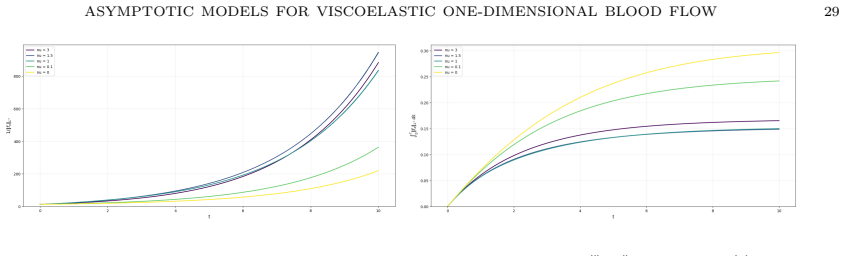
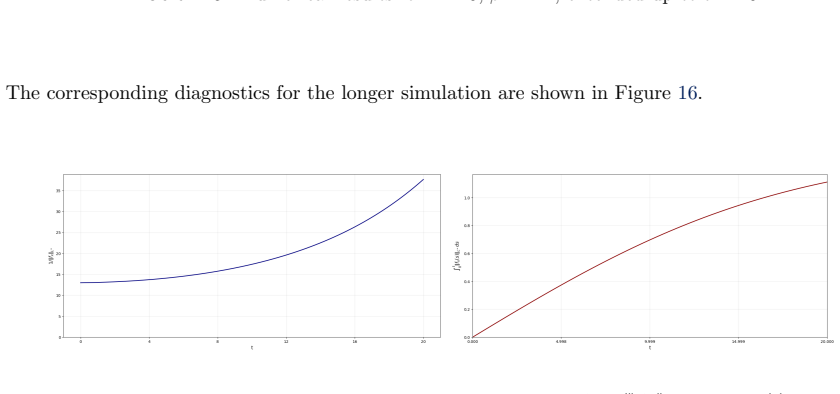
We derive a unidirectional asymptotic model for one-dimensional blood flow in viscoelastic arteries. We prove local well-posedness of strong solutions in Sobolev spaces for general parameters and mean-zero periodic data. In the purely elastic BBM regime we further establish global existence and exponential decay for sufficiently small initial data. We also present a numerical study of the reduced model, including comparisons across different viscoelastic and amplitude regimes, and discuss the observed dynamics in connection with the continuation criterion.
Editorial analysis
A structured set of objections, weighed in public.
Referee Report
Summary. The manuscript derives a unidirectional asymptotic model for one-dimensional blood flow in viscoelastic arteries from the 3D axisymmetric Navier-Stokes system with a viscoelastic wall law. It proves local well-posedness of strong solutions in Sobolev spaces H^s (s>3/2) for general parameters and mean-zero periodic data on the torus. In the purely elastic BBM regime, global existence and exponential decay are established for sufficiently small initial data via a Lyapunov functional. The paper includes a numerical study exploring dynamics across viscoelastic and amplitude regimes, relating observations to the continuation criterion.
Significance. If the results hold, the work strengthens the analytical basis for reduced 1D models in hemodynamics. The explicit small-parameter scalings and viscoelastic constitutive law in §2 justify the reduction, while the local well-posedness for general parameters and global existence/decay in the elastic case provide useful guarantees for long-term behavior and numerical stability. These are standard but carefully executed energy estimates that support further analysis of arterial wave propagation.
minor comments (3)
- §2: The scalings and wall law are clearly stated and address potential concerns about unspecified assumptions; a brief sentence comparing the viscoelastic law to standard Kelvin-Voigt or other arterial models would aid readers from the hemodynamics community.
- §4: The Lyapunov functional for the global existence proof is effective, but stating the explicit dependence of the decay rate on the smallness parameter and viscosity coefficients would make the result easier to compare with related BBM-type equations.
- Numerical section: The regime comparisons are informative, but the manuscript would benefit from a short statement on the spatial/temporal discretization and any observed convergence behavior to support the discussion of the continuation criterion.
Simulated Author's Rebuttal
We thank the referee for the positive and accurate summary of our manuscript on the asymptotic unidirectional model for viscoelastic arterial blood flow. We appreciate the recommendation for minor revision and the recognition of the local well-posedness results in Sobolev spaces as well as the global existence and decay in the elastic BBM regime. Since no specific major comments were provided in the report, we have no point-by-point rebuttals to address at this stage.
Circularity Check
No significant circularity: derivation and proofs are self-contained
full rationale
The paper explicitly states small-parameter scalings and the viscoelastic constitutive law in §2 to justify the unidirectional reduction from the 3D axisymmetric system. Local well-posedness follows from standard energy estimates in H^s (s>3/2) on the torus with mean-zero data; the elastic BBM case uses a Lyapunov functional for global existence and decay of small data. No load-bearing step reduces to a fitted input, self-citation chain, or definitionally equivalent ansatz. The numerical study is presented as exploration of dynamics, not as validation of a constructed prediction. The central claims (model derivation + existence theorems) remain independent of the inputs by construction.
Axiom & Free-Parameter Ledger
axioms (2)
- domain assumption Standard assumptions of asymptotic reduction for slender tubes (small aspect ratio and slow axial variation) are invoked to obtain the unidirectional model.
- domain assumption A viscoelastic constitutive relation for the arterial wall is assumed without specifying the exact form or parameter values.
Lean theorems connected to this paper
-
IndisputableMonolith/Foundation/RealityFromDistinction.leanreality_from_one_distinction unclear?
unclearRelation between the paper passage and the cited Recognition theorem.
We derive a unidirectional asymptotic model... multi-scale expansion in the small-amplitude/long-wave parameter 0<ε≪1... far-field variables ξ=x−t, τ=εt... yields the unidirectional far-field equation (1.6) with nonlocal operators P and M defined by Fourier multipliers.
-
IndisputableMonolith/Cost/FunctionalEquation.leanwashburn_uniqueness_aczel unclear?
unclearRelation between the paper passage and the cited Recognition theorem.
Local well-posedness... energy E(t)=‖f‖_L2² + ‖Λ^s f‖_L2²... dE/dt ≲ E + E^{3/2}... continuation criterion ∫‖f_x‖_L^∞ dt < ∞.
What do these tags mean?
- matches
- The paper's claim is directly supported by a theorem in the formal canon.
- supports
- The theorem supports part of the paper's argument, but the paper may add assumptions or extra steps.
- extends
- The paper goes beyond the formal theorem; the theorem is a base layer rather than the whole result.
- uses
- The paper appears to rely on the theorem as machinery.
- contradicts
- The paper's claim conflicts with a theorem or certificate in the canon.
- unclear
- Pith found a possible connection, but the passage is too broad, indirect, or ambiguous to say the theorem truly supports the claim.
Reference graph
Works this paper leans on
-
[1]
J. Alastruey, A. W. Khir, K. S. Matthys, P. Segers, S. J. Sherwin, P. V. Verdonck, K. H. Parker, and J. Peir´ o. Pulse wave propagation in a model human arterial network: Assessment of 1-D visco-elastic simulations against in vitro measurements.Journal of Biomechanics,44, 2250–2258 (2011)
work page 2011
-
[2]
D. Alonso-Or´ an, ´A. Dur´ an, and R. Granero-Belinch´ on. Derivation and well-posedness for asymptotic models of cold plasmas.Nonlinear Analysis,244, 113539 (2024)
work page 2024
-
[3]
R. L. Armentano, J. G. Barra, J. Levenson, A. Simon, and R. H. Pichel. Arterial wall mechanics in conscious dogs: Assessment of viscous, inertial, and elastic moduli to characterize aortic wall behavior.Circulation Research,76(3), 468–478 (1995)
work page 1995
-
[4]
C. H. Arthur Cheng, R. Granero-Belinch´ on, S. Shkoller, and J. Wilkening. Rigorous asymptotic models of water waves,Water Waves,1, 71–130 (2019)
work page 2019
-
[5]
S. R. Bistafa. Euler, Father of Hemodynamics.Advances in Historical Studies,7(2), 97–111 (2018)
work page 2018
-
[6]
E. Boileau, P. Nithiarasu, P. J. Blanco, L. O. M¨ uller, F. E. Fossan, L. R. Hellevik, W. P. Donders, W. Huberts, M. Willemet, and J. Alastruey. A benchmark study of numerical schemes for one-dimensional arterial blood flow modelling.International Journal for Numerical Methods in Biomedical Engineering,31(10) (2015)
work page 2015
-
[7]
A. Caiazzo, F. Caforio, G. Montecinos, L. O. M¨ uller, P. J. Blanco, and E. F. Toro. Assessment of reduced-order unscented Kalman filter for parameter identification in 1-dimensional blood flow models using experimental data. International Journal for Numerical Methods in Biomedical Engineering,33, e2843 (2017)
work page 2017
-
[8]
S. ˇCani´ c and E. H. Kim. Mathematical analysis of the quasilinear effects in a hyperbolic model blood flow through compliant axi-symmetric vessels.Mathematical Methods in the Applied Sciences,26, 1161–1186 (2003)
work page 2003
-
[9]
S. ˇCani´ c, C. J. Hartley, D. Rosenstrauch, J. Tambaˇ ca, G. Guidoboni, and A. Mikelic. Blood flow in compliant arteries: An effective viscoelastic reduced model, numerics, and experimental validation.Annals of Biomedical Engineering,34, 575–592 (2006)
work page 2006
-
[10]
M. G. Crandall and P. H. Rabinowitz,Bifurcation from simple eigenvalues.Journal of Functional Analysis, 8, pp. 321–340, (1971)
work page 1971
-
[11]
A. Fasano and A. Sequeira.Hemomath. The Mathematics of Blood.Springer, 2017
work page 2017
-
[12]
M. A. Fern´ andez, V. Miliˇ si´ c, and A. Quarteroni. Analysis of a geometrical multiscale blood flow model based on the coupling of ODEs and hyperbolic PDEs.Multiscale Modeling and Simulation,4, 215–236 (2005)
work page 2005
-
[13]
R. Granero-Belinch´ on, S. Scrobogna. Global well-posedness and decay for viscous water wave models,Physics of Fluids,33, 102–115 (2021)
work page 2021
-
[14]
Kato,Perturbation Theory for Linear Operators.Springer-Verlag, Berlin-Heidelberg-New York, (1995)
T. Kato,Perturbation Theory for Linear Operators.Springer-Verlag, Berlin-Heidelberg-New York, (1995)
work page 1995
-
[15]
T. Kato and G. Ponce. Commutator estimates and the Euler and Navier-Stokes equations.Comm. Pure Appl. Math.,41(7): 891–907, 1988
work page 1988
-
[16]
C. E. Kenig, G. Ponce, and L. Vega. Well-posedness of the initial value problem for the Korteweg-de Vries equation. J. Amer. Math. Soc.,4(2):323–347, 1991
work page 1991
-
[17]
H. Kielh¨ ofer,Bifurcation Theory: An Introduction with Applications to PDEs.Springer-Verlag, Berlin-Heidelberg- New York, (2004)
work page 2004
-
[18]
R. Lal, B. Mohammadi, and F. Nicoud. Data assimilation for identification of cardiovascular network characteristics. International Journal for Numerical Methods in Biomedical Engineering,33, e2824 (2017)
work page 2017
-
[19]
D. Maity, J.-P. Raymond, and A. Roy. Existence and uniqueness of maximal strong solution of a 1D blood flow in a network of vessels.Nonlinear Analysis: Real World Applications,63, 103405 (2021)
work page 2021
-
[20]
A. J. Majda and A. L. Bertozzi.Vorticity and Incompressible Flow. Cambridge Texts in Applied Mathematics. Cambridge University Press, Cambridge (2002)
work page 2002
-
[21]
G. I. Montecinos, L. O. M¨ uller, and E. F. Toro. Hyperbolic reformulation of a 1D viscoelastic blood flow model and ADER finite volume schemes.Journal of Computational Physics,266, 101–123 (2014). ASYMPTOTIC MODELS FOR VISCOELASTIC ONE-DIMENSIONAL BLOOD FLOW 35
work page 2014
-
[22]
L. O. M¨ uller, G. Leugering, and P. J. Blanco. Consistent treatment of viscoelastic effects at junctions in one- dimensional blood flow models.Journal of Computational Physics,314, 167–193 (2016)
work page 2016
-
[23]
J. P. Mynard and J. Smolich. One-dimensional haemodynamic modeling and wave dynamics in the entire adult circulation.Annals of Biomedical Engineering,43(6), 1443–1460 (2015)
work page 2015
-
[24]
R. Raghu and C. A. Taylor. Verification of a one-dimensional finite element method for modeling blood flow in the cardiovascular system incorporating a viscoelastic wall model.Finite Elements in Analysis and Design,47, 586–592 (2011)
work page 2011
-
[25]
B. N. Steele, D. Valdez-Jasso, M. A. Haider, and M. S. Olufsen. Predicting arterial flow and pressure dynamics using a 1D fluid dynamics model with a viscoelastic wall.SIAM Journal on Applied Mathematics,71, 1123–1143 (2011)
work page 2011
-
[26]
S. J. Sherwin, V. Franke, J. Peir´ o, and K. Parker. One-dimensional modelling of a vascular network in space-time variables.Journal of Engineering Mathematics,47(3-4), 217–250 (2003)
work page 2003
-
[27]
O. Shramko, A. Svitenkov, and P. Zun. Gravity influence in one-dimensional blood flow modeling.Procedia Com- puter Science,229, 8–17 (2023)
work page 2023
-
[28]
X. Wang, J.-M. Fullana, and P.-Y. Lagr´ ee. Verification and comparison of four numerical schemes for a 1D viscoelas- tic blood flow model.Computer Methods in Biomechanics and Biomedical Engineering,18, 1704–1725 (2015)
work page 2015
-
[29]
X. Wang, S. Nishi, M. Matsukawa, A. Ghigo, P.-Y. Lagr´ ee, and J.-M. Fullana. Fluid friction and wall viscosity of the 1D blood flow model.Journal of Biomechanics,49, 565–571 (2016)
work page 2016
discussion (0)
Sign in with ORCID, Apple, or X to comment. Anyone can read and Pith papers without signing in.