QA-MoE: Towards a Continuous Reliability Spectrum with Quality-Aware Mixture of Experts for Robust Multimodal Sentiment Analysis
Pith reviewed 2026-05-10 19:01 UTC · model grok-4.3
The pith
QA-MoE routes experts according to self-estimated modality reliability to handle continuous degradation in multimodal sentiment analysis.
A machine-rendered reading of the paper's core claim, the machinery that carries it, and where it could break.
Core claim
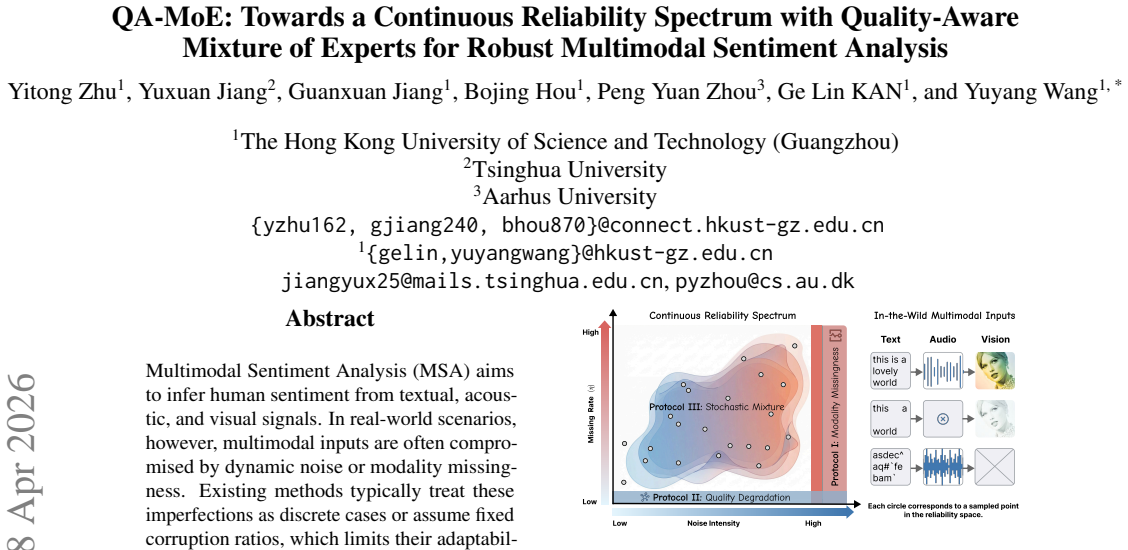
The authors introduce a Continuous Reliability Spectrum that unifies modality missingness and quality degradation into one framework. Building on this, QA-MoE quantifies each modality's reliability via self-supervised aleatoric uncertainty and uses those values to guide expert routing, suppressing error propagation from unreliable signals while preserving task-relevant information from partially degraded inputs.
What carries the argument
The Quality-Aware Mixture-of-Experts (QA-MoE) architecture in which self-supervised aleatoric uncertainty estimates serve as the signal that dynamically routes information to appropriate experts.
If this is right
- Error propagation from unreliable modalities is limited during fusion.
- Task-relevant information is retained from inputs that are only partially degraded rather than discarded.
- Competitive or state-of-the-art performance holds across a wide range of degradation scenarios.
- A single trained checkpoint maintains effectiveness under many different reliability conditions.
Where Pith is reading between the lines
- The same uncertainty-guided routing could apply to other multimodal tasks where input quality varies naturally, such as emotion recognition from video.
- Fewer separate models would be needed if one checkpoint truly covers the full spectrum of real-world degradations.
- Validation on user-generated content with organic noise would test whether the learned uncertainty values match actual contribution to sentiment accuracy.
Load-bearing premise
Self-supervised aleatoric uncertainty estimates accurately reflect true modality reliability and allow routing that blocks errors without discarding useful sentiment information from partially degraded inputs.
What would settle it
An experiment in which uncertainty-guided routing yields no accuracy gain or lower accuracy than a standard non-routed fusion model across intermediate degradation levels would falsify the routing mechanism.
Figures


read the original abstract
Multimodal Sentiment Analysis (MSA) aims to infer human sentiment from textual, acoustic, and visual signals. In real-world scenarios, however, multimodal inputs are often compromised by dynamic noise or modality missingness. Existing methods typically treat these imperfections as discrete cases or assume fixed corruption ratios, which limits their adaptability to continuously varying reliability conditions. To address this, we first introduce a Continuous Reliability Spectrum to unify missingness and quality degradation into a single framework. Building on this, we propose QA-MoE, a Quality-Aware Mixture-of-Experts framework that quantifies modality reliability via self-supervised aleatoric uncertainty. This mechanism explicitly guides expert routing, enabling the model to suppress error propagation from unreliable signals while preserving task-relevant information. Extensive experiments indicate that QA-MoE achieves competitive or state-of-the-art performance across diverse degradation scenarios and exhibits a promising One-Checkpoint-for-All property in practice.
Editorial analysis
A structured set of objections, weighed in public.
Referee Report
Summary. The paper introduces a Continuous Reliability Spectrum to unify modality missingness and continuous quality degradation in multimodal sentiment analysis (MSA). It proposes QA-MoE, a quality-aware mixture-of-experts model that estimates modality reliability through self-supervised aleatoric uncertainty to guide expert routing, with the goal of suppressing error propagation from unreliable signals while retaining task-relevant information. The authors claim that extensive experiments demonstrate competitive or state-of-the-art performance across diverse degradation scenarios and a promising One-Checkpoint-for-All property.
Significance. If the empirical support holds, the work would offer a meaningful advance in robust MSA by providing a unified handling of dynamic real-world input imperfections without requiring separate models or retraining for different degradation levels. The integration of uncertainty estimation directly into MoE routing for continuous reliability is a conceptually coherent direction that could influence future multimodal robustness research.
major comments (2)
- The abstract asserts competitive or SOTA results and the One-Checkpoint-for-All property from extensive experiments, but provides no quantitative metrics, baselines, ablation details, or error analysis. This absence is load-bearing for the central claim, as the support for robustness across degradation scenarios cannot be evaluated without these elements (see reader's take on soundness).
- The core mechanism—that self-supervised aleatoric uncertainty serves as a faithful proxy for modality reliability to guide routing and suppress error propagation—requires explicit validation that this uncertainty correlates with actual sentiment-prediction performance drop under continuous (not just discrete) degradation. Without such grounding (e.g., in the method or experiments sections), the routing decisions risk discarding task-relevant cues preserved in partially degraded inputs, undermining the Continuous Reliability Spectrum unification.
Simulated Author's Rebuttal
We thank the referee for the constructive feedback and for recognizing the potential significance of unifying modality imperfections via the Continuous Reliability Spectrum. We address each major comment below with specific plans for revision.
read point-by-point responses
-
Referee: The abstract asserts competitive or SOTA results and the One-Checkpoint-for-All property from extensive experiments, but provides no quantitative metrics, baselines, ablation details, or error analysis. This absence is load-bearing for the central claim, as the support for robustness across degradation scenarios cannot be evaluated without these elements (see reader's take on soundness).
Authors: We agree that the abstract, as a high-level summary, omits specific quantitative details. The full manuscript contains these elements in Section 4 (Experiments), including tables comparing QA-MoE against baselines across degradation levels, ablation studies on the uncertainty-guided routing, and error analyses. To strengthen the abstract's support for the claims, we will revise it to incorporate key quantitative highlights (e.g., average performance gains and One-Checkpoint-for-All results) while preserving its concise style. revision: yes
-
Referee: The core mechanism—that self-supervised aleatoric uncertainty serves as a faithful proxy for modality reliability to guide routing and suppress error propagation—requires explicit validation that this uncertainty correlates with actual sentiment-prediction performance drop under continuous (not just discrete) degradation. Without such grounding (e.g., in the method or experiments sections), the routing decisions risk discarding task-relevant cues preserved in partially degraded inputs, undermining the Continuous Reliability Spectrum unification.
Authors: This concern is well-taken and highlights a gap in explicit grounding. The current manuscript shows overall performance benefits under continuous degradation scenarios but does not include a direct analysis correlating aleatoric uncertainty estimates with performance drops. We will add this validation in the revised version, for instance by including correlation plots and quantitative metrics (e.g., Pearson coefficients) in the Experiments section demonstrating alignment between uncertainty and error rates across continuous quality levels. This will better substantiate the routing decisions and the unification claim. revision: yes
Circularity Check
No circularity detected; framework uses standard MoE and uncertainty components without self-referential reductions
full rationale
The paper introduces a Continuous Reliability Spectrum to unify degradation cases and proposes QA-MoE that quantifies reliability via self-supervised aleatoric uncertainty to guide MoE routing. No equations, derivations, or fitted-parameter predictions appear in the abstract or described framework. The approach relies on established concepts of Mixture-of-Experts routing and aleatoric uncertainty estimation rather than defining any quantity in terms of itself or renaming a fitted result as a prediction. Claims rest on experimental validation across degradation scenarios rather than tautological construction from inputs or self-citation chains. This is a standard non-circular proposal of an applied architecture.
Axiom & Free-Parameter Ledger
axioms (2)
- domain assumption Multimodal inputs can be usefully characterized by a single continuous reliability spectrum that unifies missingness and quality degradation
- domain assumption Self-supervised aleatoric uncertainty provides a reliable proxy for modality quality that can guide expert routing without external labels
invented entities (2)
-
Continuous Reliability Spectrum
no independent evidence
-
Quality-Aware Mixture-of-Experts (QA-MoE)
no independent evidence
Lean theorems connected to this paper
-
IndisputableMonolith/Cost/FunctionalEquation.leanwashburn_uniqueness_aczel unclear?
unclearRelation between the paper passage and the cited Recognition theorem.
rm = 1 / (1 + 1/d Σ σ²_m,k) ... ym = rm · Σ gi(µm)Ei(µm) + (1−rm)·yprior
-
IndisputableMonolith/Foundation/AbsoluteFloorClosure.leanabsolute_floor_iff_bare_distinguishability unclear?
unclearRelation between the paper passage and the cited Recognition theorem.
Continuous Reliability Spectrum ... Latent Reliability Score rm ∈ (0,1] ... Degradation ∝ 1−rm
What do these tags mean?
- matches
- The paper's claim is directly supported by a theorem in the formal canon.
- supports
- The theorem supports part of the paper's argument, but the paper may add assumptions or extra steps.
- extends
- The paper goes beyond the formal theorem; the theorem is a base layer rather than the whole result.
- uses
- The paper appears to rely on the theorem as machinery.
- contradicts
- The paper's claim conflicts with a theorem or certificate in the canon.
- unclear
- Pith found a possible connection, but the passage is too broad, indirect, or ambiguous to say the theorem truly supports the claim.
Reference graph
Works this paper leans on
-
[1]
Contextual augmented global contrast for mul- timodal intent recognition. InProceedings of the IEEE/CVF Conference on Computer Vision and Pat- tern Recognition (CVPR), pages 26963–26973. Kaiwei Sun and Mi Tian. 2025. Sequential fusion of text-close and text-far representations for multimodal sentiment analysis. InProceedings of the 31st Inter- national Co...
work page 2025
-
[2]
MetaTransformer: a unified framework for multimodal learning.arXiv preprint arXiv:2307.10802, 2023b
Meta-transformer: A unified framework for multimodal learning.Preprint, arXiv:2307.10802. Jinming Zhao, Ruichen Li, and Qin Jin. 2021. Missing modality imagination network for emotion recogni- tion with uncertain missing modalities. InProceed- ings of the 59th Annual Meeting of the Association for Computational Linguistics and the 11th International Joint...
-
[3]
provides 35 facial action unit visual features, and COV AREP (Degottex et al., 2014) offers 74- dimensional acoustic features. IEMOCAP(Busso et al., 2008) is a multimodal database for emotion recognition, comprising dyadic conversations between ten speakers. Fol- lowing prior works (Tsai et al., 2019), we focus on the classification of six discrete emotio...
work page 2014
discussion (0)
Sign in with ORCID, Apple, or X to comment. Anyone can read and Pith papers without signing in.