Predicted DC current induced by propagating wave in gapless Dirac materials
Pith reviewed 2026-05-10 19:30 UTC · model grok-4.3
The pith
Propagating waves induce a nonzero DC current in graphene when next-nearest-neighbor hopping is included.
A machine-rendered reading of the paper's core claim, the machinery that carries it, and where it could break.
Core claim
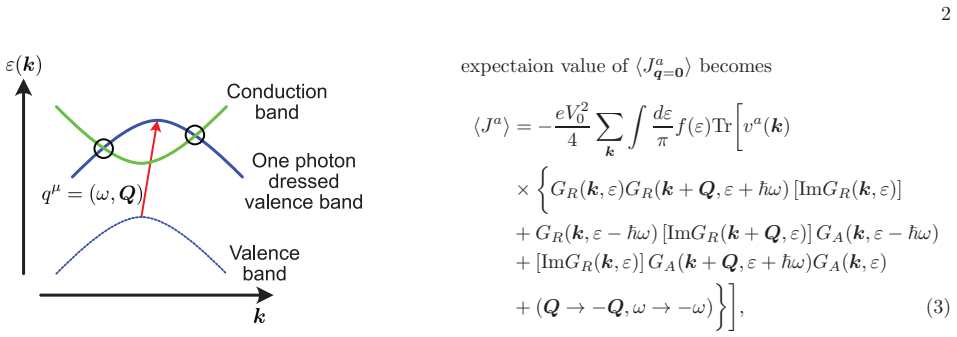
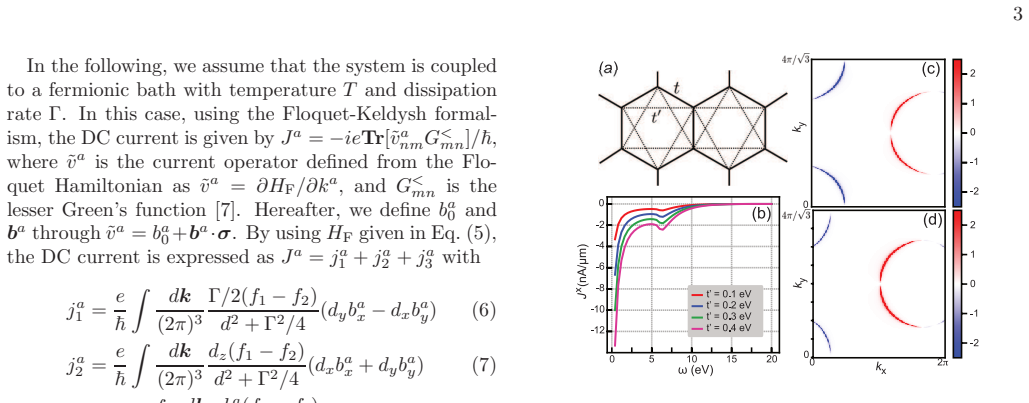
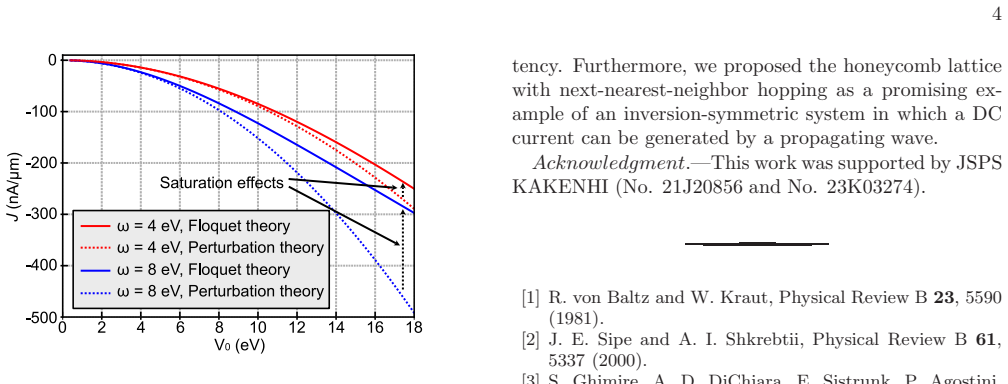
We show that the application of propagating waves can induce a DC current even in systems with spatial inversion symmetry. We derive the equation for the DC current induced by propagating waves using two methods: perturbation theory and Floquet theory. These two approaches yield consistent results. We then apply the equation to gapless graphene subjected to propagating waves. A nonzero DC current is predicted in graphene with next nearest neighbor hopping terms. Nonperturbative effects arising from a strong wave amplitude are also discussed within the framework of Floquet theory.
What carries the argument
The DC current expression obtained from perturbation theory and Floquet theory applied to the graphene tight-binding Hamiltonian that includes next-nearest-neighbor hopping.
If this is right
- The induced DC current is zero in the nearest-neighbor-only model because of inversion symmetry.
- Both perturbative and Floquet routes produce the same analytic expression for the current.
- For strong wave amplitudes the Floquet approach reveals nonperturbative corrections to the current.
- The same mechanism applies to other gapless Dirac materials once next-nearest-neighbor terms are retained.
Where Pith is reading between the lines
- The result suggests experiments that launch acoustic or electromagnetic waves across a graphene sheet and measure the resulting steady current.
- It points to a route for wave-controlled transport that does not require explicit breaking of inversion symmetry by external fields.
- The same DC-current formula could be tested in other two-dimensional Dirac systems such as transition-metal dichalcogenides when their hopping parameters are adjusted.
Load-bearing premise
The graphene tight-binding model must include next-nearest-neighbor hopping; without it the DC current vanishes and the perturbative or Floquet expansions must remain valid for the chosen wave parameters.
What would settle it
Direct measurement of a nonzero DC current whose magnitude and dependence on wave frequency and amplitude match the derived formula in a graphene sample under a propagating wave, or the absence of current when next-nearest-neighbor hopping is set to zero in the model.
Figures
read the original abstract
In this paper, we show that the application of propagating waves can induce a DC current even in systems with spatial inversion symmetry. We derive the equation for the DC current induced by propagating waves using two methods: perturbation theory and Floquet theory. These two approaches yield consistent results. We then apply the equation to gapless graphene subjected to propagating waves. A nonzero DC current is predicted in graphene with next nearest neighbor hopping terms. Nonperturbative effects arising from a strong wave amplitude are also discussed within the framework of Floquet theory.
Editorial analysis
A structured set of objections, weighed in public.
Referee Report
Summary. The manuscript claims that propagating waves induce a nonzero DC current in inversion-symmetric gapless Dirac systems. It derives the DC current expression via two independent routes—time-dependent perturbation theory and Floquet theory—reporting that the results agree. The derived formula is then applied to a tight-binding model of graphene that includes next-nearest-neighbor hopping, yielding a finite DC current; the nearest-neighbor-only case is stated to give zero current. Non-perturbative corrections for strong wave amplitudes are discussed within the Floquet framework.
Significance. If the derivations hold and the perturbative/Floquet regimes apply for realistic parameters, the result identifies a mechanism for rectified current generation that does not require explicit inversion-symmetry breaking, which could be relevant for nonlinear optoelectronics in graphene and related Dirac materials. The explicit consistency check between two standard methods is a positive feature. However, the absence of numerical parameter values, error estimates, or direct benchmarks against non-perturbative calculations limits the immediate quantitative impact of the prediction.
major comments (2)
- [Application to graphene] Application to graphene (near end of manuscript): the nonzero DC current is reported only when next-nearest-neighbor hopping t' is retained; the text should explicitly display the current expression (or its leading term) and confirm that it vanishes identically for t'=0, as this is the load-bearing distinction from the conventional nearest-neighbor graphene model.
- [Floquet theory and nonperturbative effects] Floquet-theory section and non-perturbative discussion: the validity of the high-frequency truncation and the perturbative amplitude expansion is asserted but not demonstrated for the wave parameters employed in the graphene example. No numerical values are supplied for wave amplitude, frequency, Fermi level, or t'/t ratio, nor is there a comparison of the analytic DC current against a non-perturbative benchmark or an estimate of higher-order photon processes.
minor comments (2)
- [Abstract] The abstract refers to 'gapless Dirac materials' in general, yet the concrete calculation is performed only for graphene; a brief statement clarifying the range of applicability to other Dirac cones would improve clarity.
- [Derivation sections] Notation for the propagating wave (vector potential or electric field) and the definition of the DC current component should be introduced once with explicit symbols before the derivations begin.
Simulated Author's Rebuttal
We thank the referee for the careful reading and constructive comments on our manuscript. We address each major comment below and indicate the revisions made.
read point-by-point responses
-
Referee: Application to graphene (near end of manuscript): the nonzero DC current is reported only when next-nearest-neighbor hopping t' is retained; the text should explicitly display the current expression (or its leading term) and confirm that it vanishes identically for t'=0, as this is the load-bearing distinction from the conventional nearest-neighbor graphene model.
Authors: We agree with this recommendation. In the revised manuscript, we will explicitly display the leading term of the DC current expression derived for the graphene tight-binding model (which depends on the next-nearest-neighbor hopping t'). We will also analytically confirm that this term vanishes identically upon setting t' = 0, consistent with the symmetry properties and the absence of the effect in the standard nearest-neighbor model. This addition will be placed in the application section to clarify the distinction. revision: yes
-
Referee: Floquet-theory section and non-perturbative discussion: the validity of the high-frequency truncation and the perturbative amplitude expansion is asserted but not demonstrated for the wave parameters employed in the graphene example. No numerical values are supplied for wave amplitude, frequency, Fermi level, or t'/t ratio, nor is there a comparison of the analytic DC current against a non-perturbative benchmark or an estimate of higher-order photon processes.
Authors: We acknowledge that concrete numerical values and explicit validation were missing. In the revision, we will supply representative parameters for the graphene example (e.g., nearest-neighbor hopping t ≈ 2.8 eV, t'/t ≈ 0.1, Fermi level at the Dirac point, wave frequency ~10 THz, and dimensionless amplitude e v_F A / ħω ≈ 0.1 to ensure the perturbative regime). We will also estimate the suppression of higher-order photon processes under the high-frequency approximation. A direct non-perturbative numerical benchmark (e.g., full Floquet diagonalization with many replicas) is computationally demanding and lies outside the present scope; the analytic agreement between the two methods already provides internal consistency for the reported regime. revision: partial
Circularity Check
No circularity: standard perturbative/Floquet derivation on conventional tight-binding model
full rationale
The paper derives an equation for DC current from propagating waves via perturbation theory and Floquet theory applied to a standard tight-binding Hamiltonian. It then specializes the result to gapless graphene with next-nearest-neighbor hopping and obtains a nonzero current as a direct consequence of the model's broken symmetry under the wave drive. No step redefines a fitted quantity as a prediction, imports a uniqueness theorem from self-citation, or renames an input as an output. The two methods are shown to agree by explicit calculation, and nonperturbative corrections are treated separately within Floquet theory. The derivation remains self-contained against external benchmarks.
Axiom & Free-Parameter Ledger
axioms (2)
- standard math Standard assumptions of time-dependent perturbation theory and Floquet theory apply to the driven tight-binding Hamiltonian.
- domain assumption The graphene lattice includes next-nearest-neighbor hopping terms.
Lean theorems connected to this paper
-
IndisputableMonolith/Cost/FunctionalEquation.leanwashburn_uniqueness_aczel unclear?
unclearRelation between the paper passage and the cited Recognition theorem.
We derive the equation for the DC current induced by propagating waves using two methods: perturbation theory and Floquet theory... A nonzero DC current is predicted in graphene with next nearest neighbor hopping terms.
-
IndisputableMonolith/Foundation/AlphaCoordinateFixation.leanJ_uniquely_calibrated_via_higher_derivative unclear?
unclearRelation between the paper passage and the cited Recognition theorem.
the DC current is expressed as J^a = j1^a + j2^a + j3^a ... J^a = πe/4ℏ ∫ dk (f2−f1) V0² |⟨u1| u2⟩|² / √(...) × (v11^a − v22^a) δ(ε1−ε2+ℏω)
What do these tags mean?
- matches
- The paper's claim is directly supported by a theorem in the formal canon.
- supports
- The theorem supports part of the paper's argument, but the paper may add assumptions or extra steps.
- extends
- The paper goes beyond the formal theorem; the theorem is a base layer rather than the whole result.
- uses
- The paper appears to rely on the theorem as machinery.
- contradicts
- The paper's claim conflicts with a theorem or certificate in the canon.
- unclear
- Pith found a possible connection, but the passage is too broad, indirect, or ambiguous to say the theorem truly supports the claim.
Reference graph
Works this paper leans on
-
[1]
In contrast, for a finite NNN hopping term ( t′ = 1 eV, Fig
These peaks of opposite sign cancel with each other. In contrast, for a finite NNN hopping term ( t′ = 1 eV, Fig. 2(d)), an imbalance between the positive and nega- tive peaks emerges. This asymmetry leads to a net DC current. Furthermore, the DC current is enhanced at low fre- quencies. This enhancement is attributed to the fact that as ω decreases, the k...
- [2]
-
[3]
J. E. Sipe and A. I. Shkrebtii, Physical Review B 61, 5337 (2000)
work page 2000
-
[4]
S. Ghimire, A. D. DiChiara, E. Sistrunk, P. Agostini, L. F. DiMauro, and D. A. Reis, Nat. Phys. 7, 138 (2011)
work page 2011
-
[5]
T. T. Luu, M. Garg, S. Yu, G. M. Rossi, A. Trabat- toni, G. Cerullo, and E. Goulielmakis, Nature 521, 498 (2015)
work page 2015
-
[6]
H. Liu, Y. Li, Y. S. You, S. Gholam-Mirzaei, I. G. Babar, J. R. G. Navarro, A. D. Bristow, and C. D. Lin, Nat. Phys. 13, 262 (2017)
work page 2017
- [7]
- [8]
-
[9]
S. M. Young and A. M. Rappe, Physical Review Letters 109, 116601 (2012)
work page 2012
-
[10]
J. E. Spanier, V. M. Fridkin, A. M. Rappe, A. R. Akba- shev, A. Polemi, Y. Qi, Z. Gu, S. M. Young, A. Stroppa, C. Piccirillo, and et al., Nat. Photonics 10, 611 (2016)
work page 2016
-
[11]
A. M. Glass, D. von der Linde, and T. J. Negran, Appl. Phys. Lett. 25, 233 (1974)
work page 1974
-
[12]
Oka, arXiv preprint arXiv:2407.21458 (2024)
T. Oka, arXiv preprint arXiv:2407.21458 (2024)
- [13]
- [14]
-
[15]
I. Ahmadabadi, H. Dehghani, and M. Hafezi, Commu- nications Physics 6, 149 (2023)
work page 2023
-
[16]
Z. Ji, W. Liu, S. Krylyuk, X. Fan, Z. Zhang, A. Pan, L. Feng, A. Davydov, and R. Agarwal, Science 368, 763 (2020)
work page 2020
- [17]
-
[18]
Z. Gu, H. A. Fertig, D. P. Arovas, and A. Auerbach, Phys. Rev. Lett. 107, 216601 (2011)
work page 2011
-
[19]
G. Usaj, P. M. Perez-Piskunow, L. E. F. Foa Torres, and C. A. Balseiro, Phys. Rev. B 90, 115423 (2014)
work page 2014
-
[20]
K. Kitayama and M. Mochizuki, Physical Review Re- search 2, 023229 (2020)
work page 2020
-
[21]
K. Kitayama, Y. Tanaka, M. Ogata, and M. Mochizuki, Journal of the Physical Society of Japan 90, 104705 (2021)
work page 2021
-
[22]
K. Kitayama, M. Mochizuki, Y. Tanaka, and M. Ogata, Physical Review B 104, 075127 (2021)
work page 2021
-
[23]
K. Kitayama, M. Ogata, M. Mochizuki, and Y. Tanaka, Journal of the Physical Society of Japan 91, 104704 (2022)
work page 2022
- [24]
- [25]
-
[26]
Kumar, Journal of Electronic Materials 50, 3773 5 (2021)
V. Kumar, Journal of Electronic Materials 50, 3773 5 (2021)
work page 2021
-
[27]
M. Baudisch, A. Marini, J. D. Cox, T. Zhu, F. Silva, S. Teichmann, M. Massicotte, F. Koppens, L. S. Levitov, F. J. Garcia de Abajo, et al. , Nature Communications 9, 1018 (2018)
work page 2018
-
[28]
S.-Y. Hong, J. I. Dadap, N. Petrone, P.-C. Yeh, J. Hone, and R. M. Osgood Jr, Physical Review X 3, 021014 (2013)
work page 2013
-
[29]
N. Savostianova and S. A. Mikhailov, Physical Review B 97, 165424 (2018)
work page 2018
- [30]
- [31]
- [32]
-
[33]
O. Matsyshyn, F. Piazza, R. Moessner, and I. Sodemann, Phys. Rev. Lett. 127, 126604 (2021)
work page 2021
discussion (0)
Sign in with ORCID, Apple, or X to comment. Anyone can read and Pith papers without signing in.