Free chiral self-propelled robots compared to active Brownian circle swimmers
Pith reviewed 2026-05-10 19:23 UTC · model grok-4.3
The pith
A hexbug's tracked motion agrees with active Brownian circle swimmer predictions for displacement and scattering.
A machine-rendered reading of the paper's core claim, the machinery that carries it, and where it could break.
Core claim
The central claim is that the hexbug's dynamics, extracted from video tracking, match the predictions of the active Brownian circle swimmer model derived from overdamped Langevin equations, with particularly good agreement in the mean-squared displacement and intermediate scattering function; deviations occur primarily in the short-time behavior of the real-space propagator where translational noise becomes visible.
What carries the argument
Overdamped Langevin equations for active Brownian circle swimmers, which evolve particle position and orientation under constant propulsion and chiral torque.
If this is right
- The active Brownian circle swimmer model can describe hexbug trajectories when translational noise is negligible.
- Analyses based on the intermediate scattering function and real-space propagator are sensitive enough to distinguish noise effects in active systems.
- Coarse-grained overdamped models remain a robust framework for macroscopic active matter under the stated conditions.
- The comparison opens routes to refine such models for other self-propelled macroscopic robots.
Where Pith is reading between the lines
- Extending the comparison to interacting hexbugs could test whether the same equations predict collective patterns.
- Adding a small translational diffusion term to the model might remove the short-time deviations and extend its validity to all timescales.
- Similar video-tracking tests on bristle bots or other chiral robots would check the model's generality beyond a single device.
Load-bearing premise
Translational noise remains small enough that the overdamped Langevin equations still give an accurate description of the hexbug's motion.
What would settle it
A statistically significant mismatch between hexbug data and model predictions in the long-time mean-squared displacement or intermediate scattering function would falsify the claimed agreement.
Figures



read the original abstract
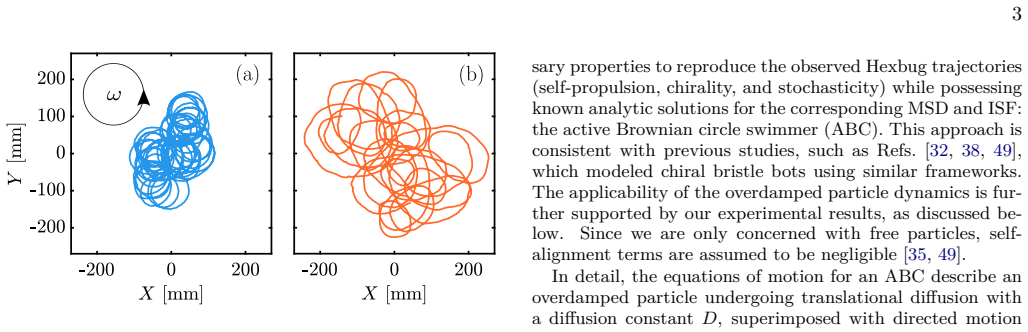
Macroscopic active matter systems, such as bristle bots, provide a compelling platform for investigating nonequilibrium dynamics at highly visible scales. To fully leverage their accessibility, accurate mathematical models are needed to corroborate experiments. In this work, we study the motion of a free chiral hexbug (Nano-Newton Series) via video tracking and compare the results to theoretical predictions from overdamped Langevin equations for active Brownian circle swimmers (ABCs). We find good agreement between the hexbug's dynamics and ABC model predictions, particularly for the mean-squared displacement and the intermediate scattering function (ISF). Deviations between the hexbug data and the ABC model arise primarily in the short-time behavior of the real-space propagator, where translational noise is most evident. Our results generally support the use of models based on overdamped Langevin equations as a robust framework for describing hexbug motion when the influence of translational noise is negligible. Moreover, they demonstrate the sensitivity of ISF- and propagator-based analyses in characterizing active systems. Our approach opens new avenues toward refining coarse-grained models and advancing the theoretical understanding of macroscopic active systems.
Editorial analysis
A structured set of objections, weighed in public.
Referee Report
Summary. The manuscript reports video-tracking experiments on the free motion of a chiral hexbug and compares the trajectories to predictions from the overdamped Langevin equations for active Brownian circle swimmers (ABCs). It claims quantitative agreement between experiment and theory for the mean-squared displacement and the intermediate scattering function (ISF), with short-time deviations in the real-space propagator attributed to translational noise; the work concludes that ABC models remain robust when translational noise is negligible.
Significance. If the agreement is confirmed with the requested checks, the work supplies a clear experimental benchmark for ABC models in a macroscopic, accessible active-matter system. The use of both MSD and ISF observables, together with the explicit identification of the noise-limited regime, strengthens the case for overdamped Langevin descriptions of chiral self-propelled robots and illustrates the diagnostic power of scattering-function analysis.
major comments (2)
- [Abstract] Abstract: the central claim of good agreement on the ISF rests on the assumption that translational noise is negligible at the experimental length scales, yet the same paragraph attributes short-time propagator deviations to this noise. Because the ISF is the spatial Fourier transform of the propagator, an unquantified noise contribution at the probed q values could produce apparent agreement at intermediate times while masking model breakdown; an independent measurement of translational diffusivity or a sensitivity analysis over the experimental q-range is required to substantiate the claim.
- [Results] Results section (comparison of MSD and ISF): the manuscript reports quantitative agreement but does not provide error bars, statistical uncertainties, or the full details of the video-tracking analysis. Without these, it is not possible to judge whether the reported match lies within experimental precision or whether the short-time deviations are fully accounted for by the noise term.
minor comments (2)
- [Abstract] The abstract states that the approach 'opens new avenues toward refining coarse-grained models'; a brief outline of one concrete refinement suggested by the data would strengthen the concluding paragraph.
- Figure captions should explicitly state the q-range used for the ISF and the time window over which the MSD is fitted, to allow readers to assess the noise issue directly.
Simulated Author's Rebuttal
We thank the referee for their thoughtful and constructive comments, which have helped us clarify key aspects of our analysis and strengthen the presentation of the results. We address each major comment below and have revised the manuscript to incorporate the suggested improvements.
read point-by-point responses
-
Referee: [Abstract] Abstract: the central claim of good agreement on the ISF rests on the assumption that translational noise is negligible at the experimental length scales, yet the same paragraph attributes short-time propagator deviations to this noise. Because the ISF is the spatial Fourier transform of the propagator, an unquantified noise contribution at the probed q values could produce apparent agreement at intermediate times while masking model breakdown; an independent measurement of translational diffusivity or a sensitivity analysis over the experimental q-range is required to substantiate the claim.
Authors: We agree that the abstract could be clarified to avoid potential misinterpretation. The short-time deviations in the real-space propagator are indeed dominated by translational noise, but our data indicate that this contribution becomes negligible at the length and time scales relevant to the ISF at the experimental q values. To substantiate this, we have added a sensitivity analysis in the revised manuscript (new subsection in Results and updated Fig. S3 in SI) in which we vary the translational diffusivity over a range consistent with our tracking resolution and demonstrate that the ISF remains robustly matched to the ABC prediction for q values used in the main text. We have also revised the abstract to explicitly state that the reported agreement holds in the regime where translational noise is subdominant. revision: yes
-
Referee: [Results] Results section (comparison of MSD and ISF): the manuscript reports quantitative agreement but does not provide error bars, statistical uncertainties, or the full details of the video-tracking analysis. Without these, it is not possible to judge whether the reported match lies within experimental precision or whether the short-time deviations are fully accounted for by the noise term.
Authors: We acknowledge that the original manuscript lacked explicit error bars and sufficient methodological detail. In the revised version we have added shaded regions representing one standard deviation from the mean, computed across 12 independent trajectories (each > 5 min long) for both the MSD and ISF. We have also expanded the Methods section with a complete description of the video-tracking pipeline, including camera calibration, particle localization algorithm, trajectory linking criteria, and the procedure used to estimate the translational diffusivity from short-time data. These additions allow direct assessment that the observed agreement lies within experimental uncertainty and that the short-time propagator deviations are quantitatively consistent with the independently measured translational noise strength. revision: yes
Circularity Check
No circularity: independent model predictions compared to experimental data
full rationale
The paper derives predictions for MSD and ISF directly from the standard overdamped Langevin equations for active Brownian circle swimmers (ABCs) and compares them to independent video-tracking data of hexbugs. No quantity is obtained by fitting parameters to the target data and then relabeled as a prediction; deviations are explicitly attributed to unmodeled translational noise rather than used to redefine the model. The central claim of agreement rests on this external comparison, not on any self-definitional loop, fitted-input renaming, or load-bearing self-citation. The derivation chain is therefore self-contained against the experimental benchmark.
Axiom & Free-Parameter Ledger
Reference graph
Works this paper leans on
-
[1]
Active particles in complex and crowded environments,
C. Bechinger, R. D. Leonardo, H. Löwen, C. Reichhardt, G. Volpe, and G. Volpe, “Active particles in complex and crowded environments,” Rev. Mod. Phys. 88, 045006 (2016)
work page 2016
-
[2]
Finite-size scaling as a way to probe near-criticality in natural swarms,
A. Attanasi, A. Cavagna, L. Del Castello, I. Giardina, S. Melillo, L. Parisi, O. Pohl, B. Rossaro, E. Shen, E. Sil- vestri, and M. Viale, “Finite-size scaling as a way to probe near-criticality in natural swarms,” Phys. Rev. Lett. 113, 238102 (2014)
work page 2014
-
[3]
Self-motile col- loidal particles: From directed propulsion to random walk,
J. R. Howse, R. A. Jones, A. J. Ryan, T. Gough, R. Vafabakhsh, and R. Golestanian, “Self-motile col- loidal particles: From directed propulsion to random walk,” Phys. Rev. Lett. 99, 048102 (2007)
work page 2007
-
[4]
Active motion of a Janus particle by self-thermophoresis in a defocused laser beam,
H. Jiang, N. Yoshinaga, and M. Sano, “Active motion of a Janus particle by self-thermophoresis in a defocused laser beam,” Phys. Rev. Lett. 105, 268302 (2010)
work page 2010
-
[5]
Microswimmers in patterned environ- ments,
G. Volpe, I. Buttinoni, D. Vogt, H. J. Kümmerer, and C. Bechinger, “Microswimmers in patterned environ- ments,” Soft Matter 7, 05960 (2011)
work page 2011
-
[6]
C. Kurzthaler, C. Devailly, J. Arlt, T. Franosch, W. C. Poon, V. A. Martinez, and A. T. Brown, “Probing the spatiotemporal dynamics of catalytic Janus particles with single-particle tracking and differential dynamic mi- croscopy,” Physical Review Letters 121, 078001 (2018)
work page 2018
-
[7]
P. Stengele, A. Lüders, and P. Nielaba, “Group forma- tion and collective motion of colloidal rods with an ac- tivity triggered by visual perception,” Phys. Rev. E 106, 014603 (2022)
work page 2022
-
[8]
Cluster dynamics in macroscopic photoac- tive particles,
S. Lévay, A. Katona, H. Löwen, R. Cruz Hidalgo, and I. Zuriguel, “Cluster dynamics in macroscopic photoac- tive particles,” Phys. Rev. Lett. 135, 098301 (2025)
work page 2025
-
[9]
Bio- catalytic metal-organic framework nanomotors for active water decontamination,
Z. Guo, J. Liu, Y. Li, J. A. McDonald, M. Y. Zulkifli, S. J. Khan, L. Xie, Z. Gu, B. Kong, and K. Liang, “Bio- catalytic metal-organic framework nanomotors for active water decontamination,” Chem. Commun. 56 (2020), 10.1039/d0cc06429g
-
[10]
Active matter at the inter- face between materials science and cell biology,
D. Needleman and Z. Dogic, “Active matter at the inter- face between materials science and cell biology,” Nature Reviews Materials 2, 17048 (2017)
work page 2017
-
[11]
Life is motion: multiscale motility of molecular motors,
R. Lipowsky and S. Klumpp, “Life is motion: multiscale motility of molecular motors,” Physica A 352, 53 (2005)
work page 2005
-
[12]
Traffic and related self-driven many-particle systems,
D. Helbing, “Traffic and related self-driven many-particle systems,” Reviews of Modern Physics 73, 1067 (2001)
work page 2001
-
[13]
M. E. Cates, “Diffusive transport without detailed bal- ance in motile bacteria: Does microbiology need statisti- cal physics?” Reports on Progress in Physics 75, 042601 (2012)
work page 2012
-
[14]
Active Brownian particles: Entropy pro- duction and fluctuation response,
D. Chaudhuri, “Active Brownian particles: Entropy pro- duction and fluctuation response,” Physical Review E 90, 022131 (2014)
work page 2014
-
[15]
How far from equilibrium is active matter?
E. Fodor, C. Nardini, M. E. Cates, J. Tailleur, P. Visco, and F. van Wijland, “How far from equilibrium is active matter?” Physical Review Letters 117, 038103 (2016)
work page 2016
-
[16]
Exact symmetries in the velocity fluctuations of a hot Brownian swimmer,
G. Falasco, R. Pfaller, A. P. Bregulla, F. Cichos, and K. Kroy, “Exact symmetries in the velocity fluctuations of a hot Brownian swimmer,” Physical Review E 94, 030602(R) (2016)
work page 2016
-
[17]
Stochastic thermodynamics for active mat- ter,
T. Speck, “Stochastic thermodynamics for active mat- ter,” Europhysics Letters 114, 30006 (2016)
work page 2016
-
[18]
The statistical physics of active matter: From self-catalytic colloids to living cells,
E. Fodor and M. C. Marchetti, “The statistical physics of active matter: From self-catalytic colloids to living cells,” Physica A 504, 106 (2018)
work page 2018
-
[19]
Analytic solution of an active Brownian particle in a harmonic well,
M. Caraglio and T. Franosch, “Analytic solution of an active Brownian particle in a harmonic well,” Physical Review Letters 129, 158001 (2022)
work page 2022
-
[20]
Transition- path sampling for run-and-tumble particles,
T. Kiechl, T. Franosch, and M. Caraglio, “Transition- path sampling for run-and-tumble particles,” Phys. Rev. E 110, 054121 (2024)
work page 2024
-
[21]
Target search of active agents crossing high energy barriers,
L. Zanovello, M. Caraglio, T. Franosch, and P. Facci- oli, “Target search of active agents crossing high energy barriers,” Phys. Rev. Lett. 126, 018001 (2021)
work page 2021
-
[22]
A nonlinear fluctuation-dissipation test for Marko- vian systems,
K. Engbring, D. Boriskovsky, Y. Roichman, and B. Lind- ner, “A nonlinear fluctuation-dissipation test for Marko- vian systems,” Phys. Rev. X 13, 021034 (2023)
work page 2023
-
[23]
Multiple-robot drug delivery strategy through co- ordinated teams of microswimmers,
K. U. Cheang, L. Kyoungwoo, J. A. Agung, and K. M. Jun, “Multiple-robot drug delivery strategy through co- ordinated teams of microswimmers,” Applied Physics Letters 105, 083705 (2014)
work page 2014
-
[24]
Nano/microscale motors: Biomedical opportunities and challenges,
J. Wang and W. Gao, “Nano/microscale motors: Biomedical opportunities and challenges,” ACS Nano 6, 5745 (2012)
work page 2012
-
[25]
Dense active matter model of motion patterns in confluent cell monolayers,
S. Henkes, K. Kostanjevec, J. M. Collinson, R. Sknepnek, and E. Bertin, “Dense active matter model of motion patterns in confluent cell monolayers,” Nature Commu- nications 11, 1405 (2020)
work page 2020
-
[26]
A. Ghosh, W. Xu, N. Gupta, and D. H. Gracias, “Active matter therapeutics,” Nano Today 31, 100836 (2020)
work page 2020
-
[27]
Mobile microrobots for active therapeutic delivery,
P. Erkoc, I. C. Yasa, H. Ceylan, O. Yasa, Y. Alapan, and M. Sitti, “Mobile microrobots for active therapeutic delivery,” Advanced Therapeutics 2, 1800064 (2019)
work page 2019
-
[28]
Scalable high-throughput microfluidic separation of magnetic mi- croparticles,
H. Gu, Y. Chen, A. Lüders, T. Bertrand, E. Hanedan, P. Nielaba, C. Bechinger, and B. J. Nelson, “Scalable high-throughput microfluidic separation of magnetic mi- croparticles,” Device 2, 100403 (2024) . 12
work page 2024
-
[29]
Microbots decorated with silver nanoparticles kill bac- teria in aqueous media,
D. Vilela, M. M. Stanton, J. Parmar, and S. Sánchez, “Microbots decorated with silver nanoparticles kill bac- teria in aqueous media,” ACS Appl. Mater. Interfaces 9 (2017), 10.1021/acsami.7b03006
-
[30]
The environmental impact of mi- cro/nanomachines: A review,
W. Gao and J. Wang, “The environmental impact of mi- cro/nanomachines: A review,” ACS Nano 8, 3170 (2014)
work page 2014
-
[31]
Environmental memory facilitates search with home returns,
A. Altshuler, O. L. Bonomo, N. Gorohovsky, S. Mar- chini, E. Rosen, O. Tal-Friedman, S. Reuveni, and Y. Roichman, “Environmental memory facilitates search with home returns,” Phys. Rev. Res. 6, 023255 (2024)
work page 2024
-
[32]
Macroscopic, artificial active matter,
L. Ning, H. Zhu, J. Yang, Q. Zhang, P. Liu, R. Ni, and N. Zheng, “Macroscopic, artificial active matter,” Na- tional Science Open 3, 20240005 (2024)
work page 2024
-
[33]
Selective and collective actuation in active solids,
P. Baconnier, D. Shohat, C. H. López, C. Coulais, V. Démery, G. Düring, and O. Dauchot, “Selective and collective actuation in active solids,” Nat. Phys. 18, 01704 (2022)
work page 2022
-
[34]
J. F. Boudet, J. Lintuvuori, C. Lacouture, T. Barois, A. Deblais, K. Xie, S. Cassagnere, B. Tregon, D. B. Brückner, J. C. Baret, and H. Kellay, “From collec- tions of independent, mindless robots to flexible, mobile, and directional superstructures,” Sci. Robot. 6, abd0272 (2021)
work page 2021
-
[35]
Dynamics of a self- propelled particle in a harmonic trap,
O. Dauchot and V. Démery, “Dynamics of a self- propelled particle in a harmonic trap,” Phys. Rev. Lett. 122, 068002 (2019)
work page 2019
-
[36]
Swarm- ing, swirling and stasis in sequestered bristle-bots,
L. Giomi, N. Hawley-Weld, and L. Mahadevan, “Swarm- ing, swirling and stasis in sequestered bristle-bots,” Proc. R. Soc. A 469, 20130263 (2013)
work page 2013
-
[37]
Using hexbugs™ to model gas pressure and electrical conduc- tion: A pandemic-inspired distance lab,
G. DiBari, L. Valle, R. T. Bua, L. Cunningham, E. Hort, T. Venenciano, and J. Hudgings, “Using hexbugs™ to model gas pressure and electrical conduc- tion: A pandemic-inspired distance lab,” Am. J. Phys. 90, 111904 (2022)
work page 2022
-
[38]
A. Barona Balda, A. Argun, A. Callegari, and G. Volpe, “Playing with active matter,” American Journal of Physics 92, 847 (2024)
work page 2024
-
[39]
The fluctuation–dissipation relation holds for a macroscopic tracer in an active bath,
D. Boriskovsky, B. Lindner, and Y. Roichman, “The fluctuation–dissipation relation holds for a macroscopic tracer in an active bath,” Soft Matter 20, 8017 (2024)
work page 2024
-
[40]
Micellization in active matter of asymmetric self-propelled particles: Experiments,
A. A. Molodtsova, M. K. Buzakov, O. I. Burmistrov, A. D. Rozenblit, V. A. Smirnov, D. V. Sennikova, V. A. Porvatov, E. M. Puhtina, A. A. Dmitriev, and N. A. Olekhno, “Micellization in active matter of asymmetric self-propelled particles: Experiments,” Phys. Rev. E 111, 065424 (2025)
work page 2025
-
[41]
Model of active solids: Rigid body motion and shape-changing mechanisms,
C. Hernández-López, P. Baconnier, C. Coulais, O. Dau- chot, and G. Düring, “Model of active solids: Rigid body motion and shape-changing mechanisms,” Phys. Rev. Lett. 132, 238303 (2024)
work page 2024
-
[42]
Bristle-bots in swarm robotics - approaches on agent development and locomotion,
E. P. Fortunić, F. Becker, K. Zimmermann, and F. Cuel- lar, “Bristle-bots in swarm robotics - approaches on agent development and locomotion,” in 2017 IEEE Interna- tional Conference on Advanced Intelligent Mechatronics (AIM) (2017) pp. 1424–1429
work page 2017
-
[43]
On the forward and backward motion of milli-bristlebots,
D. Kim, Z. Hao, A. R. Mohazab, and A. Ansari, “On the forward and backward motion of milli-bristlebots,” Inter- national Journal of Non-Linear Mechanics 127, 103551 (2020)
work page 2020
-
[44]
On the mechanics of bristle-bots - modeling, simulation and experiments,
F. Becker, S. Boerner, V. Lysenko, I. Zeidis, and K. Zim- mermann, “On the mechanics of bristle-bots - modeling, simulation and experiments,” in ISR/Robotik 2014; 41st International Symposium on Robotics (2014) pp. 1–6
work page 2014
-
[45]
Spiral folding of a flexible chain of chiral active particles,
S. K. Anand, “Spiral folding of a flexible chain of chiral active particles,” Journal of Physics: Condensed Matter (2025), 10.1088/1361-648X/adc5c1
-
[46]
Spon- taneous self-wrapping in chiral active polymers,
L. Caprini, I. Abdoli, U. Marconi, and H. Löwen, “Spon- taneous self-wrapping in chiral active polymers,” arXiv 2410 (2024), 10.48550/arXiv.2410.02567
-
[47]
Inertial effects of self-propelled particles: From active Brownian to active langevin motion,
H. Löwen, “Inertial effects of self-propelled particles: From active Brownian to active langevin motion,” J. Chem. Phys. 152, 044901 (2020)
work page 2020
-
[48]
In- ertial delay of self-propelled particles,
C. Scholz, S. Jahanshahi, A. Ldov, and H. Löwen, “In- ertial delay of self-propelled particles,” Nat. Commun. 9, 07596 (2018)
work page 2018
-
[49]
Depinning and activated motion of chiral self-propelled particles,
J. P. Carrillo-Mora, A. Garcés, and D. Levis, “Depinning and activated motion of chiral self-propelled particles,” Phys. Rev. E 112, 065417 (2025)
work page 2025
-
[50]
Interme- diate scattering function of an anisotropic active Brown- ian particle,
C. Kurzthaler, S. Leitmann, and T. Franosch, “Interme- diate scattering function of an anisotropic active Brown- ian particle,” Scientific Reports 6, 36702 (2016)
work page 2016
-
[51]
Characteri- zation and control of the run-and-tumble dynamics of escherichia coli,
C. Kurzthaler, Y. Zhao, N. Zhou, J. Schwarz-Linek, C. Devailly, J. Arlt, J. D. Huang, W. C. Poon, T. Fra- nosch, J. Tailleur, and V. A. Martinez, “Characteri- zation and control of the run-and-tumble dynamics of escherichia coli,” Physical Review Letters 132, 038302 (2024)
work page 2024
-
[52]
Size dependence of the propulsion velocity for cat- alytic Janus-sphere swimmers,
S. Ebbens, M. H. Tu, J. R. Howse, and R. Golesta- nian, “Size dependence of the propulsion velocity for cat- alytic Janus-sphere swimmers,” Phys. Rev. E 85, 020401 (2012)
work page 2012
-
[53]
K. Dietrich, D. Renggli, M. Zanini, G. Volpe, I. Butti- noni, and L. Isa, “Two-dimensional nature of the active Brownian motion of catalytic microswimmers at solid and liquid interfaces,” New J. Phys. 19, 063001 (2017)
work page 2017
-
[54]
Elec- trokinetic effects in catalytic platinum-insulator Janus swimmers,
S. Ebbens, D. A. Gregory, G. Dunderdale, J. R. Howse, Y. Ibrahim, T. B. Liverpool, and R. Golestanian, “Elec- trokinetic effects in catalytic platinum-insulator Janus swimmers,” EPL 106, 58003 (2014)
work page 2014
-
[55]
A. T. Brown, I. D. Vladescu, A. Dawson, T. Vissers, J. Schwarz-Linek, J. S. Lintuvuori, and W. C. Poon, “Swimming in a crystal,” Soft Matter 12, 11562 (2015)
work page 2015
-
[56]
Ionic effects in self-propelled Pt-coated Janus swimmers,
A. Brown and W. Poon, “Ionic effects in self-propelled Pt-coated Janus swimmers,” Soft Matter 10, 3787 (2014)
work page 2014
-
[57]
Self-assembled autonomous runners and tumblers,
S. Ebbens, R. A. Jones, A. J. Ryan, R. Golestanian, and J. R. Howse, “Self-assembled autonomous runners and tumblers,” Physical Review E - Statistical, Nonlinear, and Soft Matter Physics 82, 015304 (2010)
work page 2010
-
[58]
K. Martens, L. Angelani, R. D. Leonardo, and L. Boc- quet, “Probability distributions for the run-and-tumble bacterial dynamics: An analogy to the lorentz model,” European Physical Journal E 35, 12084 (2012)
work page 2012
-
[59]
Intermediate scatter- ing function of an anisotropic Brownian circle swimmer,
C. Kurzthaler and T. Franosch, “Intermediate scatter- ing function of an anisotropic Brownian circle swimmer,” Soft Matter 13, 6396 (2017)
work page 2017
-
[60]
Intermedi- ate scattering function of a gravitactic circle swimmer,
R. Rusch, O. Chepizhko, and T. Franosch, “Intermedi- ate scattering function of a gravitactic circle swimmer,” Phys. Rev. E 110, 054606 (2024)
work page 2024
-
[61]
Exploiting compositional disorder in collectives of light- driven circle walkers,
F. Siebers, A. Jayaram, P. Blümler, and T. Speck, “Exploiting compositional disorder in collectives of light- driven circle walkers,” Science Advances 9, eadf5443 (2023)
work page 2023
-
[62]
R. Vatash, A. Altshuler, and Y. Roichman, “Numerical prediction of the steady-state distribution under stochas- tic resetting from measurements,” Journal of Statistical Physics 192, 1 (2025)
work page 2025
-
[63]
Methods of digital video microscopy for colloidal studies,
J. C. Crocker and D. G. Grier, “Methods of digital video microscopy for colloidal studies,” Journal of Colloid and 13 Interface Science 179, 298 (1996)
work page 1996
-
[64]
Dynamics of a Brownian circle swimmer,
S. van Teeffelen and H. Löwen, “Dynamics of a Brownian circle swimmer,” Phys. Rev. E 78, 020101 (2008)
work page 2008
-
[65]
A limited memory algorithm for bound constrained optimization,
R. H. Byrd, P. Lu, J. Nocedal, and C. Zhu, “A limited memory algorithm for bound constrained optimization,” SIAM Journal on Scientific Computing 16, 1190 (1995)
work page 1995
-
[66]
The corresponding permanent DOI is doi: https:doi.org/10.5281/zenodo.18912953
The code of the performed simulations is avail- able via GitHub: https://github.com/AntonLueders/ ABC.git. The corresponding permanent DOI is doi: https:doi.org/10.5281/zenodo.18912953
-
[67]
Inertial self-propelled particles in anisotropic environments,
A. R. Sprenger, C. Scholz, A. Ldov, R. Wittkowski, and H. Löwen, “Inertial self-propelled particles in anisotropic environments,” Communications Physics 6, 301 (2023)
work page 2023
-
[68]
Circular motion of asymmetric self-propelling particles,
F. Kümmel, B. ten Hagen, R. Wittkowski, I. Buttinoni, R. Eichhorn, G. Volpe, H. Löwen, and C. Bechinger, “Circular motion of asymmetric self-propelling particles,” Phys. Rev. Lett. 110, 198302 (2013)
work page 2013
-
[69]
Gravitaxis of asymmetric self-propelled colloidal particles,
B. ten Hagen, F. Kümmel, R. Wittkowski, D. Takagi, H. Löwen, and C. Bechinger, “Gravitaxis of asymmetric self-propelled colloidal particles,” Nat. Commun. 5, 4829 (2014)
work page 2014
-
[70]
Free chiral hexbugs compared to active brownian circle swimmers (data),
T. Kiechl, A. Altshuler, A. Lüders, Y. Roichman, and T. Franosch, “Free chiral hexbugs compared to active brownian circle swimmers (data),” Universität Innsbruck - Data Repository, DOI: 10.48323/865h4-tg750
-
[71]
Intermediate scattering function of a gravi- tactic circle swimmer,
R. Rusch, “Intermediate scattering function of a gravi- tactic circle swimmer,” Universität Innsbruck
- [72]
-
[73]
Single particle track- ing. analysis of diffusion and flow in two-dimensional sys- tems,
H. Qian, M. Sheetz, and E. Elson, “Single particle track- ing. analysis of diffusion and flow in two-dimensional sys- tems,” Biophysical Journal 60, 910 (1991)
work page 1991
-
[74]
M. R. Bailey, A. R. Sprenger, F. Grillo, H. Löwen, and L. Isa, “Fitting an active Brownian particle’s mean- squared displacement with improved parameter estima- tion,” Phys. Rev. E 106, L052602 (2022)
work page 2022
-
[75]
Fitting a function to time-dependent ensemble averaged data,
K. Fogelmark, M. A. Lomholt, A. Irbäck, and T. Amb- jörnsson, “Fitting a function to time-dependent ensemble averaged data,” Scientific reports 8, 6984 (2018)
work page 2018
discussion (0)
Sign in with ORCID, Apple, or X to comment. Anyone can read and Pith papers without signing in.