Recognition: 2 theorem links
· Lean TheoremConstraint-Driven Warm-Freeze for Efficient Transfer Learning in Photovoltaic Systems
Pith reviewed 2026-05-10 18:47 UTC · model grok-4.3
The pith
Constraint-Driven Warm-Freeze adapts models for photovoltaic cyberattack detection by allocating full training only to high-importance blocks.
A machine-rendered reading of the paper's core claim, the machinery that carries it, and where it could break.
Core claim
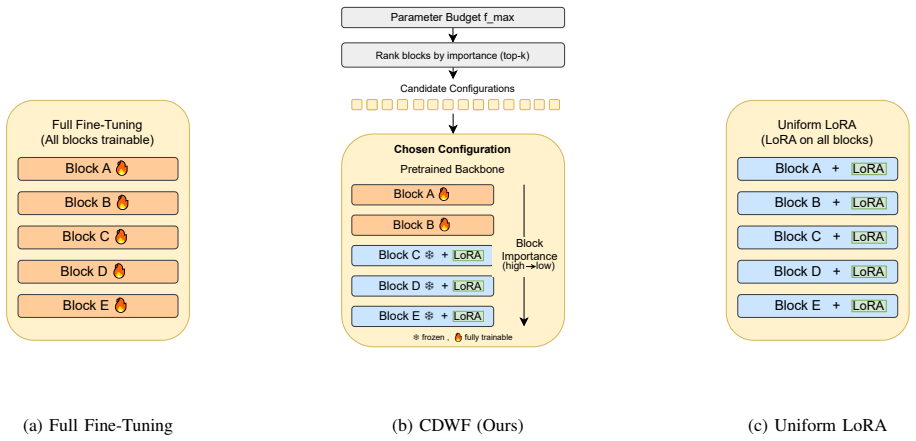
By using a brief warm-start to rank blocks via gradient-based importance and then solving a constrained optimization to grant full training to high-impact blocks while restricting the rest to low-rank adaptation, the framework achieves 90 to 99 percent of full fine-tuning performance on drift and spike detection tasks with up to a 120-fold reduction in trainable parameters.
What carries the argument
Constraint-Driven Warm-Freeze (CDWF), which quantifies block importance through a short warm-start gradient evaluation and then solves a budget-constrained allocation problem to decide between full training and low-rank adaptation for each block.
Load-bearing premise
The brief warm-start phase gives a reliable ranking of which blocks matter most for adapting to drift and spike detection so the constrained allocation avoids missing critical changes or breaching the hardware limit.
What would settle it
An experiment in which CDWF reaches the target parameter budget yet delivers accuracy below 90 percent of full fine-tuning on a held-out set of transient spike patterns in PV signals would show the importance ranking fails to support near-optimal performance.
Figures


read the original abstract
Detecting cyberattacks in photovoltaic (PV) monitoring and MPPT control signals requires models that are robust to bias, drift, and transient spikes, yet lightweight enough for resource-constrained edge controllers. While deep learning outperforms traditional physics-based diagnostics and handcrafted features, standard fine-tuning is computationally prohibitive for edge devices. Furthermore, existing Parameter-Efficient Fine-Tuning (PEFT) methods typically apply uniform adaptation or rely on expensive architectural searches, lacking the flexibility to adhere to strict hardware budgets. To bridge this gap, we propose Constraint-Driven Warm-Freeze (CDWF), a budget-aware adaptation framework. CDWF leverages a brief warm-start phase to quantify gradient-based block importance, then solves a constrained optimization problem to dynamically allocate full trainability to high-impact blocks while efficiently adapting the remaining blocks via Low-Rank Adaptation (LoRA). We evaluate CDWF on standard vision benchmarks (CIFAR-10/100) and a novel PV cyberattack dataset, transferring from bias pretraining to drift and spike detection. The experiments demonstrate that CDWF retains 90 to 99% of full fine-tuning performance while reducing trainable parameters by up to 120x. These results establish CDWF as an effective, importance-guided solution for reliable transfer learning under tight edge constraints.
Editorial analysis
A structured set of objections, weighed in public.
Referee Report
Summary. The paper introduces Constraint-Driven Warm-Freeze (CDWF), a PEFT framework for efficient transfer learning. It performs a brief warm-start phase to compute gradient-based importance scores for model blocks, then solves a constrained optimization to assign full trainability to high-importance blocks and LoRA adaptation to the rest, respecting a hardware budget. Evaluated on CIFAR-10/100 and a new PV cyberattack dataset for drift/spike detection, it reports retaining 90-99% of full fine-tuning accuracy while cutting trainable parameters by up to 120x.
Significance. If the central results hold, CDWF provides a practical, budget-aware alternative to uniform PEFT or full fine-tuning for edge deployment in PV monitoring systems, where models must handle bias, drift, and transients under strict resource limits. The explicit warm-start-plus-constrained-allocation procedure is non-circular and evaluated on both standard vision benchmarks and a domain-specific dataset; this combination of reproducibility and application relevance strengthens the contribution to efficient transfer learning.
major comments (1)
- [Experimental evaluation (results on PV dataset)] The 90-99% performance retention and 120x parameter reduction claims rest on the assumption that a brief warm-start reliably ranks block importance for the target PV drift and spike tasks. No ablation on warm-start length, no comparison of early vs. late importance rankings, and no sensitivity analysis to the number of warm-start epochs are reported, leaving open the possibility that noisy rankings cause under-allocation to critical blocks or budget violations.
minor comments (2)
- The abstract and results sections report performance numbers without error bars, standard deviations across runs, or statistical significance tests against baselines; adding these would strengthen the quantitative claims.
- Notation for the constrained optimization (importance scores, allocation variables, hardware budget) should be defined once in a dedicated subsection with explicit symbols rather than inline descriptions.
Simulated Author's Rebuttal
We thank the referee for the constructive feedback on our manuscript. We address the major comment regarding the experimental evaluation of the warm-start phase point by point below.
read point-by-point responses
-
Referee: [Experimental evaluation (results on PV dataset)] The 90-99% performance retention and 120x parameter reduction claims rest on the assumption that a brief warm-start reliably ranks block importance for the target PV drift and spike tasks. No ablation on warm-start length, no comparison of early vs. late importance rankings, and no sensitivity analysis to the number of warm-start epochs are reported, leaving open the possibility that noisy rankings cause under-allocation to critical blocks or budget violations.
Authors: We acknowledge that the current version of the manuscript does not report explicit ablations on warm-start length, early-versus-late ranking comparisons, or sensitivity to the number of warm-start epochs. The warm-start duration (typically 5 epochs) was chosen in preliminary experiments to obtain stable gradient estimates for the PV drift and spike tasks while remaining computationally light. To strengthen the claims, the revised manuscript will add a dedicated sensitivity subsection that (i) varies warm-start length from 1 to 20 epochs and reports resulting accuracy retention and parameter allocation on the PV dataset, (ii) compares block importance rankings computed after 2 epochs versus 10 epochs, demonstrating high rank correlation and stable allocation, and (iii) includes plots confirming that the constrained optimizer respects the hardware budget across these variations. These additions will directly address concerns about noisy rankings and under-allocation. revision: yes
Circularity Check
No significant circularity; method is procedural with external empirical validation
full rationale
The paper defines CDWF as an explicit two-stage procedure (brief warm-start for gradient-based block importance scoring, followed by solving a constrained optimization to allocate full trainability vs. LoRA under a hardware budget). Performance claims (90-99% retention of full fine-tuning, up to 120x parameter reduction) are presented as outcomes of experiments on CIFAR-10/100 and a novel PV cyberattack dataset. No equations reduce any result to its inputs by construction, no fitted parameters are relabeled as predictions, and the provided text contains no load-bearing self-citations or uniqueness theorems. The derivation chain is self-contained against external benchmarks.
Axiom & Free-Parameter Ledger
Lean theorems connected to this paper
-
IndisputableMonolith/Cost/FunctionalEquation.leanwashburn_uniqueness_aczel unclear?
unclearRelation between the paper passage and the cited Recognition theorem.
CDWF leverages a brief warm-start phase to quantify gradient-based block importance, then solves a constrained optimization problem to dynamically allocate full trainability to high-impact blocks while efficiently adapting the remaining blocks via Low-Rank Adaptation (LoRA).
-
IndisputableMonolith/Foundation/AlphaCoordinateFixation.leanalpha_pin_under_high_calibration unclear?
unclearRelation between the paper passage and the cited Recognition theorem.
We estimate the reference improvement relative to warm-start as G_max = A_ref - A_warm ... η(r) = min(0.5, r/8)
What do these tags mean?
- matches
- The paper's claim is directly supported by a theorem in the formal canon.
- supports
- The theorem supports part of the paper's argument, but the paper may add assumptions or extra steps.
- extends
- The paper goes beyond the formal theorem; the theorem is a base layer rather than the whole result.
- uses
- The paper appears to rely on the theorem as machinery.
- contradicts
- The paper's claim conflicts with a theorem or certificate in the canon.
- unclear
- Pith found a possible connection, but the passage is too broad, indirect, or ambiguous to say the theorem truly supports the claim.
Reference graph
Works this paper leans on
-
[1]
Snapshot of global pv markets 2024,
G. Masson, E. Bosch, A. Van Rechem, and M. de l’Epine, “Snapshot of global pv markets 2024,” 2024. [Online]. Available: https://iea-pvps. org/wp-content/uploads/2024/04/Snapshot-of-Global-PV-Markets-1.pdf
2024
-
[2]
Solar industry update – spring 2024,
D. Feldman, V . Ramasamy, J. Desai, A. Nabaptiste, I. Mayoet al., “Solar industry update – spring 2024,” National Renewable Energy Laboratory (NREL), Tech. Rep. NREL/PR-6A40-90042, 2024. [Online]. Available: https://www.nrel.gov/docs/fy24osti/90042.pdf
2024
-
[3]
Cyber-physical security for photovoltaic systems,
J. Ye, A. Gianiet al., “Cyber-physical security for photovoltaic systems,” IEEE Journal of Emerging and Selected Topics in Power Electronics, 2022
2022
-
[4]
Cybersecurity of photovoltaic systems: challenges, threats, and mitigation strategies: a short survey,
F. Harrou, B. Taghezouit, B. Bouyeddou, and Y . Sun, “Cybersecurity of photovoltaic systems: challenges, threats, and mitigation strategies: a short survey,”Frontiers in Energy Research, vol. 11, p. 1274451, 2023
2023
-
[5]
Data-driven cyber- attack detection for pv farms via time-frequency domain features,
L. Guo, J. Zhang, J. Ye, S. J. Coshatt, and W. Song, “Data-driven cyber- attack detection for pv farms via time-frequency domain features,”IEEE Transactions on Smart Grid, vol. 13, no. 2, pp. 1582–1597, 2022
2022
-
[6]
Evaluation of deep learning techniques in pv farm cyber attacks detection,
G. F. Hassan, O. A. Ahmed, and M. Sallal, “Evaluation of deep learning techniques in pv farm cyber attacks detection,” Electronics, vol. 14, no. 3, p. 546, 2025. [Online]. Available: https://doi.org/10.3390/electronics14030546
-
[7]
An online intrusion detection system for photovoltaic generators through physics-based neural networks,
D. F. Valderrama, G. B. Gaggero, G. Ferro, A. Mokarim, M. Robba, P. Girdinio, and M. Marchese, “An online intrusion detection system for photovoltaic generators through physics-based neural networks,”Electric Power Systems Research, vol. 253, p. 112528, 2025
2025
-
[8]
Accurate and energy-efficient detection of cyberattacks against non-linear agc systems,
M. Sharshar, A. M. Saber, D. Svetinovic, H. Zeineldin, and E. F. El- Saadany, “Accurate and energy-efficient detection of cyberattacks against non-linear agc systems,”IEEE Transactions on Smart Grid, pp. 1–1, 2025
2025
-
[9]
Smart energy guardian: A hybrid deep learning model for detecting fraudulent pv generation,
X. Chen, C. Huang, Y . Zhang, and H. Wang, “Smart energy guardian: A hybrid deep learning model for detecting fraudulent pv generation,” in2024 IEEE International Smart Cities Conference (ISC2), 2024, pp. 1–6
2024
-
[10]
Evaluation of unsupervised anomaly detection approaches on photovoltaic monitoring data,
S. Hempelmann, L. Feng, C. Basoglu, G. Behrens, M. Diehl, W. Friedrich, S. Brandt, and T. Pfeil, “Evaluation of unsupervised anomaly detection approaches on photovoltaic monitoring data,” in2020 47th IEEE Photovoltaic Specialists Conference (PVSC), 2020, pp. 2671– 2674
2020
-
[11]
Topology informed transformer for cyber attack detection in grid- connected PV systems,
D. R. Olojede, M. J. Uddin, R. A. Jacob, B. Coskunuzer, and J. Zhang, “Topology informed transformer for cyber attack detection in grid- connected PV systems,”IEEE Transactions on Sustainable Energy, 2025, in press
2025
-
[12]
Dual-hybrid intrusion detection system to detect false data injection in smart grids,
S. H. Mohammed, M. S. J. Singh, A. Al-Jumaily, M. T. Islam, M. S. Islam, A. M. Alenezi, and M. S. Soliman, “Dual-hybrid intrusion detection system to detect false data injection in smart grids,”PLOS ONE, vol. 20, no. 1, p. e0316536, 2025
2025
-
[13]
ACM Computing Surveys 55, 1–29
A. Paleyes, R.-G. Urma, and N. D. Lawrence, “Challenges in deploying machine learning: A survey of case studies,”ACM Computing Surveys, vol. 55, no. 6, p. 1–29, Dec. 2022. [Online]. Available: http://dx.doi.org/10.1145/3533378
-
[14]
Lora: Low-rank adaptation of large language models,
E. J. Hu, Y . Shen, P. Wallis, Z. Allen-Zhu, Y . Li, S. Wang, L. Wang, and W. Chen, “Lora: Low-rank adaptation of large language models,”
-
[15]
LoRA: Low-Rank Adaptation of Large Language Models
[Online]. Available: https://arxiv.org/abs/2106.09685
work page internal anchor Pith review Pith/arXiv arXiv
-
[16]
AdaLoRA: Adaptive Budget Allocation for Parameter-Efficient Fine-Tuning
Q. Zhang, M. Chen, A. Bukharin, N. Karampatziakis, P. He, Y . Cheng, W. Chen, and T. Zhao, “Adalora: Adaptive budget allocation for parameter-efficient fine-tuning,” 2023. [Online]. Available: https://arxiv.org/abs/2303.10512
work page internal anchor Pith review arXiv 2023
-
[17]
F., Cheng, K.-T., and Chen, M.-H
S.-Y . Liu, C.-Y . Wang, H. Yin, P. Molchanov, Y .-C. F. Wang, K.-T. Cheng, and M.-H. Chen, “Dora: Weight-decomposed low-rank adaptation,” 2024. [Online]. Available: https://arxiv.org/abs/2402.09353
-
[18]
QLoRA: Efficient Finetuning of Quantized LLMs
T. Dettmers, A. Pagnoni, A. Holtzman, and L. Zettlemoyer, “Qlora: Efficient finetuning of quantized llms,” 2023. [Online]. Available: https://arxiv.org/abs/2305.14314
work page internal anchor Pith review arXiv 2023
-
[19]
Autopeft: Automatic configuration search for parameter-efficient fine-tuning,
H. Zhou, X. Wan, I. Vuli ´c, and A. Korhonen, “Autopeft: Automatic configuration search for parameter-efficient fine-tuning,” 2024. [Online]. Available: https://arxiv.org/abs/2301.12132
-
[20]
arXiv preprint arXiv:2306.09782 , year=
K. Lv, Y . Yang, T. Liu, Q. Gao, Q. Guo, and X. Qiu, “Full parameter fine-tuning for large language models with limited resources,” 2024. [Online]. Available: https://arxiv.org/abs/2306.09782
-
[21]
Prunepeft: Iterative hybrid pruning for parameter-efficient fine-tuning of llms,
T. Yu, Z. Zhang, G. Zhu, S. Jiang, M. Qiu, and Y . Huang, “Prunepeft: Iterative hybrid pruning for parameter-efficient fine-tuning of llms,”
-
[22]
Available: https://arxiv.org/abs/2506.07587
[Online]. Available: https://arxiv.org/abs/2506.07587
-
[23]
Gradient-based parameter selection for efficient fine- tuning,
Z. Zhanget al., “Gradient-based parameter selection for efficient fine- tuning,” inProceedings of the IEEE/CVF Conference on Computer Vision and Pattern Recognition (CVPR), June 2024, pp. 28 566–28 577
2024
-
[24]
A layer selection approach to test time adaptation,
S. Sahoo, M. ElAraby, J. Ngnawe, Y . Pequignot, F. Precioso, and C. Gagne, “A layer selection approach to test time adaptation,” 2025. [Online]. Available: https://arxiv.org/abs/2404.03784
-
[25]
Gradnorm: Gradient normalization for adaptive loss balancing in deep multitask networks,
Z. Chen, V . Badrinarayanan, C.-Y . Lee, and A. Rabinovich, “Gradnorm: Gradient normalization for adaptive loss balancing in deep multitask networks,” 2018. [Online]. Available: https://arxiv.org/abs/1711.02257
-
[26]
Universal language model fine-tuning for text classification,
J. Howard and S. Ruder, “Universal language model fine-tuning for text classification,” 2018. [Online]. Available: https://arxiv.org/abs/1801. 06146
2018
-
[27]
Pv modeling and extracting the single-diode model parameters: A review study on analytical and numerical methods,
A. Elhammoudyet al., “Pv modeling and extracting the single-diode model parameters: A review study on analytical and numerical methods,” inAdvances in Electrical Systems and Innovative Renewable Energy Techniques, ser. Advances in Science, Technology & Innovation. Cham: Springer, 2024. [Online]. Available: https://doi.org/10.1007/ 978-3-031-49772-8 9
2024
-
[28]
Analysis of the factors influencing the performance of single- and multi-diode pv solar modules,
D. Yadav, N. Singh, V . S. Bhadoria, V . Vita, G. Fotis, E. G. Tsampasis, and T. I. Maris, “Analysis of the factors influencing the performance of single- and multi-diode pv solar modules,”IEEE Access, vol. 11, pp. 95 507–95 525, 2023
2023
-
[29]
Learning multiple layers of features from tiny images,
A. Krizhevsky, “Learning multiple layers of features from tiny images,” Tech. Rep., 2009. [Online]. Available: https://www.cs.toronto.edu/∼kriz/ cifar.html
2009
-
[30]
Decoupled weight decay regularization,
I. Loshchilov and F. Hutter, “Decoupled weight decay regularization,”
-
[31]
Decoupled Weight Decay Regularization
[Online]. Available: https://arxiv.org/abs/1711.05101
work page internal anchor Pith review Pith/arXiv arXiv
discussion (0)
Sign in with ORCID, Apple, or X to comment. Anyone can read and Pith papers without signing in.