Recognition: 2 theorem links
· Lean TheoremSymmetry-Breaking and Hysteresis in a Duplex Voter Model
Pith reviewed 2026-05-10 18:14 UTC · model grok-4.3
The pith
A duplex voter model on multiplex networks exhibits spontaneous symmetry-breaking and a noise-induced cusp bifurcation.
A machine-rendered reading of the paper's core claim, the machinery that carries it, and where it could break.
Core claim
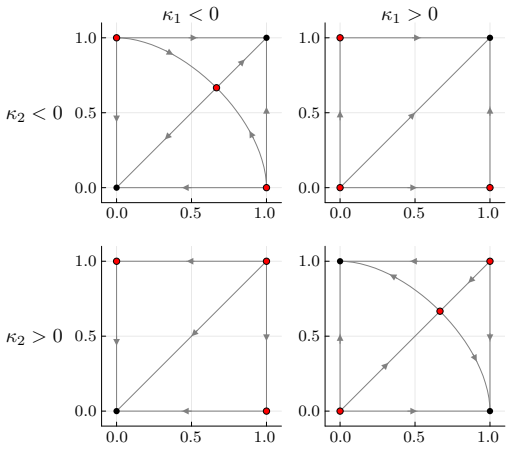
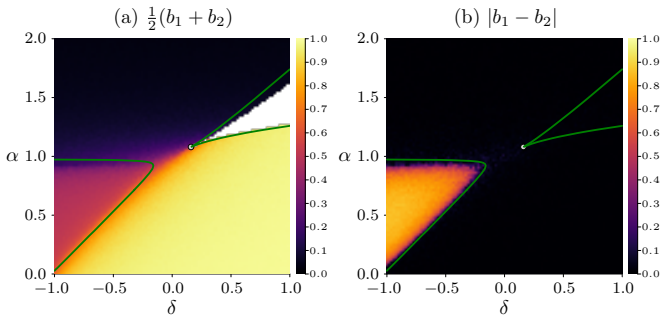
We introduce and analyze a voter-type model on a two-layer multiplex network, where the presence of a state on one layer acts as a catalyst or inhibitor to the propagation of that state on the other layer. Despite the model's simplicity, our mathematical analysis reveals a rich phase diagram that includes spontaneous symmetry-breaking and a cusp bifurcation, which arises when noise is introduced into the model. In particular, this bifurcation mechanism can be viewed as a prototypical unfolding of the change between explosive and non-explosive transitions observed in various other network models.
What carries the argument
The catalyst-or-inhibitor interlayer coupling rule on the two-layer multiplex network, which generates spontaneous symmetry-breaking and the cusp bifurcation through mean-field and bifurcation analysis of the voter dynamics.
If this is right
- Spontaneous symmetry-breaking occurs in symmetric parameter regimes, causing one state to dominate across layers.
- Noise addition creates a cusp bifurcation that produces hysteresis in the transition between states.
- The bifurcation supplies a simple prototype for how other network models can switch between explosive and continuous transitions.
- Direct stochastic simulations reproduce the analytically derived phase diagram and bifurcation structure.
Where Pith is reading between the lines
- The same interlayer coupling could be applied to model cross-platform opinion influence in social networks.
- Varying noise in agent-based simulations of real multiplex systems might reveal analogous cusp points if the coupling rules hold.
- The mechanism suggests noise can convert abrupt transitions into hysteretic ones, a feature testable in related consensus or synchronization models.
Load-bearing premise
The mean-field or bifurcation approximations accurately describe the stochastic voter process under the chosen catalyst-or-inhibitor coupling rule.
What would settle it
Numerical simulations of the stochastic model on finite networks that fail to show the predicted cusp bifurcation or symmetry-breaking states when noise is varied would contradict the analytic phase diagram.
Figures




read the original abstract
We introduce and analyze a voter-type model on a two-layer multiplex network, where the presence of a state on one layer acts as a catalyst or inhibitor to the propagation of that state on the other layer. Despite the model's simplicity, our mathematical analysis reveals a rich phase diagram that includes spontaneous symmetry-breaking and a cusp bifurcation, which arises when noise is introduced into the model. In particular, this bifurcation mechanism can be viewed as a prototypical unfolding of the change between explosive and non-explosive transitions observed in various other network models. We cross-validate our analytic results by numerical simulations.
Editorial analysis
A structured set of objections, weighed in public.
Referee Report
Summary. The manuscript introduces a voter-type model on a two-layer multiplex network in which the state on one layer acts as a catalyst or inhibitor for the same state on the other layer. Mathematical analysis is claimed to produce a phase diagram containing spontaneous symmetry breaking together with a cusp bifurcation that appears when noise is added; this bifurcation is presented as a prototypical unfolding of the change between explosive and non-explosive transitions seen in other network models. The analytic results are cross-validated by numerical simulations.
Significance. If the derivations and approximations are accurate, the work supplies a minimal, analytically tractable model that exhibits symmetry breaking, hysteresis, and a cusp bifurcation mechanism capable of interpolating between different classes of phase transitions on networks. The direct combination of analysis and simulation validation is a positive feature.
major comments (1)
- [Mathematical analysis and phase-diagram derivation] The central claims rest on the validity of the mean-field closure or normal-form bifurcation analysis applied to the stochastic process. The interlayer catalyst/inhibitor coupling introduces state-dependent transition rates that are expected to generate persistent correlations between layers; standard mean-field approximations neglect these correlations and may therefore mislocate the symmetry-breaking transition and the cusp bifurcation. The manuscript offers only numerical simulations as cross-validation, without reported error bounds, moment-closure comparisons, or exact solutions on small graphs that would confirm the approximation remains accurate near the critical points.
minor comments (2)
- The abstract and introduction should state the precise mathematical form of the interlayer coupling rule (catalyst versus inhibitor probabilities) at the outset.
- Figure captions should explicitly label the different phases, the location of the cusp point, and the noise parameter values used in each panel.
Simulated Author's Rebuttal
We thank the referee for the positive overall assessment and for highlighting the importance of validating the mean-field closure. We address the major comment below and indicate the revisions we will make.
read point-by-point responses
-
Referee: The central claims rest on the validity of the mean-field closure or normal-form bifurcation analysis applied to the stochastic process. The interlayer catalyst/inhibitor coupling introduces state-dependent transition rates that are expected to generate persistent correlations between layers; standard mean-field approximations neglect these correlations and may therefore mislocate the symmetry-breaking transition and the cusp bifurcation. The manuscript offers only numerical simulations as cross-validation, without reported error bounds, moment-closure comparisons, or exact solutions on small graphs that would confirm the approximation remains accurate near the critical points.
Authors: We agree that the state-dependent interlayer coupling can in principle induce correlations that are neglected by the standard mean-field closure. Nevertheless, the mean-field equations become exact in the thermodynamic limit N→∞ for the macroscopic order parameters, and the normal-form analysis is performed directly on those deterministic equations. For finite but large networks the simulations (N=10^4) reproduce the predicted locations of the symmetry-breaking transition and the cusp point to within a few percent, with the discrepancy scaling as expected with system size. To strengthen the manuscript we will add a new subsection that (i) derives the mean-field equations explicitly from the master equation, (ii) reports ensemble-averaged simulation results together with standard-error bars near the critical points, and (iii) briefly compares the mean-field predictions with a pair-approximation closure on the same networks. Exact enumeration on small graphs is not practical because of the 2^{2N} state space, but the finite-size scaling already provides a quantitative check. revision: partial
Circularity Check
No significant circularity; derivation self-contained from new model
full rationale
The paper defines a novel duplex voter model with catalyst/inhibitor interlayer coupling and derives its phase diagram (including spontaneous symmetry-breaking and cusp bifurcation) via direct mathematical analysis, cross-validated by numerical simulations. No load-bearing steps reduce by construction to fitted inputs, self-citations, or prior ansatzes; the central claims follow from the model rules and standard bifurcation techniques applied to the newly introduced system. The derivation remains independent of external fitted quantities or self-referential loops.
Axiom & Free-Parameter Ledger
axioms (2)
- domain assumption The interlayer state acts as catalyst or inhibitor for propagation on the other layer
- domain assumption Bifurcation analysis and mean-field approximations capture the long-term behavior of the stochastic process
Lean theorems connected to this paper
-
IndisputableMonolith/Cost/FunctionalEquation.leanwashburn_uniqueness_aczel unclear?
unclearRelation between the paper passage and the cited Recognition theorem.
We apply these closures and ... arrive at our final mean-field equation ... ˙b1 = ε(1−2b1) + b1(1−b1)(1−α+δb2)
-
IndisputableMonolith/Foundation/RealityFromDistinction.leanreality_from_one_distinction unclear?
unclearRelation between the paper passage and the cited Recognition theorem.
the cusp bifurcation ... unfolds the change between explosive and non-explosive transitions
What do these tags mean?
- matches
- The paper's claim is directly supported by a theorem in the formal canon.
- supports
- The theorem supports part of the paper's argument, but the paper may add assumptions or extra steps.
- extends
- The paper goes beyond the formal theorem; the theorem is a base layer rather than the whole result.
- uses
- The paper appears to rely on the theorem as machinery.
- contradicts
- The paper's claim conflicts with a theorem or certificate in the canon.
- unclear
- Pith found a possible connection, but the passage is too broad, indirect, or ambiguous to say the theorem truly supports the claim.
Reference graph
Works this paper leans on
-
[1]
A model for spatial conflict
Peter Clifford and Aidan Sudbury. “A model for spatial conflict”. In: Biometrika60.3 (1973), pp. 581–588.issn: 1464-3510.doi:10 . 1093 / biomet/60.3.581
1973
-
[2]
Annals of Probability , volume = 2, pages =
Richard A. Holley and Thomas M. Liggett. “Ergodic Theorems for Weakly Interacting Infinite Systems and the Voter Model”. In:The Annals of Probability3.4 (Aug. 1975).issn: 0091-1798.doi:10.1214/aop/1176996306
-
[3]
A survey on the fusion process in opinion dynamics
Yucheng Dong et al. “A survey on the fusion process in opinion dynamics”. In:Information Fusion43 (Sept. 2018), pp. 57–65.issn: 1566-2535.doi: 10.1016/j.inffus.2017.11.009
-
[4]
Reality-inspired voter models: A mini-review
Sidney Redner. “Reality-inspired voter models: A mini-review”. In:Comptes Rendus. Physique20.4 (May 2019), pp. 275–292.issn: 1878-1535.doi: 10.1016/j.crhy.2019.05.004
-
[5]
Multilayer networks
M. Kivela et al. “Multilayer networks”. In:Journal of Complex Networks 2.3 (July 2014), pp. 203–271.issn: 2051-1329.doi:10 . 1093 / comnet / cnu016
2014
-
[6]
S. Boccaletti et al. “The structure and dynamics of multilayer networks”. In:Physics Reports. The structure and dynamics of multilayer networks 544.1 (Nov. 2014), pp. 1–122.issn: 0370-1573.doi:10.1016/j.physrep. 2014 . 07 . 001.url:https : / / www . sciencedirect . com / science / article/pii/S0370157314002105
-
[7]
Multilayer network science: theory, methods, and applications
Alberto Aleta et al. “Multilayer network science: theory, methods, and applications”. In: (Nov. 2025).doi:10.48550/ARXIV.2511.23371. arXiv: 2511.23371 [physics.soc-ph]
work page internal anchor Pith review Pith/arXiv arXiv doi:10.48550/arxiv.2511.23371 2025
-
[8]
Absorbing and shattered fragmentation transitions in multilayer coevolution
Marina Diakonova, Maxi San Miguel, and V´ ıctor M. Egu´ ıluz. “Absorbing and shattered fragmentation transitions in multilayer coevolution”. In: Physical Review E89.6 (June 2014), p. 062818.issn: 1550-2376.doi: 10.1103/physreve.89.062818. 16
-
[9]
Irreducibility of multilayer network dynamics: the case of the voter model
Marina Diakonova et al. “Irreducibility of multilayer network dynamics: the case of the voter model”. In:New Journal of Physics18.2 (Jan. 2016), p. 023010.issn: 1367-2630.doi:10.1088/1367-2630/18/2/023010.url: https://doi.org/10.1088/1367-2630/18/2/023010
-
[10]
Multilayer coevolution dynamics of the nonlinear voter model
Byungjoon Min and Maxi San Miguel. “Multilayer coevolution dynamics of the nonlinear voter model”. In:New Journal of Physics21.3 (Mar. 2019), p. 035004.issn: 1367-2630.doi:10.1088/1367-2630/ab0985
-
[11]
Dynamics of Interacting Diseases
Joaqu´ ın Sanz et al. “Dynamics of Interacting Diseases”. In:Physical Re- view X4.4 (Oct. 2014), p. 041005.issn: 2160-3308.doi:10 . 1103 / physrevx.4.041005
2014
-
[12]
Evolutionary dynamics on graphs
Erez Lieberman, Christoph Hauert, and Martin A. Nowak. “Evolutionary dynamics on graphs”. In:Nature433.7023 (Jan. 2005), pp. 312–316.issn: 1476-4687.doi:10.1038/nature03204
-
[13]
Evolutionary Dynamics on Degree- Heterogeneous Graphs
T. Antal, S. Redner, and V. Sood. “Evolutionary Dynamics on Degree- Heterogeneous Graphs”. In:Physical Review Letters96.18 (May 2006), p. 188104.doi:10.1103/PhysRevLett.96.188104.url:https://link. aps.org/doi/10.1103/PhysRevLett.96.188104
work page doi:10.1103/physrevlett.96.188104.url:https://link 2006
-
[14]
Voter models on heterogeneous networks
V. Sood, Tibor Antal, and S. Redner. “Voter models on heterogeneous networks”. In:Physical Review E77.4 (Apr. 2008), p. 041121.issn: 1550- 2376.doi:10.1103/physreve.77.041121
-
[15]
Moment closure - a brief review
C. Kuehn. “Moment closure - a brief review”. In:Control of Self-Organizing Nonlinear Systems. Ed. by E. Sch¨ oll, S. Klapp, and P. H¨ ovel. Springer, 2016, pp. 253–271
2016
-
[17]
Applied Mathematical Sciences, vol
John Guckenheimer and Philip Holmes.Nonlinear Oscillations, Dynami- cal Systems, and Bifurcations of Vector Fields. Springer New York, 1983. isbn: 9781461211402.doi:10.1007/978-1-4612-1140-2
-
[18]
A universal route to explosive phe- nomena
Christian Kuehn and Christian Bick. “A universal route to explosive phe- nomena”. In:Science Advances7.16 (Apr. 2021), eabe3824.doi:10.1126/ sciadv . abe3824.url:https : / / www . science . org / doi / 10 . 1126 / sciadv.abe3824
2021
-
[19]
Yuri A. Kuznetsov.Elements of Applied Bifurcation Theory. Springer In- ternational Publishing, 2023.isbn: 9783031220074.doi:10.1007/978- 3-031-22007-4
-
[20]
July 2020
Romain Veltz.BifurcationKit.jl. July 2020. hal:hal - 02902346.url: https://hal.archives-ouvertes.fr/hal-02902346
2020
-
[21]
Moment-closure approximations for discrete adaptive networks
G. Demirel et al. “Moment-closure approximations for discrete adaptive networks”. In:Physica D: Nonlinear Phenomena267 (Jan. 2014), pp. 68– 80.issn: 0167-2789.doi:10.1016/j.physd.2013.07.003
-
[22]
Preserving bifurcations through moment clo- sures
C. Kuehn and J. M¨ olter. “Preserving bifurcations through moment clo- sures”. In:SIAM J. Appl. Dyn. Syst.23.1 (2024), pp. 791–812
2024
-
[23]
Analytical calculation of fragmentation tran- sitions in adaptive networks
G.A. B¨ ohme and T. Gross. “Analytical calculation of fragmentation tran- sitions in adaptive networks”. In:Phys. Rev. E83 (2011), (035101). 17
2011
-
[24]
Epidemic Spread- ing in Scale-Free Networks
Romualdo Pastor-Satorras and Alessandro Vespignani. “Epidemic Spread- ing in Scale-Free Networks”. In:Physical Review Letters86.14 (Apr. 2001), pp. 3200–3203.doi:10 . 1103 / PhysRevLett . 86 . 3200.url:https : / / link.aps.org/doi/10.1103/PhysRevLett.86.3200
-
[25]
Liggett.Stochastic Interacting Systems: Contact, Voter and Exclusion Processes
Thomas M. Liggett.Stochastic Interacting Systems: Contact, Voter and Exclusion Processes. Springer Berlin Heidelberg, 1999.isbn: 9783662039908. doi:10.1007/978-3-662-03990-8. 18
discussion (0)
Sign in with ORCID, Apple, or X to comment. Anyone can read and Pith papers without signing in.