Long distance attraction between particles in a soap film
Pith reviewed 2026-05-10 18:34 UTC · model grok-4.3
The pith
Particles in a soap film attract each other with forces that differ in strength and direction from the reverse pull.
A machine-rendered reading of the paper's core claim, the machinery that carries it, and where it could break.
Core claim
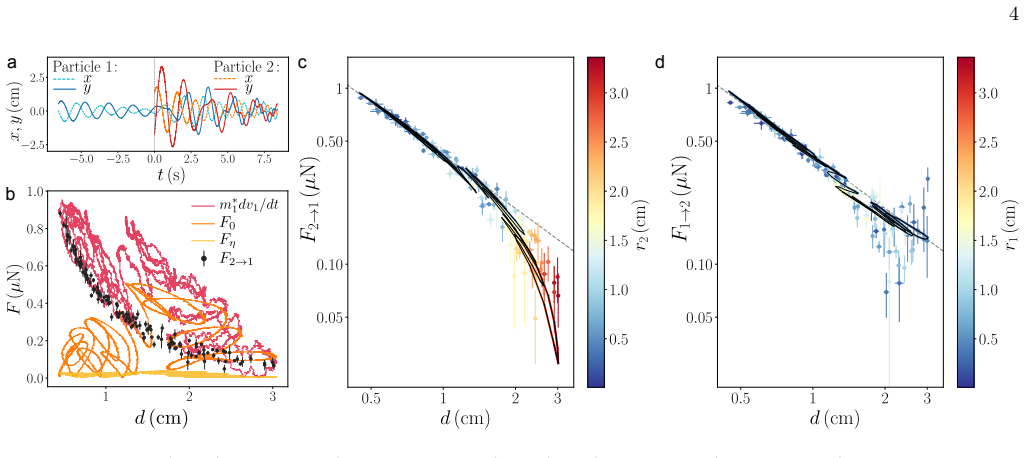
The central claim is that the attractive force between two particles in a soap film is non-reciprocal because the interface deformation induced by each particle depends on its position in the film. The force exerted by one particle on the other differs both in direction and magnitude from the reverse interaction, with an asymmetry reaching 150 percent when one particle is close to the center and the other close to the frame. Reciprocity is recovered when both particles are close to the film center. These results follow from the long-ranged deformation that spans the entire system size combined with low viscous friction.
What carries the argument
The position-dependent deformation of the soap-film interface by each particle's weight, which sets the local slope and thereby the horizontal force on the second particle.
If this is right
- The long-ranged attraction produces intricate particle orbits lasting up to ten seconds before collision.
- Force asymmetry reaches 150 percent for one particle near the center and the other near the frame.
- Reciprocity holds when both particles lie close to the film center.
- Low viscous friction allows the non-reciprocal dynamics to persist until the particles meet.
Where Pith is reading between the lines
- The same position-dependent deformation mechanism may appear in other thin liquid layers or membranes where boundaries shape the interface.
- Non-reciprocal capillary forces could be used to steer particle assembly or transport in confined geometries without external fields.
- Varying film size or particle mass would test how strongly boundary proximity controls the size of the asymmetry.
Load-bearing premise
The deformation of the film due to one particle's weight extends over the entire system and changes with the particle's distance from the boundaries.
What would settle it
Direct measurement of the mutual forces at fixed positions, checking whether the action-reaction pair is always equal in magnitude and opposite in direction or whether systematic asymmetry appears precisely when one particle is near the center and the other near the frame.
Figures


read the original abstract
Millimeter-sized particles trapped at the surface of a liquid bath attract each other through the deformation of the liquid-air interface, a phenomenon known as "the Cheerios effect". We consider here a situation similar at first sight: the interaction between two millimeter-sized particles trapped in an horizontal soap film. In this geometry, the deformation of the film due to the weight of one particle extends over the entire system size, which induces an extremely long-ranged attraction. Combined with the low viscous friction in the film, this leads to intricate particle orbits, lasting up to ten seconds before the two particles eventually collide. By tracking the particles dynamics, we measure the force exerted by each particle on the other, and we develop a theoretical model. Because the interface deformation induced by a particle depends on its position in the soap film, the attractive force has two features that fundamentally depart from classical interaction forces. The force exerted by one particle on the other differs both in direction and magnitude from the reverse interaction, with an asymmetry reaching 150% when one particle is close to the center and the other one close to the frame. Reciprocity is recovered when both particles are close to the film center. These results are a original example of non-reciprocal effective interactions due to boundary conditions.
Editorial analysis
A structured set of objections, weighed in public.
Referee Report
Summary. The manuscript reports experimental tracking of millimeter-sized particles in a horizontal soap film, revealing long-range attractive forces arising from interface deformation that spans the system size under fixed frame boundaries. From trajectories, the authors extract forces showing non-reciprocal behavior: the force from particle A on B differs in magnitude and direction from the reverse, with asymmetry up to 150% when one particle is near the center and the other near the frame. A model based on the harmonic (Laplace) solution for film height with position-dependent Green's function is developed to explain the observations, recovering reciprocity near the center. The work positions this as an example of boundary-condition-induced non-reciprocal effective interactions.
Significance. If the central claims hold after addressing methodological details, this constitutes a clean experimental demonstration of non-reciprocal effective forces emerging purely from the absolute-position dependence of the deformation field in a 2D tension-dominated system. The long-range character follows directly from the 2D Green's function under Dirichlet boundaries, and the reported asymmetry is a natural consequence rather than an ad-hoc addition. Trajectory-based force inference combined with a minimal model offers a reproducible platform for studying confined interfacial interactions, with potential relevance to soft-matter assembly and non-reciprocal dynamics.
major comments (2)
- [Experimental force measurement section] Force extraction from trajectories: no error bars, data exclusion criteria, or explicit account of how the viscous drag coefficient is calibrated or held constant across positions are provided. Without these, the quantitative 150% asymmetry cannot be assessed for robustness against measurement noise or systematic bias.
- [Theoretical model and validation] Model-data comparison: the theoretical model is stated to explain the measured trajectories, yet no quantitative metrics (residuals, chi-squared values, or direct overlay statistics) are reported. This leaves open whether the position-dependent deformation fully accounts for the data or requires additional fitting parameters.
minor comments (2)
- [Figures and captions] Figure captions and axis labels should explicitly state how asymmetry is quantified (e.g., ratio of force magnitudes at specific positions) to allow readers to verify the 150% figure directly from the plots.
- [Methods] The manuscript would benefit from a brief statement on film-thickness uniformity and any controls performed to confirm the tension-dominated regime (i.e., negligible gravity or bending effects).
Simulated Author's Rebuttal
We thank the referee for their careful reading of the manuscript and for the positive assessment of its significance. We address each major comment below and have revised the manuscript to incorporate additional details and quantitative comparisons as requested.
read point-by-point responses
-
Referee: [Experimental force measurement section] Force extraction from trajectories: no error bars, data exclusion criteria, or explicit account of how the viscous drag coefficient is calibrated or held constant across positions are provided. Without these, the quantitative 150% asymmetry cannot be assessed for robustness against measurement noise or systematic bias.
Authors: We agree that the original submission omitted explicit documentation of these aspects. In the revised manuscript we now report error bars on all extracted forces, computed as the standard deviation across at least five independent trajectory realizations for each pair of initial positions. Data exclusion criteria are stated explicitly: trajectories are retained only if the particles remain at least 2 mm from the frame boundaries and show no detectable out-of-plane motion (verified by auxiliary side-view imaging). The viscous drag coefficient is calibrated from the long-time diffusive motion of single particles at five representative locations spanning the film; these measurements establish that the coefficient varies by less than 8 % across the domain, consistent with the uniform film thickness. With these additions the reported 150 % asymmetry remains well outside the combined experimental uncertainties. revision: yes
-
Referee: [Theoretical model and validation] Model-data comparison: the theoretical model is stated to explain the measured trajectories, yet no quantitative metrics (residuals, chi-squared values, or direct overlay statistics) are reported. This leaves open whether the position-dependent deformation fully accounts for the data or requires additional fitting parameters.
Authors: We accept that quantitative validation metrics were absent. The revised manuscript includes overlaid experimental and model trajectories for four representative initial configurations, together with the root-mean-square deviation between observed and predicted particle positions (typically 0.3–0.5 mm, comparable to the particle radius and tracking precision). No adjustable parameters are introduced beyond the independently measured particle weights and film tension; the interface height is obtained directly from the position-dependent Green’s function satisfying the Dirichlet boundary conditions. The residuals are statistically consistent with the measured noise level, confirming that the boundary-constrained deformation accounts for the data without supplementary fitting. revision: yes
Circularity Check
No significant circularity
full rationale
The paper's central claim rests on direct experimental tracking of particle trajectories in a soap film to extract forces, followed by a model based on the standard 2D Laplace equation for meniscus deformation (∇²η = 0) subject to fixed boundary conditions at the frame. The resulting position-dependent, non-reciprocal forces emerge as a direct mathematical consequence of the Green's function for this boundary-value problem and do not reduce to any fitted parameter, self-definition, or self-citation chain by construction. No ansatz is smuggled in, no uniqueness theorem is invoked from prior author work, and the asymmetry (including the 150% figure) is presented as a predicted outcome of the mechanics rather than an input. The derivation is therefore self-contained against external benchmarks of 2D tension-dominated interface physics.
Axiom & Free-Parameter Ledger
Lean theorems connected to this paper
-
IndisputableMonolith/Cost/FunctionalEquation.leanwashburn_uniqueness_aczel unclear?
unclearRelation between the paper passage and the cited Recognition theorem.
the film profile h obeys Δh = ρ_f g e / (2γ) with h=0 at the frame; F_{2→1} = -m_1^* g ∂h_2/∂r_1
-
IndisputableMonolith/Foundation/AlexanderDuality.leanalexander_duality_circle_linking unclear?
unclearRelation between the paper passage and the cited Recognition theorem.
h_2 = - (m_2^* g / 4πγ) (τ - τ_0) in bipolar coordinates
What do these tags mean?
- matches
- The paper's claim is directly supported by a theorem in the formal canon.
- supports
- The theorem supports part of the paper's argument, but the paper may add assumptions or extra steps.
- extends
- The paper goes beyond the formal theorem; the theorem is a base layer rather than the whole result.
- uses
- The paper appears to rely on the theorem as machinery.
- contradicts
- The paper's claim conflicts with a theorem or certificate in the canon.
- unclear
- Pith found a possible connection, but the passage is too broad, indirect, or ambiguous to say the theorem truly supports the claim.
Reference graph
Works this paper leans on
-
[1]
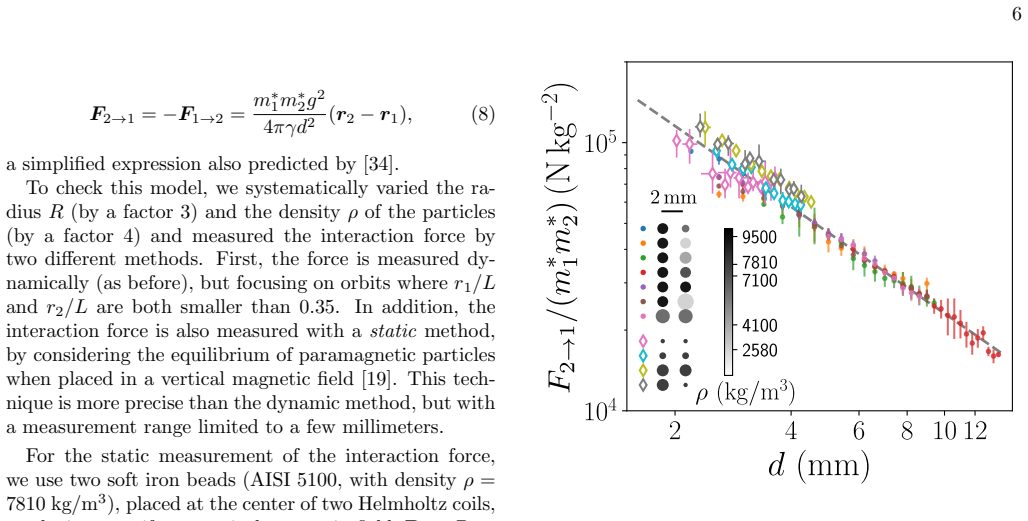
The experimental data is scattered at small timest (corresponding the larger distancesd), which we explain by vertical oscillations of particle 2 in the film in the first seconds after its deposition, that temporarily impact the horizontal force balance (equation 1). Here,r 1 remains relatively small at all times, and the forceF 2→1 follows the 1/dscaling...
-
[2]
The interaction between floating particles
MM Nicolson. The interaction between floating particles. InMathematical Proceedings of the Cambridge Philosoph- ical Society, volume 45, pages 288–295. Cambridge Uni- versity Press, 1949
work page 1949
-
[3]
Dominic Vella and L Mahadevan. The cheerios effect. American journal of physics, 73(9):817–825, 2005
work page 2005
-
[4]
Jean-Christophe Loudet, Ahmed M Alsayed, Jian Zhang, and Arjun G Yodh. Capillary interactions between anisotropic colloidal particles.Physical review letters, 94(1):018301, 2005
work page 2005
-
[5]
Paolo Peruzzo, Andrea Defina, Heidi M Nepf, and Ro- man Stocker. Capillary interception of floating particles by surface-piercing vegetation.Physical review letters, 111(16):164501, 2013
work page 2013
-
[6]
Megan Delens, Axel Franckart, Daniel M Harris, and Nicolas Vandewalle. 3d-printed spines for programmable liquid topographies and micromanipulation.Nature Communications, 16(1):4348, 2025
work page 2025
-
[7]
Ned Bowden, Andreas Terfort, Jeff Carbeck, and George M Whitesides. Self-assembly of mesoscale ob- jects into ordered two-dimensional arrays.Science, 276(5310):233–235, 1997
work page 1997
-
[8]
The collective motion of nematodes in a thin liquid layer.Soft Matter, 7(6):2444–2448, 2011
Sean Gart, Dominic Vella, and Sunghwan Jung. The collective motion of nematodes in a thin liquid layer.Soft Matter, 7(6):2444–2448, 2011
work page 2011
-
[9]
Iris B Liu, Nima Sharifi-Mood, and Kathleen J Stebe. Capillary assembly of colloids: Interactions on planar and curved interfaces.Annual Review of Condensed Matter Physics, 9(1):283–305, 2018
work page 2018
-
[10]
Small fire ant rafts are unstable.Physical Review Fluids, 7(9):090501, 2022
Hungtang Ko, Mathias Hadgu, Keyana Komilian, and David L Hu. Small fire ant rafts are unstable.Physical Review Fluids, 7(9):090501, 2022
work page 2022
-
[11]
Interactions and pattern formation in a macro- scopic magnetocapillary salr system of mermaid cereal
Alireza Hooshanginejad, Jack-William Barotta, Victoria Spradlin, Giuseppe Pucci, Robert Hunt, and Daniel M Harris. Interactions and pattern formation in a macro- scopic magnetocapillary salr system of mermaid cereal. Nature Communications, 15(1):5466, 2024
work page 2024
-
[12]
Two-dimensional interfacial colloidal crystals.Physical review letters, 45(7):569, 1980
Pawel Pieranski. Two-dimensional interfacial colloidal crystals.Physical review letters, 45(7):569, 1980
work page 1980
-
[13]
Pleats in crystals on curved surfaces.Nature, 468(7326):947–951, 2010
William TM Irvine, Vincenzo Vitelli, and Paul M Chaikin. Pleats in crystals on curved surfaces.Nature, 468(7326):947–951, 2010
work page 2010
-
[14]
N Aubry, P Singh, M Janjua, and S Nudurupati. Micro- and nanoparticles self-assembly for virtually defect-free, adjustable monolayers.Proceedings of the National Academy of Sciences, 105(10):3711–3714, 2008
work page 2008
-
[15]
Switchable self-assembled capillary structures.Soft Mat- ter, 16(45):10320–10325, 2020
Nicolas Vandewalle, Martin Poty, Nathan Vanesse, Jeremie Caprasse, Thomas Defize, and Christine Jerome. Switchable self-assembled capillary structures.Soft Mat- ter, 16(45):10320–10325, 2020
work page 2020
-
[16]
Peter A Kralchevsky and Nikolai D Denkov. Capillary forces and structuring in layers of colloid particles.Cur- rent opinion in colloid and interface science, 6(4):383– 401, 2001
work page 2001
-
[17]
Force balance of particles trapped at fluid interfaces
Alvaro Dominguez, Martin Oettel, and Siegfried Diet- rich. Force balance of particles trapped at fluid interfaces. The Journal of chemical physics, 128(11), 2008
work page 2008
-
[18]
Virginia Carrasco-Fadanelli and Rolando Castillo. Mea- surement of the force between uncharged colloidal parti- cles trapped at a flat air - water interface.Soft Matter, 15(29):5815–5818, 2019
work page 2019
-
[19]
Ian Ho, Giuseppe Pucci, and Daniel M Harris. Di- rect measurement of capillary attraction between floating disks.Physical Review Letters, 123(25):254502, 2019
work page 2019
-
[20]
Induced capillary dipoles in floating particle assemblies
Megan Delens, Ylona Collard, and Nicolas Vandewalle. Induced capillary dipoles in floating particle assemblies. Physical Review Fluids, 8(7):074001, 2023
work page 2023
-
[21]
Energy absorption in a bamboo foam.Europhys
A Le Goff, L Courbin, Howard A Stone, and D Quere. Energy absorption in a bamboo foam.Europhys. Lett, 84(3):36001, 2008
work page 2008
-
[22]
Tristan Gilet and John WM Bush. The fluid trampo- line: droplets bouncing on a soap film.Journal of Fluid Mechanics, 625:167–203, 2009
work page 2009
-
[23]
Birgitt Boschitsch Stogin, Luke Gockowski, Hannah Feld- stein, Houston Claure, Jing Wang, and Tak-Sing Wong. Free-standing liquid membranes as unusual particle sep- arators.Science advances, 4(8):eaat3276, 2018
work page 2018
-
[24]
Sliding dynamics of a particle in a soap film.Journal of Fluid Mechanics, 1007:R8, 2025
Youna Louyer, Benjamin Dollet, Isabelle Cantat, and Anais Gauthier. Sliding dynamics of a particle in a soap film.Journal of Fluid Mechanics, 1007:R8, 2025
work page 2025
-
[25]
Orbiting, colliding and merging liquid lenses on a soap film: Toward gravitational analogues
Jean-Paul Martischang, Benjamin Reichert, Ilies Haouche, Germain Rousseaux, Alexis Duchesne, and Michael Baudoin. Orbiting, colliding and merging liquid lenses on a soap film: Toward gravitational analogues. PNAS Nexus, page pgag079, 03 2026
work page 2026
-
[26]
Yang Shi, Danning Wang, Yuqing Xiao, Ting Pan, Wen- peng Liu, Luke P Lee, Hongbao Xin, and Baojun Li. Spontaneous particle ordering, sorting, and assembly on soap films.Nano Letters, 24(21):6433–6440, 2024
work page 2024
-
[27]
Roberto Di Leonardo, F Saglimbeni, and Giancarlo Ruocco. Very-long-range nature of capillary interactions in liquid films.Physical review letters, 100(10):106103, 2008
work page 2008
-
[28]
Pendular rings between solids: meniscus properties and capillary force
FM Orr, LE Scriven, and Ay P Rivas. Pendular rings between solids: meniscus properties and capillary force. Journal of Fluid Mechanics, 67(4):723–742, 1975
work page 1975
-
[29]
Marginal pinching in soap films.Europhysics Letters, 55(6):834, 2001
Achod Aradian, Elie Raphael, and P-G De Gennes. Marginal pinching in soap films.Europhysics Letters, 55(6):834, 2001
work page 2001
-
[30]
Onset of thin film meniscus along a fibre.Journal of Fluid Mechanics, 865:650–680, 2019
Shuo Guo, Xianmin Xu, Tiezheng Qian, Yana Di, Masao Doi, and Penger Tong. Onset of thin film meniscus along a fibre.Journal of Fluid Mechanics, 865:650–680, 2019
work page 2019
-
[31]
Nikolina D Vassileva, Dirk van den Ende, Frieder Mugele, and Jorrit Mellema. Capillary forces between spherical particles floating at a liquid- liquid interface.Langmuir, 21(24):11190–11200, 2005
work page 2005
-
[32]
Marie-Julie Dalbe, Darija Cosic, Michael Berhanu, and Arshad Kudrolli. Aggregation of frictional particles due to capillary attraction.Physical Review E, 83(5):051403, 2011
work page 2011
-
[33]
Capillary orbits.Nature communications, 10(1):3947, 2019
Anais Gauthier, Devaraj van Der Meer, Jacco H Snoei- jer, and Guillaume Lajoinie. Capillary orbits.Nature communications, 10(1):3947, 2019. 8
work page 2019
-
[34]
Caroline Cohen, Baptiste Darbois Texier, Etienne Reyssat, Jacco H Snoeijer, David Qu´ er´ e, and Christophe Clanet. On the shape of giant soap bubbles.Proceedings of the National Academy of Sciences, 114(10):2515–2519, 2017
work page 2017
-
[35]
Jean-Paul Martischang, Benjamin Reichert, Germain Rousseaux, Alexis Duchesne, and Michael Baudoin. Orbiting, colliding and merging droplets on a soap film: toward gravitational analogues.arXiv preprint arXiv:2503.08331, 2025
-
[36]
Statics and dynamics of magnetocapillary bonds
Guillaume Lagubeau, Galien Grosjean, Alexis Darras, Geoffroy Lumay, Maxime Hubert, and Nicolas Vande- walle. Statics and dynamics of magnetocapillary bonds. Physical Review E, 93(5):053117, 2016
work page 2016
discussion (0)
Sign in with ORCID, Apple, or X to comment. Anyone can read and Pith papers without signing in.