Recognition: no theorem link
The Cohesive Object Sequence: The Mass-Density Distribution of Astronomical Objects from Asteroids to Stars
Pith reviewed 2026-05-10 18:48 UTC · model grok-4.3
The pith
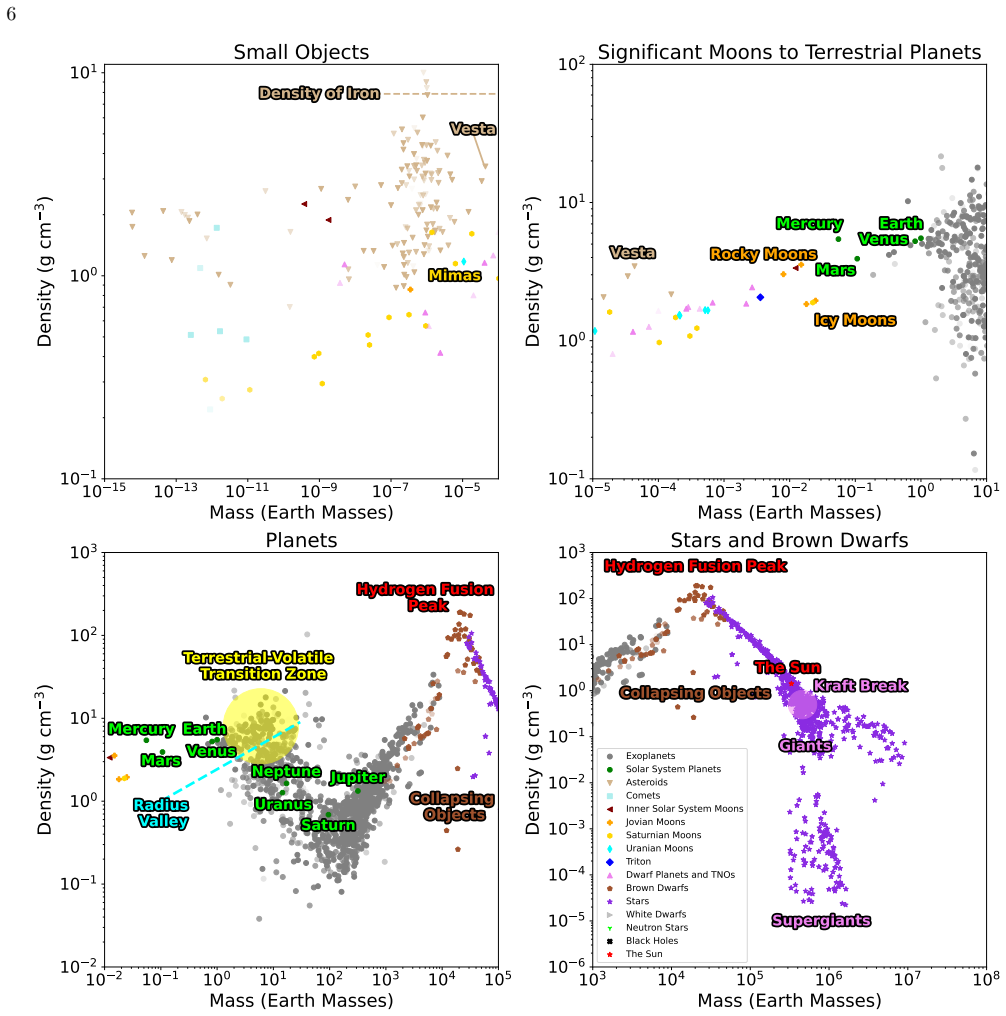
Most astronomical objects from asteroids to giant stars align on a single mass-density sequence when plotted against mass.
A machine-rendered reading of the paper's core claim, the machinery that carries it, and where it could break.
Core claim
Plotting the mass-density of a wide range of astronomical objects as a function of their mass reveals that the vast majority of these objects fall along a cohesive object sequence that extends all the way from asteroids to the largest stars. Trends and features within this sequence reflect fundamental astronomical processes and phenomena, including the gravitational contraction of progressively higher-mass planets and the onset of nuclear reactions within stars. Compact stellar remnants fall well off this sequence, reflecting their extreme natures.
What carries the argument
The cohesive object sequence, the observed continuous trend in mass-density versus mass that links diverse bodies through shared gravitational and nuclear processes.
If this is right
- The sequence encodes the effects of gravitational contraction as planet masses increase.
- The onset of nuclear fusion in stars produces a visible feature or change in slope along the sequence.
- Compact stellar remnants lie distinctly off the sequence because their densities are set by degeneracy pressure rather than the same equilibrium processes.
- The plot provides a practical way to classify objects by seeing whether they fall on or off the main trend.
Where Pith is reading between the lines
- If the sequence holds across more complete samples, it could serve as a quick diagnostic for whether an object has reached hydrostatic equilibrium or experienced unusual formation history.
- Extending the same plot to include exoplanets with measured densities might reveal whether the sequence continues smoothly into the super-Earth and mini-Neptune regime.
- Deviations at the high-mass end could help identify the transition to objects that undergo pair-instability supernovae or other mass-loss events.
Load-bearing premise
The chosen objects and their measured masses and densities are sufficiently complete and unbiased to reveal a physically meaningful sequence rather than an artifact of catalog selection or measurement inconsistencies across scales.
What would settle it
New, independent measurements of objects in under-sampled mass ranges such as large brown dwarfs or low-mass stars that place them far from the reported sequence without corresponding adjustments for selection effects or measurement error.
Figures


read the original abstract
Plotting the mass-density of a wide range of astronomical objects as a function of their mass reveals that the vast majority of these objects fall along a ``cohesive object sequence'' that extends all the way from asteroids to the largest stars. Trends and features within this sequence reflect fundamental astronomical processes and phenomena, including the gravitational contraction of progressively higher-mass planets and the onset of nuclear reactions within stars. Meanwhile, compact stellar remnants fall well off this sequence, reflecting their extreme natures. This type of plot is therefore useful both for showcasing the relationships and connections between a wide range of astronomical objects and for clarifying the distinctions used to identify particular types of objects.
Editorial analysis
A structured set of objections, weighed in public.
Referee Report
Summary. The manuscript claims that plotting mass-density against mass for a wide range of astronomical objects reveals that the vast majority align along a 'cohesive object sequence' extending from asteroids to the largest stars. Trends within the sequence are said to reflect gravitational contraction of planets and the onset of nuclear reactions in stars, while compact remnants deviate from it. The diagram is presented as useful for illustrating relationships and classification distinctions across object types.
Significance. If the alignment were shown to be robust against selection effects and measurement inconsistencies, the sequence could serve as a unifying pedagogical tool linking planetary and stellar regimes through shared physics of contraction and ignition. No machine-checked proofs, reproducible code, or parameter-free derivations are provided; the contribution is primarily conceptual and visual.
major comments (2)
- [Abstract] Abstract: the assertion that 'the vast majority of these objects fall along' the sequence supplies no data sources, inclusion criteria, total population considered, quantitative scatter metric, or statistical test. Without these, the claim cannot be evaluated and selection bias remains a load-bearing concern for the central result.
- No section on data or methods: masses and densities are drawn from heterogeneous techniques (radar/photometric for small bodies, spectroscopic/evolutionary models for stars) with no discussion of how inconsistencies are propagated or normalized, undermining the physical continuity interpretation.
minor comments (2)
- The invented term 'cohesive object sequence' is used without reference to prior literature on mass-radius or mass-density relations.
- Figures (if present) should include error bars and outlier annotations to allow readers to assess the tightness of the claimed alignment.
Simulated Author's Rebuttal
We thank the referee for their constructive comments, which have prompted us to clarify key aspects of the manuscript. We respond to each major comment below and indicate the changes made.
read point-by-point responses
-
Referee: [Abstract] Abstract: the assertion that 'the vast majority of these objects fall along' the sequence supplies no data sources, inclusion criteria, total population considered, quantitative scatter metric, or statistical test. Without these, the claim cannot be evaluated and selection bias remains a load-bearing concern for the central result.
Authors: We agree the abstract requires more context. The revised abstract now states that the sequence is illustrated with a representative compilation of objects drawn from the published literature, with sources and references detailed in the main text. We clarify that 'vast majority' is a qualitative description of the visual trend across known object classes rather than a statistical claim about the complete astronomical population. No quantitative scatter metric or formal statistical test is added, as the work is conceptual and visual in nature; such analysis would require a different scope. Selection effects are inherent to any literature compilation, but the alignment spans many orders of magnitude and multiple independent datasets, supporting the physical interpretation. revision: partial
-
Referee: [—] No section on data or methods: masses and densities are drawn from heterogeneous techniques (radar/photometric for small bodies, spectroscopic/evolutionary models for stars) with no discussion of how inconsistencies are propagated or normalized, undermining the physical continuity interpretation.
Authors: We have added a dedicated 'Data Sources and Methods' section. It describes the literature origins of the mass and density values for each object class, including radar and photometric methods for small bodies and spectroscopic plus evolutionary models for stars. The section notes the heterogeneous techniques and explains that the plot uses standard accepted values without attempting quantitative normalization or error propagation, as the diagram is schematic and intended to reveal broad trends rather than precise inter-comparisons. The continuity interpretation rests on the persistence of the sequence despite these differences, not on the assumption of uniform data quality. revision: yes
Circularity Check
No circularity: empirical sequence defined directly from plotted data with no reducing equations or self-referential derivations
full rationale
The paper's central claim is an observational pattern identified by plotting existing mass and density measurements for a range of astronomical objects. No equations, fitted parameters, predictions, or first-principles derivations are presented that could reduce to inputs by construction. The sequence is not derived mathematically but is instead the visual result of the data points themselves. No self-citations, uniqueness theorems, or ansatzes are invoked as load-bearing steps. Selection and measurement bias concerns affect the physical interpretation but do not constitute circularity in any derivation chain, as there is none.
Axiom & Free-Parameter Ledger
axioms (2)
- domain assumption Gravitational contraction increases density with mass for planets and lower-mass stars.
- domain assumption Onset of nuclear reactions alters the mass-density relation for stars.
invented entities (1)
-
Cohesive object sequence
no independent evidence
Reference graph
Works this paper leans on
-
[1]
47, A Global Degree and Order 1200 Model of the Lunar Gravity Field Using GRAIL Mission Data, Houston, Texas, 1484
2016, Lunar and Planetary Science Conference, Vol. 47, A Global Degree and Order 1200 Model of the Lunar Gravity Field Using GRAIL Mission Data, Houston, Texas, 1484
2016
-
[2]
, archivePrefix = "arXiv", eprint =
Adams, E. R., Seager, S., & Elkins-Tanton, L. 2008, The Astrophysical Journal, 673, 1160–1164, doi: 10.1086/524925
-
[3]
Agnor, C. B., & Hamilton, D. P. 2006, Nature, 441, 192–194, doi: 10.1038/nature04792 12
-
[4]
2019, The Astrophysical Journal Letters, 875, L6, doi: 10.3847/2041-8213/ab1141
Akiyama, K., Alberdi, A., Alef, W., et al. 2019, The Astrophysical Journal Letters, 875, L6, doi: 10.3847/2041-8213/ab1141
-
[5]
Allen, P. R., Trilling, D. E., Koerner, D. W., & Reid, I. N. 2003, The Astrophysical Journal, 595, 1222–1230, doi: 10.1086/377436
-
[6]
Anderson, J. D., Colombo, G., Esposito, P. B., Lau, E. L., & Trager, G. B. 1987, Icarus, 71, 337–349, doi: 10.1016/0019-1035(87)90033-9
-
[7]
Anderson, J. D., Johnson, T. V., Schubert, G., et al. 2005, Science, 308, 1291–1293, doi: 10.1126/science.1110422
-
[8]
Archinal, B. A., Acton, C. H., A’Hearn, M. F., et al. 2018, Celestial Mechanics and Dynamical Astronomy, 130, doi: 10.1007/s10569-017-9805-5
-
[9]
2019, The Astrophysical Journal Letters, 880, L1, doi: 10.3847/2041-8213/ab2ba2
Veras, D. 2019, The Astrophysical Journal Letters, 880, L1, doi: 10.3847/2041-8213/ab2ba2
-
[10]
Armstrong, D. J., Lopez, T. A., Adibekyan, V., et al. 2020, Nature, 583, 39–42, doi: 10.1038/s41586-020-2421-7
-
[11]
2007, Jupiter: The Planet, Satellites and Magnetosphere (Cambridge, New York: Cambridge University Press)
Bagenal, F., Dowling, T., & McKinnon, W. 2007, Jupiter: The Planet, Satellites and Magnetosphere (Cambridge, New York: Cambridge University Press)
2007
-
[12]
1998, doi: 10.48550/ARXIV.ASTRO-PH/9805009
Baraffe, I., Chabrier, G., Allard, F., & Hauschildt, P. 1998, doi: 10.48550/ARXIV.ASTRO-PH/9805009
-
[13]
Batygin, K., Stevenson, D. J., & Bodenheimer, P. H. 2011, The Astrophysical Journal, 738, 1, doi: 10.1088/0004-637x/738/1/1
-
[14]
The Astrophysical Journal , author =
Beyer, A. C., & White, R. J. 2024, The Astrophysical Journal, 973, 28, doi: 10.3847/1538-4357/ad6b0d
-
[15]
2019, Icarus, 326, 10–17, doi: 10.1016/j.icarus.2019.01.027
Bierson, C., & Nimmo, F. 2019, Icarus, 326, 10–17, doi: 10.1016/j.icarus.2019.01.027
-
[16]
Bills, B. G., Neumann, G. A., Smith, D. E., & Zuber, M. T. 2005, Journal of Geophysical Research: Planets, 110, doi: 10.1029/2004je002376
-
[17]
Bodenheimer, P., & Pollack, J. B. 1986, Icarus, 67, 391–408, doi: 10.1016/0019-1035(86)90122-3
-
[18]
Bond, H. E., Schaefer, G. H., Gilliland, R. L., et al. 2017, The Astrophysical Journal, 840, 70, doi: 10.3847/1538-4357/aa6af8
-
[19]
Boss, A. P., Butler, R. P., Hubbard, W. B., et al. 2005, Proceedings of the International Astronomical Union, 1, 183–186, doi: 10.1017/s1743921306004509
-
[20]
Brown, M. E., & Butler, B. J. 2017, The Astronomical Journal, 154, 19, doi: 10.3847/1538-3881/aa6346 Brozovi´ c, M., Showalter, M. R., Jacobson, R. A., & Buie, M. W. 2015, Icarus, 246, 317–329, doi: 10.1016/j.icarus.2014.03.015
-
[21]
2025, Emergent Scientist, 9, 2, doi: 10.1051/emsci/2025001
Camposeo, S. 2025, Emergent Scientist, 9, 2, doi: 10.1051/emsci/2025001
-
[22]
Carroll, B. W., & Ostlie, D. A. 2017, An Introduction to Modern Astrophysics (Cambridge University Press), doi: 10.1017/9781108380980
-
[23]
2012, Planetary and Space Science, 73, 98–118, doi: 10.1016/j.pss.2012.03.009
Carry, B. 2012, Planetary and Space Science, 73, 98–118, doi: 10.1016/j.pss.2012.03.009
-
[24]
Chen, J., & Kipping, D. 2016, The Astrophysical Journal, 834, 17, doi: 10.3847/1538-4357/834/1/17
-
[25]
Collaboration, E. H. T., Akiyama, K., Alberdi, A., et al. 2022, The Astrophysical Journal Letters, 930, L15, doi: 10.3847/2041-8213/ac6736
-
[26]
Daly, R. A., Donahue, M., O’Dea, C. P., et al. 2023, Monthly Notices of the Royal Astronomical Society, 527, 428–436, doi: 10.1093/mnras/stad3228
-
[27]
2022, Nature Astronomy, 6, 1444–1451, doi: 10.1038/s41550-022-01800-1
Santangelo, A. 2022, Nature Astronomy, 6, 1444–1451, doi: 10.1038/s41550-022-01800-1
-
[28]
Emilio, M., Kuhn, J. R., Bush, R. I., & Scholl, I. F. 2012, The Astrophysical Journal, 750, 135, doi: 10.1088/0004-637x/750/2/135
-
[29]
2021, Butsuri, 76, 637, doi: 10.11316/butsuri.76.10 637
Enoto, T., & Yasutake, N. 2021, Butsuri, 76, 637, doi: 10.11316/butsuri.76.10 637
-
[30]
M., Williams, J
Folkner, W. M., Williams, J. G., & Boggs, D. 2009, Interplanetary Network Progress Report, 42-178, 1
2009
-
[31]
Gillies, G. T. 1997, Reports on Progress in Physics, 60, 151–225, doi: 10.1088/0034-4885/60/2/001
-
[32]
Gimnez, A., & Zamorano, J. 1985, Astrophysics and Space Science, 114, 259–269, doi: 10.1007/bf00653969 Gonz´ alez-Caniulef, D., Guillot, S., & Reisenegger, A. 2019, Monthly Notices of the Royal Astronomical Society, 490, 5848–5859, doi: 10.1093/mnras/stz2941
-
[33]
2021, Astronomy & Astrophysics, 652, A127, doi: 10.1051/0004-6361/202141145
Grieves, N., Bouchy, F., Lendl, M., et al. 2021, Astronomy & Astrophysics, 652, A127, doi: 10.1051/0004-6361/202141145
-
[34]
2016, ARA&A, 54, 135, doi: 10.1146/annurev-astro-081915-023347
Hartmann, L., Herczeg, G., & Calvet, N. 2016, Annual Review of Astronomy and Astrophysics, 54, 135–180, doi: 10.1146/annurev-astro-081915-023347
-
[35]
Helled, R. 2023, Astronomy & Astrophysics, 675, L8, doi: 10.1051/0004-6361/202346850
-
[36]
2021, Icarus, 355, 114130, doi: 10.1016/j.icarus.2020.114130
Holler, B., Grundy, W., Buie, M., & Noll, K. 2021, Icarus, 355, 114130, doi: 10.1016/j.icarus.2020.114130
-
[37]
Jacobson, R. A. 2009, The Astronomical Journal, 137, 4322–4329, doi: 10.1088/0004-6256/137/5/4322 —. 2014, The Astronomical Journal, 148, 76, doi: 10.1088/0004-6256/148/5/76 —. 2022, The Astronomical Journal, 164, 199, doi: 10.3847/1538-3881/ac90c9
-
[38]
Jacobson, R. A., Antreasian, P. G., Bordi, J. J., et al. 2006, The Astronomical Journal, 132, 2520–2526, doi: 10.1086/508812 13
-
[39]
Kanodia, S., Gupta, A. F., Ca˜ nas, C. I., et al. 2024, The Astronomical Journal, 168, 235, doi: 10.3847/1538-3881/ad7796
-
[40]
Kiss, C., Marton, G., Parker, A. H., et al. 2019, Icarus, 334, 3–10, doi: 10.1016/j.icarus.2019.03.013
-
[41]
1999, Icarus, 139, 3–18, doi: 10.1006/icar.1999.6086
Konopliv, A., Banerdt, W., & Sjogren, W. 1999, Icarus, 139, 3–18, doi: 10.1006/icar.1999.6086
-
[42]
Lange, S., Murphy, J. M. A., Batalha, N. M., et al. 2024, The Astronomical Journal, 167, 282, doi: 10.3847/1538-3881/ad34d9
-
[43]
M., Gerasimov, R., & Burgasser, A
Larkin, M. M., Gerasimov, R., & Burgasser, A. J. 2022, The Astronomical Journal, 165, 2, doi: 10.3847/1538-3881/ac9b43
-
[44]
Lauretta, D. S., DellaGiustina, D. N., Bennett, C. A., et al. 2019, Nature, 568, 55–60, doi: 10.1038/s41586-019-1033-6
-
[45]
Lee, E. J., & Chiang, E. 2016, The Astrophysical Journal, 817, 90, doi: 10.3847/0004-637x/817/2/90
-
[46]
Lemoine, F. G., Goossens, S., Sabaka, T. J., et al. 2014, Geophysical Research Letters, 41, 3382–3389, doi: 10.1002/2014gl060027
-
[47]
Libby-Roberts, J. E., Berta-Thompson, Z. K., D´ esert, J.-M., et al. 2020, The Astronomical Journal, 159, 57, doi: 10.3847/1538-3881/ab5d36
-
[48]
Limbach, M. A., Vos, J. M., Vanderburg, A., & Dai, F. 2024, The Astronomical Journal, 168, 54, doi: 10.3847/1538-3881/ad4ed5
-
[49]
Lineweaver, C. H., & Norman, M. 2010, The Potato Radius: a Lower Minimum Size for Dwarf Planets, arXiv, doi: 10.48550/ARXIV.1004.1091
-
[50]
Lineweaver, C. H., & Patel, V. M. 2023, American Journal of Physics, 91, 819–825, doi: 10.1119/5.0150209
-
[51]
Maio, U., Ciardi, B., Dolag, K., Tornatore, L., & Khochfar, S. 2010, Monthly Notices of the Royal Astronomical Society, 407, 1003–1015, doi: 10.1111/j.1365-2966.2010.17003.x
-
[52]
Mann, R. B., Murk, S., & Terno, D. R. 2022, International Journal of Modern Physics D, 31, doi: 10.1142/s0218271822300154
-
[53]
Metzger, P. T., Grundy, W., Sykes, M. V., et al. 2022, Icarus, 374, 114768, doi: 10.1016/j.icarus.2021.114768
-
[54]
Miller, M. C., Lamb, F. K., Dittmann, A. J., et al. 2019, The Astrophysical Journal Letters, 887, L24, doi: 10.3847/2041-8213/ab50c5
-
[55]
Morin, J., Donati, J.-F., Petit, P., et al. 2010, Monthly Notices of the Royal Astronomical Society, 407, 2269–2286, doi: 10.1111/j.1365-2966.2010.17101.x M¨ uller, S., Baron, J., Helled, R., Bouchy, F., & Parc, L. 2024, Astronomy & Astrophysics, 686, A296, doi: 10.1051/0004-6361/202348690 M¨ uller, S., & Helled, R. 2021, Monthly Notices of the Royal Astr...
-
[56]
2023, Nature, 622, 255–260, doi: 10.1038/s41586-023-06499-2 NASA Exoplanet Science Institute
Naponiello, L., Mancini, L., Sozzetti, A., et al. 2023, Nature, 622, 255–260, doi: 10.1038/s41586-023-06499-2 NASA Exoplanet Science Institute. 2020, Planetary Systems Table, IPAC, doi: 10.26133/NEA12 N¨ attil¨ a, J., Miller, M. C., Steiner, A. W., et al. 2017, Astronomy &; Astrophysics, 608, A31, doi: 10.1051/0004-6361/201731082
-
[57]
Nimmo, F., Umurhan, O., Lisse, C. M., et al. 2017, Icarus, 287, 12–29, doi: 10.1016/j.icarus.2016.06.027
-
[58]
L., Sicardy, B., Braga-Ribas, F., et al
Ortiz, J. L., Sicardy, B., Braga-Ribas, F., et al. 2012, Nature, 491, 566–569, doi: 10.1038/nature11597
-
[59]
L., Santos-Sanz, P., Sicardy, B., et al
Ortiz, J. L., Santos-Sanz, P., Sicardy, B., et al. 2017, Nature, 550, 219–223, doi: 10.1038/nature24051
-
[60]
2005, A&A, 432, L57, doi: 10.1051/0004-6361:200500020
Palla, F., & Baraffe, I. 2005, Astronomy & Astrophysics, 432, L57–L60, doi: 10.1051/0004-6361:200500020
-
[61]
Park, R. S., Folkner, W. M., Williams, J. G., & Boggs, D. H. 2021, The Astronomical Journal, 161, 105, doi: 10.3847/1538-3881/abd414
-
[62]
Parsons, S. G., G¨ ansicke, B. T., Marsh, T. R., et al. 2017, Monthly Notices of the Royal Astronomical Society, 470, 4473–4492, doi: 10.1093/mnras/stx1522 P¨ atzold, M., Andert, T., Hahn, M., et al. 2016, Nature, 530, 63–65, doi: 10.1038/nature16535
-
[63]
S., Youngblood, A., & France, K
Pineda, J. S., Youngblood, A., & France, K. 2021, The Astrophysical Journal, 918, 40, doi: 10.3847/1538-4357/ac0aea
-
[64]
Ragozzine, D., & Brown, M. E. 2009, The Astronomical Journal, 137, 4766–4776, doi: 10.1088/0004-6256/137/6/4766
-
[65]
J., Hobbs, G., Coles, W., et al
Reardon, D. J., Hobbs, G., Coles, W., et al. 2015, Monthly Notices of the Royal Astronomical Society, 455, 1751–1769, doi: 10.1093/mnras/stv2395
-
[66]
Riley, T. E., Watts, A. L., Bogdanov, S., et al. 2019, The Astrophysical Journal Letters, 887, L21, doi: 10.3847/2041-8213/ab481c
-
[67]
Russell, C. T., Raymond, C. A., Coradini, A., et al. 2012, Science, 336, 684–686, doi: 10.1126/science.1219381
-
[68]
Schlaufman, K. C. 2018, The Astrophysical Journal, 853, 37, doi: 10.3847/1538-4357/aa961c
-
[69]
Scott, E. R. D. 2020, Iron Meteorites: Composition, Age, and Origin, Oxford University Press, doi: 10.1093/acrefore/9780190647926.013.206
-
[70]
Sicardy, B., Ortiz, J. L., Assafin, M., et al. 2011, Nature, 478, 493–496, doi: 10.1038/nature10550
-
[71]
2006, The Astronomical Journal, 132, 2513–2519, doi: 10.1086/508861 14
Soter, S. 2006, The Astronomical Journal, 132, 2513–2519, doi: 10.1086/508861 14
-
[72]
2020, Astronomy & Astrophysics, 643, A125, doi: 10.1051/0004-6361/202038526
Souami, D., Braga-Ribas, F., Sicardy, B., et al. 2020, Astronomy & Astrophysics, 643, A125, doi: 10.1051/0004-6361/202038526
-
[73]
M., Torres G., Zejda M., eds, Astronomical Society of the Pacific Conference Series Vol
Southworth, J. 2014, doi: 10.48550/ARXIV.1411.1219
-
[74]
2001, Planetary and Space Science, 49, 1561–1570, doi: 10.1016/s0032-0633(01)00093-9
Spohn, T., Sohl, F., Wieczerkowski, K., & Conzelmann, V. 2001, Planetary and Space Science, 49, 1561–1570, doi: 10.1016/s0032-0633(01)00093-9
-
[75]
Stassun, K. G., Mathieu, R. D., & Valenti, J. A. 2007, The Astrophysical Journal, 664, 1154–1166, doi: 10.1086/519231
-
[76]
Stern, S. A., Grundy, W. M., McKinnon, W. B., Weaver, H. A., & Young, L. A. 2018, Annual Review of Astronomy and Astrophysics, 56, 357–392, doi: 10.1146/annurev-astro-081817-051935
-
[77]
Stern, S. A., & Levison, H. F. 2002, Highlights of Astronomy, 12, 205–213, doi: 10.1017/s1539299600013289
-
[78]
Tamburini, F., Thid´ e, B., & Della Valle, M. 2019, Monthly Notices of the Royal Astronomical Society: Letters, 492, L22–L27, doi: 10.1093/mnrasl/slz176
-
[79]
1988, Icarus, 73, 427–441, doi: 10.1016/0019-1035(88)90054-1 —
Thomas, P. 1988, Icarus, 73, 427–441, doi: 10.1016/0019-1035(88)90054-1 —. 2000, Icarus, 148, 587–588, doi: 10.1006/icar.2000.6511
-
[80]
2020, Icarus, 344, 113355, doi: 10.1016/j.icarus.2019.06.016
Thomas, P., & Helfenstein, P. 2020, Icarus, 344, 113355, doi: 10.1016/j.icarus.2019.06.016
discussion (0)
Sign in with ORCID, Apple, or X to comment. Anyone can read and Pith papers without signing in.