A proximal approach to the Schr\"odinger bridge problem with incomplete information and application to contamination tracking in water networks
Pith reviewed 2026-05-10 18:49 UTC · model grok-4.3
The pith
An entropic proximal scheme solves the discrete Schrödinger bridge problem from partial marginal observations.
A machine-rendered reading of the paper's core claim, the machinery that carries it, and where it could break.
Core claim
The central claim is that the Schrödinger bridge problem with partial marginals admits a dual formulation whose solutions can be recovered by an entropic proximal scheme; this scheme converges to the optimal transport plan, and an observability condition on the measured locations determines uniqueness of that plan.
What carries the argument
The entropic proximal scheme, which alternates proximal steps with entropy regularization to enforce the observed marginal constraints while keeping the iterates feasible.
If this is right
- The duality framework supplies a certificate for optimality that does not require recovering the full primal plan.
- Uniqueness holds precisely when the sensor placement satisfies the stated observability condition.
- The same proximal iteration can be used for any linear marginal constraints that leave the problem convex but not strictly convex.
- Sensor data alone suffice to estimate the full space-time contamination field inside the network.
Where Pith is reading between the lines
- The same proximal construction could be applied to other optimal-transport problems that become non-strictly convex once some marginals are replaced by linear measurements.
- In network settings the observability condition gives a concrete rule for placing the minimal number of sensors needed to guarantee a unique reconstruction.
- Because the method is iterative and matrix-free, it extends naturally to time-varying or large-scale networks without storing the full transport plan.
Load-bearing premise
The proximal iterations still converge to a meaningful optimum even though the problem is not strictly convex.
What would settle it
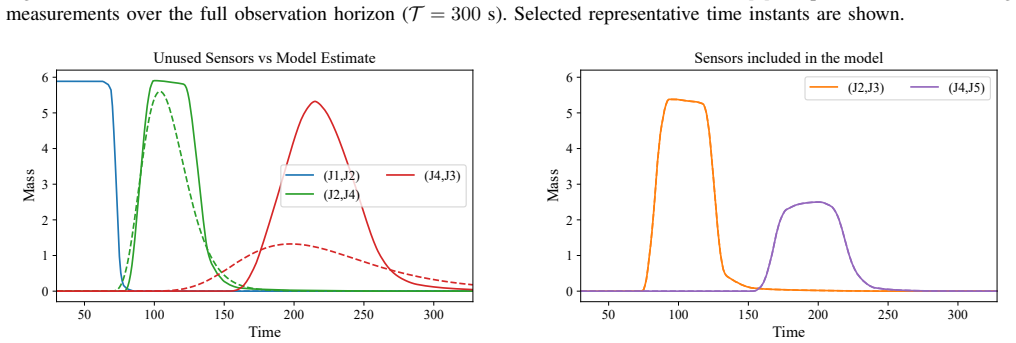
Apply the algorithm to the laboratory water network with a known injected contaminant at a chosen node and check whether the reconstructed concentrations at unmonitored nodes match the laboratory measurements within experimental error.
Figures



read the original abstract
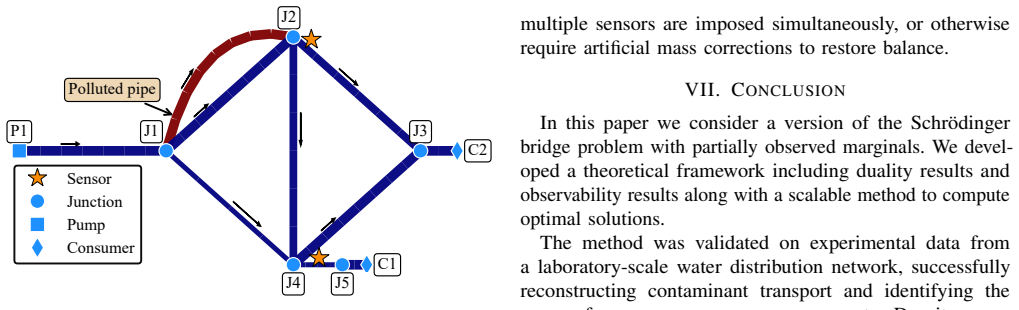
In this work, we study a discrete Schr\"odinger bridge problem with partial marginal observations. A main difficulty compared to the classical Schr\"odinger bridge formulation is that our problem is not strictly convex and standard Sinkhorn-type methods cannot be directly applied. To address this issue, we propose a scalable computational method based on an entropic proximal scheme. Furthermore, we develop a framework for this problem that includes duality results, characterization of the optimal solutions, and an observability condition that determines when the optimal solution is unique. We validate the method on the problem of estimating contamination in a water distribution network, where the partial marginals correspond to measured pollutant concentrations at the sensor locations. The experiments were conducted on a laboratory-scale water distribution network.
Editorial analysis
A structured set of objections, weighed in public.
Referee Report
Summary. The paper studies the discrete Schrödinger bridge problem with partial marginal observations, which lacks strict convexity and thus precludes direct application of Sinkhorn-type algorithms. It introduces an entropic proximal scheme as a scalable solver, develops duality results together with a characterization of optimal solutions, and states an observability condition that guarantees uniqueness. The approach is validated on contamination tracking in a laboratory-scale water distribution network, where partial marginals are supplied by sensor measurements of pollutant concentrations.
Significance. If the duality framework and convergence properties are established, the work supplies a theoretically grounded method for a practically relevant class of optimal-transport problems with incomplete data. The observability condition and the water-network application illustrate how the theory translates to network estimation tasks; the laboratory experiments provide concrete empirical support for the computational scheme.
major comments (2)
- [§3] §3 (entropic proximal scheme) and the convergence statement following the duality results: because the problem is explicitly not strictly convex, the proof that the proximal iterates converge to a minimizer (and, when the observability condition holds, to the unique minimizer) must be supplied in full. The current sketch does not address the case of multiple optima or the interaction between the proximal parameter and the observability matrix; without this, the claim that the scheme “recovers the optimal solution” remains unsubstantiated.
- [§4] Theorem on uniqueness via the observability condition (likely §4): the condition is stated to determine uniqueness, yet it is not shown that the proximal scheme is guaranteed to select the unique solution when the condition holds, nor that it remains stable when the condition fails. This link is load-bearing for both the theoretical framework and the water-network experiments.
minor comments (2)
- [Notation and §2] Notation for the partial marginals and the observability matrix should be introduced once and used consistently; several symbols appear to be redefined between the duality section and the algorithm description.
- [Experiments] The experimental section would benefit from a table reporting iteration counts, proximal-parameter sensitivity, and a direct comparison against a baseline (e.g., projected gradient or ADMM) on the same network instances.
Simulated Author's Rebuttal
We thank the referee for the thorough review and constructive major comments. We agree that the convergence analysis and its connection to uniqueness require fuller treatment and will revise the manuscript accordingly.
read point-by-point responses
-
Referee: [§3] §3 (entropic proximal scheme) and the convergence statement following the duality results: because the problem is explicitly not strictly convex, the proof that the proximal iterates converge to a minimizer (and, when the observability condition holds, to the unique minimizer) must be supplied in full. The current sketch does not address the case of multiple optima or the interaction between the proximal parameter and the observability matrix; without this, the claim that the scheme “recovers the optimal solution” remains unsubstantiated.
Authors: We agree that a complete proof is needed. The manuscript currently contains only a sketch relying on standard proximal-point convergence results for convex problems. In the revision we will supply the full argument in an expanded §3 (or dedicated appendix). The proof will show that the iterates converge to a minimizer of the original problem for any positive proximal parameter, explicitly handling the non-strictly-convex case by working with the subdifferential and the duality framework already developed. When the observability condition holds, uniqueness of the limit follows directly from the characterization of optimal solutions; we will add the corresponding corollary. The role of the proximal parameter will be clarified: convergence holds independently of its specific positive value, while its magnitude affects only the speed and numerical conditioning. revision: yes
-
Referee: [§4] Theorem on uniqueness via the observability condition (likely §4): the condition is stated to determine uniqueness, yet it is not shown that the proximal scheme is guaranteed to select the unique solution when the condition holds, nor that it remains stable when the condition fails. This link is load-bearing for both the theoretical framework and the water-network experiments.
Authors: We acknowledge that the algorithmic implication of the uniqueness theorem must be stated explicitly. In the revised manuscript we will insert a corollary in §4 establishing that, whenever the observability condition is satisfied, every limit point of the proximal sequence is the unique optimal solution. When the condition fails we will prove that the sequence still converges to some minimizer (not necessarily unique) and add a short stability discussion. For the water-network application we will include additional numerical diagnostics (e.g., variation of recovered contamination maps over different proximal-parameter choices and sensor configurations) to illustrate practical robustness even in the non-unique regime. revision: yes
Circularity Check
No circularity: derivation is self-contained via new proximal scheme and internal duality/observability results
full rationale
The paper introduces an entropic proximal scheme to handle the non-strictly-convex discrete Schrödinger bridge problem with partial observations, then derives duality results, optimal-solution characterizations, and an observability condition for uniqueness entirely within the present framework. No load-bearing step reduces to a fitted input renamed as prediction, a self-citation chain, or an ansatz smuggled from prior author work; the water-network experiments serve only as validation and do not substitute for or circularly define the mathematical claims. The derivation therefore stands on its own stated assumptions and constructions without reducing to its inputs by definition.
Axiom & Free-Parameter Ledger
axioms (2)
- domain assumption Entropic regularization yields a well-behaved proximal mapping even when the original problem is not strictly convex
- domain assumption The observability condition on sensor locations determines uniqueness of the optimal solution
Lean theorems connected to this paper
-
IndisputableMonolith/Cost/FunctionalEquation.leanwashburn_uniqueness_aczel unclear?
unclearRelation between the paper passage and the cited Recognition theorem.
we propose a scalable computational method based on an entropic proximal scheme... duality results, characterization of the optimal solutions, and an observability condition
-
IndisputableMonolith/Foundation/AlphaCoordinateFixation.leanJ_uniquely_calibrated_via_higher_derivative unclear?
unclearRelation between the paper passage and the cited Recognition theorem.
the entropic proximal-point algorithm (16), applied to f, converges to a minimizer of f
What do these tags mean?
- matches
- The paper's claim is directly supported by a theorem in the formal canon.
- supports
- The theorem supports part of the paper's argument, but the paper may add assumptions or extra steps.
- extends
- The paper goes beyond the formal theorem; the theorem is a base layer rather than the whole result.
- uses
- The paper appears to rely on the theorem as machinery.
- contradicts
- The paper's claim conflicts with a theorem or certificate in the canon.
- unclear
- Pith found a possible connection, but the passage is too broad, indirect, or ambiguous to say the theorem truly supports the claim.
Reference graph
Works this paper leans on
- [1]
-
[2]
D. P. Bertsekas.Nonlinear programming. Athena Scientific, 1999
work page 1999
-
[3]
P. Bjelkmar, A. Hansen, C. Sch ¨onning, J. Bergstr ¨om, M. L ¨ofdahl, M. Lebbad, A. Wallensten, S. S. G ¨orel Allestam, and J. Lindh. Early outbreak detection by linking health advice line calls to water distribution areas retrospectively demonstrated in a large waterborne outbreak of cryptosporidiosis in sweden.BMC Public Health, 17(328), 2017
work page 2017
-
[4]
S. Boyd and L. Vandenberghe.Convex optimization. Cambridge university press, 2004
work page 2004
-
[5]
B. M. Brentan, G. L. Meirelles, D. Manzi, and E. Luvizotto. Water demand time series generation for distribution network modeling and water demand forecasting.Urban Water Journal, 15(2):150–158, 2018
work page 2018
-
[6]
Y . Chen, T. T. Georgiou, and M. Pavon. On the relation between optimal transport and Schr ¨odinger bridges: A stochastic control viewpoint. Journal of Optimization Theory and Applications, 169(2):671–691, 2016
work page 2016
-
[7]
Y . Chen, T. T. Georgiou, and M. Pavon. Stochastic control liaisons: Richard Sinkhorn meets Gaspard Monge on a Schr ¨odinger bridge.Siam Review, 63(2):249–313, 2021
work page 2021
-
[8]
Y . Chen, T. T. Georgiou, and M. Pavon. Optimal survival strategies for diffusive flows: A Schr¨odinger bridge approach to unbalanced transport. SIAM Review, 67(3):579–604, 2025
work page 2025
-
[9]
D. M. Costa, L. F. Melo, and F. G. Martins. Localization of contamination sources in drinking water distribution systems: A method based on successive positive readings of sensors.Water Resources Management, 27(2), 2013
work page 2013
-
[10]
M. Cuturi. Sinkhorn distances: Lightspeed computation of optimal transport.Advances in neural information processing systems, 26:2292– 2300, 2013
work page 2013
-
[11]
D. Eliades, T. Lambrou, C. Panayiotou, and M. Polycarpou. Contamina- tion event detection in water distribution systems using a model-based approach.Procedia Engineering, 89:1089–1096, 2014. 16th Water Distribution System Analysis Conference, WDSA2014
work page 2014
-
[12]
D. G. Eliades, S. G. Vrachimis, A. Moghaddam, I. Tzortzis, and M. M. Polycarpou. Contamination event diagnosis in drinking water networks: A review.Annual Reviews in Control, 55:420–441, 2023
work page 2023
-
[13]
C. M. Fontanazza, V . Notaro, V . Puleo, P. Nicolosi, and G. Freni. Contaminant intrusion through leaks in water distribution system: experimental analysis.Procedia engineering, 119:426–433, 2015
work page 2015
-
[14]
J. Guan, M. M. Aral, M. L. Maslia, and W. M. Grayman. Identification of contaminant sources in water distributionsystems using simula- tion–optimization method: Case study.Journal of Water Resources Planning and Management, 132(4), 2006
work page 2006
-
[15]
I. Haasler, A. Ringh, Y . Chen, and J. Karlsson. Estimating ensemble flows on a hidden Markov chain. In2019 IEEE 58th Conference on Decision and Control (CDC), pages 1331–1338. IEEE, 2019
work page 2019
-
[16]
I. Haasler, A. Ringh, Y . Chen, and J. Karlsson. Multimarginal optimal transport with a tree-structured cost and the Schr¨odinger bridge problem. SIAM Journal on Control and Optimization, 59(4):2428–2453, 2021
work page 2021
-
[17]
I. Haasler, R. Singh, Q. Zhang, J. Karlsson, and Y . Chen. Multi- marginal optimal transport and probabilistic graphical models.IEEE Transactions on Information Theory, 2021
work page 2021
-
[18]
J. J. Huang and E. A. McBean. Data mining to identify contaminant event locations in water distribution systems.Journal of Water Resources Planning and Management, 135(6), 2009
work page 2009
- [19]
-
[20]
C. D. Laird, L. T. Biegler, B. G. van Bloemen Waanders, and R. A. Bartlett. Identification of contaminant sources in water distributionsys- tems using simulation–optimization method: Case study.Journal of Water Resources Planning and Management, 131(2), 2005
work page 2005
- [21]
-
[22]
M. Mascherpa, I. Haasler, B. Ahlgren, and J. Karlsson. Estimating pollution spread in water networks as a Schr ¨odinger bridge problem with partial information.European Journal of Control, 2023
work page 2023
-
[23]
M. Mascherpa, A. Ringh, A. Taghvaei, and J. Karlsson. A convex approach for markov chain estimation from aggregate data via inverse optimal transport.arXiv preprint arXiv:2511.16458, 2025
-
[24]
M. Opper. Variational inference for stochastic differential equations. Annalen der Physik, 531(3):1800233, 2019
work page 2019
- [25]
-
[26]
M. Pavon and F. Ticozzi. Discrete-time classical and quantum Markovian evolutions: Maximum entropy problems on path space. Journal of Mathematical Physics, 51(4):042104, 2010
work page 2010
- [27]
-
[28]
G. Peyr ´e, M. Cuturi, et al. Computational optimal transport: With applications to data science.Foundations and Trends® in Machine Learning, 11(5-6):355–607, 2019
work page 2019
-
[29]
S. B. Pope. Turbulent flows.Measurement Science and Technology, 12(11):2020–2021, 2001
work page 2020
-
[30]
A. Preis and A. Ostfeld. Contamination source identification in water systems: A hybrid model trees–linear programming scheme.Journal of Water Resources, Planning and Management, 132(4), 2006
work page 2006
-
[31]
A. Rasekh and K. Brumbelow. Drinking water distribution systems contamination management to reduce public health impacts and system service interruptions.Environmental Modelling & Software, 51, 2014
work page 2014
-
[32]
S. S. Rathore, S. G. Vrachimis, D. G. Eliades, M. M. Polycarpou, C. S. Kallesøe, and R. Wisniewski. Consumer demand control for contamination impact mitigation in water distribution networks.Journal of Water Resources Planning and Management, 151(12), 2025
work page 2025
-
[33]
D. V . Renwick, A. Heinrich, R. Weisman, H. Arvanaghi, and K. Rotert. Potential public health impacts of deteriorating distribution system infrastructure.Journal-American Water Works Association, 111(2):42, 2019
work page 2019
-
[34]
R. T. Rockafellar.Convex Analysis. Princeton University Press, 1970
work page 1970
-
[35]
R. T. Rockafellar and R. J.-B. Wets.Variational analysis, volume 317. Springer Science & Business Media, 2009
work page 2009
-
[36]
L. A. Rossman et al. Epanet 2: users manual. 2000
work page 2000
-
[37]
T. Rutkowski and F. Prokopiuk. Identification of the contamination source location in the drinking water distribution system based on the neural network classifier.IFAC-PapersOnLine, 51(24), 2018
work page 2018
-
[38]
J. Schijven, J. M. For ˆet, J. Chardon, P. Teunis, M. Bouwknegt, and B. Tangena. valuation of exposure scenarios on intentional microbiological contamination in a drinking water distribution network. Water Research, 96, 2016
work page 2016
-
[39]
E. Schr ¨odinger. ¨Uber die umkehrung der naturgesetze. Verlag der Akademie der Wissenschaften in Kommission bei Walter De Gruyter u. Company, 1931
work page 1931
-
[40]
E. Schr ¨odinger. Sur la th ´eorie relativiste de l’´electron et l’interpr´etation de la m ´ecanique quantique. InAnnales de l’institut Henri Poincar ´e, volume 2, pages 269–310, 1932
work page 1932
-
[41]
M. E. Shafiee and E. Z. Berglund. Complex adaptive systems framework to simulate theperformance of hydrant flushing rules and broadcastsduring a water distribution system contamination event. Journal of Water Resources Planning and Management, 143(4), 2017
work page 2017
- [42]
- [43]
- [44]
-
[45]
USEPA. United states environmental protection agency; a water security handbook: Planning for and responding to drinking water contamination threats and incidents, 2006
work page 2006
-
[46]
J. Val Ledesma, R. Wisniewski, and C. S. Kallesøe. Smart water infrastructures laboratory: Reconfigurable test-beds for research in water infrastructures management.Water, 13(13):1875, 2021
work page 2021
-
[47]
L. Weiss. Controllability, realization and stability of discrete-time systems.SIAM Journal on Control, 10(2):230–251, 1972
work page 1972
discussion (0)
Sign in with ORCID, Apple, or X to comment. Anyone can read and Pith papers without signing in.