Necessary and sufficient conditions for the N-representability of functionals of the one-electron reduced density matrix
Pith reviewed 2026-05-10 19:04 UTC · model grok-4.3
The pith
Necessary and sufficient conditions ensure that functionals of the one-electron reduced density matrix produce variational upper bounds on the true energy.
A machine-rendered reading of the paper's core claim, the machinery that carries it, and where it could break.
Core claim
The central claim is that necessary and sufficient conditions for the N-representability of the universal one-electron reduced density matrix functional have been established. Any functional obeying these conditions yields variational upper bounds on the true energy in one-electron reduced density matrix functional theory for arbitrary interaction strengths. Conversely, any functional that violates the conditions necessarily underestimates the true energy for certain systems. The conditions therefore impose a strict filter on density-matrix approximations and can direct the construction of new functionals and algorithms.
What carries the argument
The necessary and sufficient N-representability conditions on the universal one-electron reduced density matrix functional, which enforce that the functional corresponds to some valid N-electron ensemble.
Load-bearing premise
The derivation assumes a well-defined universal functional exists and that its N-representability conditions can be stated independently of any particular system.
What would settle it
Exhibit either a functional that satisfies the stated conditions yet produces an energy below the true ground-state energy for some N-representable one-electron reduced density matrix, or a functional that violates the conditions yet never underestimates the energy.
Figures
read the original abstract
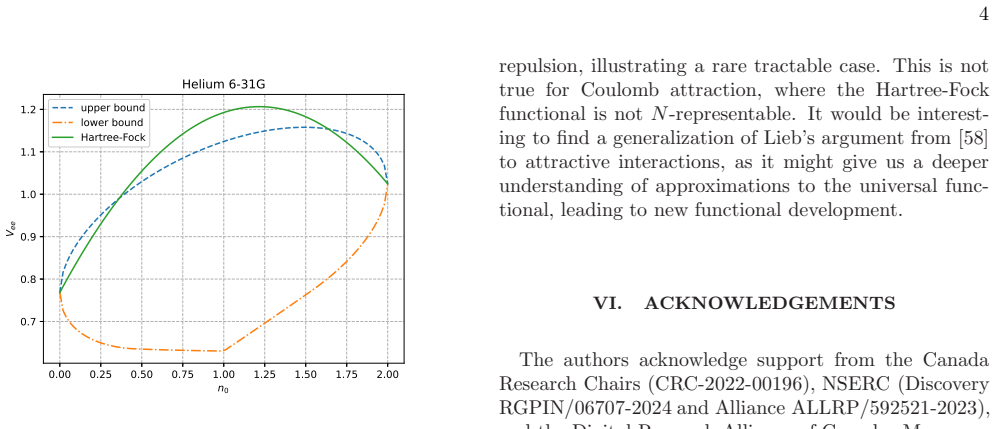
We establish necessary and sufficient conditions for the N-representability of the universal one-electron reduced density matrix functional. Functionals satisfying these conditions are guaranteed to yield variational upper bounds on the true energy in one-electron reduced density matrix functional theory, regardless of the strength of the interparticle repulsion. Conversely, any functional violating these conditions will necessarily underestimate the true energy for certain systems. These exact constraints impose a stringent restriction on density matrix functional approximations, as many existing functionals-including the Hartree-Fock functional-appear to violate them. This mathematical formalism, therefore, can guide the development of new approximate functionals and numerical algorithms.
Editorial analysis
A structured set of objections, weighed in public.
Referee Report
Summary. The manuscript derives necessary and sufficient conditions for the N-representability of the universal functional F[γ] of the one-electron reduced density matrix (1-RDM). Functionals obeying these conditions are claimed to produce variational upper bounds to the exact ground-state energy in 1-RDM functional theory for arbitrary interaction strength; conversely, any violation is asserted to produce an underestimation for certain physical systems. The authors apply the conditions to common approximations, including Hartree-Fock, and conclude that the constraints impose a stringent restriction on future functional development.
Significance. If the stated conditions are rigorously necessary and sufficient, the result supplies an exact, interaction-independent constraint on 1-RDM functionals. This would be a foundational contribution to 1-RDMFT, directly limiting the space of admissible approximations and guaranteeing variational behavior without reference to the strength of the repulsion. The explicit demonstration that Hartree-Fock violates the conditions is a concrete illustration of the practical utility of the criterion.
major comments (2)
- [main theorem / necessity statement (abstract and §3)] The necessity direction (any violation implies underestimation for certain systems) is load-bearing for the central claim yet rests on the surjectivity of the ground-state map onto the set of ensemble N-representable 1-RDMs. In continuous space the set of v-representable 1-RDMs is a proper subset; the manuscript must therefore either restrict the necessity statement to v-representable γ or explicitly verify that the violating γ chosen for the Hartree-Fock (and other) counter-examples are ground-state 1-RDMs for some external potential. This point is not addressed in the abstract and appears unexamined in the derivation of the necessity theorem.
- [§2–3, sufficiency proof] Sufficiency is stated to follow once the conditions enforce F[γ] ≥ F_true[γ] for every ensemble N-representable γ. The manuscript should supply the explicit inequality chain that converts this pointwise bound into the variational upper bound min_γ Tr((h+V)γ) + F[γ] ≥ E_true for arbitrary V, including the case of infinite repulsion. The current presentation leaves the precise operator-domain assumptions (Hilbert space, self-adjointness of the two-body operator) implicit.
minor comments (2)
- [Introduction] The notation distinguishing the universal functional F[γ] from approximate functionals F_approx[γ] is introduced late; an early, explicit definition in the introduction would improve readability.
- [Introduction / §1] Several standard references on ensemble N-representability of the 1-RDM (e.g., the convex-set characterization and the relation to v-representability) are omitted; adding them would place the new conditions in clearer context.
Simulated Author's Rebuttal
We thank the referee for the careful reading and the two major comments, which have prompted us to strengthen the statements on necessity and to make the sufficiency argument fully explicit. We address each point below and have revised the manuscript accordingly.
read point-by-point responses
-
Referee: [main theorem / necessity statement (abstract and §3)] The necessity direction (any violation implies underestimation for certain systems) is load-bearing for the central claim yet rests on the surjectivity of the ground-state map onto the set of ensemble N-representable 1-RDMs. In continuous space the set of v-representable 1-RDMs is a proper subset; the manuscript must therefore either restrict the necessity statement to v-representable γ or explicitly verify that the violating γ chosen for the Hartree-Fock (and other) counter-examples are ground-state 1-RDMs for some external potential. This point is not addressed in the abstract and appears unexamined in the derivation of the necessity theorem.
Authors: We agree that the necessity claim requires qualification in continuous space. In the revised manuscript we have restricted the necessity statement to v-representable 1-RDMs. We have also added an explicit verification that the specific violating 1-RDMs employed in the Hartree-Fock (and other) counter-examples are ground-state 1-RDMs for suitably chosen external potentials; concrete one-body operators V are constructed for which these γ minimize the exact energy functional. The abstract has been updated to reflect the restricted scope. revision: yes
-
Referee: [§2–3, sufficiency proof] Sufficiency is stated to follow once the conditions enforce F[γ] ≥ F_true[γ] for every ensemble N-representable γ. The manuscript should supply the explicit inequality chain that converts this pointwise bound into the variational upper bound min_γ Tr((h+V)γ) + F[γ] ≥ E_true for arbitrary V, including the case of infinite repulsion. The current presentation leaves the precise operator-domain assumptions (Hilbert space, self-adjointness of the two-body operator) implicit.
Authors: We thank the referee for this request. The revised manuscript now contains the explicit chain: if F[γ] ≥ F_true[γ] for every ensemble N-representable γ, then for any external potential V (including arbitrarily strong repulsion) one has min_γ [Tr((h+V)γ) + F[γ]] ≥ min_γ [Tr((h+V)γ) + F_true[γ]] = E_true, where the minimum runs over the set of ensemble N-representable 1-RDMs. We have also stated the operator-domain assumptions explicitly: the N-particle Hamiltonian is self-adjoint and bounded from below on the Sobolev space H^1(ℝ^{3N}), guaranteeing existence of the ground state. These additions appear in the sufficiency proof. revision: yes
Circularity Check
No circularity: conditions derived as external constraints on the universal functional
full rationale
The paper claims to derive necessary and sufficient N-representability conditions for the universal 1-RDM functional F[γ] such that any functional obeying them yields variational upper bounds and any violation produces underestimation for some systems. No step reduces to a self-definition, a fitted parameter renamed as prediction, or a load-bearing self-citation; the abstract and described formalism treat the conditions as independent mathematical constraints on admissible F rather than tautological restatements of the input functional or of prior results by the same authors. The derivation is therefore self-contained against external benchmarks of N-representability.
Axiom & Free-Parameter Ledger
axioms (1)
- domain assumption Existence of N-electron wavefunctions and corresponding reduced density matrices in a Hilbert space setting.
Lean theorems connected to this paper
-
IndisputableMonolith/Cost/FunctionalEquation.leanwashburn_uniqueness_aczel unclear?
unclearRelation between the paper passage and the cited Recognition theorem.
A 1DM functional, (Vee, γ), is ensemble-N-representable if and only if, for all one-electron operators h, and interaction strengths, λ ∈ (−∞, ∞), Tr[hγ] + λ Vee[γ] ≥ E_λ_g.s. [N, h]
-
IndisputableMonolith/Foundation/AbsoluteFloorClosure.leanabsolute_floor_iff_bare_distinguishability unclear?
unclearRelation between the paper passage and the cited Recognition theorem.
FN is closed and convex since it is defined by a linear map from the (closed and convex) set of N-electron density matrices, Γ.
What do these tags mean?
- matches
- The paper's claim is directly supported by a theorem in the formal canon.
- supports
- The theorem supports part of the paper's argument, but the paper may add assumptions or extra steps.
- extends
- The paper goes beyond the formal theorem; the theorem is a base layer rather than the whole result.
- uses
- The paper appears to rely on the theorem as machinery.
- contradicts
- The paper's claim conflicts with a theorem or certificate in the canon.
- unclear
- Pith found a possible connection, but the passage is too broad, indirect, or ambiguous to say the theorem truly supports the claim.
Reference graph
Works this paper leans on
-
[1]
I.e., FN = { (W, η ) ⏐ ⏐ ⏐ ∃ {pi, Ψ i}N i=1 : η = γ [ {pi, Ψ i} ] , W = Vee [ {pi, Ψ i} ] }
and ( 5), respectively. I.e., FN = { (W, η ) ⏐ ⏐ ⏐ ∃ {pi, Ψ i}N i=1 : η = γ [ {pi, Ψ i} ] , W = Vee [ {pi, Ψ i} ] } . (8) FN is closed and convex since it is defined by a linear map from the (closed and convex) set of N -electron density matrices, Γ. III. THEOREMS Theorem 1. A 1DM functional, (Vee, γ ), is ensemble-N- representable if and only if, for all ...
-
[2]
To show sufficiency of the condition, choose a trial ( ˜Vee, ˜γ) ∈ V that is not N -representable
is necessary for ( Vee, γ ) ∈ F N . To show sufficiency of the condition, choose a trial ( ˜Vee, ˜γ) ∈ V that is not N -representable. Since the FN is a convex subset of a Hilbert space, the hyperplane sep- aration theorem guarantees that there exists an element of the dual space, represented by ( λ, g ), that separates the convex set FN from the chosen poi...
-
[3]
The N - electron ground-state energy, Eg.s
for a given 1-body potential ˜h and interaction strength λ. The N - electron ground-state energy, Eg.s. [h; N ], can be obtained by the bivariational principle: Eλ g.s. [h; N ] = max ˜h∈B HS (H) min (Vee,γ )∈H λ [N, ˜h] (Tr[hγ] + λV ee[γ]) . (16) Proof. For any trial one body Hamiltonian ˜h, Eq. 9 de- fines a necessary criterion for N -representability. By...
-
[4]
is satisfied. The upper bound for Vee[γ] is obtained from the lower-bound for an attractive Coulomb interac- tion, V u.b. ee [γ] = max { x | (x,γ )∈F N } x = − min {pi, Ψ i}→ γ ∑ i pi⟨Ψ i| − Vee|Ψ i⟩, (19) In our numerical work we do not implement the constrained-search functionals [7] 18 and 19 directly, but instead use the equivalent Legendre-transform (...
work page 2022
-
[5]
Piris, in Novel Treatments of Strong Correlations , Advances in Quantum Chemistry, Vol
M. Piris, in Novel Treatments of Strong Correlations , Advances in Quantum Chemistry, Vol. 90, edited by R. A. M. Quintana and J. F. Stanton (Academic Press,
- [6]
- [7]
-
[8]
P. G. Mezey and J. Cioslowski, eds., Many-Electron Den- sities and Reduced Density Matrices , Mathematical and Computational Chemistry (Springer, New York, 2000)
work page 2000
-
[9]
T. L. Gilbert, Phys. Rev. B 12, 2111 (1975)
work page 1975
-
[10]
M. Levy, Proc. Natl. Acad. Sci. 76, 6062 (1979) , https://www.pnas.org/doi/pdf/10.1073/pnas.76.12.6062
-
[11]
S. M. Valone, J. Chem. Phys. 73, 1344 (1980)
work page 1980
-
[12]
P. W. Ayers and M. Levy, Journal of Chemical Sciences 117, 507 (2005)
work page 2005
-
[13]
P. W. Ayers, S. Golden, and M. Levy, J. Chem. Phys. 124, 054101 (2006)
work page 2006
-
[14]
D. Feliciangeli, A. Gerolin, and L. Portinale, J. Funct. Anal. 285, 109963 (2023)
work page 2023
-
[15]
E. H. Lieb, Int. J. Quantum Chem. 24, 243 (1983)
work page 1983
-
[16]
A. J. Cohen, P. Mori-S´ anchez, and W. Yang, Science 321, 792 (2008) , https://www.science.org/doi/pdf/10.1126/science.1158722
- [17]
- [18]
- [19]
-
[20]
A. M. Teale, S. Coriani, and T. Helgaker, Journal of Chemical Physics 132, 164115 (2010)
work page 2010
-
[21]
A. M. Teale, S. Coriani, and T. Helgaker, Journal of Chemical Physics 130, 104111 (2009)
work page 2009
- [22]
- [23]
-
[24]
A. M. Teale and T. Helgaker, in The Physics and Math- ematics of Elliott Lieb , Vol. 1 (EMS Press, 2022) pp. 527–559
work page 2022
-
[25]
Reduced density matrix functional theory and a reduced formulation of density functional theory,
H. R. Fredheim and S. Kvaal, “Reduced density matrix functional theory and a reduced formulation of density functional theory,” (2025), arXiv:2510.12242
-
[26]
J. P. Perdew, V. N. Staroverov, J. Tao, and G. E. Scuse- ria, Phys. Rev. A 78, 052513 (2008)
work page 2008
-
[27]
J. P. Perdew, K. Burke, and M. Ernzerhof, Phys. Rev. Lett. 77, 3865 (1996)
work page 1996
-
[28]
A. D. Becke, J. Chem. Phys. 98, 5648 (1993)
work page 1993
-
[29]
J. Sun, A. Ruzsinszky, and J. P. Perdew, Phys. Rev. Lett. 115, 036402 (2015)
work page 2015
- [30]
- [31]
-
[32]
J. P. Perdew, A. Ruzsinszky, J. Tao, V. N. Staroverov, G. E. Scuseria, and G. I. Csonka, J. Chem. Phys. 123, 062201 (2005)
work page 2005
-
[33]
A. M. Teale, T. Helgaker, A. Savin, C. Adamo, B. Aradi, A. V. Arbuznikov, P. W. Ayers, E. J. Baerends, V. Barone, P. Calaminici, E. Canc` es, E. A. Carter, P. K. Chattaraj, H. Chermette, I. Ciofini, T. D. Craw- ford, F. De Proft, J. F. Dobson, C. Draxl, T. Frauen- heim, E. Fromager, P. Fuentealba, L. Gagliardi, G. Galli, J. Gao, P. Geerlings, N. Gidopoulos...
work page 2022
- [34]
-
[35]
M¨ uller,Physics Letters A 105, 446 (1984)
A. M¨ uller,Physics Letters A 105, 446 (1984)
work page 1984
- [36]
-
[37]
O. Gritsenko, K. Pernal, and E. Baerends, J. Chem. Phys. 122, 204102 (2005)
work page 2005
- [39]
- [40]
- [41]
- [42]
-
[43]
A. J. Coleman, Rev. Mod. Phys. 35, 668 (1963)
work page 1963
-
[44]
P. Mori-Sanchez, A. J. Cohen, and W. T. Yang, Journal of Chemical Physics 125, 201102 (2006)
work page 2006
-
[45]
E. V. Ludena, F. J. Torres, and C. Costa, J. Mod. Phys. 4, 29318 (2013)
work page 2013
-
[46]
E. V. Ludena, F. Illas, and A. Ramirez-Solis, Condens. Matter Theor., Vol 23 , 354 (2009)
work page 2009
-
[47]
E. S. Kryachko and E. V. Ludena, Physical Review A 43, 2179 (1991)
work page 1991
-
[48]
E. V. Ludena, Journal of Molecular Structure-Theochem 709, 25 (2004)
work page 2004
-
[49]
P. W. Ayers and S. Liu, Phys. Rev. A 75, 022514 (2007)
work page 2007
-
[50]
R. Cuevas-Saavedra, D. Chakraborty, S. Rabi, C. Cardenas, and P. W. Ayers, J. Chem. Theory Comput. 8, 4081 (2012)
work page 2012
-
[51]
R. A. Donnelly, J. Chem. Phys. 71, 2874 (1979)
work page 1979
-
[52]
J. M. Herbert and J. E. Harriman, J. Chem. Phys. 118, 10835 (2003)
work page 2003
-
[53]
J. Cioslowski and K. Pernal, Journal of Chemical Physics 117, 67 (2002)
work page 2002
- [54]
-
[55]
M. Rodr ´ ıguez-Mayorga, E. Ramos-Cordoba, M. Via-Nadal, M. Piris, and E. Matito, Phys. Chem. Chem. Phys. 19, 24029 (2017)
work page 2017
- [56]
-
[57]
R. Gebauer, M. H. Cohen, and R. Car, Proceedings of the National Academy of Sciences of the Unite d States
-
[58]
P. W. Ayers and P. Fuentealba, Physical Review A 80, 032510 (2009)
work page 2009
-
[59]
D. Gibney, J.-N. Boyn, and D. A. Mazziotti, Phys. Rev. Lett. 131, 243003 (2023)
work page 2023
-
[60]
B. Senjean, S. Yalouz, N. Nakatani, and E. Fromager, Physical Review A 106, 032203 (2022)
work page 2022
-
[61]
Larsen, Functional Analysis: An Introduction , Pure Appl
R. Larsen, Functional Analysis: An Introduction , Pure Appl. Math. Ser. (Marcel Dekker, Incorporated, 1973)
work page 1973
-
[62]
E. H. Lieb, Phys. Rev. Lett. 46, 457 (1981)
work page 1981
-
[63]
Data to support figure 1. version 1.0,
J. Erhad and P. Ayers, “Data to support figure 1. version 1.0,” (2025), https://github.com/theochem/research- data
work page 2025
- [64]
discussion (0)
Sign in with ORCID, Apple, or X to comment. Anyone can read and Pith papers without signing in.