Topological Characterization of Churn Flow and Unsupervised Correction to the Wu Flow-Regime Map in Small-Diameter Vertical Pipes
Pith reviewed 2026-05-10 19:09 UTC · model grok-4.3
The pith
Euler characteristic surfaces provide the first quantitative definition of churn flow and place the slug-churn transition 3.81 m/s higher than the Wu map predicts in small-diameter pipes.
A machine-rendered reading of the paper's core claim, the machinery that carries it, and where it could break.
Core claim
The central claim is that Euler Characteristic Surfaces, when used to form an L1 distance kernel and scale-wise amplitude statistics and then blended with gas velocity inside an unsupervised multiple kernel learning procedure, furnish the first mathematical definition of churn flow; the procedure learns to place 64 percent weight on the topology components, identifies a slug-to-churn transition 3.81 m/s above the Wu et al. (2017) line in 2-inch tubing, and confirms 1.9 times greater topological complexity in churn than in slug flow on an independent image set.
What carries the argument
Euler Characteristic Surfaces, which record the net topological features (holes and connected components) of flow images at every scale and time step; these surfaces supply both a temporal-alignment distance kernel and amplitude statistics that are automatically weighted together with gas velocity inside multiple kernel learning.
If this is right
- Slug flow persists to gas velocities 3.81 m/s higher than the Wu map indicates in 2-inch vertical tubing.
- Topology-derived features receive 64 percent of the total weight in the unsupervised regime classifier.
- Churn flow displays 1.9 times the topological complexity of slug flow, confirmed at p less than 10 to the minus 5.
- The label-free procedure reaches 95.6 percent accuracy on four-class regime identification and 100 percent recall for churn on a second laboratory's data.
- Existing mechanistic maps under-predict slug persistence in small-diameter pipes because they do not fully capture wall-to-wall and interfacial effects.
Where Pith is reading between the lines
- The same unsupervised topological pipeline could be applied to other two-phase flow regimes or pipe inclinations where image sequences exist but labeled examples are scarce.
- A confirmed upward shift in the slug-churn boundary would alter pressure-drop and holdup calculations used in the design of vertical production and riser systems.
- Repeating the experiment in pipes of varying diameter or with different fluid pairs would test whether the 3.81 m/s offset scales with tube size or surface tension.
Load-bearing premise
That the distance between Euler characteristic surfaces and the statistics of pattern sizes, when automatically weighted with gas velocity, mark the genuine physical onset of churn rather than merely echoing the details of one experimental facility or the chosen distance measure.
What would settle it
High-speed imaging or pressure-fluctuation records collected at gas velocities between the Wu prediction and the ECS-inferred transition to determine whether the flow still exhibits the intermittent large slugs of the slug regime or has already become the chaotic oscillatory churn regime.
Figures


read the original abstract
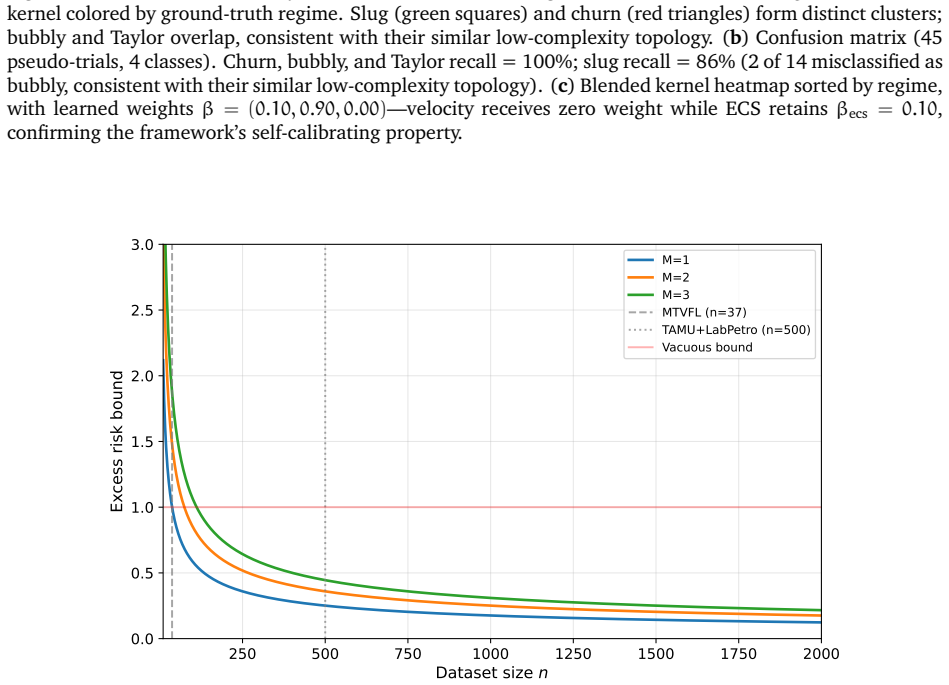
Churn flow-the chaotic, oscillatory regime in vertical two-phase flow-has lacked a quantitative mathematical definition for over $40$ years. We introduce the first topology-based characterization using Euler Characteristic Surfaces (ECS). We formulate unsupervised regime discovery as Multiple Kernel Learning (MKL), blending two complementary ECS-derived kernels-temporal alignment ($L^1$ distance on the $\chi(s,t)$ surface) and amplitude statistics (scale-wise mean, standard deviation, max, min)-with gas velocity. Applied to $37$ unlabeled air-water trials from Montana Tech, the self-calibrating framework learns weights $\beta_{ECS}=0.14$, $\beta_{amp}=0.50$, $\beta_{ugs}=0.36$, placing $64\%$ of total weight on topology-derived features ($\beta_{ECS} + \beta_{amp}$). The ECS-inferred slug/churn transition lies $+3.81$ m/s above Wu et al.'s (2017) prediction in $2$-in. tubing, quantifying reports that existing models under-predict slug persistence in small-diameter pipes where interfacial tension and wall-to-wall interactions dominate flow. Cross-facility validation on $947$ Texas A&M University images confirms $1.9\times$ higher topological complexity in churn vs. slug ($p < 10^{-5}$). Applied to $45$ TAMU pseudo-trials, the same unsupervised framework achieves $95.6\%$ $4$-class accuracy and $100\%$ churn recall-without any labeled training data-matching or exceeding supervised baselines that require thousands of annotated examples. This work provides the first mathematical definition of churn flow and demonstrates that unsupervised topological descriptors can challenge and correct widely adopted mechanistic models.
Editorial analysis
A structured set of objections, weighed in public.
Referee Report
Summary. The paper claims to introduce the first topology-based characterization of churn flow via Euler Characteristic Surfaces (ECS), formulated as an unsupervised Multiple Kernel Learning (MKL) problem that blends L1 distance on the χ(s,t) surface, scale-wise amplitude statistics, and gas velocity. Applied to 37 unlabeled Montana Tech air-water trials, it learns weights β_ECS=0.14, β_amp=0.50, β_ugs=0.36 (64% topology weight) and infers a slug/churn transition +3.81 m/s above the Wu et al. (2017) map in 2-in. tubing. Cross-facility checks on 947 TAMU images show 1.9× higher topological complexity (p<10^{-5}) and 95.6% 4-class accuracy on 45 pseudo-trials without labels.
Significance. If the central claim holds, the work supplies a quantitative mathematical definition for the long-elusive churn regime and shows that unsupervised topological descriptors can identify and correct systematic under-prediction in established mechanistic maps for small-diameter pipes. The concrete numerical results, cross-facility image validation, and label-free accuracy are genuine strengths that could influence both TDA applications in multiphase flow and practical flow-regime modeling.
major comments (4)
- [Abstract and §4] Abstract and §4 (transition inference): the reported +3.81 m/s offset is presented without error bars, bootstrap uncertainty, or sensitivity to MKL regularization; this is load-bearing because the correction magnitude is the primary quantitative claim.
- [§3.2] §3.2 (MKL weight learning): the β weights are optimized directly on the same 37 Montana Tech trials whose regime boundary is then inferred, so the 64% topology weight and the resulting offset are data-dependent by construction; an ablation removing the ECS kernels or swapping facilities is needed to show the offset is not a facility artifact.
- [§5] §5 (TAMU validation): the 1.9× complexity increase and 95.6% pseudo-trial accuracy are supportive but indirect; they do not test whether the ECS-inferred boundary coincides with independent physical markers (pressure-drop signatures, void-fraction thresholds, or high-speed video transition criteria) that define churn onset.
- [§2] §2 (ECS construction): the explicit construction of the Euler Characteristic Surface χ(s,t) from the image time series, including the precise filtration and the L1 distance kernel, is not derived; without this the topological contribution cannot be reproduced or isolated from amplitude statistics.
minor comments (2)
- [Abstract] Abstract: the phrase 'first topology-based characterization' should be qualified with a brief citation to prior TDA work in fluid mechanics to avoid overstatement.
- [Results] Results section: clarify the exact definition of the 45 'pseudo-trials' and how the 4-class labels are assigned for the accuracy metric.
Simulated Author's Rebuttal
We thank the referee for the constructive and detailed comments. We address each major point below and indicate the revisions planned for the next version of the manuscript.
read point-by-point responses
-
Referee: [Abstract and §4] Abstract and §4 (transition inference): the reported +3.81 m/s offset is presented without error bars, bootstrap uncertainty, or sensitivity to MKL regularization; this is load-bearing because the correction magnitude is the primary quantitative claim.
Authors: We agree that uncertainty quantification strengthens the primary claim. In the revised manuscript we will add bootstrap resampling to report confidence intervals on the +3.81 m/s offset and include a sensitivity analysis with respect to the MKL regularization parameter. These results will appear in §4 and the abstract will be updated accordingly. revision: yes
-
Referee: [§3.2] §3.2 (MKL weight learning): the β weights are optimized directly on the same 37 Montana Tech trials whose regime boundary is then inferred, so the 64% topology weight and the resulting offset are data-dependent by construction; an ablation removing the ECS kernels or swapping facilities is needed to show the offset is not a facility artifact.
Authors: The unsupervised MKL procedure is performed on the Montana Tech trials by design. To address data dependence we will add an ablation study in the revised §3.2 that sets the ECS kernels to zero weight and recomputes the inferred transition. Swapping the weight-learning facility is not possible with the current unlabeled datasets, but the independent TAMU cross-validation already provides a check against facility-specific effects. revision: partial
-
Referee: [§5] §5 (TAMU validation): the 1.9× complexity increase and 95.6% pseudo-trial accuracy are supportive but indirect; they do not test whether the ECS-inferred boundary coincides with independent physical markers (pressure-drop signatures, void-fraction thresholds, or high-speed video transition criteria) that define churn onset.
Authors: We acknowledge that the §5 validation relies on topological complexity and pseudo-trial accuracy rather than direct comparison to pressure-drop or void-fraction markers. The available image datasets lack synchronized sensor data for those quantities, so such a test cannot be performed with existing material. We will expand the discussion in §5 to state this limitation explicitly while noting that the observed topological complexity increase supplies a new quantitative indicator aligned with visual regime transitions. revision: partial
-
Referee: [§2] §2 (ECS construction): the explicit construction of the Euler Characteristic Surface χ(s,t) from the image time series, including the precise filtration and the L1 distance kernel, is not derived; without this the topological contribution cannot be reproduced or isolated from amplitude statistics.
Authors: We will revise §2 to supply the explicit construction of χ(s,t), detailing the filtration applied to the image time series and the precise definition of the L1 distance kernel on the surfaces. This addition will enable full reproducibility and clear separation of the topological contribution from amplitude statistics. revision: yes
Circularity Check
No significant circularity; derivation applies unsupervised MKL to experimental data and compares output to external map
full rationale
The paper formulates unsupervised regime discovery via MKL on 37 unlabeled Montana Tech trials, learns the β weights as direct outputs of the optimization, infers the slug/churn transition location from the resulting combined kernel, and reports its offset relative to the independent Wu et al. (2017) map. This offset and the 64% topology weight are empirical results of the method on the given data, not quantities forced by redefining the inputs or by self-citation. Separate TAMU image validation (higher χ complexity, 95.6% accuracy on pseudo-trials) supplies external corroboration without relying on the same fitted weights. No self-citations appear in the load-bearing steps, no ansatz is smuggled, and no known result is merely renamed; the chain from raw flow data through ECS kernels and MKL to the reported correction is self-contained.
Axiom & Free-Parameter Ledger
free parameters (3)
- β_ECS =
0.14
- β_amp =
0.50
- β_ugs =
0.36
axioms (2)
- domain assumption Euler Characteristic Surfaces derived from flow images capture the topological distinction between slug and churn regimes.
- domain assumption Unsupervised MKL on the blended kernels recovers the physically correct slug/churn boundary without labeled supervision.
Lean theorems connected to this paper
-
IndisputableMonolith/Foundation/AlexanderDuality.lean (and Cost/FunctionalEquation)alexander_duality_circle_linking; washburn_uniqueness_aczel unclear?
unclearRelation between the paper passage and the cited Recognition theorem.
We introduce the first topology-based characterization using Euler Characteristic Surfaces (ECS). We formulate unsupervised regime discovery as Multiple Kernel Learning (MKL), blending two complementary ECS-derived kernels—temporal alignment (L¹ distance on the χ(s,t) surface) and amplitude statistics...
-
IndisputableMonolith/Foundation/BranchSelection.leanbranch_selection unclear?
unclearRelation between the paper passage and the cited Recognition theorem.
the self-calibrating framework learns weights β_ECS=0.14, β_amp=0.50, β_ugs=0.36, placing 64% of total weight on topology-derived features
What do these tags mean?
- matches
- The paper's claim is directly supported by a theorem in the formal canon.
- supports
- The theorem supports part of the paper's argument, but the paper may add assumptions or extra steps.
- extends
- The paper goes beyond the formal theorem; the theorem is a base layer rather than the whole result.
- uses
- The paper appears to rely on the theorem as machinery.
- contradicts
- The paper's claim conflicts with a theorem or certificate in the canon.
- unclear
- Pith found a possible connection, but the passage is too broad, indirect, or ambiguous to say the theorem truly supports the claim.
Forward citations
Cited by 1 Pith paper
-
Detecting Regime Transitions in Dynamical Systems via the Mixup Euler Characteristic Profile
The Mixup Euler Characteristic Profile detects regime transitions via Euler characteristics of geometric intersections in delay-embedded trajectories, achieving 9.50 days MAE on Indian monsoon onset with 32% improveme...
Reference graph
Works this paper leans on
-
[1]
J Orkiszewski. Predicting two-phase pressure drops in vertical pipe.Journal of Petroleum Technology, 19(06):829–838, June 1967
work page 1967
-
[2]
B. J. Azzopardi and E. Wren. What is entrainment in vertical two-phase churn flow?Interna- tional Journal of Multiphase Flow, 30(1):89–103, 2004
work page 2004
-
[3]
G. F. Hewitt. Churn and wispy annular flow regimes in vertical gas–liquid flows.Energy & Fuels, 26(8):4067–4077, 2012
work page 2012
- [4]
-
[5]
S. Jayanti and G. F. Hewitt. Prediction of the slug-to-churn flow transition in vertical two- phase flow.International Journal of Multiphase Flow, 18(6):847–860, 1992
work page 1992
-
[6]
A. H. Govan, G. F. Hewitt, H. J. Richter, and A. Scott. Flooding and churn flow in vertical pipes.International Journal of Multiphase Flow, 17(1):27–44, 1991
work page 1991
- [7]
-
[8]
A. E. Dukler and Y. Taitel. Flow pattern transitions in gas-liquid systems: Measurement and modelling. In G. F. Hewitt, J. M. Delhaye, and N. Zuber, editors,Multiphase Science and Technology, volume 2, pages 1–94. Hemisphere Publishing Corp., 1986
work page 1986
-
[9]
Shoham.Mechanistic Modeling of Gas-Liquid Two-Phase Flow in Pipes
O. Shoham.Mechanistic Modeling of Gas-Liquid Two-Phase Flow in Pipes. Society of Petroleum Engineers, 2006
work page 2006
-
[10]
P. J. Waltrich, G. Falcone, and J. R. Barbosa. Axial development of annular, churn and slug flows in a long vertical tube.International Journal of Multiphase Flow, 57:38–48, 2013
work page 2013
-
[11]
K. Mishima and M. Ishii. Flow regime transition criteria for upward two-phase flow in vertical tubes.International Journal of Heat and Mass Transfer, 27(5):723–737, 1984
work page 1984
-
[12]
M. Hossain, M. Parsi, R. E. Vieira, B. S. McLaury , and S. A. Shirazi. Slug-to-churn or churn-to- slug: revisiting the flow patterns transition debate.International Journal of Multiphase Flow, 186:105164, 2025
work page 2025
-
[13]
B. Wu, M. Firouzi, T. Mitchell, T. E. Rufford, C. Leonardi, and B. Towler. A critical review of flow maps for gas–liquid flows in vertical pipes and annuli.Chemical Engineering Journal, 326:350–377, 2017
work page 2017
-
[14]
J. F. Lea, H. V. Nickens, and M. R. Wells.Gas Well Deliquification. Gulf Professional Publishing, 1st edition, 2003. 31
work page 2003
-
[15]
H. G. Fisher, H. S. Forrest, S. S. Grossel, J. E. Huff, A. R. Muller, J. A. Noronha, D. A. Shaw, and B. J. Tilley .Emergency Relief System Design Using DIERS Technology. Design Institute for Emergency Relief Systems (DIERS), 1992
work page 1992
- [16]
-
[17]
E. T. Brantson, B. Ju, D. Wu, and L. A. Glodji. Hybrid deep learning architecture for two-phase flow pattern recognition using wire mesh sensor images.Flow Measurement and Instrumenta- tion, 87:102214, 2022
work page 2022
-
[18]
M. Malin. An investigation into the mechanisms of liquid loading in small-diameter vertical pipes. Master’s thesis, Montana Technological University , 2019
work page 2019
-
[19]
R. Kaji and B. J. Azzopardi. The effect of pipe diameter on the structure of gas/liquid flow in vertical pipes.International Journal of Multiphase Flow, 36:303–313, 2010
work page 2010
-
[20]
R. Kong and S. Kim. Characterization of horizontal air–water two-phase flow.Nuclear Engi- neering and Design, 312:266–276, 2017
work page 2017
-
[21]
A. Ullmann and N. Brauner. The prediction of flow pattern maps in minichannels.Multiphase Science and Technology, 19(1):49–73, 2007
work page 2007
-
[22]
S. Zou, J. Gong, and W. Wang. Flow regime identification for gas–liquid two-phase flow in a 1,687 m pipeline-riser system using differential pressure signals and support vector machine. Journal of Petroleum Science and Engineering, 209:109889, 2022
work page 2022
-
[23]
M. Brownrigg, J. Brennan, and S. Kam. Camera-based flow regime identification in vertical two-phase flow using convolutional and recurrent neural networks. InProceedings of the 11th International Conference on Multiphase Flow, 2022. University of Cape Town
work page 2022
-
[24]
A. Roy , R. A. I. Haque, A. J. Mitra, M. Dutta Choudhury , S. Tarafdar, and T. Dutta. Under- standing flow features in drying droplets via Euler characteristic surfaces—a topological tool. Physics of Fluids, 32(12):123310, 2020
work page 2020
-
[25]
A. Roy , R. A. I. Haque, A. J. Mitra, S. Tarafdar, and T. Dutta. Characterizing fluid dynamical systems using Euler characteristic surface and Euler metric.Physics of Fluids, 35(8), 2023
work page 2023
-
[26]
G. Beltramo, R. Andreeva, Y. Giarratano, M. O. Bernabeu, R. Sarkar, and P. Skraba. Euler characteristic surfaces. arXiv preprint arXiv:2102.08260, 2021
-
[27]
J. Hoshen and R. Kopelman. Percolation and cluster distribution. I. cluster multiple labeling technique and critical concentration algorithm.Physical Review B, 14(8):3438–3445, 1976
work page 1976
-
[28]
Anamika Roy , Atish J. Mitra, and Tapati Dutta. Euler characteristic surfaces: A stable multi- scale topological summary of time series data.La Mathematica, 2025
work page 2025
-
[29]
Interpretable classification of time series using euler characteristic surfaces
Salam Rabindrajit Luwang, Sushovan Majhi, Vishal Mandal, Atish J Mitra, Md Nurujjaman, and Buddha Nath Sharma. Interpretable classification of time series using euler characteristic surfaces. March 2026
work page 2026
-
[30]
O. Hacquard and V. Lebovici. Euler characteristic tools for topological data analysis. arXiv preprint arXiv:2303.14040, 2023. 32
-
[31]
L. Snidaro and G. L. Foresti. Real-time thresholding with Shanon entropy .Proceedings of the International Conference on Image Analysis and Processing, pages 271–276, 2001
work page 2001
-
[32]
Multiple kernel learning algorithms.Journal of Machine Learning Research, 12:2211–2268, 2011
Mehmet G ¨onen and Ethem Alpaydin. Multiple kernel learning algorithms.Journal of Machine Learning Research, 12:2211–2268, 2011
work page 2011
-
[33]
I. S. Dhillon, Y. Guan, and B. Kulis. Kernel k-means: spectral clustering and normalized cuts. InProceedings of the 10th ACM SIGKDD International Conference on Knowledge Discovery and Data Mining, pages 551–556, 2004
work page 2004
-
[34]
N. Meinshausen and P. B ¨uhlmann. Stability selection.Journal of the Royal Statistical Society: Series B (Statistical Methodology), 72(4):417–473, 2010
work page 2010
-
[35]
Smola.Learning with Kernels: Support Vector Machines, Regularization, Optimization, and Beyond
Bernhard Sch ¨olkopf and Alexander J. Smola.Learning with Kernels: Support Vector Machines, Regularization, Optimization, and Beyond. MIT Press, Cambridge, MA, 2002
work page 2002
-
[36]
Peter L. Bartlett and Shahar Mendelson. Rademacher and gaussian complexities: Risk bounds and structural results.Journal of Machine Learning Research, 3:463–482, 2002
work page 2002
-
[37]
Ver- tical multiphase flow database
Kalyan Manikonda, Sai Kam, Prince Akangah, Mauricio Villa, and Pradeepkumar Ashok. Ver- tical multiphase flow database. DOI: 10.17632/nxncbzzz38.2, 2024. Version 2
-
[38]
A theory of learning from different domains
Shai Ben-David, John Blitzer, Koby Crammer, Alex Kulesza, Fernando Pereira, and Jen- nifer Wortman Vaughan. A theory of learning from different domains. InMachine Learning, volume 79, pages 151–175, 2010
work page 2010
-
[39]
S. Azizi, E. Ahmadloo, and M. A. Rahman. Automated flow pattern classification in multi-phase systems using AI and capacitance sensing techniques.Applied Soft Computing, 154:111329, 2025. Preprint arXiv:2502.16432. 33 Figures 34 Slug flow (14 SCFM) Raw grayscale Nb = 115, Nw = 33 = +82 Binary ( = 0.6) Churn flow (44 SCFM) Nb = 82, Nw = 96 = 14 Annular mis...
discussion (0)
Sign in with ORCID, Apple, or X to comment. Anyone can read and Pith papers without signing in.