Recognition: no theorem link
Skin-Deep Bias: How Avatar Appearances Shape Perceptions of AI Hiring
Pith reviewed 2026-05-15 21:53 UTC · model grok-4.3
The pith
Racial mismatch between AI avatars and applicants heightens perceptions of ethnic bias in hiring interviews.
A machine-rendered reading of the paper's core claim, the machinery that carries it, and where it could break.
Core claim
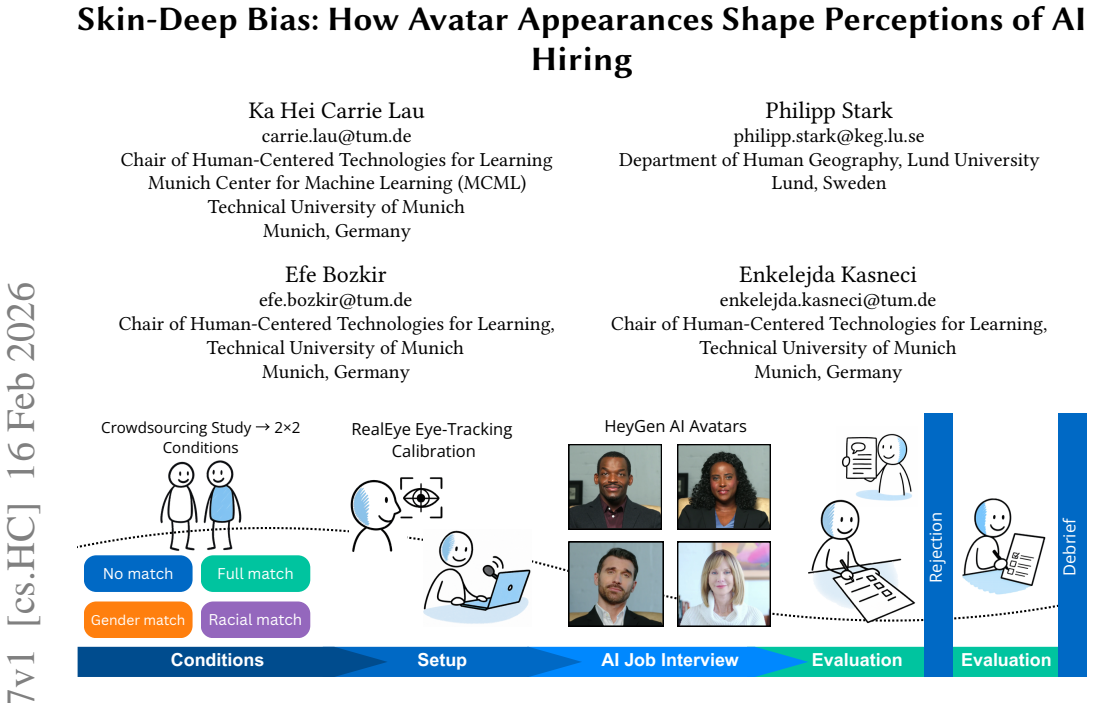
Photorealistic AI avatars varied in phenotypic traits (race and sex) were deployed in simulated interviews; results showed that racial mismatch between avatar and participant increased perceptions of ethnic bias, while partial identity matches (sharing only race or only sex) reduced fairness judgments relative to both complete matches and complete mismatches.
What carries the argument
Photorealistic AI avatars whose race and sex were systematically varied, with perceptions of trust, fairness, and bias measured through self-reports, sentiment analysis, and eye tracking after a fixed rejection.
If this is right
- Avatar design choices in AI hiring tools directly influence applicants' attributions of bias and fairness.
- The Computers-Are-Social-Actors effect extends to justice evaluations of algorithmic decision systems.
- Equitable AI interview systems require deliberate attention to how avatar identity cues align with or diverge from applicants.
Where Pith is reading between the lines
- The same avatar-identity effects may appear in other high-stakes AI domains such as loan or medical triage interfaces.
- Randomizing or neutralizing avatar appearances could serve as a practical mitigation if the partial-match penalty proves robust.
- Regulators might require disclosure of avatar characteristics used in automated interviews to allow applicants to anticipate cue-based reactions.
Load-bearing premise
Observed differences in fairness and bias reports are caused by the avatars' manipulated phenotypic traits rather than other uncontrolled features of the interview scenario or participant expectations.
What would settle it
A replication study that holds all interview elements constant while removing variation in avatar race and sex and finds no corresponding differences in fairness or bias perceptions would falsify the claim.
Figures


read the original abstract
Artificial intelligence is increasingly used in hiring, raising concerns about how applicants perceive these systems. While prior work on algorithmic fairness has emphasized technical bias mitigation, little is known about how avatar identity cues influence applicants' justice attributions in an interview context. We conducted a crowdsourcing study with 215 participants who completed an interview with photorealistic AI avatars varied in phenotypic traits (race and sex), followed by a standardized rejection. Using self-reports, sentiment analysis, and eye tracking, we measured perceptions of trust, fairness, and bias. Results show that racial mismatch heightened perceptions of ethnic bias, while partial match (sharing only one identity) reduced fairness judgments compared to both full and no match. This work extends the Computers-Are-Social-Actors paradigm by demonstrating that avatar appearances shape justicerelated evaluations of AI. We contribute to HCI by revealing how identity cues influence fairness attributions and offer actionable insights for designing equitable AI interview systems.
Editorial analysis
A structured set of objections, weighed in public.
Referee Report
Summary. The paper reports a crowdsourced study with 215 participants who completed a simulated hiring interview with photorealistic AI avatars that varied in phenotypic traits (race and sex), followed by a standardized rejection. Perceptions of trust, fairness, and bias were measured via self-reports, sentiment analysis, and eye tracking. Key results indicate that racial mismatch increased perceptions of ethnic bias, while partial identity match (sharing only one trait) lowered fairness judgments relative to full match or no match. The work claims to extend the Computers-Are-Social-Actors paradigm by showing how avatar appearances shape justice attributions and offers design implications for equitable AI interview systems.
Significance. If the central findings hold after addressing controls, the non-monotonic pattern of identity matching on fairness perceptions would provide novel empirical evidence for how visual cues influence justice evaluations in AI-mediated hiring. This could inform HCI design guidelines for avatar selection in recruitment tools and strengthen the CASA framework with multimodal data from self-reports, sentiment, and eye tracking.
major comments (2)
- [Methods] Methods section: The description of the avatar manipulation does not confirm that non-phenotypic features (voice, facial animation, lighting, attractiveness, or interview script wording) were held constant across full-match, partial-match, and no-match conditions. Without explicit controls or stimulus validation, the reported differences in fairness and bias cannot be confidently attributed to the intended race/sex manipulations rather than confounds.
- [Results] Results section: The manuscript reports the non-monotonic pattern but lacks effect sizes, confidence intervals, exact statistical tests, and power analysis for the key comparisons (racial mismatch on ethnic bias; partial match on fairness). These details are necessary to evaluate the robustness of the 215-participant findings.
minor comments (3)
- [Abstract] Abstract: The term 'justicerelated evaluations' is missing a hyphen and should read 'justice-related evaluations'.
- [Introduction] Introduction: Additional citations to recent HCI work on avatar bias in virtual interviews or algorithmic fairness perceptions would strengthen the positioning relative to prior CASA studies.
- [Discussion] Discussion: The actionable design insights for equitable AI systems are stated at a high level; more concrete recommendations (e.g., specific avatar selection criteria or testing protocols) would improve utility.
Simulated Author's Rebuttal
Thank you for the constructive feedback on our manuscript. We address each major comment below and have made revisions to improve clarity and rigor where appropriate.
read point-by-point responses
-
Referee: [Methods] Methods section: The description of the avatar manipulation does not confirm that non-phenotypic features (voice, facial animation, lighting, attractiveness, or interview script wording) were held constant across full-match, partial-match, and no-match conditions. Without explicit controls or stimulus validation, the reported differences in fairness and bias cannot be confidently attributed to the intended race/sex manipulations rather than confounds.
Authors: We appreciate this point and agree that explicit confirmation is needed. The avatars were generated from the same base model with identical voice synthesis, facial animation parameters, lighting conditions, and interview script wording; only the phenotypic traits (skin tone, facial features for race; and secondary sex characteristics) were varied. We have revised the Methods section to detail these controls and added a brief report of our pre-experiment stimulus validation pilot (n=30) confirming no significant differences in perceived attractiveness or other non-target attributes across conditions. revision: yes
-
Referee: [Results] Results section: The manuscript reports the non-monotonic pattern but lacks effect sizes, confidence intervals, exact statistical tests, and power analysis for the key comparisons (racial mismatch on ethnic bias; partial match on fairness). These details are necessary to evaluate the robustness of the 215-participant findings.
Authors: We agree these details strengthen the reporting. The key comparisons used mixed ANOVA with post-hoc Tukey tests; we have now inserted effect sizes (partial η² and Cohen’s d), 95% confidence intervals, exact p-values, and a sensitivity power analysis (achieved power = 0.82 for the observed medium effects at α=0.05 with n=215) into the Results section and a new supplementary table. revision: yes
Circularity Check
No circularity: empirical measurements from participant data
full rationale
This is a standard empirical HCI study reporting direct measurements of self-reported fairness, bias perceptions, sentiment, and eye-tracking metrics from 215 participants exposed to manipulated avatar conditions. No equations, model derivations, fitted parameters, or predictions are present that could reduce results to inputs by construction. The abstract and methods describe a controlled experiment with standardized rejection and phenotypic variation; findings are presented as observed patterns rather than derived from prior self-citations or ansatzes. The analysis is self-contained against external benchmarks (participant responses), with no load-bearing self-citation chains or renaming of known results as new derivations.
Axiom & Free-Parameter Ledger
axioms (1)
- domain assumption Self-report scales and sentiment analysis reliably measure subjective perceptions of bias and fairness
Reference graph
Works this paper leans on
-
[1]
Elham Albaroudi, Taha Mansouri, and Ali Alameer. 2024. A Comprehensive Review of AI Techniques for Addressing Algorithmic Bias in Job Hiring.AI5, 1 (2024), 383–404. doi:10.3390/ai5010019
-
[2]
Anna Aumüller, Andreas Winklbauer, Beatrice Schreibmaier, Bernad Batinic, and Martina Mara. 2024. Rethinking feminized service bots: user responses to abstract and gender-ambiguous chatbot avatars in a large-scale interaction study.Personal and Ubiquitous Computing28, 6 (01 Dec 2024), 1021–1032. doi:10.1007/s00779- 024-01830-8
-
[3]
Jasmin Baake, Josephine Schmitt, and Julia Metag. 2025. Balancing Realism and Trust: AI Avatars In Science Communication.Journal of Science Communication 24 (04 2025). doi:10.22323/2.24020203
-
[4]
Gérard Bailly, Stephan Raidt, and Frédéric Elisei. 2010. Gaze, conversational agents and face-to-face communication.Speech Communication52, 6 (2010), 598–
work page 2010
-
[5]
doi:10.1016/j.specom.2010.02.015 Speech and Face-to-Face Communication
- [6]
-
[7]
Hi. I’m Molly, Your Virtual Interviewer!
Shreyan Biswas, Ji-Youn Jung, Abhishek Unnam, Kuldeep Yadav, Shreyansh Gupta, and Ujwal Gadiraju. 2024. “Hi. I’m Molly, Your Virtual Interviewer!” Exploring the Impact of Race and Gender in AI-Powered Virtual Interview Ex- periences.Proceedings of the AAAI Conference on Human Computation and Crowdsourcing12, 1 (Oct. 2024), 12–22. doi:10.1609/hcomp.v12i1.31596
-
[8]
Pieter Blignaut and Daniël Wium. 2014. Eye-tracking data quality as affected by ethnicity and experimental design.Behavior Research Methods46, 1 (01 Mar 2014), 67–80. doi:10.3758/s13428-013-0343-0
-
[9]
Kelly, Vonetta Coakley, Tamar Gordon, Shola Thomp- son, Erika Levy, Andrea Cassells, Jonathan N
Elizabeth Brondolo, Kim P. Kelly, Vonetta Coakley, Tamar Gordon, Shola Thomp- son, Erika Levy, Andrea Cassells, Jonathan N. Tobin, Monica Sweeney, and Richard J. Contrada. 2005. The Perceived Ethnic Discrimination Question- naire: Development and Preliminary Validation of a Community Version.Jour- nal of Applied Social Psychology35, 2 (2005), 335–365. doi...
-
[10]
Merve Bulut and Burak Erdeniz. 2020. The Other-Race and Other-Species Effect during a Sex Categorization Task: An Eye Tracker Study.Behavioral Sciences10, 1 (2020), 10 pages. doi:10.3390/bs10010024
- [11]
-
[12]
Michael A. Campion, David K. Palmer, and James E. Campion. 1997. A review of structure in the selection interview.Personnel Psychology50, 3 (1997), 655–702. doi:10.1111/j.1744-6570.1997.tb00709.x
-
[13]
Francesco Chiossi, Ekaterina R. Stepanova, Benjamin Tag, Monica Perusquia- Hernandez, Alexandra Kitson, Arindam Dey, Sven Mayer, and Abdallah El Ali
-
[14]
PhysioCHI: Towards Best Practices for Integrating Physiological Signals in HCI. InExtended Abstracts of the CHI Conference on Human Factors in Computing Systems(Honolulu, HI, USA)(CHI EA ’24). Association for Computing Machinery, New York, NY, USA, Article 485, 7 pages. doi:10.1145/3613905.3636286
-
[15]
Jason A. Colquitt. 2001. On the dimensionality of organizational justice: A construct validation of a measure.Journal of Applied Psychology86, 3 (2001), 386–400. doi:10.1037/0021-9010.86.3.386
-
[16]
Michela Cortini, Teresa Galanti, and Massimiliano Barattucci. 2019. The Effect of Different Rejection Letters on Applicants’ Reactions.Behavioral Sciences9, 10 (2019), 1–15. https://www.mdpi.com/2076-328X/9/10/102
work page 2019
-
[17]
2019.Bias and Productivity in Humans and Machines
Bo Cowgill. 2019.Bias and Productivity in Humans and Machines. Upjohn Institute Working Paper 19-309. W.E. Upjohn Institute for Employment Research. https://ssrn.com/abstract=3433737
work page 2019
-
[18]
Birk, Youssef Shiban, Knut Schnell, and Regan L
Martin Johannes Dechant, Max V. Birk, Youssef Shiban, Knut Schnell, and Regan L. Mandryk. 2021. How Avatar Customization Affects Fear in a Game-based Digital Exposure Task for Social Anxiety.Proc. ACM Hum.-Comput. Interact.5, CHI PLAY, Article 248 (Oct. 2021), 27 pages. doi:10.1145/3474675
-
[19]
Do, Juanita Benjamin, Camille Isabella Protko, and Ryan P
Tiffany D. Do, Juanita Benjamin, Camille Isabella Protko, and Ryan P. McMahan
-
[20]
Cultural Reflections in Virtual Reality: The Effects of User Ethnicity in Avatar Matching Experiences on Sense of Embodiment.IEEE Transactions on Visualization and Computer Graphics30, 11 (2024), 7408–7418. doi:10.1109/TVCG. 2024.3456196
-
[21]
Chad Edwards, Autumn Edwards, Brett Stoll, Xialing Lin, and Noelle Massey
-
[22]
Evaluations of an artificial intelligence instructor’s voice: Social Identity Theory in human-robot interactions.Computers in Human Behavior90 (2019), 357–362
work page 2019
-
[23]
Lisa A. Elkin, Matthew Kay, James J. Higgins, and Jacob O. Wobbrock. 2021. An Aligned Rank Transform Procedure for Multifactor Contrast Tests. InThe 34th Annual ACM Symposium on User Interface Software and Technology(Virtual Event, USA)(UIST ’21). Association for Computing Machinery, New York, NY, USA, 754–768. doi:10.1145/3472749.3474784
-
[24]
Andrew Gambino, Jesse Fox, and Rabindra A Ratan. 2020. Building a Stronger CASA: Extending the Computers Are Social Actors Paradigm.Human- Machine Communication1 (2020), 71–85. https://search.informit.org/doi/10. 3316/INFORMIT.097034846749023
work page 2020
- [25]
-
[26]
Lorentsa Gkinko and Amany Elbanna. 2023. The appropriation of conversational AI in the workplace: A taxonomy of AI chatbot users.International Journal of Information Management69 (2023), 102568. doi:10.1016/j.ijinfomgt.2022.102568
-
[27]
Li Gong. 2008. How social is social responses to computers? The function of the degree of anthropomorphism in computer representations.Computers in Human Behavior24, 4 (2008), 1494–1509. doi:10.1016/j.chb.2007.05.007 Including the Special Issue: Integration of Human Factors in Networked Computing
-
[28]
2024.Chipotle Introduces New AI Hiring Plat- form to Support Its Accelerated Growth
Chipotle Mexican Grill. 2024.Chipotle Introduces New AI Hiring Plat- form to Support Its Accelerated Growth. Chipotle Mexican Grill. Re- trieved August 20, 2025 from https://newsroom.chipotle.com/2024-10-22- CHIPOTLE-INTRODUCES-NEW-AI-HIRING-PLATFORM-TO-SUPPORT-ITS- ACCELERATED-GROWTH
work page 2024
-
[29]
Pamela Grimm. 2010.Social Desirability Bias. John Wiley & Sons, Ltd, Hoboken, NJ, USA. doi:10.1002/9781444316568.wiem02057 arXiv:https://onlinelibrary.wiley.com/doi/pdf/10.1002/9781444316568.wiem02057
-
[30]
Jennifer X. Haensel, Tim J. Smith, and Atsushi Senju. 2022. Cultural differences in mutual gaze during face-to-face interactions: A dual head-mounted eye-tracking study.Visual Cognition30, 1-2 (2022), 100–115. doi:10.1080/13506285.2021.1928354 arXiv:https://doi.org/10.1080/13506285.2021.1928354
-
[31]
Marshall, Jennifer Booker, Houda Elmimouni, Imani Walker, and Jennifer A
David Hankerson, Andrea R. Marshall, Jennifer Booker, Houda Elmimouni, Imani Walker, and Jennifer A. Rode. 2016. Does Technology Have Race?. InProceedings of the 2016 CHI Conference Extended Abstracts on Human Factors in Computing Systems(San Jose, California, USA)(CHI EA ’16). Association for Computing Machinery, New York, NY, USA, 473–486. doi:10.1145/2...
-
[32]
Sumin Heo, Erika R Chen, and Jasmine Khuu. 2025. Exploring Gender Biases in LLM-based Voice Chatbots for Job Interviews. InProceedings of the Extended Abstracts of the CHI Conference on Human Factors in Computing Systems (CHI EA ’25). Association for Computing Machinery, New York, NY, USA, Article 899, 8 pages. doi:10.1145/3706599.3719281
-
[33]
Evelien Heyselaar. 2023. The CASA theory no longer applies to desktop comput- ers.Scientific Reports13, 1 (11 Nov 2023), 19693. doi:10.1038/s41598-023-46527-9
-
[34]
Peter J. Hills and J. Michael Pake. 2013. Eye-tracking the own-race bias in face recognition: Revealing the perceptual and socio-cognitive mechanisms.Cognition 129, 3 (2013), 586–597. doi:10.1016/j.cognition.2013.08.012
-
[35]
2025.HireVue: AI-driven Hiring Platform
HireVue. 2025.HireVue: AI-driven Hiring Platform. HireVue. Retrieved July 7, 2025 from https://www.hirevue.com/
work page 2025
-
[36]
Michael A. Hogg and Scott A. Reid. 2006. Social Identity, Self-Categorization, and the Communication of Group Norms.Communication Theory16 (2006), 7–30. https://api.semanticscholar.org/CorpusID:16594940
work page 2006
-
[37]
Md Sajjad Hosain, Mohammad Bin Amin, Gouranga Chandra Debnath, and Md Atikur Rahaman. 2025. The use of Artificial Intelligence (AI) in the hiring process: Job applicants’ perceptions of procedural justice.Computers in Human Behavior Reports19 (2025), 100713. doi:10.1016/j.chbr.2025.100713
-
[38]
Edwin Ip. 2025. Fair AI in hiring: Experimental evidence on how biased hir- ing algorithms and different debiasing methods affect the quality and diversity of applicants.Behavioral Science & Policy11, 1 (2025), 44–54. doi:10.1177/ 23794607251353585 arXiv:https://doi.org/10.1177/23794607251353585
-
[39]
Sheree Josephson and Michael E. Holmes. 2008. Cross-race recognition deficit and visual attention: do they all look (at faces) alike?. InProceedings of the 2008 Symposium on Eye Tracking Research & Applications(Savannah, Georgia) (ETRA ’08). Association for Computing Machinery, New York, NY, USA, 157–164. doi:10.1145/1344471.1344513
-
[40]
Sonia K. Kang and Galen V. Bodenhausen. 2015. Multiple Identities in Social Perception and Interaction: Challenges and Opportunities.Annual Review of Psychology66, Volume 66, 2015 (2015), 547–574. doi:10.1146/annurev-psych- 010814-015025
-
[41]
Krzysztof Krejtz, Andrew Duchowski, Izabela Krejtz, Agnieszka Szarkowska, and Agata Kopacz. 2016. Discerning Ambient/Focal Attention with Coefficient K.ACM Trans. Appl. Percept.13, 3, Article 11 (May 2016), 20 pages. doi:10.1145/2896452
-
[42]
Vivian Lai, Chacha Chen, Alison Smith-Renner, Q. Vera Liao, and Chenhao Tan. 2023. Towards a Science of Human-AI Decision Making: An Overview of Design Space in Empirical Human-Subject Studies. InProceedings of the 2023 ACM Conference on Fairness, Accountability, and Transparency(Chicago, IL, USA)(FAccT ’23). Association for Computing Machinery, New York,...
-
[43]
Markus Langer, Cornelius J. König, and Victoria Hemsing. 2020. Is anybody listening? The impact of automatically evaluated job interviews on impression management and applicant reactions.Journal of Man- agerial Psychology35, 4 (02 2020), 271–284. doi:10.1108/JMP-03-2019- 0156 arXiv:https://www.emerald.com/jmp/article-pdf/35/4/271/1560299/jmp-03- 2019-0156.pdf
-
[44]
Julia Levashina, Christopher J. Hartwell, Frederick P. Morgeson, and Michael A. Campion. 2014. The structured employment interview: Narrative and quantitative review of the research literature.Personnel Psychology67, 1 (2014), 241–293. doi:10.1111/peps.12052
-
[45]
2022.Attention measurement with eye-tracking & K-coefficient – explained
Beata Lewandowska and Kasia Wisiecka. 2022.Attention measurement with eye-tracking & K-coefficient – explained. RealEye. Retrieved August 21, 2025 from https://www.realeye.io/blog/143-attention-measurements-k-coefficient Blog post in collaboration with SWPS University
work page 2022
-
[46]
Lan Li, Tina Lassiter, Joohee Oh, and Min Kyung Lee. 2021. Algorithmic Hiring in Practice: Recruiter and HR Professional’s Perspectives on AI Use in Hiring. In Proceedings of the 2021 AAAI/ACM Conference on AI, Ethics, and Society(Virtual Event, USA)(AIES ’21). Association for Computing Machinery, New York, NY, USA, 166–176. doi:10.1145/3461702.3462531
-
[47]
Vera Liao, Daniel Gruen, and Sarah Miller
Q. Vera Liao, Daniel Gruen, and Sarah Miller. 2020. Questioning the AI: Informing Design Practices for Explainable AI User Experiences. InProceedings of the 2020 CHI Conference on Human Factors in Computing Systems(Honolulu, HI, USA) (CHI ’20). Association for Computing Machinery, New York, NY, USA, 1–15. doi:10.1145/3313831.3376590
-
[48]
Q. Vera Liao and Kush R. Varshney. 2022. Human-Centered Explainable AI (XAI): From Algorithms to User Experiences. arXiv:2110.10790 [cs.AI] https: //arxiv.org/abs/2110.10790
-
[49]
Sally Lindsay and Anne-Marie DePape. 2015. Exploring differences in the content of job interviews between youth with and without a physical disability.PLoS One10, 3 (March 2015), e0122084
work page 2015
-
[50]
Sebastian Linxen, Christian Sturm, Florian Brühlmann, Vincent Cassau, Klaus Opwis, and Katharina Reinecke. 2021. How WEIRD is CHI?. InProceedings of the 2021 CHI Conference on Human Factors in Computing Systems(Yokohama, Japan) (CHI ’21). Association for Computing Machinery, New York, NY, USA, Article 143, 14 pages. doi:10.1145/3411764.3445488
-
[51]
Kate Loveys, Gabrielle Sebaratnam, Mark Sagar, and Elizabeth Broadbent. 2020. The Effect of Design Features on Relationship Quality with Embodied Conversa- tional Agents: A Systematic Review.International Journal of Social Robotics12, 6 (01 Dec 2020), 1293–1312. doi:10.1007/s12369-020-00680-7
-
[52]
Brenda Major and Sarah S. M. Townsend. 2012. Meaning Making in Response to Unfairness.Psychological Inquiry23, 4 (2012), 361–366. doi:10.1080/1047840X. How Avatar Appearances Shape Perceptions of AI Hiring CHI ’26, April 13–17, 2026, Barcelona, Spain 2012.722785 arXiv:https://doi.org/10.1080/1047840X.2012.722785
-
[53]
Ninareh Mehrabi, Fred Morstatter, Nripsuta Saxena, Kristina Lerman, and Aram Galstyan. 2021. A Survey on Bias and Fairness in Machine Learning.ACM Comput. Surv.54, 6, Article 115 (July 2021), 35 pages. doi:10.1145/3457607
- [54]
-
[55]
Clifford Nass, Jonathan Steuer, and Ellen R. Tauber. 1994. Computers are social actors. InProceedings of the SIGCHI Conference on Human Factors in Computing Systems(Boston, Massachusetts, USA)(CHI ’94). Association for Computing Machinery, New York, NY, USA, 72–78. doi:10.1145/191666.191703
-
[56]
2025.Neufast: AI Recruitment Platform
Neufast. 2025.Neufast: AI Recruitment Platform. Neufast. Retrieved July 7, 2025 from https://www.neufast.com/
work page 2025
-
[57]
Rock Yuren Pang, Hope Schroeder, Kynnedy Simone Smith, Solon Barocas, Ziang Xiao, Emily Tseng, and Danielle Bragg. 2025. Understanding the LLM-ification of CHI: Unpacking the Impact of LLMs at CHI through a Systematic Literature Review. InProceedings of the 2025 CHI Conference on Human Factors in Computing Systems (CHI ’25). Association for Computing Mach...
-
[58]
Tabitha C. Peck, Jessica J. Good, and Katharina Seitz. 2021. Evidence of Racial Bias Using Immersive Virtual Reality: Analysis of Head and Hand Motions During Shooting Decisions.IEEE Transactions on Visualization and Computer Graphics 27, 5 (2021), 2502–2512. doi:10.1109/TVCG.2021.3067767
-
[59]
Kristi Pham, Krishna Chaitanya Rao Kathala, and Shashank Palakurthi. 2025. Reddit Sentiment Analysis on the Impact of AI Using VADER, TextBlob, and BERT. Procedia Computer Science258 (2025), 886–892. doi:10.1016/j.procs.2025.04.326 International Conference on Machine Learning and Data Engineering
-
[60]
Simon Provoost, Jeroen Ruwaard, Ward van Breda, Heleen Riper, and Tibor Bosse
-
[61]
Validating Automated Sentiment Analysis of Online Cognitive Behavioral Therapy Patient Texts: An Exploratory Study.Frontiers in Psychology10 (2019),
work page 2019
-
[62]
doi:10.3389/fpsyg.2019.01065
-
[63]
Valerie Purdie-Vaughns and Richard P. Eibach. 2008. Intersectional Invisibility: The Distinctive Advantages and Disadvantages of Multiple Subordinate-Group Identities.Sex Roles59, 5 (01 Sep 2008), 377–391. doi:10.1007/s11199-008-9424-4
-
[64]
Cassidy Pyle, Kat Roemmich, and Nazanin Andalibi. 2024. U.S. Job-Seekers’ Organizational Justice Perceptions of Emotion AI-Enabled Interviews.Proc. ACM Hum.-Comput. Interact.8, CSCW2, Article 454 (Nov. 2024), 42 pages. doi:10.1145/ 3686993
work page 2024
-
[65]
Tereza Raisova. 2012. The Comparison between the Effectiveness of the Com- petency based Interview and the behavioral event interview.Human Resources Management & Ergonomics6, 1 (2012), 52–63
work page 2012
- [66]
-
[67]
2025.Participant Quality Stats Explained
RealEye. 2025.Participant Quality Stats Explained. RealEye. Retrieved August 21, 2025 from https://support.realeye.io/participant-quality-stats-explained
work page 2025
-
[68]
Byron Reeves and Clifford Nass. 1996.The Media Equation: How People Treat Com- puters, Television, and New Media Like Real People and Places. CSLI Publications, Stanford, CA
work page 1996
-
[69]
Afsheen Rezai. 2022. Fairness in classroom assessment: development and val- idation of a questionnaire.Language Testing in Asia12, 1 (01 Jun 2022), 17. doi:10.1186/s40468-022-00162-9
-
[70]
Ann Marie Ryan and Robert E Ployhart. 2000. Applicants’ perceptions of selection procedures and decisions: a critical review and agenda for the future.Journal of Management26, 3 (2000), 565–606. doi:10.1016/S0149-2063(00)00041-6
-
[71]
Sayan Sacar, Cosmin Munteanu, Jaisie Sin, Christina Wei, Sergio Sayago, Wei Zhao, and Jenny Waycott. 2024. Designing Age-Inclusive Interfaces: Emerging Mobile, Conversational, and Generative AI to Support Interactions across the Life Span. InProceedings of the 6th ACM Conference on Conversational User Interfaces (Luxembourg, Luxembourg)(CUI ’24). Associat...
-
[72]
Fernando Salvetti, Barbara Bertagni, and Ianna Contardo. 2024. Fostering In- clusive Recruitment Interviews with Intelligent Digital Humans: A Diversity and Inclusion Training Initiative.International Journal of Advanced Corporate Learning (iJAC)17 (05 2024), 78–84. doi:10.3991/ijac.v17i3.45431
-
[73]
Rohan Charudatt Salvi and Nigel Bosch. 2025. Investigating Perception of Gender Stereotypes in Large Language Models: A Computational Grounded Theory Approach.ACM J. Responsib. Comput.2, 2, Article 9 (Aug. 2025), 29 pages. doi:10.1145/3737882
-
[74]
2025.spacytextblob: A TextBlob sentiment analysis pipeline compo- nent for spaCy
Sam Edwardes. 2025.spacytextblob: A TextBlob sentiment analysis pipeline compo- nent for spaCy. spaCy. Retrieved August 21, 2025 from https://spacy.io/universe/ project/spacy-textblob
work page 2025
-
[75]
Ari Schlesinger, W. Keith Edwards, and Rebecca E. Grinter. 2017. Intersectional HCI: Engaging Identity through Gender, Race, and Class. InProceedings of the 2017 CHI Conference on Human Factors in Computing Systems(Denver, Colorado, USA)(CHI ’17). Association for Computing Machinery, New York, NY, USA, 5412–5427. doi:10.1145/3025453.3025766
-
[76]
Katie Seaborn. 2025. Social Identity in Human-Agent Interaction: A Primer.J. Hum.-Robot Interact.(Aug. 2025). doi:10.1145/3760500 Just Accepted
-
[77]
Ruoxi Shang, Gary Hsieh, and Chirag Shah. 2025. Trusting Your AI Agent Emo- tionally and Cognitively: Development and Validation of a Semantic Differential Scale for AI Trust. InProceedings of the 2024 AAAI/ACM Conference on AI, Ethics, and Society(San Jose, California, USA)(AIES ’24). AAAI Press, Palo Alto, CA, USA, 1343–1356
work page 2025
-
[78]
Daniel Shank. 2012. Perceived Justice and Reactions to Coercive Computers. Sociological Forum27 (06 2012), 372–391. doi:10.2307/23262113
-
[79]
Skitka, Jennifer Winquist, and Susan Hutchinson
Linda J. Skitka, Jennifer Winquist, and Susan Hutchinson. 2003. Are Outcome Fairness and Outcome Favorability Distinguishable Psychological Constructs? A Meta-Analytic Review.Social Justice Research16, 4 (01 Dec 2003), 309–341. doi:10.1023/A:1026336131206
-
[80]
Vibha Soni. 2024. AI in Job Matching and Recruitment: Analyzing the Efficiency and Equity of Automated Hiring Processes. In2024 International Conference on Knowledge Engineering and Communication Systems (ICKECS), Vol. 1. IEEE, Chikkaballapur, India, 1–5. doi:10.1109/ICKECS61492.2024.10617325
discussion (0)
Sign in with ORCID, Apple, or X to comment. Anyone can read and Pith papers without signing in.