Quality-preserving Model for Electronics Production Quality Tests Reduction
Pith reviewed 2026-05-10 19:41 UTC · model grok-4.3
The pith
An adaptive framework using offline set cover and online Thompson sampling eliminates defect escapes in electronics testing while cutting test times.
A machine-rendered reading of the paper's core claim, the machinery that carries it, and where it could break.
Core claim
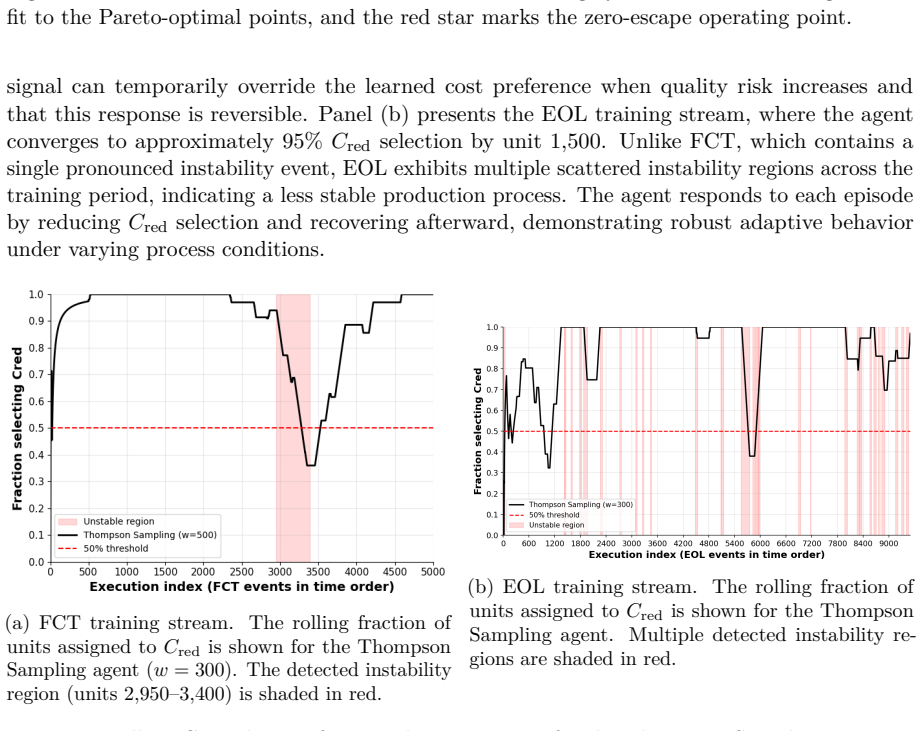
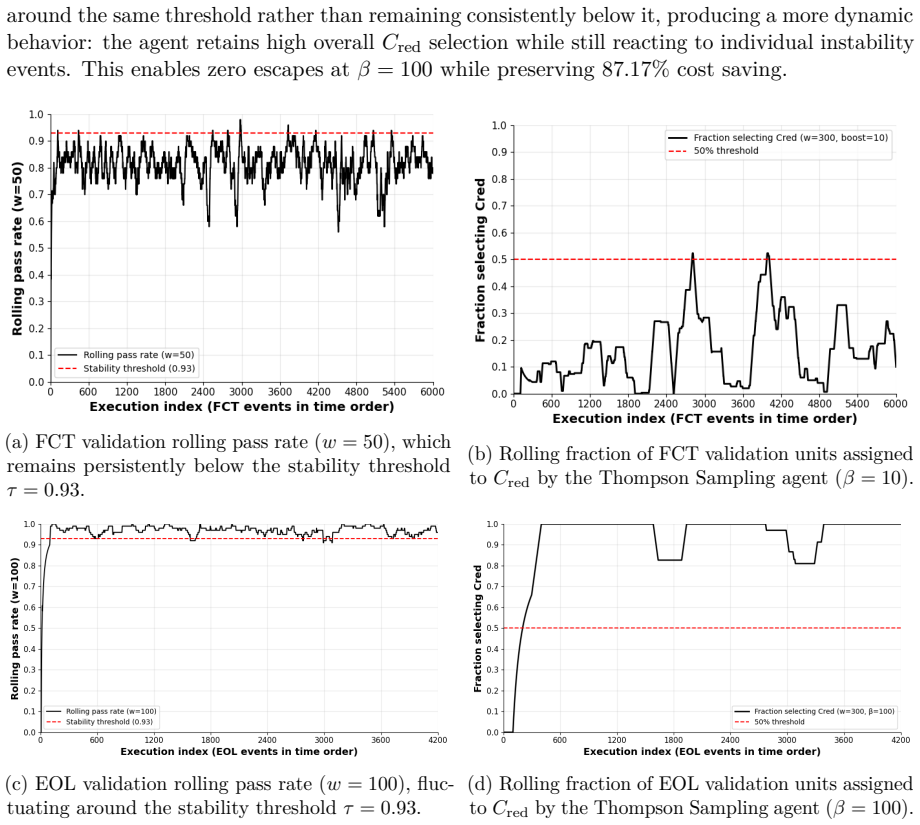
The adaptive test-selection framework, built from offline minimum-cost diagnostic subsets via greedy set cover and an online Thompson-sampling multi-armed bandit controlled by a rolling process-stability signal, produced zero escaped defects under temporal validation with real concept drift on two printed circuit board assembly stages, while static reduction plans produced 110 escapes in Functional Circuit Test and 8 in End-of-Line testing.
What carries the argument
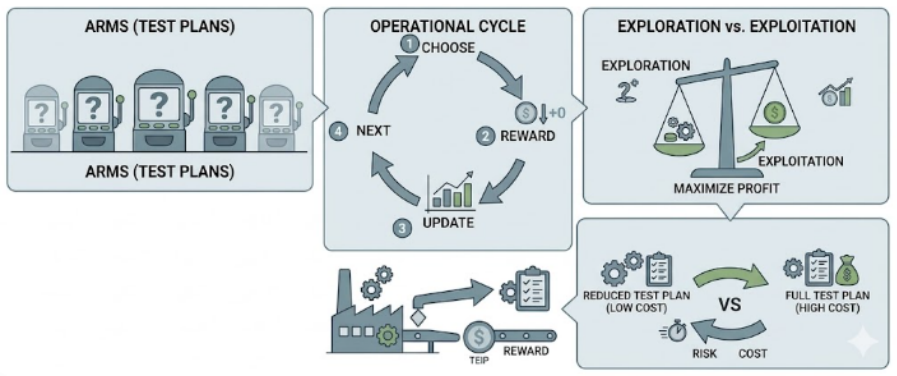
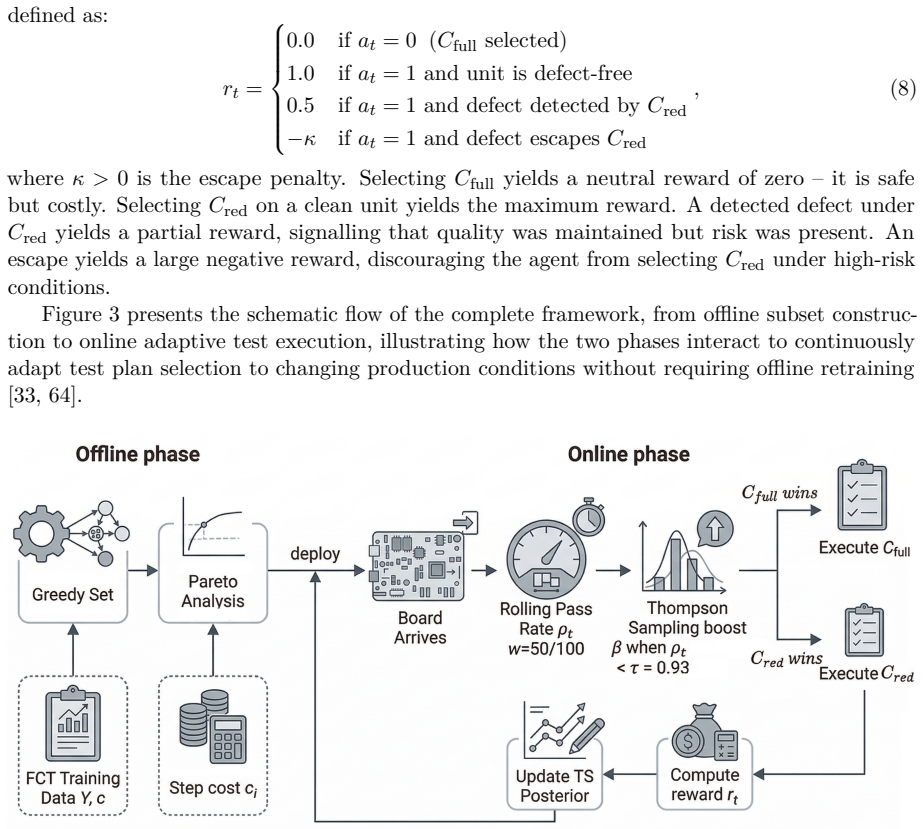
The Thompson-sampling multi-armed bandit that switches between full and reduced test plans using a rolling process-stability signal.
If this is right
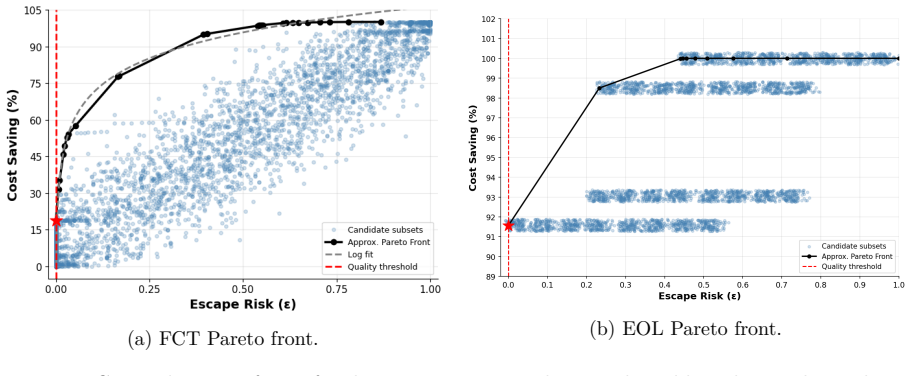
- Offline construction yields zero-escape reduced plans that cut test time by 18.78 percent in Functional Circuit Test and 91.57 percent in End-of-Line testing.
- The online bandit policy maintains zero escapes by reverting to fuller coverage precisely when instability is detected.
- The combined offline-plus-online approach supplies a concrete route to adaptive test planning that balances cost reduction against escape risk across production stages.
Where Pith is reading between the lines
- The same stability-triggered switching logic could be tested on other manufacturing lines that face gradual shifts in defect distributions.
- Integrating the bandit decision layer with existing factory data pipelines would allow real-time test adjustment without manual intervention.
- Extending the offline subset construction to include multiple cost objectives (time, equipment wear, operator effort) could further improve practical adoption.
Load-bearing premise
The rolling process-stability signal reliably detects periods when reduced testing would allow defect escapes.
What would settle it
A production run where the stability signal indicates stability, the system uses a reduced test plan, and one or more defects still escape detection.
Figures
read the original abstract
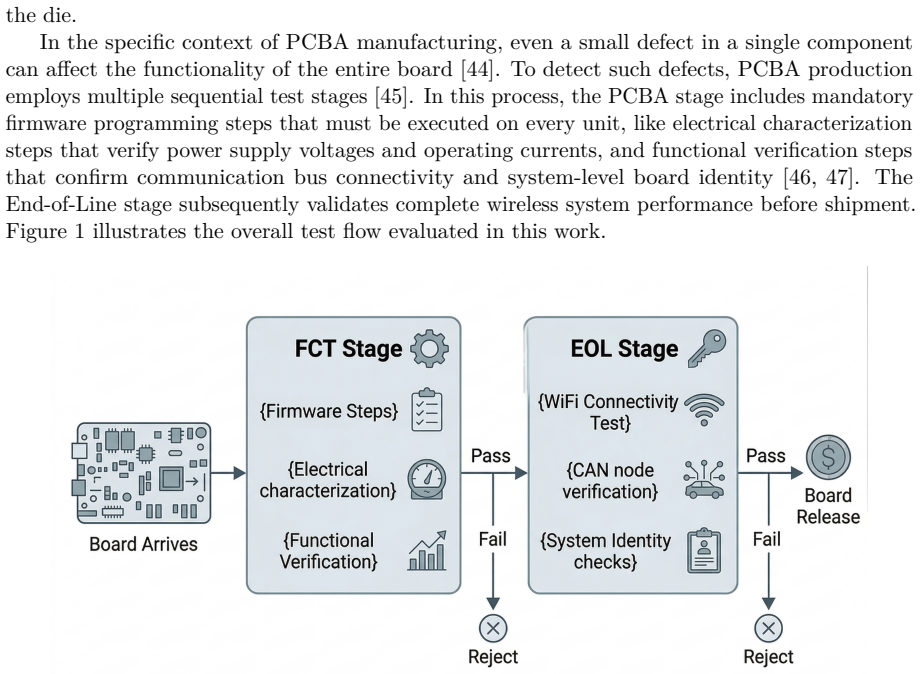
Manufacturing test flows in high-volume electronics production are typically fixed during product development and executed unchanged on every unit, even as failure patterns and process conditions evolve. This protects quality, but it also imposes unnecessary test cost, while existing data-driven methods mostly optimize static test subsets and neither adapt online to changing defect distributions nor explicitly control escape risk. In this study, we present an adaptive test-selection framework that combines offline minimum-cost diagnostic subset construction using greedy set cover with an online Thompson-sampling multi-armed bandit that switches between full and reduced test plans using a rolling process-stability signal. We evaluate the framework on two printed circuit board assembly stages-Functional Circuit Test and End-of-Line test-covering 28,000 board runs. Offline analysis identified zero-escape reduced plans that cut test time by 18.78% in Functional Circuit Test and 91.57\% in End-of-Line testing. Under temporal validation with real concept drift, static reduction produced 110 escaped defects in Functional Circuit Test and 8 in End-of-Line, whereas the adaptive policy reduced escapes to zero by reverting to fuller coverage when instability emerged in practice. These results show that online learning can preserve manufacturing quality while reducing test burden, offering a practical route to adaptive test planning across production domains, and offering both economic and logistics improvement for companies.
Editorial analysis
A structured set of objections, weighed in public.
Referee Report
Summary. The paper proposes an adaptive test-selection framework for high-volume electronics manufacturing that first uses offline greedy set cover to construct minimum-cost reduced diagnostic subsets and then deploys an online Thompson-sampling multi-armed bandit. The bandit switches between full and reduced test plans on the basis of a rolling process-stability signal. On a temporal split of 28,000 real PCB boards from Functional Circuit Test and End-of-Line stages, static reduced plans produced 110 and 8 escapes respectively, while the adaptive policy achieved zero escapes by reverting to fuller coverage when the stability signal indicated drift.
Significance. If the central result holds, the work supplies a practical, data-driven route to lowering test cost (reported 18.78 % and 91.57 % reductions) while explicitly controlling escape risk under real concept drift—an improvement over purely static reduction methods that dominate current practice. The combination of offline set-cover optimization with an online bandit that uses an external stability signal, together with temporal validation on production data, is a concrete strength that could be adopted in other manufacturing domains.
major comments (2)
- [Online Thompson-sampling component (Section 3.2)] The zero-escape claim for the adaptive policy rests entirely on the rolling process-stability signal correctly detecting instability and triggering reversion to full coverage. The manuscript provides no definition of this signal (input metrics, window length, statistic, or threshold) nor any ablation or sensitivity analysis of its parameters; without these details it is impossible to determine whether the reported advantage is a general mechanism or an artifact of tuning to the specific drift patterns in the 28,000-board temporal split.
- [Evaluation under temporal validation (Section 4)] Table 2 (or equivalent results table) reports escape counts of 110/8 for static reduction versus 0 for the adaptive policy, yet no statistical test, confidence interval, or comparison against alternative adaptive baselines (e.g., other bandit formulations or simple threshold rules) is supplied. This weakens the strength of the cross-policy claim.
minor comments (2)
- [Abstract] The abstract states '91.57% in End-of-Line testing' but the percentage sign is inconsistently formatted; standardize notation throughout.
- [Offline subset construction (Section 3.1)] The description of the offline greedy set cover algorithm would benefit from an explicit statement of the cost function and the stopping criterion used to guarantee zero escapes on the training data.
Simulated Author's Rebuttal
We thank the referee for the constructive and detailed feedback. The comments identify important gaps in methodological description and evaluation rigor that we will address in revision. Below we respond point-by-point to the major comments.
read point-by-point responses
-
Referee: [Online Thompson-sampling component (Section 3.2)] The zero-escape claim for the adaptive policy rests entirely on the rolling process-stability signal correctly detecting instability and triggering reversion to full coverage. The manuscript provides no definition of this signal (input metrics, window length, statistic, or threshold) nor any ablation or sensitivity analysis of its parameters; without these details it is impossible to determine whether the reported advantage is a general mechanism or an artifact of tuning to the specific drift patterns in the 28,000-board temporal split.
Authors: We acknowledge that the description of the rolling process-stability signal in Section 3.2 is insufficiently detailed. In the revised manuscript we will explicitly specify the signal definition, including the input metrics (rolling defect rate and variance computed over a sliding window), the exact window length, the statistic employed, and the threshold used to trigger reversion to full coverage. We will also add a sensitivity analysis and ablation study that varies these parameters across a range of plausible values and reports the resulting escape counts and test-time reductions. This will demonstrate that the zero-escape outcome is robust rather than an artifact of tuning to the particular drift patterns in the 28k-board dataset. revision: yes
-
Referee: [Evaluation under temporal validation (Section 4)] Table 2 (or equivalent results table) reports escape counts of 110/8 for static reduction versus 0 for the adaptive policy, yet no statistical test, confidence interval, or comparison against alternative adaptive baselines (e.g., other bandit formulations or simple threshold rules) is supplied. This weakens the strength of the cross-policy claim.
Authors: We agree that the current presentation of results would be strengthened by statistical support and additional baselines. In the revised Section 4 we will augment the escape-count comparisons with appropriate statistical tests (e.g., McNemar’s test for paired binary outcomes) together with confidence intervals or bootstrap estimates for the escape rates. We will also report results for two alternative adaptive policies—an epsilon-greedy bandit and a simple threshold rule on the same stability signal—to provide direct context for the Thompson-sampling policy. These additions will allow readers to assess the relative contribution of the bandit formulation more rigorously. revision: yes
Circularity Check
No circularity: derivation uses standard algorithms and external signal without self-referential reduction.
full rationale
The framework applies off-the-shelf greedy set cover for offline minimum-cost subset selection and Thompson sampling for the online multi-armed bandit, with decisions driven by a rolling process-stability signal treated as an external input. The reported results compare static versus adaptive policies on a temporal split of 28,000 boards under real drift; zero escapes under the adaptive policy follow from the policy's switching behavior on observed instability rather than from any parameter fitted to the escape count itself or from a self-citation chain. No equation or step equates the outcome to its own inputs by construction, and the cited methods are independent of the target result.
Axiom & Free-Parameter Ledger
axioms (1)
- domain assumption Rolling process-stability signal correlates with defect escape risk
Lean theorems connected to this paper
-
IndisputableMonolith/Cost/FunctionalEquation.leanwashburn_uniqueness_aczel unclear?
unclearRelation between the paper passage and the cited Recognition theorem.
offline minimum-cost diagnostic subset construction using greedy set cover with an online Thompson-sampling multi-armed bandit that switches between full and reduced test plans using a rolling process-stability signal
-
IndisputableMonolith/Foundation/RealityFromDistinction.leanreality_from_one_distinction unclear?
unclearRelation between the paper passage and the cited Recognition theorem.
rolling pass rate ρ_t = 1/w ∑ 1[outcome= PASS] compared against threshold τ; instability boost ˜θ0 = θ0 + β·(τ−ρ_t)
What do these tags mean?
- matches
- The paper's claim is directly supported by a theorem in the formal canon.
- supports
- The theorem supports part of the paper's argument, but the paper may add assumptions or extra steps.
- extends
- The paper goes beyond the formal theorem; the theorem is a base layer rather than the whole result.
- uses
- The paper appears to rely on the theorem as machinery.
- contradicts
- The paper's claim conflicts with a theorem or certificate in the canon.
- unclear
- Pith found a possible connection, but the passage is too broad, indirect, or ambiguous to say the theorem truly supports the claim.
Reference graph
Works this paper leans on
-
[1]
Guide to good manufacturing practice for medicinal products.Annexes PE, pages 009–6, 2009
Pharmaceutical Inspection Co-operation Scheme. Guide to good manufacturing practice for medicinal products.Annexes PE, pages 009–6, 2009
work page 2009
-
[2]
Joana Galvão Duarte, Maria Galvão Duarte, Ana Paula Piedade, and Filipa Mascarenhas- Melo. Rethinking pharmaceutical industry with quality by design: application in research, development, manufacturing, and quality assurance.The AAPS journal, 27(4):96, 2025
work page 2025
-
[3]
Patrik Grznár, Ladislav Papánek, Milan Marčan, Martin Krajčovič, Ivan Antoniuk, Štefan Mozol, and Lucia Mozolová. Enhancing production efficiency through digital twin simulation scheduling.Applied Sciences, 15(7):3637, 2025
work page 2025
-
[4]
Jonathan Walston, M.Affan Badar, Christopher Kluse, and Riem Rostom. A review analysis of cost of quality, cost of poor quality, and hidden quality cost.The Journal of Technology Studies, 50:1–13, 06 2025
work page 2025
-
[5]
Zelin Tong, Jingdan Feng, and Fang Liu. Understanding damage to and reparation of brand trust: a closer look at image congruity in the context of negative publicity.Journal of Product & Brand Management, 32(1):157–170, 2023
work page 2023
-
[6]
Impact of product quality on customer satisfaction: A systematic literature review
Anuj Bhowmick and Arumugam Seetharaman. Impact of product quality on customer satisfaction: A systematic literature review. InProceedings of the 2023 7th International Conference on Virtual and Augmented Reality Simulations, pages 93–99, 2023
work page 2023
-
[7]
Venkata Charan Kantumchu, Syed Quadir Moinuddin, Ashok Kumar Dewangan, and Mu- ralimohan Cheepu.Quality Assurance and Control in Welding and Additive Manufacturing, pages 245–261. 2024
work page 2024
-
[8]
Elisabeth Lervåg Synnes and Torgeir Welo. Bridging the gap between high and low-volume production through enhancement of integrative capabilities.Procedia Manufacturing, 5:26–40, 2016
work page 2016
-
[9]
A signature test framework for rapid production testing of rf circuits
Ramakrishna Voorakaranam, Sasikumar Cherubal, and Abhijit Chatterjee. A signature test framework for rapid production testing of rf circuits. InProceedings 2002 Design, Automation and Test in Europe Conference and Exhibition, pages 186–191. IEEE, 2002. 18
work page 2002
-
[10]
Linda Milor and Alberto L Sangiovanni-Vincentelli. Minimizing production test time to detect faults in analog circuits.IEEE Transactions on Computer-Aided Design of Integrated Circuits and Systems, 13(6):796–813, 1994
work page 1994
-
[11]
Jon M. Quigley. Five approaches to product testing.IEEE Reliability Magazine, 1(1):30–36, 2024
work page 2024
-
[12]
Chapter 1 - best practices in mission-assured, mission-critical, and safety-critical systems
Kim Fowler. Chapter 1 - best practices in mission-assured, mission-critical, and safety-critical systems. In Kim Fowler, editor,Mission-Critical and Safety-Critical Systems Handbook, pages 1–82. Newnes, Boston, 2010
work page 2010
-
[13]
Maria Chiara Magnanini, Ozan Demir, Marcello Colledani, and Tullio Tolio. Performance evaluation of multi-stage manufacturing systems operating under feedback and feedforward quality control loops.CIRP Annals, 73(1):349–352, 2024
work page 2024
-
[14]
Khadija Tahera, David Wynn, Chris Earl, and Claudia Eckert. Testing in the incremental design and development of complex products.Research in Engineering Design, 30, 04 2019
work page 2019
-
[15]
Adar Chowdhury and Md Nuruzzaman. Design, testing, and troubleshooting of industrial equipment: A systematic review of integration techniques for us manufacturing plants. Review of Applied Science and Technology, 2(01):53–84, 2023
work page 2023
-
[16]
Haolin Fan, Xuan Liu, Jerry Ying Hsi Fuh, Wen Feng Lu, and Bingbing Li. Embodied intelligence in manufacturing: leveraging large language models for autonomous industrial robotics.Journal of Intelligent Manufacturing, 36(2):1141–1157, 2025
work page 2025
-
[17]
Model- based test design of product lines: Raising test design to the product line level
Hartmut Lackner, Martin Thomas, Florian Wartenberg, and Stephan Weißleder. Model- based test design of product lines: Raising test design to the product line level. In2014 IEEE Seventh International Conference on Software Testing, Verification and Validation, pages 51–60, 2014
work page 2014
-
[18]
The role of testing in the engineering product development process
Khadija Tahera, Christopher Earl, and Claudia Eckert. The role of testing in the engineering product development process. 05 2012
work page 2012
-
[19]
Giusy Iaria, Paolo Bernardi, Claudia Bertani, Lorenzo Cardone, Giuseppe Garozzo, and Vincenzo Tancorre. A comprehensive scan test cost model to optimize the production of very large socs.IEEE Transactions on Computers, 74(4):1278–1292, 2025
work page 2025
-
[20]
Marta Cecchitelli, Giorgia Fiori, Jan Galo, Salvatore Andrea Sciuto, and Andrea Scorza. Measurements for quality control in biomedical 3-d printing: Standards, gaps, and missing protocols.IEEE Sensors Reviews, 3, 2026
work page 2026
-
[21]
Artificial intelligence for smart manufacturing: Methods and applications
Kim Phuc TRAN. Artificial intelligence for smart manufacturing: Methods and applications. Sensors, 21, 08 2021
work page 2021
-
[22]
Dong-Hyuk Yang, Hyeongjun Lee, and Yong-Shin Kang. Development of an ai model adaptation strategy based on multi-resolution concept drift detection: A case study in virtual metrology for smart manufacturing. In2025 IEEE Annual Congress on Artificial Intelligence of Things (AIoT), pages 335–341, 2025
work page 2025
-
[23]
Hoo Meng Wong and Sundresan Perumal. Ai-driven model-retraining architecture to sustain operational accuracy in data-drifting environments. In2025 IEEE Symposium on Wireless Technology & Applications (ISWTA), pages 1–6, 2025
work page 2025
-
[24]
Tania Cerquitelli, Daniele Jahier Pagliari, Andrea Calimera, Lorenzo Bottaccioli, Edoardo Patti, Andrea Acquaviva, and Massimo Poncino. Manufacturing as a data-driven practice: Methodologies, technologies, and tools.Proceedings of the IEEE, 109(4):399–422, 2021. 19
work page 2021
-
[25]
Siby Jose Plathottam, Arin Rzonca, Rishi Lakhnori, and Chukwunwike O Iloeje. A review of artificial intelligence applications in manufacturing operations.Journal of Advanced Manufacturing and Processing, 5(3):e10159, 2023
work page 2023
-
[26]
Harshitkumar Ghelani. Ai-driven quality control in pcb manufacturing: Enhancing produc- tion efficiency and precision.Valley International Journal Digital Library, 12(10):1549–1564, 2024
work page 2024
-
[27]
Harshitkumar Ghelani. Advanced ai technologies for defect prevention and yield optimization in pcb manufacturing.International Journal Of Engineering And Computer Science, 13(10), 2024
work page 2024
-
[28]
Bathrinath, Praveen Vundrajavarapu, R
M Anusuya, Kavitha P, S. Bathrinath, Praveen Vundrajavarapu, R. Bharath Kumar, and M. Sakthivel. Automation of test and measurement in electronics manufacturing through ai. In2024 International Conference on Science Technology Engineering and Management (ICSTEM), pages 1–6, 2024
work page 2024
-
[29]
Anurag Vijay Agrawal, Kommisetti Murthy Raju, Aparna P, Gade Sravya, A Chan- drashekhar, and J. Ramya. Ai-driven test and measurement automation in electronics manufacturing. In2024 Ninth International Conference on Science Technology Engineering and Mathematics (ICONSTEM), pages 1–6, 2024
work page 2024
-
[30]
Low test cost adaptive testing method for high yield ic products.Integration, 103:102401, 2025
Yuqi Pan, Huaguo Liang, Junming Li, Zhengfeng Huang, Maoxiang Yi, and Yingchun Lu. Low test cost adaptive testing method for high yield ic products.Integration, 103:102401, 2025
work page 2025
-
[31]
Sung Wook Kim, Jun Ho Kong, Sang Won Lee, and Seungchul Lee. Recent advances of artificial intelligence in manufacturing industrial sectors: A review.International journal of precision engineering and manufacturing, 23(1):111–129, 2022
work page 2022
-
[32]
A surprisal- based greedy heuristic for the set covering problem, 06 2023
Tommaso Adamo, Gianpaolo Ghiani, Emanuela Guerriero, and Deborah Pareo. A surprisal- based greedy heuristic for the set covering problem, 06 2023
work page 2023
-
[33]
Daniel Russo, Benjamin Roy, Abbas Kazerouni, Ian Osband, and Zheng Wen.A Tutorial on Thompson Sampling. 2018
work page 2018
-
[34]
Jackson Antonio do Prado Lima and Silvia Vergilio. Multi-armed bandit test case prioritiza- tion in continuous integration environments: A trade-off analysis. 10 2020
work page 2020
- [35]
-
[36]
Optimal sampling and decision-making strategies in multi-stage manufacturing processes
Xu Wang and Zhiyan Yang. Optimal sampling and decision-making strategies in multi-stage manufacturing processes. In2025 10th International Conference on Cloud Computing and Big Data Analytics (ICCCBDA), pages 658–663, 2025
work page 2025
-
[37]
Ender Yilmaz, Sule Ozev, and Kenneth M. Butler. Adaptive test flow for mixed-signal/rf circuits using learned information from device under test. In2010 IEEE International Test Conference, pages 1–10, Nov 2010
work page 2010
-
[38]
M. Scheffler, P.D. Franzon, and G. Troster. A "defect level versus cost" system tradeoff for electronics manufacturing.IEEE Transactions on Electronics Packaging Manufacturing, 27(1):67–76, 2004. 20
work page 2004
-
[39]
Test cost-test quality modeling for adaptive test
Bekir Zahit Demiray and Baris Arslan. Test cost-test quality modeling for adaptive test. In 2022 IEEE International Conference on Automation, Quality and Testing, Robotics (AQTR), pages 1–5, 2022
work page 2022
-
[40]
François-Fabien Ferhani, Nirmal R. Saxena, Edward J. McCluskey, and Phil Nigh. How many test patterns are useless? In26th IEEE VLSI Test Symposium (vts 2008), pages 23–28, 2008
work page 2008
-
[41]
S. Benner and O. Boroffice. Optimal production test times through adaptive test program- ming. InProceedings International Test Conference 2001 (Cat. No.01CH37260), pages 908–915, 2001
work page 2001
-
[42]
Adam Hamrol, Agnieszka Kujawińska, and Mariusz Bożek. Quality inspection planning within a multistage manufacturing process based on the added value criterion.The Interna- tional Journal of Advanced Manufacturing Technology, 108:1–14, 05 2020
work page 2020
-
[43]
An industry example to reduce the test time by optimizing data extration method
Xiaofeng Liang and Deguang Zheng. An industry example to reduce the test time by optimizing data extration method. In2022 China Semiconductor Technology International Conference (CSTIC), pages 1–4, 2022
work page 2022
-
[44]
Nikolay Petkov and Malinka Ivanova. Printed circuit board and printed circuit board assem- bly methods for testing and visual inspection: a review.Bulletin of Electrical Engineering and Informatics, 13:2566–2585, 08 2024
work page 2024
-
[45]
Optimized lightweight pcb real-time defect detection algorithm
Dahua Li, Ao Xu, and Xiao Yu. Optimized lightweight pcb real-time defect detection algorithm. In2023 IEEE 16th International Conference on Electronic Measurement & Instruments (ICEMI), pages 262–269, 2023
work page 2023
-
[46]
Universal platform for pcb functional testing
Marian Serban, Yuriy Vagapov, Zheng Chen, Reg Holme, and Sergey Lupin. Universal platform for pcb functional testing. pages 402–409, 09 2014
work page 2014
-
[47]
Árpád Kis, Cosmin Ancuti, and Codruta O. Ancuti. Ats-pcb: An effective automated testing system for advanced driver assistance systems. In2019 International Symposium ELMAR, pages 215–218, 2019
work page 2019
-
[48]
Mominul Ahsan, Stoyan Stoyanov, Chris Bailey, and Alhussein Albarbar. Developing computational intelligence for smart qualification testing of electronic products.IEEE Access, 8:16922–16933, 2020
work page 2020
-
[49]
Ashfakul Karim Kausik, Adib Bin Rashid, Ramisha Fariha Baki, and Md Mifthahul Jannat Maktum. Machine learning algorithms for manufacturing quality assurance: A systematic review of performance metrics and applications.Array, 26:100393, 2025
work page 2025
-
[50]
Adaptation of functional inspection test plan in a production line using a multi-agent system
Nelson Rodrigues, Paulo Leitão, Matthias Foehr, Claudio Turrin, Arnaldo Pagani, and Roberto Decesari. Adaptation of functional inspection test plan in a production line using a multi-agent system. In2013 IEEE International Symposium on Industrial Electronics, pages 1–6, 2013
work page 2013
-
[51]
Ke Huang, Jian Wen, and Jim Willmore. Test-suite-based analog/rf test time reduction using canonical correlation.IEEE Transactions on Computer-Aided Design of Integrated Circuits and Systems, 35(12):2143–2147, 2016
work page 2016
-
[52]
Machine learning classification algorithm for vlsi test cost reduction.Integration, 87:40–48, 2022
Tai Song, Zhengfeng Huang, and Aibin Yan. Machine learning classification algorithm for vlsi test cost reduction.Integration, 87:40–48, 2022. 21
work page 2022
-
[53]
Adaptive testing of compute-in-memory based cnns using probabilistic test acceptance limits
Anurup Saha, Kwondo Ma, Chandramouli Amarnath, Moinuddin Qureshi, and Abhijit Chatterjee. Adaptive testing of compute-in-memory based cnns using probabilistic test acceptance limits. In2025 IEEE 31st International Symposium on On-Line Testing and Robust System Design (IOLTS), pages 1–7, 2025
work page 2025
-
[54]
Adaptive test framework for achieving target test quality at minimal cost
Baris Arslan and Alex Orailoglu. Adaptive test framework for achieving target test quality at minimal cost. In2011 Asian Test Symposium, pages 323–328, 2011
work page 2011
-
[55]
Introduction to multi-armed bandits.Foundations and Trends®in Machine Learning, 12(1-2):1–286, 2019
Aleksandrs Slivkins. Introduction to multi-armed bandits.Foundations and Trends®in Machine Learning, 12(1-2):1–286, 2019
work page 2019
-
[56]
Multi-armed bandit algorithms and empirical evaluation
Joannes Vermorel and Mehryar Mohri. Multi-armed bandit algorithms and empirical evaluation. InEuropean conference on machine learning, pages 437–448. Springer, 2005
work page 2005
-
[57]
Aditya Mahajan and Demosthenis Teneketzis. Multi-armed bandit problems. InFoundations and applications of sensor management, pages 121–151. Springer, 2008
work page 2008
-
[58]
Teddy Lazebnik. Data-driven hospitals staff and resources allocation using agent-based sim- ulation and deep reinforcement learning.Engineering Applications of Artificial Intelligence, 126:106783, 2023
work page 2023
-
[59]
Teddy Lazebnik, Yiftach Golov, Roi Gurka, Ally Harari, and Alex Liberzon. Exploration– exploitation model of moth-inspired olfactory navigation.Journal of the Royal Society Interface, 21(216), 2024
work page 2024
-
[60]
TeddyLazebnik, ShirAviv-Reuven, andArielRosenfeld. Publishinginstincts: Anexploration- exploitation framework for studying academic publishing behavior and “home venues”. Journal of Informetrics, 19(3):101705, 2025
work page 2025
- [61]
-
[62]
Sige Liu, Peng Cheng, Zhuo Chen, Kan Yu, Wei Xiang, Jun Li, Branka Vucetic, and Yonghui Li. A learning-based context-aware quality test system in B5G-aided advanced manufacturing.IEEE Transactions on Industrial Informatics, 19(2):1548–1558, 2023
work page 2023
-
[63]
Prado Lima and Silvia Regina Vergilio
Jackson A. Prado Lima and Silvia Regina Vergilio. A multi-armed bandit approach for test case prioritization in continuous integration environments.IEEE Transactions on Software Engineering, 48(2):453–465, 2022
work page 2022
-
[64]
Survey on applications of multi-armed and contextual bandits
Djallel Bouneffouf, Irina Rish, and Charu Aggarwal. Survey on applications of multi-armed and contextual bandits. In2020 IEEE Congress on Evolutionary Computation (CEC), pages 1–8, 2020
work page 2020
-
[65]
Teddy Lazebnik. The economical-ecological benefits of matching non-matching socks.arXiv preprint arXiv:2602.18221, 2026
work page internal anchor Pith review arXiv 2026
-
[66]
Haoyu Nie. Exploring the depths of multi-armed bandit algorithms: From theoretical foundations to modern applications.Applied and Computational Engineering, 68:183–191, 06 2024
work page 2024
-
[67]
Xiao Han, Yuqi Cai, Anqi Zhang, Yao Zhu, Yihai He, and Rui Shi. Adaptive policy optimization for product infant failure risk control in manufacturing processes with variable demands. In2025 16th International Conference on Reliability, Maintainability and Safety (ICRMS), pages 376–381, 2025. 22
work page 2025
-
[68]
A greedy heuristic for the set-covering problem.Math
Vasek Chvátal. A greedy heuristic for the set-covering problem.Math. Oper. Res., 4:233–235, 1979
work page 1979
-
[69]
A learning-based context-aware quality test system in b5g-aided advanced manufacturing
Sige Liu, Peng Cheng, Zhuo Chen, Kan Yu, Wei Xiang, Jun Li, Branka Vucetic, and Yonghui Li. A learning-based context-aware quality test system in b5g-aided advanced manufacturing. IEEE Transactions on Industrial Informatics, 04 2022
work page 2022
-
[70]
G. Burg, A. Nazábal, and C. Sutton. Wrangling messy csv files by detecting row and type patterns.Data Mining and Knowledge Discovery, 33, 11 2019
work page 2019
-
[71]
Kalyani Sankpal. A review on data normalization techniques.International Journal of Engineering Research and, V9, 07 2020
work page 2020
-
[72]
Advancing zero defect manufacturing: A state-of-the-art perspective and future research directions
Daryl Powell, Maria Chiara Magnanini, Marcello Colledani, and Odd Myklebust. Advancing zero defect manufacturing: A state-of-the-art perspective and future research directions. Computers in Industry, 136:103596, 2022
work page 2022
-
[73]
Marc-André Filz, Jan Philipp Bosse, and Christoph Herrmann. Digitalization platform for data-driven quality management in multi-stage manufacturing systems.Journal of Intelligent Manufacturing, 35(6):2699–2718, 2024
work page 2024
-
[74]
Adam Hamrol, Agnieszka Kujawińska, and Mariusz Bożek. Quality inspection planning within a multistage manufacturing process based on the added value criterion.The Interna- tional Journal of Advanced Manufacturing Technology, 108(5–6):1399–1412, 2020
work page 2020
-
[75]
Muhammad Arsalan Farooq, Randolph Kirchain, Henriqueta Novoa, and Antonio Araújo. Cost of quality: Evaluating cost-quality trade-offs for inspection strategies of manufacturing processes.International Journal of Production Economics, 188:156–166, 2017
work page 2017
-
[76]
Yifan Wu, Roshan Shariff, Tor Lattimore, and Csaba Szepesvári. Conservative bandits. InProceedings of the 33rd International Conference on Machine Learning, volume 48 of Proceedings of Machine Learning Research, pages 1254–1262. PMLR, 2016
work page 2016
-
[77]
Conservative contextual linear bandits
Abbas Kazerouni, Mohammad Ghavamzadeh, Yasin Abbasi-Yadkori, and Benjamin Van Roy. Conservative contextual linear bandits. InAdvances in Neural Information Processing Systems 30, pages 3910–3919. Curran Associates, Inc., 2017
work page 2017
-
[78]
Mohamed Ismail, Noha A. Mostafa, and Ahmed El-assal. Quality monitoring in multi- stage manufacturing systems by using machine learning techniques.Journal of Intelligent Manufacturing, 33:2471–2486, 2022. 23
work page 2022
discussion (0)
Sign in with ORCID, Apple, or X to comment. Anyone can read and Pith papers without signing in.