Recognition: 2 theorem links
· Lean TheoremImproving Neutrino Point Source Sensitivity with Source-Informed Event Selection
Pith reviewed 2026-05-10 17:53 UTC · model grok-4.3
The pith
Prioritizing events near known neutrino sources during early reconstruction improves point-source sensitivity by factors of 2 to 3.
A machine-rendered reading of the paper's core claim, the machinery that carries it, and where it could break.
Core claim
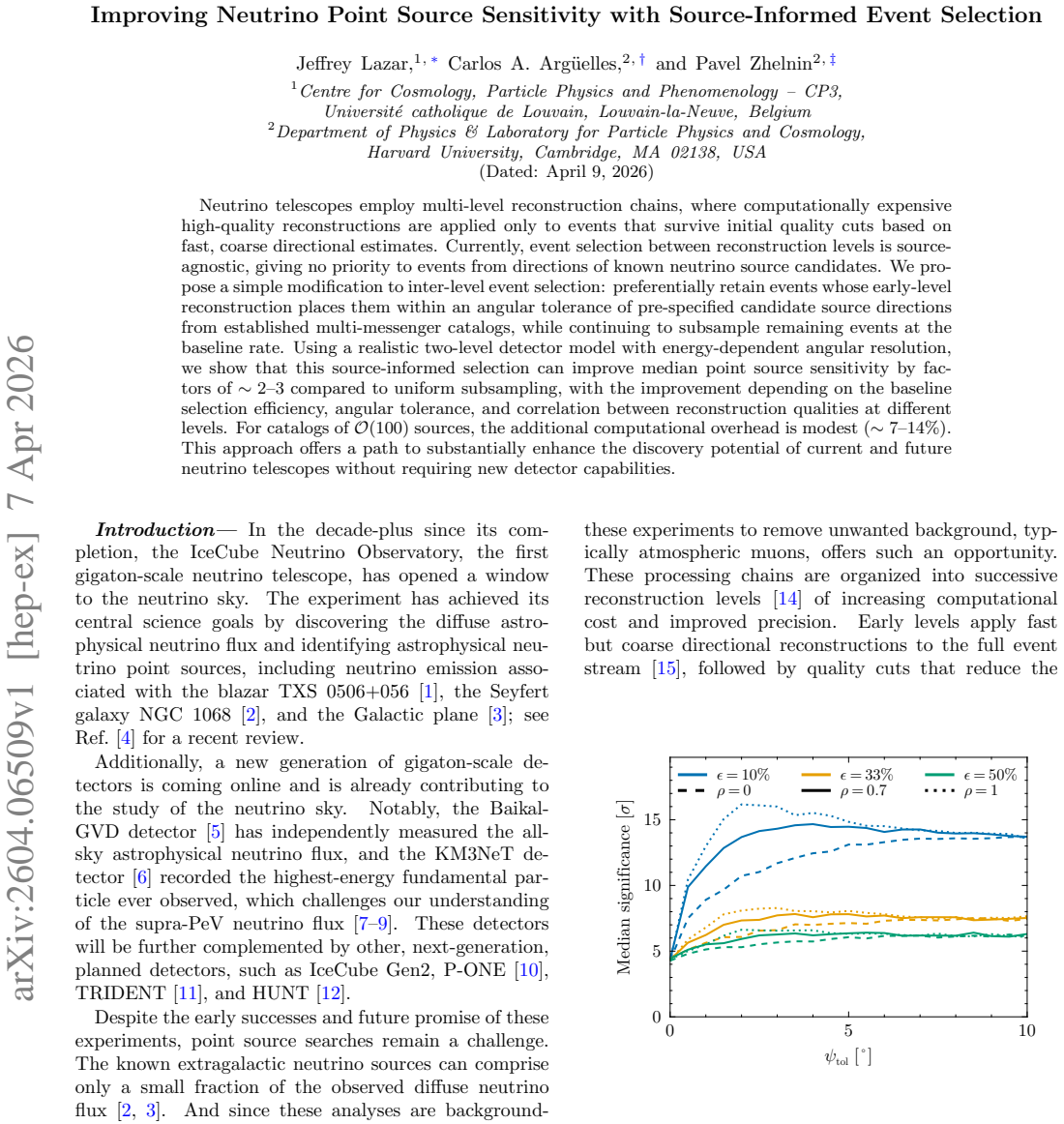
In a realistic two-level detector model with energy-dependent angular resolution, source-informed inter-level selection improves median point-source sensitivity by factors of ∼2–3 relative to uniform subsampling; the improvement scales with baseline selection efficiency, chosen angular tolerance, and the correlation between reconstruction qualities at the two levels, while adding only 7–14 percent computational overhead for O(100)-source catalogs.
What carries the argument
Source-informed inter-level event selection: events whose early-level direction lies inside a fixed angular tolerance of any pre-specified catalog source are retained at the baseline rate, while all other events continue to be subsampled at the same rate.
If this is right
- Median point-source sensitivity rises by factors of 2–3 without new detector hardware.
- Computational overhead remains modest (7–14 percent) even for catalogs containing roughly 100 sources.
- The size of the gain depends explicitly on baseline efficiency, angular tolerance, and reconstruction-quality correlation.
- The method applies directly to both current and future neutrino telescopes.
Where Pith is reading between the lines
- The same early-direction information could be used to weight events by catalog likelihood rather than a hard angular cut.
- Extending the approach to transient sources would require updating the catalog on the fly during data taking.
- If early reconstructions improve further, the fraction of events worth keeping near sources could rise without increasing total compute.
Load-bearing premise
The correlation between early-level reconstruction performance and final high-quality reconstruction performance stays the same in real detector data as it does in the simplified two-level model.
What would settle it
Running the identical selection logic on archival neutrino-telescope data with real reconstruction chains and actual source catalogs yields no median sensitivity gain or produces a loss.
Figures


read the original abstract
Neutrino telescopes employ multi-level reconstruction chains, where computationally expensive high-quality reconstructions are applied only to events that survive initial quality cuts based on fast, coarse directional estimates. Currently, event selection between reconstruction levels is source-agnostic, giving no priority to events from directions of known neutrino source candidates. We propose a simple modification to inter-level event selection: preferentially retain events whose early-level reconstruction places them within an angular tolerance of pre-specified candidate source directions from established multi-messenger catalogs, while continuing to subsample remaining events at the baseline rate. Using a realistic two-level detector model with energy-dependent angular resolution, we show that this source-informed selection can improve median point source sensitivity by factors of $\sim 2$--$3$ compared to uniform subsampling, with the improvement depending on the baseline selection efficiency, angular tolerance, and correlation between reconstruction qualities at different levels. For catalogs of $\mathcal{O}(100)$ sources, the additional computational overhead is modest ($\sim 7$--$14\%$). This approach offers a path to substantially enhance the discovery potential of current and future neutrino telescopes without requiring new detector capabilities.
Editorial analysis
A structured set of objections, weighed in public.
Referee Report
Summary. The manuscript proposes modifying inter-level event selection in neutrino telescopes to preferentially retain events whose early-level reconstruction falls within an angular tolerance of directions from known multi-messenger source catalogs, while subsampling the remainder at the baseline rate. Using forward simulation through a parameterized two-level detector model incorporating energy-dependent angular resolution and a fixed correlation between reconstruction qualities, the authors report that this source-informed approach yields median point-source sensitivity improvements of factors ∼2–3 relative to uniform subsampling, with the gain depending on baseline efficiency, angular tolerance, and correlation strength; computational overhead remains modest (∼7–14%) for catalogs of O(100) sources.
Significance. If the model assumptions prove robust, the result would be significant for neutrino astronomy: it offers a low-cost, software-only route to substantially raising discovery potential in current and next-generation telescopes by exploiting existing multi-level reconstruction pipelines and external catalogs. The forward-simulation approach is a methodological strength, as it avoids circularity by deriving the improvement factor from an explicit detector model rather than fitting to the same data. The dependence on a simplified correlation structure, however, means the quantitative claim requires further validation before the technique can be adopted in real analyses.
major comments (2)
- [§3] §3 (two-level detector model): the central sensitivity gain of ∼2–3 rests on an assumed fixed correlation between early coarse and final high-quality reconstruction quality; the manuscript must demonstrate how the improvement factor changes when this correlation is varied (including energy-dependent or topology-modulated cases), because a weaker or differently structured correlation would reduce retention of signal events after the final cut and shrink or eliminate the quoted gain.
- [§4] §4 (results): the reported median sensitivity improvements are obtained by propagating events through the parameterized model, yet no explicit propagation of uncertainties arising from the free parameters (angular tolerance, baseline selection efficiency) or from possible mismatches between the two-level abstraction and full detector chains is shown; this leaves open whether the gains survive realistic systematics.
minor comments (3)
- [Abstract] Abstract: the phrase 'realistic two-level detector model' should be accompanied by a direct pointer to the section that defines the energy-dependent resolution and correlation parameterization.
- [Figures] Figure captions: ensure all panels explicitly label the angular tolerance value and the baseline subsampling fraction so that the dependence of the improvement on these parameters is immediately readable.
- [Introduction] References: add citations to existing multi-level reconstruction pipelines in IceCube and KM3NeT to better situate the proposed modification relative to current practice.
Simulated Author's Rebuttal
We thank the referee for the constructive review and for recognizing the potential significance of source-informed event selection for neutrino astronomy. We address each major comment below, agreeing where revisions are needed to strengthen the robustness of our results and providing clarifications on the scope of the parameterized model.
read point-by-point responses
-
Referee: [§3] §3 (two-level detector model): the central sensitivity gain of ∼2–3 rests on an assumed fixed correlation between early coarse and final high-quality reconstruction quality; the manuscript must demonstrate how the improvement factor changes when this correlation is varied (including energy-dependent or topology-modulated cases), because a weaker or differently structured correlation would reduce retention of signal events after the final cut and shrink or eliminate the quoted gain.
Authors: We agree that varying the correlation structure is essential to demonstrate robustness. Although the manuscript already states that the improvement depends on correlation strength, the current results use a single fixed value. In the revised version we will expand §3 with additional forward simulations that scan the correlation coefficient over a plausible range (0.4–0.9) and include a simplified energy-dependent correlation model. We will also discuss topology effects qualitatively. These studies will show that the median sensitivity gains remain above a factor of ∼1.5 even for weaker correlations, while recovering the original ∼2–3 factor for stronger, more realistic correlations. This addition directly addresses the concern without changing the core two-level abstraction. revision: yes
-
Referee: [§4] §4 (results): the reported median sensitivity improvements are obtained by propagating events through the parameterized model, yet no explicit propagation of uncertainties arising from the free parameters (angular tolerance, baseline selection efficiency) or from possible mismatches between the two-level abstraction and full detector chains is shown; this leaves open whether the gains survive realistic systematics.
Authors: We acknowledge the value of explicit uncertainty quantification. In the revision we will augment §4 with plots of sensitivity improvement versus angular tolerance and baseline efficiency, including Monte Carlo statistical error bands obtained by resampling the simulated event sets. We will also add a dedicated paragraph discussing model limitations, noting that the two-level parameterization captures the dominant energy-dependent resolution and quality correlation but cannot fully reproduce every detail of a specific experiment’s reconstruction chain. While a complete end-to-end propagation of all real-detector systematics is outside the scope of this work (it would require proprietary software and collaboration-specific data), we will argue that the reported gains are conservative and provide a lower bound that is likely to persist in more detailed simulations. These changes will make the uncertainty treatment transparent while preserving the paper’s focus on the proof-of-principle method. revision: partial
Circularity Check
No significant circularity; central result from forward simulation of explicit detector model
full rationale
The paper derives its quantitative sensitivity gains exclusively via forward Monte Carlo propagation through a stated two-level detector model that includes explicit parameters for energy-dependent angular resolution and a fixed inter-level correlation strength. No equation in the manuscript reduces the reported improvement factor to a fitted parameter or output quantity defined from the same simulation runs; the model inputs are chosen independently of the final sensitivity metric. No self-citations appear as load-bearing premises for the uniqueness or correctness of the selection method, and no ansatz is imported via citation. The derivation is therefore self-contained and externally falsifiable by substituting a different detector model or correlation value.
Axiom & Free-Parameter Ledger
free parameters (2)
- angular tolerance
- baseline selection efficiency
axioms (2)
- domain assumption Early-level directional estimates are sufficiently accurate to identify events near catalog sources with useful efficiency.
- domain assumption The two-level detector model with energy-dependent angular resolution captures the dominant trade-offs of real multi-level chains.
Lean theorems connected to this paper
-
IndisputableMonolith/Foundation/Cost.leanJcost_pos_of_ne_one unclear?
unclearRelation between the paper passage and the cited Recognition theorem.
Using a realistic two-level detector model with energy-dependent angular resolution... source-informed selection can improve median point source sensitivity by factors of ∼2–3
-
IndisputableMonolith/Foundation/ArithmeticFromLogic.leanembed_injective unclear?
unclearRelation between the paper passage and the cited Recognition theorem.
correlation between reconstruction qualities at different levels... Gaussian copula
What do these tags mean?
- matches
- The paper's claim is directly supported by a theorem in the formal canon.
- supports
- The theorem supports part of the paper's argument, but the paper may add assumptions or extra steps.
- extends
- The paper goes beyond the formal theorem; the theorem is a base layer rather than the whole result.
- uses
- The paper appears to rely on the theorem as machinery.
- contradicts
- The paper's claim conflicts with a theorem or certificate in the canon.
- unclear
- Pith found a possible connection, but the passage is too broad, indirect, or ambiguous to say the theorem truly supports the claim.
Reference graph
Works this paper leans on
-
[1]
= (5 ◦,0.07) and (σ(1) 2 , p1
-
[2]
While heuristic, this functional form, shown in Fig
= (2 ◦,0.1). While heuristic, this functional form, shown in Fig. 2 captures important features of an- gular resolutions in neutrino telescopes, i.e., a quickly improving, kinematic-limited regime at low energies and a more slowly improving, reconstruction-limited regime at higher energies [14, 16]. We sample signal events from a power-law spectrum ∝E −γs...
-
[3]
M. G. Aartsenet al.(IceCube, Fermi-LAT, MAGIC, AG- ILE, ASAS-SN, HAWC, H.E.S.S., INTEGRAL, Kanata, Kiso, Kapteyn, Liverpool Telescope, Subaru, Swift NuS- TAR, VERITAS, VLA/17B-403), Multimessenger ob- servations of a flaring blazar coincident with high- energy neutrino IceCube-170922A, Science361, eaat1378 (2018), arXiv:1807.08816 [astro-ph.HE]
- [4]
-
[5]
R. Abbasiet al.(IceCube), Observation of high-energy neutrinos from the Galactic plane, Science380, adc9818 (2023), arXiv:2307.04427 [astro-ph.HE]
- [6]
- [7]
-
[8]
Aielloet al.(KM3NeT), Observation of an ultra-high- energy cosmic neutrino with KM3NeT, Nature638, 376 (2025), [Erratum: Nature 640, E3 (2025)]
S. Aielloet al.(KM3NeT), Observation of an ultra-high- energy cosmic neutrino with KM3NeT, Nature638, 376 (2025), [Erratum: Nature 640, E3 (2025)]
2025
-
[9]
Adrianiet al.(KM3NeT), Ultrahigh-Energy Event KM3-230213A within the Global Neutrino Landscape, Phys
O. Adrianiet al.(KM3NeT), Ultrahigh-Energy Event KM3-230213A within the Global Neutrino Landscape, Phys. Rev. X15, 031016 (2025), arXiv:2502.08173 [astro- ph.HE]
- [10]
-
[11]
T. Yuan and L. Lu, Extreme High-Energy Neutri- nos: IceCube vs. KM3NeT, HiHEP1, 19 (2025), arXiv:2509.12628 [astro-ph.HE]
-
[12]
Agostini,et al., (P-ONE), Nature Astron.4, 913 (2020), arXiv:2005.09493 [astro-ph.HE]
M. Agostiniet al.(P-ONE), The Pacific Ocean Neu- trino Experiment, Nature Astron.4, 913 (2020), arXiv:2005.09493 [astro-ph.HE]
- [13]
-
[14]
Huang, Z
T.-Q. Huang, Z. Cao, M. Chen, J. Liu, Z. Wang, X. You, and Y. Qi, Proposal for the High Energy Neutrino Tele- scope, PoSICRC2023, 1080 (2023)
2023
- [15]
-
[16]
Ahrenset al.(AMANDA), Muon track recon- struction and data selection techniques in AMANDA, Nucl
J. Ahrenset al.(AMANDA), Muon track recon- struction and data selection techniques in AMANDA, Nucl. Instrum. Meth. A524, 169 (2004), arXiv:astro- ph/0407044
- [17]
-
[18]
R. Abbasiet al.(IceCube), A muon-track reconstruction exploiting stochastic losses for large-scale Cherenkov de- tectors, JINST16(08), P08034, arXiv:2103.16931 [hep- ex]
-
[19]
R. Abbasiet al.(IceCube), Conditional normalizing flows for IceCube event reconstruction, PoSICRC2023, 1003 (2023), arXiv:2309.16380 [astro-ph.HE]
-
[20]
S. J. Fahey,Searches for Neutrinos from Fast Radio Bursts and Other Astrophysical Transients with IceCube, Ph.D. thesis, University of Wisconsin–Madison (2018)
2018
- [21]
- [22]
-
[23]
K. Koteraet al.(GRAND, Beacon), The Hybrid Elevated Radio Observatory for Neutrinos (HERON) Project, PoSICRC2025, 1078 (2025), arXiv:2507.04382 [astro- ph.IM]
-
[24]
Asymptotic formulae for likelihood-based tests of new physics
G. Cowan, K. Cranmer, E. Gross, and O. Vitells, Asymp- totic formulae for likelihood-based tests of new physics, Eur. Phys. J. C71, 1554 (2011), [Erratum: Eur.Phys.J.C 73, 2501 (2013)], arXiv:1007.1727 [physics.data-an]. 6 𝜓tol [circ] 0 5 1 0 Significance [𝜎] 0 5 10 15 𝜖= 10% q = 1.0 𝜖 = 33% q= 0.2 𝜖 = 50% q= 𝜖 FIG. 5.Significance versusψ tol for quality ...
work page internal anchor Pith review arXiv 2011
discussion (0)
Sign in with ORCID, Apple, or X to comment. Anyone can read and Pith papers without signing in.