CCD-CBT: Multi-Agent Therapeutic Interaction for CBT Guided by Cognitive Conceptualization Diagram
Pith reviewed 2026-05-10 18:42 UTC · model grok-4.3
The pith
A multi-agent framework with dynamic cognitive diagrams and asymmetric roles improves LLM-based CBT simulations.
A machine-rendered reading of the paper's core claim, the machinery that carries it, and where it could break.
Core claim
By shifting CBT simulation from static profiles and omniscient single-agent designs to a dynamically reconstructed Cognitive Conceptualization Diagram maintained by a Control Agent together with enforced information asymmetry between Therapist and Client Agents, the CCD-CBT framework generates more clinically plausible therapeutic dialogues in language models.
What carries the argument
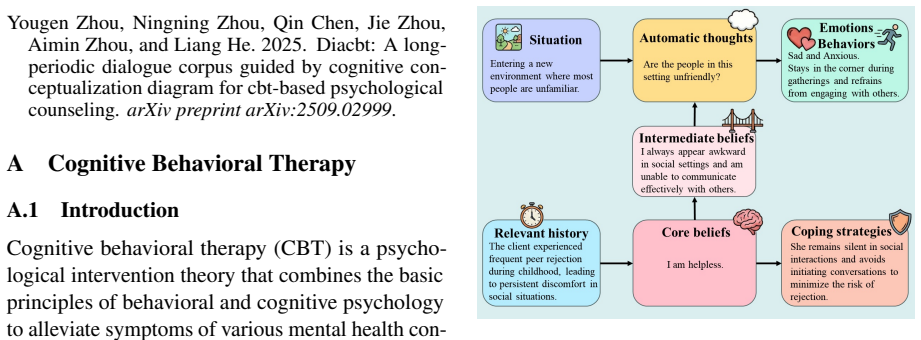
The CCD-CBT multi-agent framework, in which a Control Agent maintains and updates a Cognitive Conceptualization Diagram to structure information-asymmetric exchanges between a Therapist Agent and a Client Agent.
If this is right
- Fine-tuned models on the CCDCHAT dataset outperform baselines in counseling fidelity as assessed by clinical scales.
- These models also produce larger improvements in positive affect for simulated clients.
- Removing dynamic CCD updates or the asymmetric agent roles leads to measurable drops in performance, confirming both components are required.
- The approach supplies a concrete method for constructing theory-grounded conversational agents that better align with established CBT principles.
Where Pith is reading between the lines
- The same structure of live diagram updates plus information asymmetry could be tested in simulations of other therapy modalities to check whether the gains generalize.
- Deploying the trained models in pilot apps with consenting users would allow direct comparison of engagement and reported helpfulness against non-asymmetric systems.
- Adding mechanisms for the diagram to incorporate real-time user feedback might further reduce the gap between synthetic training and live sessions.
Load-bearing premise
That a synthetic multi-turn dataset generated by the framework, together with ratings from clinical scales and expert therapists, sufficiently represents the dynamic and asymmetric character of real human therapy interactions.
What would settle it
A controlled study measuring actual symptom reduction in real clients who interact over multiple sessions with a model fine-tuned on CCDCHAT versus clients using baseline models or standard care.
Figures






read the original abstract
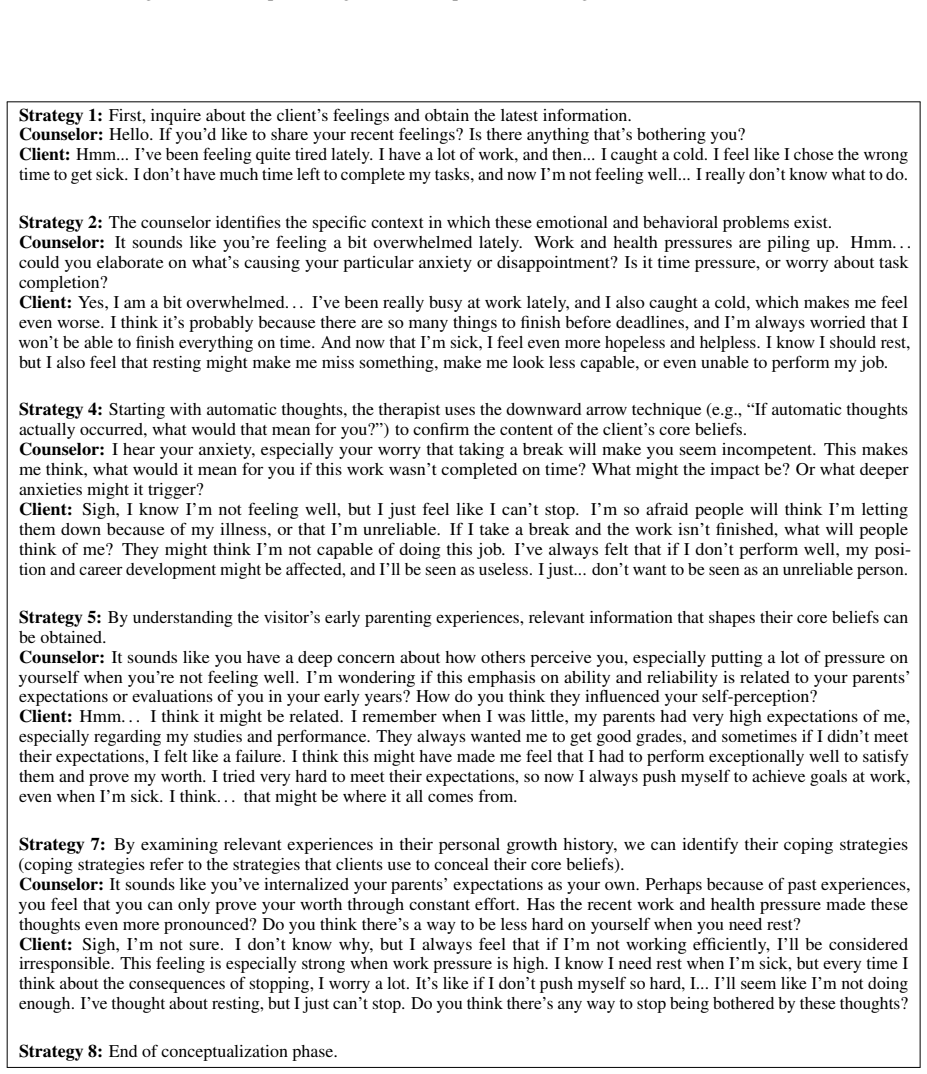
Large language models show potential for scalable mental-health support by simulating Cognitive Behavioral Therapy (CBT) counselors. However, existing methods often rely on static cognitive profiles and omniscient single-agent simulation, failing to capture the dynamic, information-asymmetric nature of real therapy. We introduce CCD-CBT, a multi-agent framework that shifts CBT simulation along two axes: 1) from a static to a dynamically reconstructed Cognitive Conceptualization Diagram (CCD), updated by a dedicated Control Agent, and 2) from omniscient to information-asymmetric interaction, where the Therapist Agent must reason from inferred client states. We release CCDCHAT, a synthetic multi-turn CBT dataset generated under this framework. Evaluations with clinical scales and expert therapists show that models fine-tuned on CCDCHAT outperform strong baselines in both counseling fidelity and positive-affect enhancement, with ablations confirming the necessity of dynamic CCD guidance and asymmetric agent design. Our work offers a new paradigm for building theory-grounded, clinically-plausible conversational agents.
Editorial analysis
A structured set of objections, weighed in public.
Referee Report
Summary. The paper introduces CCD-CBT, a multi-agent framework for CBT simulation that replaces static cognitive profiles and omniscient single-agent setups with a Control Agent that dynamically reconstructs and updates a Cognitive Conceptualization Diagram (CCD) while enforcing information asymmetry between Therapist and Client agents. It generates and releases the synthetic CCDCHAT multi-turn dataset under this framework, then reports that LLMs fine-tuned on CCDCHAT outperform baselines on clinical scales and expert therapist ratings for counseling fidelity and positive-affect enhancement, with ablations supporting the necessity of dynamic CCD guidance and asymmetric roles.
Significance. If the central claims hold after addressing evaluation independence, the work could advance theory-grounded mental-health agents by better approximating real therapy's dynamic and asymmetric information flow; the dataset release and explicit use of CBT's CCD construct are positive contributions that could support reproducible follow-on research.
major comments (3)
- [§3 and §4.1] §3 (CCD-CBT Framework) and §4.1 (CCDCHAT Construction): The entire CCDCHAT dataset is generated inside the proposed multi-agent pipeline (Control Agent updating CCD, Therapist reasoning from partial states). This makes training and test distributions dependent on the exact mechanisms being evaluated, so reported gains in fidelity and affect may reflect distribution match rather than genuine capture of real therapy asymmetry.
- [§4.3] §4.3 (Evaluation Protocol): The manuscript provides no details on whether expert ratings or clinical-scale assessments used held-out dialogues generated by a different process, real therapist-client transcripts, or external benchmarks. Without such separation, the outperformance claim and the ablation results confirming dynamic CCD and asymmetry cannot be distinguished from artifacts of the synthetic generation process.
- [Ablation Studies] Ablation Studies (Table 2 or equivalent): The 'no dynamic CCD' and 'symmetric agent' conditions must be shown to have been created without reusing the same Control Agent or generation pipeline; otherwise the ablations do not isolate the claimed contributions and the necessity argument is weakened.
minor comments (2)
- [Abstract and §4] The abstract and §4 could state the exact number of dialogues in CCDCHAT, the number of expert raters, and inter-rater agreement statistics for transparency.
- [§3] Notation for the CCD update rule and the asymmetric state representations could be formalized with a small diagram or pseudocode to improve readability.
Simulated Author's Rebuttal
We thank the referee for the constructive and detailed feedback. The comments highlight important aspects of our evaluation methodology that we will clarify in the revision. We address each major comment below.
read point-by-point responses
-
Referee: [§3 and §4.1] §3 (CCD-CBT Framework) and §4.1 (CCDCHAT Construction): The entire CCDCHAT dataset is generated inside the proposed multi-agent pipeline (Control Agent updating CCD, Therapist reasoning from partial states). This makes training and test distributions dependent on the exact mechanisms being evaluated, so reported gains in fidelity and affect may reflect distribution match rather than genuine capture of real therapy asymmetry.
Authors: We acknowledge that CCDCHAT is entirely generated via the CCD-CBT multi-agent pipeline, as this controlled synthetic generation is the core of our contribution for simulating dynamic, asymmetric CBT interactions. The train/test split uses held-out client profiles and distinct generation seeds not seen in training to create distributional separation within the framework. This design allows us to isolate the effects of our proposed mechanisms rather than claiming direct equivalence to real therapy data. We will revise §4.1 to explicitly describe the splitting procedure and add a Limitations section discussing the synthetic nature of the data and its implications for generalizability to real-world transcripts. revision: yes
-
Referee: [§4.3] §4.3 (Evaluation Protocol): The manuscript provides no details on whether expert ratings or clinical-scale assessments used held-out dialogues generated by a different process, real therapist-client transcripts, or external benchmarks. Without such separation, the outperformance claim and the ablation results confirming dynamic CCD and asymmetry cannot be distinguished from artifacts of the synthetic generation process.
Authors: All clinical-scale assessments and expert ratings were performed on held-out dialogues from CCDCHAT, generated with the same pipeline but using previously unseen client profiles and conversation seeds to ensure they were not part of the training distribution. No real therapist-client transcripts or external benchmarks were used, given ethical and privacy constraints on accessing such data at scale. We will update §4.3 with a full description of this held-out protocol, including how dialogues were sampled for expert review and the exact clinical scales applied, to eliminate ambiguity. revision: yes
-
Referee: [Ablation Studies] Ablation Studies (Table 2 or equivalent): The 'no dynamic CCD' and 'symmetric agent' conditions must be shown to have been created without reusing the same Control Agent or generation pipeline; otherwise the ablations do not isolate the claimed contributions and the necessity argument is weakened.
Authors: The ablation variants were produced through independent generation runs in which the Control Agent's CCD update logic was disabled for the 'no dynamic CCD' condition and full state sharing was enabled for the 'symmetric agent' condition. These runs used the same agent code base but with the targeted modifications and separate random seeds, ensuring the performance differences arise from the ablated components. We will expand the ablation section to document the exact generation configurations and confirm the independence of each condition from the main dataset. revision: yes
Circularity Check
No significant circularity: novel multi-agent components and external expert validation keep derivation self-contained
full rationale
The paper introduces a multi-agent framework with a Control Agent for dynamic CCD updates and asymmetric Therapist/Client roles, generates the CCDCHAT synthetic dataset under this framework, and reports that fine-tuned models outperform baselines on counseling fidelity and positive-affect metrics per clinical scales and expert therapist evaluations. No load-bearing step reduces to a self-definition, a fitted parameter renamed as prediction, or a self-citation chain; the ablations test the added components within the generated data, yet the human-expert and scale-based evaluations supply independent external grounding. The central claims therefore rest on empirical comparisons rather than any construction that equates outputs to inputs by definition.
Axiom & Free-Parameter Ledger
axioms (1)
- domain assumption Large language models can simulate realistic therapeutic interactions when guided by structured cognitive models such as the CCD.
invented entities (1)
-
Control Agent
no independent evidence
Reference graph
Works this paper leans on
-
[1]
Psychatbot: a psychological counseling agent towards depressed chinese population based on cog- nitive behavioural therapy.ACM Transactions on Asian and Low-Resource Language Information Pro- cessing. Yirong Chen, Xiaofen Xing, Jingkai Lin, Huimin Zheng, Zhenyu Wang, Qi Liu, and Xiangmin Xu. 2023. SoulChat: Improving LLMs’ empathy, listening, and comfort ...
work page internal anchor Pith review Pith/arXiv arXiv 2023
-
[2]
Development and validation of brief measures of positive and negative affect: the panas scales.Jour- nal of personality and social psychology, 54(6):1063. CONSTITUTION OF WHO. 2020. World health orga- nization.Air Quality Guidelines for Europe, (91). Mengxi Xiao, Qianqian Xie, Ziyan Kuang, Zhicheng Liu, Kailai Yang, Min Peng, Weiguang Han, and Jimin Huang...
discussion (0)
Sign in with ORCID, Apple, or X to comment. Anyone can read and Pith papers without signing in.