Clothoid helices obtained via the Lie-Darboux method
Pith reviewed 2026-05-10 18:37 UTC · model grok-4.3
The pith
Clothoid helices with curvature and torsion both linear in arc length are constructed via the Lie-Darboux method.
A machine-rendered reading of the paper's core claim, the machinery that carries it, and where it could break.
Core claim
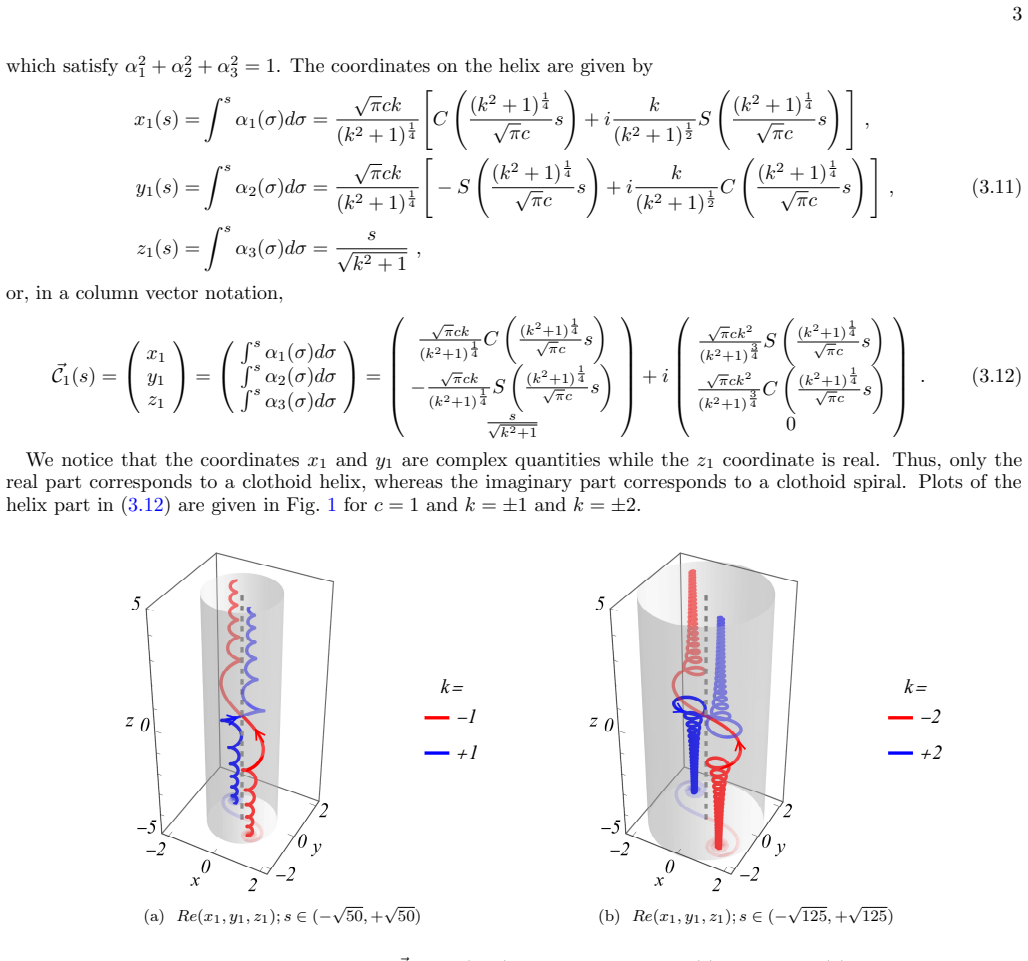
The clothoid helices that have both curvature and torsion directly proportional to the arclength are obtained via the Lie-Darboux method and studied in some detail. Shifted counterparts are also introduced and presented in the same approach.
What carries the argument
The Lie-Darboux method applied to the differential equations for curves whose curvature and torsion are linear functions of arc length.
Load-bearing premise
The Lie-Darboux method applies directly to the differential equations for curves with curvature and torsion linear in arc length without further restrictions.
What would settle it
Explicit integration of the Frenet-Serret equations for curvature proportional to arc length and torsion proportional to arc length that produces curves whose curvature and torsion deviate from the linear relations obtained by the Lie-Darboux construction.
Figures


read the original abstract
The clothoid helices that have both curvature and torsion directly proportional to the arclength are obtained via the Lie-Darboux method and analyzed in some detail. Shifted counterparts are also introduced and studied within the same framework.
Editorial analysis
A structured set of objections, weighed in public.
Referee Report
Summary. The manuscript claims to obtain and study in detail the clothoid helices with both curvature and torsion directly proportional to arc length (i.e., κ(s) = a s and τ(s) = b s) by applying the Lie-Darboux method to the associated linear system; it also constructs and analyzes shifted counterparts of these curves using the same approach.
Significance. If the derivations hold, the work supplies explicit, closed-form realizations of a nontrivial integrable family of space curves whose Frenet-Serret data are linear in arc length. The Lie-Darboux method guarantees that the resulting frame and position vector satisfy the governing equations by construction, which is a clear methodological strength and yields falsifiable, parameter-dependent families that can be directly compared with classical clothoids and helices.
minor comments (2)
- [Abstract] The abstract is terse and does not preview the explicit parametrizations or key properties obtained; a single additional sentence summarizing the main closed-form results would improve reader orientation.
- Notation for the integration constants (a, b and the shift parameters) is introduced without a consolidated table; adding such a table in the final section would aid comparison between the standard and shifted families.
Simulated Author's Rebuttal
We thank the referee for their positive evaluation of the manuscript and for recommending acceptance. The report accurately captures the main contributions.
Circularity Check
No significant circularity; method applied externally to linear system
full rationale
The paper applies the Lie-Darboux method to the differential system for curves with κ(s) = a s and τ(s) = b s, yielding explicit solutions whose frame and position satisfy the Frenet-Serret equations by the standard construction of the method. No step reduces a prediction or central result to a fitted parameter, self-definition, or load-bearing self-citation chain; the derivation is self-contained and independent of its outputs. Minor self-citation, if present, is not load-bearing on the central claim.
Axiom & Free-Parameter Ledger
axioms (1)
- standard math Standard differential geometry of space curves with well-defined curvature and torsion functions
Lean theorems connected to this paper
-
IndisputableMonolith/Foundation/AlexanderDuality.leanalexander_duality_circle_linking unclear?
unclearRelation between the paper passage and the cited Recognition theorem.
The clothoid helices that have both curvature and torsion directly proportional to the arclength are obtained via the Lie-Darboux method... dw/ds = −i κ(s) w + i τ(s)/2 w² − i τ(s)/2
What do these tags mean?
- matches
- The paper's claim is directly supported by a theorem in the formal canon.
- supports
- The theorem supports part of the paper's argument, but the paper may add assumptions or extra steps.
- extends
- The paper goes beyond the formal theorem; the theorem is a base layer rather than the whole result.
- uses
- The paper appears to rely on the theorem as machinery.
- contradicts
- The paper's claim conflicts with a theorem or certificate in the canon.
- unclear
- Pith found a possible connection, but the passage is too broad, indirect, or ambiguous to say the theorem truly supports the claim.
discussion (0)
Sign in with ORCID, Apple, or X to comment. Anyone can read and Pith papers without signing in.