Recognition: no theorem link
CoverAssert: Iterative LLM Assertion Generation Driven by Functional Coverage via Syntax-Semantic Representations
Pith reviewed 2026-05-10 18:38 UTC · model grok-4.3
The pith
Iterative clustering of assertion features with coverage feedback lets LLMs generate more complete SystemVerilog assertions.
A machine-rendered reading of the paper's core claim, the machinery that carries it, and where it could break.
Core claim
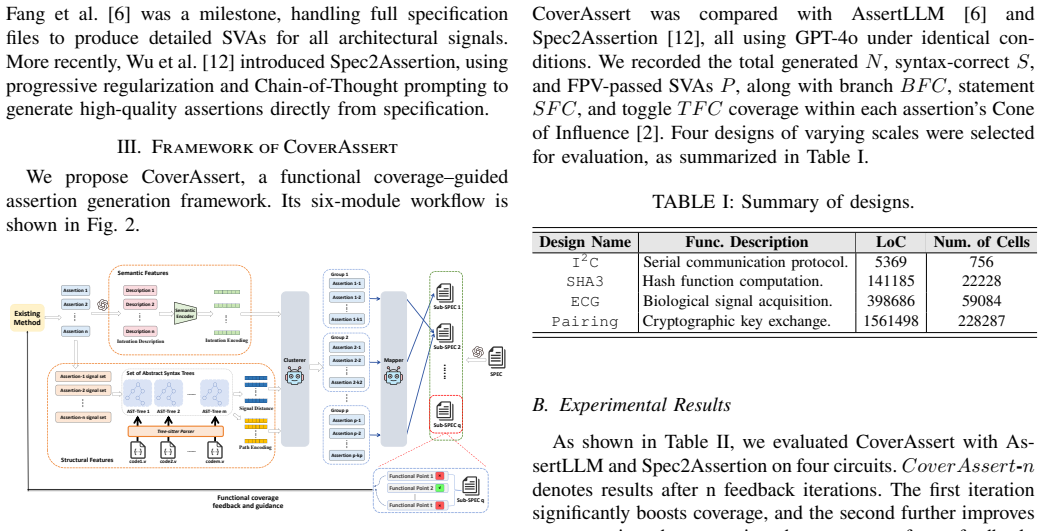
CoverAssert is an iterative framework that clusters semantic and AST-based structural features of assertions, maps them to specifications, and uses functional coverage feedback to guide LLMs in prioritizing uncovered points.
What carries the argument
Syntax-semantic clustering of assertions that groups outputs by meaning and parse-tree structure to expose specification coverage gaps for the next LLM iteration.
If this is right
- Integration with AssertLLM and Spec2Assertion produces average gains of 9.57 percent branch coverage, 9.64 percent statement coverage, and 15.69 percent toggle coverage.
- Single-pass LLM assertion generation is replaced by a loop that repeatedly targets uncovered functional points.
- Assertions become more complete with respect to the original specification because coverage data directly informs prioritization.
- The same clustering-plus-feedback pattern can be applied to any LLM-based assertion generator without changing the underlying model.
Where Pith is reading between the lines
- The approach could be tested on larger proprietary designs to check whether the clustering step remains effective when the number of assertions grows.
- Similar coverage-driven iteration might improve LLM outputs in related verification tasks such as test sequence generation.
- If the AST and semantic features prove stable across different HDLs, the framework could be adapted beyond SystemVerilog.
Load-bearing premise
Clustering semantic and AST features accurately identifies uncovered specification points without bias or missed critical behaviors, and the LLM can act on the coverage feedback in later rounds.
What would settle it
Running the full CoverAssert loop on one of the four designs and observing zero improvement in branch, statement, or toggle coverage after several iterations would show the feedback mechanism fails to drive progress.
Figures

read the original abstract
LLMs can generate SystemVerilog assertions (SVAs) from natural language specs, but single-pass outputs often lack functional coverage due to limited IC design understanding. We propose CoverAssert, an iterative framework that clusters semantic and AST-based structural features of assertions, maps them to specifications, and uses functional coverage feedback to guide LLMs in prioritizing uncovered points. Experiments on four open-source designs show that integrating CoverAssert with AssertLLM and Spec2Assertion improves average improvements of 9.57 % in branch coverage, 9.64 % in statement coverage, and 15.69 % in toggle coverage.
Editorial analysis
A structured set of objections, weighed in public.
Referee Report
Summary. The paper proposes CoverAssert, an iterative LLM-driven framework for generating SystemVerilog assertions (SVAs) from natural-language specifications. Assertions are clustered using semantic embeddings and AST-based structural features, mapped to uncovered specification points, and refined via functional coverage feedback in subsequent LLM prompts. When integrated with AssertLLM and Spec2Assertion, experiments on four open-source designs report average coverage gains of 9.57% (branch), 9.64% (statement), and 15.69% (toggle).
Significance. If the reported gains can be attributed to the syntax-semantic clustering and coverage-guided loop rather than generic iteration, the work would provide a practical advance in automated hardware verification by closing the coverage gap that single-pass LLM assertion generators typically exhibit. The approach is grounded in existing EDA tools and open-source designs, making it immediately testable by practitioners. No machine-checked proofs or parameter-free derivations are present, but the falsifiable coverage metrics constitute a clear empirical contribution if properly controlled.
major comments (2)
- [§4 (Experimental Evaluation)] §4 (Experimental Evaluation) and Table 1: the headline claim attributes the 9.57–15.69 % coverage deltas specifically to CoverAssert’s clustering of semantic/AST features plus coverage-guided re-prompting. The section compares only the full pipeline against the two base generators; no ablation removes the clustering step, substitutes random or uniform coverage signals, or holds total LLM calls constant while varying only the feedback mechanism. Without these controls the measured improvements cannot be isolated from additional iterations or prompt engineering.
- [Abstract and §4.1] Abstract and §4.1: average coverage improvements are stated without reporting per-design values, standard deviations, number of LLM calls per iteration, or statistical significance tests. The experimental setup description also omits implementation details of the clustering algorithm and the exact mapping from clusters to specification points, leaving the central empirical support only partially documented.
minor comments (3)
- [Abstract] Abstract: the phrase “improves average improvements” is redundant and should be rephrased for clarity.
- [Figure 3] Figure 3 (coverage feedback loop): the diagram does not label the semantic embedding model or the distance metric used for clustering, making the syntax-semantic representation harder to reproduce.
- [§3.2] §3.2: the notation for the combined feature vector (semantic + AST) is introduced without an explicit equation; adding a compact definition would improve readability.
Simulated Author's Rebuttal
We thank the referee for the constructive feedback on our manuscript. The comments highlight important opportunities to strengthen the experimental evaluation and reporting. We address each major comment below and outline the revisions we will incorporate.
read point-by-point responses
-
Referee: [§4 (Experimental Evaluation)] §4 (Experimental Evaluation) and Table 1: the headline claim attributes the 9.57–15.69 % coverage deltas specifically to CoverAssert’s clustering of semantic/AST features plus coverage-guided re-prompting. The section compares only the full pipeline against the two base generators; no ablation removes the clustering step, substitutes random or uniform coverage signals, or holds total LLM calls constant while varying only the feedback mechanism. Without these controls the measured improvements cannot be isolated from additional iterations or prompt engineering.
Authors: We agree that the current experiments do not fully isolate the contributions of syntax-semantic clustering and coverage-guided re-prompting from the effects of additional iterations or prompt engineering. The base generators (AssertLLM and Spec2Assertion) are single-pass methods, so the reported deltas demonstrate the value of the overall iterative framework. To strengthen attribution, we will add ablation studies in the revised §4: (1) replacing syntax-semantic clustering with random grouping of assertions, (2) substituting functional coverage feedback with random or uniform signals, and (3) holding the total number of LLM calls constant while varying only the feedback mechanism. These controls will clarify whether the gains stem specifically from the proposed components. revision: yes
-
Referee: [Abstract and §4.1] Abstract and §4.1: average coverage improvements are stated without reporting per-design values, standard deviations, number of LLM calls per iteration, or statistical significance tests. The experimental setup description also omits implementation details of the clustering algorithm and the exact mapping from clusters to specification points, leaving the central empirical support only partially documented.
Authors: We acknowledge that the current reporting is incomplete. In the revised manuscript we will expand the abstract and §4.1 to report per-design coverage values for all four open-source designs, standard deviations across multiple runs, the exact number of LLM calls per iteration, and statistical significance tests (e.g., paired t-tests on coverage deltas). We will also add a detailed description of the clustering algorithm, specifying how semantic embeddings and AST structural features are combined (including similarity metric and weighting), and the precise mapping procedure that associates clusters with uncovered specification points via the functional coverage database. revision: yes
Circularity Check
No circularity: empirical framework with external experimental validation
full rationale
The paper describes an iterative LLM framework (CoverAssert) that clusters assertions by semantic/AST features, maps to specs, and uses coverage feedback for re-prompting. Central claims consist of measured coverage gains (9.57–15.69 %) on four open-source designs when the method is integrated with AssertLLM and Spec2Assertion. No equations, first-principles derivations, or predictions appear; results are reported from direct experiments rather than any fitted parameter or self-referential definition. No self-citation load-bearing steps, uniqueness theorems, or ansatzes are invoked in the provided text. The derivation chain is therefore self-contained as an empirical proposal.
Axiom & Free-Parameter Ledger
Reference graph
Works this paper leans on
-
[1]
https://iwls.org/iwls2005/benchmarks.html
Iwls 2005 benchmaeks. https://iwls.org/iwls2005/benchmarks.html
2005
-
[2]
https://community.cadence.com/ cadence blogs 8/b/breakfast-bytes/posts/jasper-ml
Jaspergold: the Next Generation. https://community.cadence.com/ cadence blogs 8/b/breakfast-bytes/posts/jasper-ml
-
[3]
Focs–automatic generation of simulation checkers from formal specifications
Yael Abarbanel, Ilan Beer, Leonid Gluhovsky, Sharon Keidar, and Yaron Wolfsthal. Focs–automatic generation of simulation checkers from formal specifications. InComputer Aided Verification: 12th International Conference, CAV 2000, Chicago, IL, USA, July 15-19,
2000
-
[4]
Springer, 2000
Proceedings 12, pages 538–542. Springer, 2000
2000
-
[5]
Hybrid rule-based and machine learning system for assertion generation from natural language specifications
Fnu Aditi and Michael S Hsiao. Hybrid rule-based and machine learning system for assertion generation from natural language specifications. In 2022 IEEE 31st Asian Test Symposium (ATS), pages 126–131. IEEE, 2022
2022
-
[6]
Yunsheng Bai, Ghaith Bany Hamad, Syed Suhaib, and Haoxing Ren. Assertionforge: Enhancing formal verification assertion generation with structured representation of specifications and rtl.arXiv preprint arXiv:2503.19174, 2025
-
[7]
Wenji Fang, Mengming Li, Min Li, Zhiyuan Yan, Shang Liu, Zhiyao Xie, and Hongce Zhang. Assertllm: Generating and evaluating hardware verification assertions from design specifications via multi-llms.arXiv preprint arXiv:2402.00386, 2024
-
[8]
Harry Foster. 2024 wilson research group ic/asic functional verification trend report.https://resources.sw.siemens.com/zh-TW/white-paper-2024- wilson-research-group-ic-asic-functional-verification-trend-report/
2024
-
[9]
Assertion-based verification: Industry myths to realities (invited tutorial)
Harry Foster. Assertion-based verification: Industry myths to realities (invited tutorial). InComputer Aided Verification: 20th International Conference, CAV 2008 Princeton, NJ, USA, July 7-14, 2008 Proceedings 20, pages 5–10. Springer, 2008
2008
-
[10]
Assertgen: Enhancement of llm-aided assertion generation through cross-layer signal bridging
Hongqin Lyu, Yonghao Wang, Yunlin Du, Mingyu Shi, Zhiteng Chao, Wenxing Li, Tiancheng Wang, and Huawei Li. Assertgen: Enhancement of llm-aided assertion generation through cross-layer signal bridging. arXiv preprint arXiv:2509.23674, 2025
-
[11]
Using LLMs to facilitate formal verification of RTL,
Marcelo Orenes-Vera, Margaret Martonosi, and David Wentzlaff. Us- ing llms to facilitate formal verification of rtl.arXiv preprint arXiv:2309.09437, 2023
-
[12]
Yonghao Wang, Jiaxin Zhou, Hongqin Lyu, Zhiteng Chao, Tiancheng Wang, and Huawei Li. Deepassert: An llm-aided verification framework with fine-grained assertion generation for modules with extracted module specifications.arXiv preprint arXiv:2509.14668, 2025
-
[13]
Fenghua Wu, Evan Pan, Rahul Kande, Michael Quinn, Aakash Tyagi, David Kebo, Jeyavijayan Rajendran, and Jiang Hu. Spec2Assertion: Automatic pre-rtl assertion generation using large language models with progressive regularization.arXiv preprint arXiv:2505.07995, 2025
discussion (0)
Sign in with ORCID, Apple, or X to comment. Anyone can read and Pith papers without signing in.