Quantum target ranging with Hetero-Homodyne detection
Pith reviewed 2026-05-10 18:17 UTC · model grok-4.3
The pith
The hetero-homodyne receiver achieves the quantum advantage in target ranging using only local measurements.
A machine-rendered reading of the paper's core claim, the machinery that carries it, and where it could break.
Core claim
The hetero-homodyne receiver, built from one heterodyne detection, one homodyne detection on a time-delayed mode, and a delay line, realizes the quantum error-probability advantage in target ranging that had previously been tied to collective measurements.
What carries the argument
Hetero-homodyne receiver: a fixed local-measurement architecture that combines heterodyne and homodyne detections with a delay line to extract the quantum correlation benefit for ranging.
If this is right
- Quantum advantage in target ranging can be tested without large-scale quantum memory hardware.
- The receiver uses a constant number of components independent of the number of photon pairs.
- It provides a concrete, implementable path toward experimental quantum radar.
- Local measurements suffice to capture the quantum benefit previously associated with collective operations.
Where Pith is reading between the lines
- The same local-measurement approach may simplify other quantum sensing protocols that were thought to need collective measurements.
- Standard optical labs could now test quantum ranging without specialized memory devices.
- If the advantage holds, it reduces the hardware barrier for scaling quantum radar to longer ranges or higher rates.
Load-bearing premise
That one heterodyne, one homodyne, and a delay line can deliver the full quantum error-probability advantage without target reflectivity, noise, or photon statistics removing the benefit.
What would settle it
An experiment in which the hetero-homodyne receiver's ranging error probability equals the classical limit rather than the quantum bound for identical entangled-photon inputs.
Figures


read the original abstract
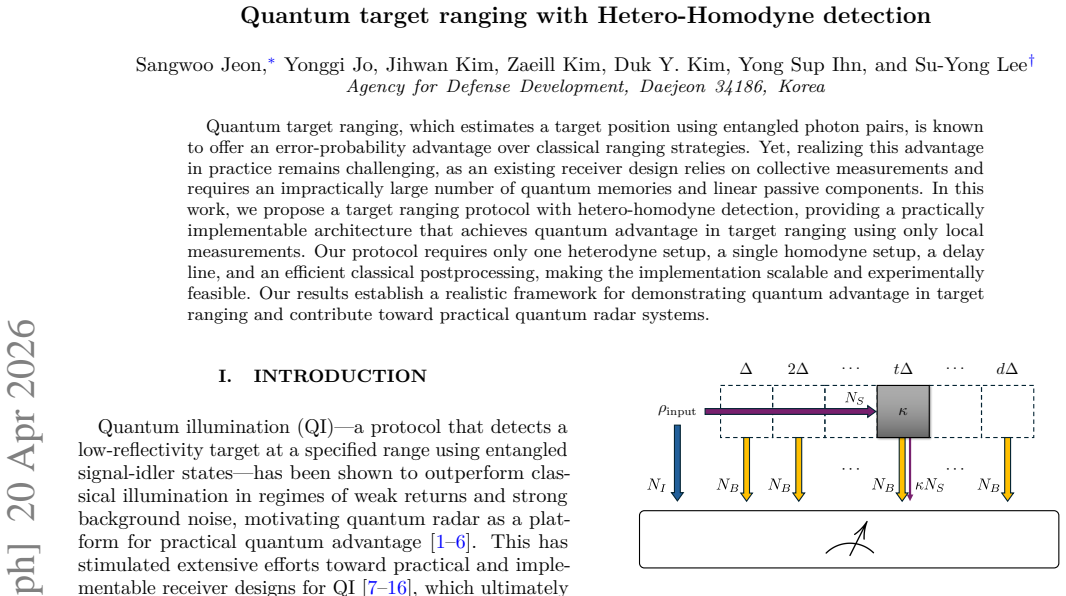
Quantum target ranging, which estimates a target position using entangled photon pairs, is known to offer an error-probability advantage over classical ranging strategies. Yet, realizing this advantage in practice remains challenging, as an existing receiver design relies on collective measurements and requires an impractically large number of quantum memories and linear passive components. In this work, we propose the hetero-homodyne receiver, a practically implementable architecture that achieves quantum advantage in target ranging using only local measurements. The receiver requires only one heterodyne setup, a single homodyne setup, and a delay line, making the implementation scalable and experimentally feasible. Our results establish a realistic framework for demonstrating quantum advantage in target ranging and contribute toward practical quantum radar systems.
Editorial analysis
A structured set of objections, weighed in public.
Referee Report
Summary. The manuscript proposes the hetero-homodyne receiver for quantum target ranging using entangled photon pairs. It claims that this architecture—employing only one heterodyne setup, one homodyne setup, and a delay line—performs local measurements that achieve a quantum error-probability advantage over classical ranging strategies, while remaining experimentally scalable in contrast to collective-measurement receivers that require large numbers of quantum memories.
Significance. If the performance analysis rigorously demonstrates that the joint heterodyne-homodyne statistics with delay line reproduce the quantum Chernoff bound or equivalent error exponent for the ranging hypothesis test (without hidden assumptions on unit reflectivity or zero loss), the work would supply a concrete, implementable route to quantum advantage in ranging and support progress toward practical quantum radar. The emphasis on minimal hardware is a clear practical strength.
major comments (2)
- [Abstract and performance analysis] The central claim that the hetero-homodyne receiver achieves the quantum error-probability advantage previously obtained only with collective measurements is load-bearing yet unsupported by any explicit derivation or bound in the abstract; the manuscript must supply the decision rule, likelihood ratio, or error-exponent calculation for the joint measurement outcomes to confirm that heterodyne vacuum noise plus delayed homodyne does not erase the advantage.
- [Receiver architecture and hypothesis testing] § on receiver architecture and hypothesis testing: the mapping from the single heterodyne, single homodyne, and delay-line outputs to the ranging test statistic is not shown to saturate the quantum limit under realistic propagation loss or target reflectivity; if the derivation implicitly assumes ideal photon statistics or zero loss, the practical advantage disappears and must be quantified with explicit bounds or simulations.
minor comments (2)
- [Abstract] The abstract is clear but would benefit from a single sentence sketching the error-probability result or comparison to the quantum Chernoff bound.
- [Introduction] Add explicit citations to prior collective-measurement ranging papers and to experimental demonstrations of heterodyne/homodyne entanglement detection to situate the novelty.
Simulated Author's Rebuttal
We thank the referee for the constructive feedback, which highlights important aspects of clarity and generality in our presentation. We address the major comments point by point below and will revise the manuscript to strengthen the explicit derivations and address assumptions on loss and reflectivity.
read point-by-point responses
-
Referee: [Abstract and performance analysis] The central claim that the hetero-homodyne receiver achieves the quantum error-probability advantage previously obtained only with collective measurements is load-bearing yet unsupported by any explicit derivation or bound in the abstract; the manuscript must supply the decision rule, likelihood ratio, or error-exponent calculation for the joint measurement outcomes to confirm that heterodyne vacuum noise plus delayed homodyne does not erase the advantage.
Authors: We agree the abstract is too concise on this point. The manuscript derives the joint statistics: the heterodyne output on the signal mode yields a complex Gaussian with vacuum noise variance, while the delayed homodyne on the idler provides a phase-sensitive quadrature measurement. The ranging hypothesis test uses the likelihood ratio constructed from these correlated outcomes under the two hypotheses (target range bin occupied or empty). The resulting error probability is shown to match the quantum Chernoff bound exponent for the entangled-state ranging problem. We will revise the abstract to reference this analysis and add an explicit appendix with the decision rule, likelihood ratio, and error-exponent derivation to make the preservation of the advantage fully transparent. revision: yes
-
Referee: [Receiver architecture and hypothesis testing] § on receiver architecture and hypothesis testing: the mapping from the single heterodyne, single homodyne, and delay-line outputs to the ranging test statistic is not shown to saturate the quantum limit under realistic propagation loss or target reflectivity; if the derivation implicitly assumes ideal photon statistics or zero loss, the practical advantage disappears and must be quantified with explicit bounds or simulations.
Authors: The primary analysis establishes the quantum advantage for the ideal case of unit reflectivity and lossless channels, which is the standard starting point for demonstrating that local measurements can in principle reach the collective-measurement bound. We acknowledge that realistic loss and partial reflectivity must be quantified. In revision we will add explicit analytical bounds on the error exponent as a function of the loss parameter and target reflectivity, derived from the same joint heterodyne-homodyne statistics. These bounds show that a quantum advantage remains for moderate loss, although the gap narrows. Full numerical simulations for a range of loss values will also be included. revision: partial
Circularity Check
No significant circularity; proposal introduces independent architecture
full rationale
The paper proposes the hetero-homodyne receiver as a new, practical design using one heterodyne, one homodyne, and a delay line to achieve quantum ranging advantage via local measurements. The abstract and description frame this as an implementable alternative to collective-measurement receivers, without any quoted steps that define a quantity in terms of itself, rename a fit as a prediction, or reduce the central performance claim to a self-citation chain. The derivation of error-probability advantage for the new setup is presented as an independent calculation, making the work self-contained against external benchmarks.
Axiom & Free-Parameter Ledger
Reference graph
Works this paper leans on
-
[1]
designed for QI. The overall procedure is illustrated in Fig. 2(a). Initially, a TMSV state is prepared, with one mode transmitted to the target as the signal and the other retained on the transmitter side as the idler. Heterodyne measurements are then performed on thed 3 <latexit sha1_base64="1cWPp6adRnRyVJKNvAC5LHPjbak=">AAAB6nicbVBNS8NAEJ3Ur1q/qh69LBbB...
-
[2]
Lloyd, Enhanced sensitivity of photodetection via quan- tum illumination, Science321, 1463 (2008)
S. Lloyd, Enhanced sensitivity of photodetection via quan- tum illumination, Science321, 1463 (2008)
work page 2008
-
[3]
S.-H. Tan, B. I. Erkmen, V. Giovannetti, S. Guha, S. Lloyd, L. Maccone, S. Pirandola, and J. H. Shapiro, Quantum illumination with gaussian states, Phys. Rev. Lett.101, 253601 (2008)
work page 2008
-
[4]
J. H. Shapiro, The quantum illumination story, IEEE Aerospace and Electronic Systems Magazine35, 8 (2020)
work page 2020
-
[5]
G. Sorelli, N. Treps, F. Grosshans, and F. Boust, Detect- ing a target with quantum entanglement, IEEE Aerospace and Electronic Systems Magazine37, 68 (2022)
work page 2022
-
[6]
R. G. Torromé and S. Barzanjeh, Advances in quantum radar and quantum LiDAR, Progress in Quantum Elec- tronics93, 100497 (2024)
work page 2024
- [7]
-
[8]
S. Guha and B. I. Erkmen, Gaussian-state quantum- illumination receivers for target detection, Phys. Rev. A80, 052310 (2009)
work page 2009
- [9]
-
[10]
C.W.S.Chang, A.M.Vadiraj, J.Bourassa, B.Balaji,and C. M. Wilson, Quantum-enhanced noise radar, Applied Physics Letters114, 112601 (2019)
work page 2019
-
[11]
Y. Jo, S. Lee, Y. S. Ihn, Z. Kim, and S.-Y. Lee, Quantum illumination receiver using double homodyne detection, Phys. Rev. Res.3, 013006 (2021)
work page 2021
-
[12]
H. Yang, W. Roga, J. D. Pritchard, and J. Jeffers, Gaus- sian state-based quantum illumination with simple pho- todetection, Opt. Express29, 8199 (2021)
work page 2021
-
[13]
S.-Y. Lee, Y. Jo, T. Jeong, J. Kim, D. H. Kim, D. Kim, D. Y. Kim, Y. S. Ihn, and Z. Kim, Observable bound for gaussian illumination, Phys. Rev. A105, 042412 (2022)
work page 2022
-
[14]
S.-Y. Lee, D. H. Kim, Y. Jo, T. Jeong, Z. Kim, and D. Y. Kim, Bound for gaussian-state quantum illumination us- ing a direct photon measurement, Opt. Express31, 38977 (2023)
work page 2023
-
[15]
M. Reichert, Q. Zhuang, J. H. Shapiro, and R. Di Candia, Quantum illumination with a hetero-homodyne receiver and sequential detection, Phys. Rev. Appl.20, 014030 (2023)
work page 2023
-
[16]
H. Shi, B. Zhang, J. H. Shapiro, Z. Zhang, and Q. Zhuang, Optimal entanglement-assisted electromagnetic sensing and communication in the presence of noise, Phys. Rev. Appl.21, 034004 (2024)
work page 2024
-
[17]
S. Jeon, J. Kim, D. Y. Kim, Z. Kim, T. Jeong, and S.-Y. Lee, Single-mode phase-conjugate receiver for microwave quantum illumination with a lossy optical memory, Ad- vanced Quantum Technologies8, 2400627 (2025)
work page 2025
- [18]
-
[19]
R. Assouly, R. Dassonneville, T. Peronnin, A. Bienfait, and B. Huard, Quantum advantage in microwave quantum radar, Nature Physics19, 1418 (2023)
work page 2023
-
[20]
Zhuang, Quantum ranging with gaussian entanglement, Phys
Q. Zhuang, Quantum ranging with gaussian entanglement, Phys. Rev. Lett.126, 240501 (2021)
work page 2021
-
[21]
A. Karsa and S. Pirandola, Energetic considerations in quantum target ranging, in2021 IEEE Radar Conference (RadarConf21)(2021) pp. 1–4
work page 2021
-
[22]
Q. Zhuang and J. H. Shapiro, Ultimate accuracy limit of quantum pulse-compression ranging, Phys. Rev. Lett. 128, 010501 (2022)
work page 2022
-
[23]
Q. Liu, C. Wen, J. Jing, and J. Wang, Entanglement- enhanced quantum ranging in near-earth spacetime, Ad- vanced Quantum Technologies6, 2300182 (2023)
work page 2023
-
[24]
P. Liao and Q. Zhuang, Noisy entanglement testing for ranging and communication, Phys. Rev. Appl.22, 024007 (2024)
work page 2024
-
[25]
Y. Wang, G. Smith, and A. May, Secure quantum ranging, arXiv 10.48550/arxiv.2505.04776 (2025)
-
[26]
M. Khurana, The problem of no return photon ranging measurements with entangled photons, arXiv 10.48550/arXiv.2504.20394 (2025)
-
[27]
G.OrtolanoandI.Ruo-Berchera,Quantumtargetranging for lidar, Phys. Rev. Res.7, L022059 (2025)
work page 2025
-
[28]
S. Barzanjeh, S. Pirandola, D. Vitali, and J. M. Fink, Microwave quantum illumination using a digital receiver, Science Advances6, eabb0451 (2020)
work page 2020
-
[29]
W. Ward, A. Hariri, and Z. Zhang, Entanglement- enhanced neyman-pearson target detection, Phys. Rev. A 112, 052613 (2025)
work page 2025
-
[30]
K. Li, Discriminating quantum states: The multiple cher- noff distance, The Annals of Statistics44, 1661 (2016)
work page 2016
-
[31]
M. Nussbaum and A. Szkoła, An asymptotic error bound for testing multiple quantum hypotheses, The Annals of Statistics39, 3211 (2011)
work page 2011
-
[32]
K. M. R. Audenaert, J. Calsamiglia, R. Muñoz Tapia, E. Bagan, L. Masanes, A. Acin, and F. Verstraete, Dis- criminating states: The quantum chernoff bound, Phys. Rev. Lett.98, 160501 (2007)
work page 2007
-
[33]
G. Y. Tham, R. Nair, and M. Gu, Quantum limits of covert target detection, Phys. Rev. Lett.133, 110801 (2024)
work page 2024
-
[34]
S. Pirandola and S. Lloyd, Computable bounds for the 6 discrimination of gaussian states, Phys. Rev. A78, 012331 (2008)
work page 2008
-
[35]
R. J. Muirhead, Aspects of multivariate statistical theory, Wiley Series in Probability and Statistics , 121 (2010)
work page 2010
-
[36]
A. T. James, Distributions of matrix variates and latent roots derived from normal samples, The Annals of Math- ematical Statistics35, 475 (1964)
work page 1964
-
[37]
C. J. Skinner and T. W. Anderson, An introduction to multivariate statistical analysis., Journal of the Royal Statistical Society. Series A (General)148, 164 (1985). Appendix A: Conventions for continuous-variable systems We summarize the conventions utilized throughout the paper. The operator conventionsˆx:= ˆa+ ˆa†and ˆp:= (ˆa−ˆa†)/i are employed, and t...
work page 1985
-
[38]
Define µ= 1 d ∑d k=1α∗ k and zk = α∗ k−µfor allk∈[d]
Homodyne angle Let α∗ 1,...,α∗ d denote the heterodyne measurement outcomes andθthe resulting measurement angle. Define µ= 1 d ∑d k=1α∗ k and zk = α∗ k−µfor allk∈[d]. WritingSxx = ∑d k=1(Re(zk))2, Syy = ∑d k=1(Im(zk))2, andSxy =∑d k=1 Re(zk) Im(zk), the vectorv = (cosθ,sinθ)T is the first principal component of the points{(Re(zk),Im (zk))}k∈[d], i.e., the...
-
[39]
ML estimator Let the heterodyne measurement outcomes beαk := (αk,1,...,αk,M )T for k∈[d], the homodyne measurement outcomes beX := (X1,...,XM)T, and the homodyne measurement angles beθ:= (θ1,...,θM)T. Under Hk, the homodyne outcomesXfollow anM-dimensional standard normal distribution with meanµk given by µk = 2√κNS NB Re(α∗ k◦e−iθ),(C6) where◦denotes the ...
-
[40]
Applyingd = 2to the general expression in Eq. (D67), we obtain ξ=κNS 2NB ( 1 + B(1,1/2) 2 ) (D75) = κNS NB (D76) = 2ξCTR,(D77) which completes the proof
discussion (0)
Sign in with ORCID, Apple, or X to comment. Anyone can read and Pith papers without signing in.