FlowInOne:Unifying Multimodal Generation as Image-in, Image-out Flow Matching
Pith reviewed 2026-05-15 06:58 UTC · model grok-4.3
The pith
All multimodal generation can be unified as image-in, image-out flow matching using visual prompts.
A machine-rendered reading of the paper's core claim, the machinery that carries it, and where it could break.
Core claim
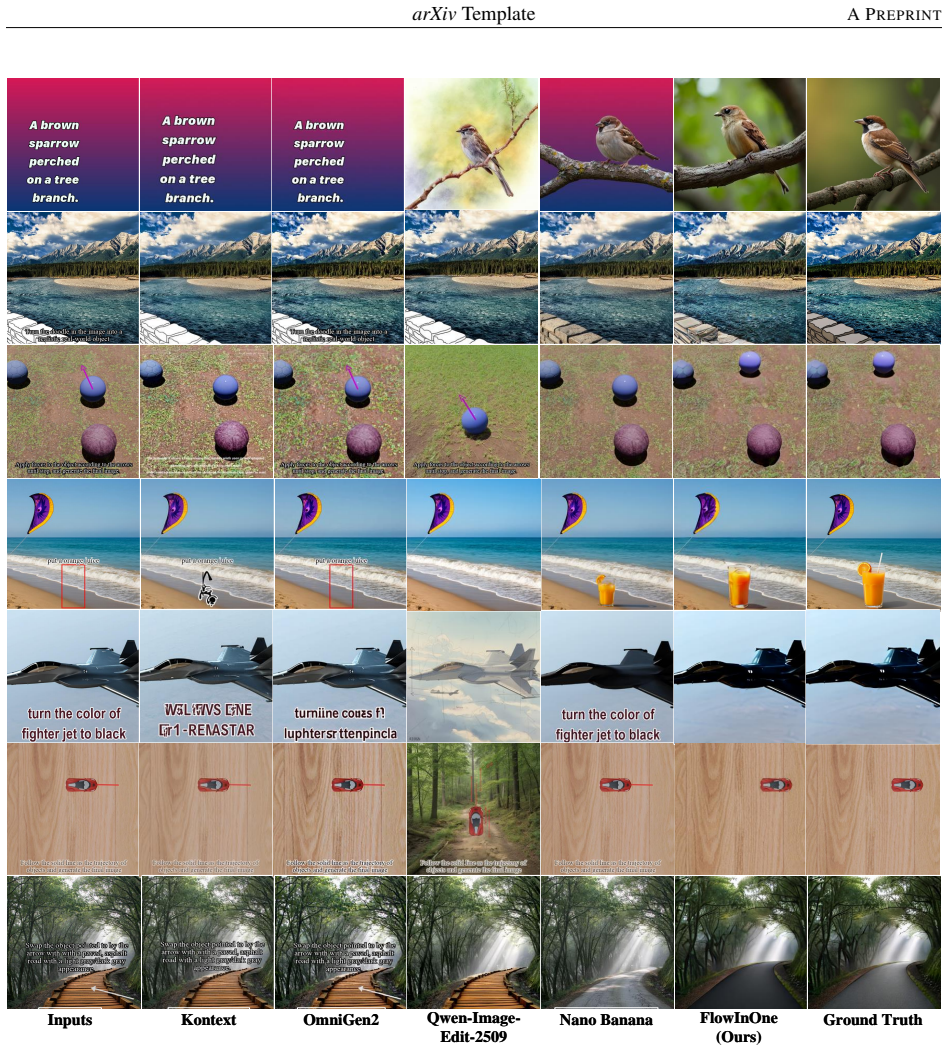
By converting textual descriptions, spatial layouts, and editing instructions into visual prompts, FlowInOne enables a single flow matching model to perform text-to-image generation, layout-guided editing, and visual instruction following as a unified image-to-image flow without cross-modal alignment or task branches.
What carries the argument
The visual prompt representation that encodes all task information visually for the flow matching process.
If this is right
- Text-to-image generation operates purely on visual inputs without language models.
- Layout-guided and instruction-based editing share the same model as generation.
- State-of-the-art results are obtained on unified tasks surpassing commercial systems.
- Physics-aware dynamics and trajectory prediction are supported within the visual framework.
Where Pith is reading between the lines
- Models trained this way could handle new tasks by simply designing appropriate visual prompts without retraining separate modules.
- Extending the approach to video generation might require only adding temporal visual prompts.
- Potential for fully visual reasoning agents where input and output stay in image space.
Load-bearing premise
Visual prompts can capture all the information from text, layouts, and instructions without any loss in fidelity or precision.
What would settle it
A controlled test where the same complex editing instruction is given via text to a standard model and via visual prompt to FlowInOne, and the visual prompt version shows clear degradation in following the instruction details.
Figures




read the original abstract
Multimodal generation has long been dominated by text-driven pipelines where language dictates vision but cannot reason or create within it. We challenge this paradigm by asking whether all modalities, including textual descriptions, spatial layouts, and editing instructions, can be unified into a single visual representation. We present FlowInOne, a framework that reformulates multimodal generation as a purely visual flow, converting all inputs into visual prompts and enabling a clean image-in, image-out pipeline governed by a single flow matching model. This vision-centric formulation naturally eliminates cross-modal alignment bottlenecks, noise scheduling, and task-specific architectural branches, unifying text-to-image generation, layout-guided editing, and visual instruction following under one coherent paradigm. To support this, we introduce VisPrompt-5M, a large-scale dataset of 5 million visual prompt pairs spanning diverse tasks including physics-aware force dynamics and trajectory prediction, alongside VP-Bench, a rigorously curated benchmark assessing instruction faithfulness, spatial precision, visual realism, and content consistency. Extensive experiments demonstrate that FlowInOne achieves state-of-the-art performance across all unified generation tasks, surpassing both open-source models and competitive commercial systems, establishing a new foundation for fully vision-centric generative modeling where perception and creation coexist within a single continuous visual space. Our code and models are released on https://csu-jpg.github.io/FlowInOne.github.io/
Editorial analysis
A structured set of objections, weighed in public.
Referee Report
Summary. The paper introduces FlowInOne, a framework that unifies multimodal generation (text-to-image, layout-guided editing, visual instruction following) by converting all inputs into visual prompts and training a single flow-matching model for image-in, image-out generation. It releases the VisPrompt-5M dataset (5M visual-prompt pairs) and VP-Bench benchmark, claiming SOTA performance that surpasses open-source and commercial systems while eliminating cross-modal alignment and task-specific branches.
Significance. If the central claims hold, the work offers a coherent vision-centric alternative to text-dominated pipelines, with the new large-scale dataset and benchmark providing reusable resources for the community. Public release of code and models is a clear strength that supports reproducibility.
major comments (1)
- [§3.2, Figure 3] §3.2 and Figure 3: the conversion pipeline (caption rendering, layout rasterization, instruction overlay) is presented as lossless, yet no quantitative measure of information preservation (mutual information, attribute reconstruction error, or held-out spatial/negation accuracy) is reported. This directly underpins the claim that the single visual space incurs no alignment loss or task degradation.
minor comments (1)
- [Abstract] Abstract: the SOTA claim is stated without any numerical metrics, baseline names, or ablation summary; a one-sentence quantitative highlight would improve readability.
Simulated Author's Rebuttal
We thank the referee for the constructive feedback on our manuscript. We address the major comment point by point below and commit to incorporating the suggested improvements in the revised version.
read point-by-point responses
-
Referee: [§3.2, Figure 3] §3.2 and Figure 3: the conversion pipeline (caption rendering, layout rasterization, instruction overlay) is presented as lossless, yet no quantitative measure of information preservation (mutual information, attribute reconstruction error, or held-out spatial/negation accuracy) is reported. This directly underpins the claim that the single visual space incurs no alignment loss or task degradation.
Authors: We appreciate the referee's observation that explicit quantitative validation of the conversion pipeline would strengthen our claims. Although the pipeline was engineered to preserve information via deterministic rendering steps (e.g., exact font placement for captions and precise bounding-box rasterization for layouts), we acknowledge that no direct metrics such as reconstruction error or held-out task accuracy were reported. In the revised manuscript we will add a new subsection in §3.2 with quantitative results: (i) attribute reconstruction accuracy on a held-out set of 10k visual prompts, (ii) spatial precision (IoU and coordinate error) for layout elements, and (iii) negation and instruction faithfulness scores measured via automated parsing of generated outputs against ground-truth overlays. These additions will directly quantify any residual information loss. revision: yes
Circularity Check
No circularity: unification achieved via new dataset and empirical training, not self-referential equations
full rationale
The paper's core claim is that multimodal inputs can be converted to visual prompts for a single flow-matching model, eliminating cross-modal issues. This is supported by the introduction of VisPrompt-5M dataset and VP-Bench benchmark, with released code. No equations, derivations, or self-citations are shown that reduce the central result to fitted inputs or prior author work by construction. The approach is self-contained as an empirical unification rather than a mathematical reduction to its own assumptions.
Axiom & Free-Parameter Ledger
Lean theorems connected to this paper
-
IndisputableMonolith/Cost/FunctionalEquation.leanwashburn_uniqueness_aczel unclear?
unclearRelation between the paper passage and the cited Recognition theorem.
Flow Matching (FM) Lipman et al. [2023] ... z_t = t z_1 + (1-(1-σ_min)t) z_0, v^*_t = z_1 - (1-σ_min) z_0 ... ODE d z_t / d t = v_θ(z_t, t)
-
IndisputableMonolith/Foundation/RealityFromDistinction.leanreality_from_one_distinction unclear?
unclearRelation between the paper passage and the cited Recognition theorem.
unifies text-to-image generation, layout-guided editing, and visual instruction following under one coherent paradigm
What do these tags mean?
- matches
- The paper's claim is directly supported by a theorem in the formal canon.
- supports
- The theorem supports part of the paper's argument, but the paper may add assumptions or extra steps.
- extends
- The paper goes beyond the formal theorem; the theorem is a base layer rather than the whole result.
- uses
- The paper appears to rely on the theorem as machinery.
- contradicts
- The paper's claim conflicts with a theorem or certificate in the canon.
- unclear
- Pith found a possible connection, but the passage is too broad, indirect, or ambiguous to say the theorem truly supports the claim.
Reference graph
Works this paper leans on
-
[1]
Robust Font Selection and Glyph Validation.To ensure the generative robustness of the text rendering, we implement a dynamic font-picking mechanism. Given an input text sequence, the engine first validates character support by parsing the TrueType font’scmap tables. To prevent the rendering of corrupted or “missing glyph” boxes (often caused by incomplete...
-
[2]
We utilize a custom tokenization algorithm tailored for visual layouts
Semantic-Aware Tokenization.Handling multi-lingual instructions requires precise line-breaking strategies. We utilize a custom tokenization algorithm tailored for visual layouts. Characters are isolated as individual tokens to allow flexible word wrapping, whereas Latin alphanumeric sequences and symbols are grouped as cohesive whole-word tokens. This str...
-
[3]
Adaptive Bounding-Box Layout Algorithm.To automatically determine the optimal typographic layout within a constrained visual canvas, we model the layout generation as a constrained optimization problem. Given a target bounding box with dimensions W×H , our goal is to find the maximum font size smax that accommodates the tokenized sequence T without overfl...
-
[4]
Context-Aware Stylization and Alpha Compositing.To guarantee text legibility regardless of the underlying visual content, we integrate a context-aware color contrast mechanism. Before rendering, the engine calculates the perceptual luminanceLof the underlying image region bounded by the text block: L= 0.299µ R + 0.587µG + 0.114µB (11) where µR, µG, µB den...
-
[5]
Analysis of the Layout Algorithm.The proposed adaptive layout strategy (Algorithm 1) provides several critical advantages for large-scale data synthesis: • Computational Efficiency:Traditional text rendering engines often rely on a linear step-down approach (iteratively decreasing font size until the text fits), yielding a time complexity of O(Smax −S min...
-
[6]
OCR-based Legibility Verification.To ensure the synthesized text is completely legible and free from truncation or rendering artifacts (e.g., overlapping bounding boxes or corrupted glyphs), we deploy an Optical Character Recognition (OCR) engine as the first filter. Let Tsrc denote the original instruction text and Tocr denote the text extracted from the...
work page 2000
-
[7]
Does the main subject in the image perfectly align with the embedded text prompt: [PROMPT]?
Task-Specific VLM Quality Inspection.Images that pass the OCR check are subsequently evaluated by an advanced Multimodal Large Language Model (MLLM, e.g., Qwen3-VL). To handle the diverse nature of our generative tasks, we design task-specific prompts. The VLM acts as a judge, outputting a boolean decision based on customized criteria: • Fundamental Gener...
-
[8]
We extract CLIP image embeddings Eclip(I) for all candidates within a specific sub-task
Diversity-Oriented Deduplication.To maximize the informational entropy of the dataset and prevent mode collapse during training, we apply a diversity-oriented filtering mechanism. We extract CLIP image embeddings Eclip(I) for all candidates within a specific sub-task. A candidate Ii is retained only if its cosine similarity with all previously accepted im...
-
[9]
Broad Semantic and Stylistic Coverage (Long-Tailed Nature).Our text-in-image editing subsets—derived heavily from UnicEdit, GPT-Image-Edit, and PicoBanana—encompass a massive spectrum of user intents. UnicEdit and GPT-Image-Edit contribute the bulk of the volume, dominated by high-frequency operations such asColor Alteration (∼203K),Attribute Modification...
-
[10]
Our structured editing subsets (PixWizard and VisMarker) serve this exact purpose
Spatial Reasoning and Region-Aware Constraints.While text instructions govern semantic changes, visual and geometric inputs dictate spatial precision. Our structured editing subsets (PixWizard and VisMarker) serve this exact purpose. The VisMarker subset provides highly balanced, region-aware supervision across 8 core categories (e.g., Object Swap,Removal...
-
[11]
Physics-Aware and Kinematic Dynamics.A uniquely challenging component ofVisPrompt-5Mis the Force & Trajectory generation subset. While smaller in scale compared to semantic edits (comprising specifically curated classes likeballs_pokeat ∼11K andwindat ∼9K), this subset is of exceptionally high fidelity. It forces the image-to-image paradigm to step beyond...
work page 2024
-
[13]
Spatial Precision The semantic precision of the generated result in responding to the generation instruction. Object that matches instruction description Checkpoints Objects Attributes Actions …… Case A Canvas cleanliness Case B Background preservation Checkpoints Preservation of the background and non- edited areas Removal of instructions/markers …… The ...
-
[15]
Spatial Precision The semantic precision of the generated result in responding to the generation instruction. Object that matches instruction description Checkpoints Objects Attributes Actions …… Case A Canvas cleanliness Case B Background preservation Checkpoints Preservation of the background and non- edited areas Removal of instructions/markers …… The ...
-
[16]
Instruction Fidelity
-
[17]
Spatial Precision The semantic precision of the generated result in responding to the generation instruction. Object that matches instruction description Checkpoints Objects Attributes Actions …… Case A Canvas cleanliness Case B Background preservation Checkpoints Preservation of the background and non- edited areas Removal of instructions/markers …… The ...
-
[18]
Instruction Fidelity •General Objective: The semantic precision of the generated result in responding to the generation instruction. •Checkpoints: Do the core objects, attributes (color, material), and actions described in the instruction accurately appear in the generated image? •Critical Judgment: If the generated content is irrelevant to the text descr...
-
[19]
Content Consistency (Non-Edited Areas) •Case A (Text-Only Source Image): • Objective: Canvas cleanliness. • Checkpoints: Is the generated subject clear? Is the background clean or logical? (i.e., it should not produce messy, hallucinated objects). As long as the generated image is not chaotic, this metric can receive a high score. •Case B (Annotated Real-...
-
[20]
Visual Realism •General Objective: The naturalness of the image and the effective suppression of artifacts. •Checkpoints: • Are there conspicuous artifacts, blurriness, jagged edges, or anatomical distortions (e.g., twisted limbs)? • For Case B, is the blending between the edited region and the original background natural?
-
[21]
Spatial Control Precision •Case A (Text-Only Source Image): • Objective: Compositional rationality. • Checkpoints: If there are no explicit visual markers, assign a default score of 5 (provided the object is complete and within the frame). •Case B (Annotated Real-World Image): • Objective: Marker alignment. • Checkpoints: Is the generated content strictly...
work page 2020
discussion (0)
Sign in with ORCID, Apple, or X to comment. Anyone can read and Pith papers without signing in.