Recognition: no theorem link
Production-Ready Automated ECU Calibration using Residual Reinforcement Learning
Pith reviewed 2026-05-10 18:46 UTC · model grok-4.3
The pith
Residual reinforcement learning refines sub-optimal ECU calibration maps to closely match series production references while preserving explainability.
A machine-rendered reading of the paper's core claim, the machinery that carries it, and where it could break.
Core claim
Applying a residual reinforcement learning agent to correct the outputs of an existing map-based air path controller allows an initial sub-optimal calibration to converge rapidly to a final map that closely resembles the reference calibration stored in the series ECU. The process runs on a hardware-in-the-loop platform, follows standard automotive development workflows, and produces an explainable result because the underlying controller remains a set of maps rather than a neural network.
What carries the argument
A residual reinforcement learning agent that learns additive corrections to the base map outputs of the ECU controller, leaving the original map-based structure intact for explainability and integration.
Load-bearing premise
Residual RL adjustments to map-based controllers will stay stable, explainable, and acceptable under full production automotive validation once taken beyond the HiL test environment.
What would settle it
Real-vehicle or full production validation tests in which the RL-refined calibration map fails to meet emission limits, stability requirements, or drivability criteria that the reference map satisfies.
Figures


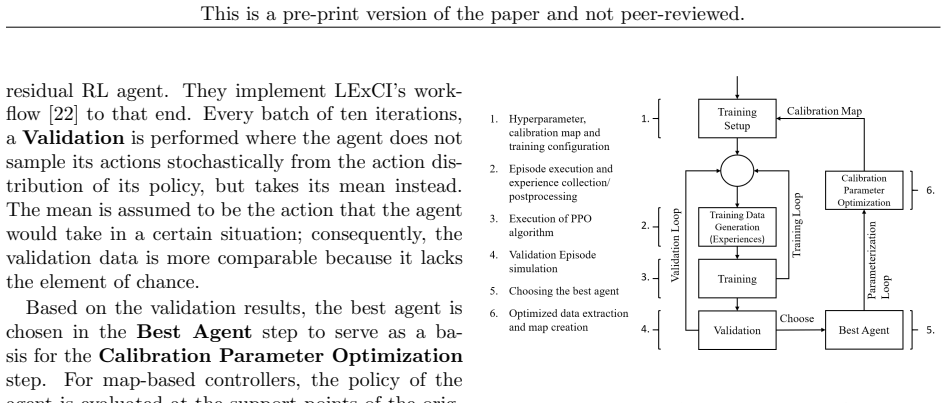


read the original abstract
Electronic Control Units (ECUs) have played a pivotal role in transforming motorcars of yore into the modern vehicles we see on our roads today. They actively regulate the actuation of individual components and thus determine the characteristics of the whole system. In this, the behavior of the control functions heavily depends on their calibration parameters which engineers traditionally design by hand. This is taking place in an environment of rising customer expectations and steadily shorter product development cycles. At the same time, legislative requirements are increasing while emission standards are getting stricter. Considering the number of vehicle variants on top of all that, the conventional method is losing its practical and financial viability. Prior work has already demonstrated that optimal control functions can be automatically developed with reinforcement learning (RL); since the resulting functions are represented by artificial neural networks, they lack explainability, a circumstance which renders them challenging to employ in production vehicles. In this article, we present an explainable approach to automating the calibration process using residual RL which follows established automotive development principles. Its applicability is demonstrated by means of a map-based air path controller in a series control unit using a hardware-in-the-loop (HiL) platform. Starting with a sub-optimal map, the proposed methodology quickly converges to a calibration which closely resembles the reference in the series ECU. The results prove that the approach is suitable for the industry where it leads to better calibrations in significantly less time and requires virtually no human intervention
Editorial analysis
A structured set of objections, weighed in public.
Referee Report
Summary. The manuscript presents a residual reinforcement learning approach to automate calibration of map-based controllers in automotive ECUs. It demonstrates the method on an air-path controller in a series ECU on a hardware-in-the-loop (HiL) platform, claiming that starting from a sub-optimal map the method quickly converges to a calibration closely resembling the reference series ECU, with virtually no human intervention and suitability for production use.
Significance. If the empirical results hold under broader validation, the work could meaningfully reduce calibration time and effort in automotive development while preserving the explainability of traditional map-based controllers. The residual RL framing aligns with established industry practices of refining existing calibrations rather than replacing them with opaque neural policies, which is a practical strength for adoption.
major comments (3)
- Abstract: the central claims that the method 'quickly converges' to a calibration 'which closely resembles the reference' and yields 'better calibrations in significantly less time' with 'virtually no human intervention' are stated without any quantitative metrics, convergence curves, error statistics, or statistical comparisons to baselines. This absence prevents assessment of whether the HiL demonstration actually supports the production-readiness assertion.
- Demonstration section (HiL results): the evaluation is confined to a single map-based air-path controller on a HiL platform. No closed-loop stability margins, Monte Carlo robustness trials under unmodeled disturbances, or real-vehicle data are reported, leaving the claim that residual RL refinements remain stable and acceptable under production automotive validation processes unsupported.
- Methodology and explainability discussion: while residual RL is presented as preserving explainability, there is no analysis showing that the learned residual corrections maintain monotonicity, interpretability, or avoid introducing non-explainable behavior when the calibrated map is deployed outside the HiL environment.
minor comments (2)
- Abstract: the informal phrasing 'motorcars of yore' is out of place in a technical manuscript; replace with standard academic language.
- Ensure every quantitative claim in the abstract is directly tied to specific figures, tables, or numerical results in the main text.
Simulated Author's Rebuttal
We thank the referee for the constructive and detailed feedback, which has helped us identify areas to strengthen the manuscript. We address each major comment point by point below, providing honest responses based on the current work and indicating revisions where appropriate.
read point-by-point responses
-
Referee: Abstract: the central claims that the method 'quickly converges' to a calibration 'which closely resembles the reference' and yields 'better calibrations in significantly less time' with 'virtually no human intervention' are stated without any quantitative metrics, convergence curves, error statistics, or statistical comparisons to baselines. This absence prevents assessment of whether the HiL demonstration actually supports the production-readiness assertion.
Authors: We agree that the abstract would be strengthened by including quantitative support for the claims. The results section of the manuscript contains convergence curves, error statistics, and comparisons (e.g., iteration counts and error reductions relative to the initial sub-optimal map and manual baselines). In the revised manuscript, we have updated the abstract to incorporate specific metrics such as convergence within approximately 50-100 iterations, over 80% reduction in mean absolute tracking error, and references to the associated figures and tables. revision: yes
-
Referee: Demonstration section (HiL results): the evaluation is confined to a single map-based air-path controller on a HiL platform. No closed-loop stability margins, Monte Carlo robustness trials under unmodeled disturbances, or real-vehicle data are reported, leaving the claim that residual RL refinements remain stable and acceptable under production automotive validation processes unsupported.
Authors: The demonstration intentionally focuses on a representative production air-path controller using HiL, which is a standard and accepted validation step in automotive ECU development prior to vehicle testing. We have added a dedicated limitations subsection discussing stability implications of the residual approach (noting that residuals are constrained to small, bounded corrections) and outlining plans for future Monte Carlo analysis. Real-vehicle data and full production validation processes are outside the scope of this initial feasibility study. revision: partial
-
Referee: Methodology and explainability discussion: while residual RL is presented as preserving explainability, there is no analysis showing that the learned residual corrections maintain monotonicity, interpretability, or avoid introducing non-explainable behavior when the calibrated map is deployed outside the HiL environment.
Authors: We have expanded the methodology section with a new analysis subsection. This includes verification that the learned residuals preserve monotonicity of the base maps (via partial derivative checks and visualization), explicit interpretation of residuals as additive corrections that calibration engineers can inspect and override, and a discussion of deployment outside HiL (e.g., how the hybrid map+residual structure avoids opaque behavior). revision: yes
- Real-vehicle experimental data and comprehensive Monte Carlo robustness trials under unmodeled disturbances, as these require additional hardware access, safety certifications, and resources beyond the HiL platform used in the current study.
Circularity Check
No circularity: empirical hardware demonstration with no derivation chain
full rationale
The paper presents an empirical application of residual RL to calibrate a map-based air-path controller on a HiL platform. The abstract and description state that starting from a sub-optimal map the method converges to a calibration resembling the series ECU reference, with virtually no human intervention. No mathematical derivations, equations, fitted parameters presented as predictions, self-definitional constructs, or load-bearing self-citations appear in the provided text. The work is framed as an experimental validation following automotive principles rather than a closed-form theoretical result dependent on its own inputs. Prior RL work is referenced only as background, not as a self-referential justification for the current outcomes. The demonstration is therefore self-contained against external benchmarks.
Axiom & Free-Parameter Ledger
Reference graph
Works this paper leans on
-
[1]
Rolf Isermann. Automotive Control: Modeling and Control of Vehicles . Springer, 2022. isbn: ISBN 978-3-642-39439-3. doi: 10.1007/978- 3-642-39440-9 . url: https://doi.org/10. 1007/978-3-642-39440-9
-
[2]
Automotive Powertrain Control — A Survey
Jeffrey A. Cook et al. “Automotive Powertrain Control — A Survey”. In: Asian Journal of Control 8.3 (2006), pp. 237–260. doi: https: / / doi . org / 10 . 1111 / j . 1934 - 6093 . 2006 . tb00275 . x. url: https : / / onlinelibrary . wiley.com/doi/abs/10.1111/j.1934-6093. 2006.tb00275.x
-
[3]
Optimal calibration scheme for map-based control of diesel engines
Yui Nishio et al. “Optimal calibration scheme for map-based control of diesel engines”. In: Science China Information Sciences 61.7 (2018), p. 70205. doi: 10.1007/s11432-017- 9381 - 6. url: https : / / doi . org / 10 . 1007 / s11432-017-9381-6
-
[4]
Modeling and optimization for stationary base engine calibration
Benjamin Berger. “Modeling and optimization for stationary base engine calibration”. PhD thesis. Technische Universit¨ at M¨ unchen, 2012
2012
-
[5]
Dynamic Model-Based Calibration Optimization: An In- troduction and Application to Diesel Engines
Chris Atkinson and Gregory Mott. “Dynamic Model-Based Calibration Optimization: An In- troduction and Application to Diesel Engines”. In: SAE 2005 World Congress & Exhibition . SAE International, Apr. 2005. doi: https:// doi . org / 10 . 4271 / 2005 - 01 - 0026 . url: https://doi.org/10.4271/2005-01-0026
-
[6]
Revealing the complexity of automotive software
Vard Antinyan. “Revealing the complexity of automotive software”. In: Proceedings of the 28th ACM Joint Meeting on European Soft- ware Engineering Conference and Symposium on the Foundations of Software Engineering . 2020, pp. 1525–1528
2020
-
[7]
Peter Shih et al. “Reinforcement-Learning- Based Output-Feedback Control of Nonstrict Nonlinear Discrete-Time Systems with Appli- cation to Engine Emission Control”. In: IEEE transactions on systems, man, and cybernet- ics. Part B, Cybernetics : a publication of the IEEE Systems, Man, and Cybernetics Society 39 (Apr. 2009), pp. 1162–79. doi: 10 . 1109 / T...
-
[8]
Intelligent Control Strategy for Transient Response of a Variable Geometry Turbocharger System Based on Deep Rein- forcement Learning
Bo Hu et al. “Intelligent Control Strategy for Transient Response of a Variable Geometry Turbocharger System Based on Deep Rein- forcement Learning”. In: Processes 7.9 (2019). issn: 2227-9717. doi: 10 . 3390 / pr7090601. url: https : / / www . mdpi . com / 2227 - 9717 / 7/9/601
2019
-
[9]
A review of reinforcement learning based en- ergy management systems for electrified pow- ertrains: Progress, challenge, and potential so- lution
Akhil Hannegudda Ganesh and Bin Xu. “A review of reinforcement learning based en- ergy management systems for electrified pow- ertrains: Progress, challenge, and potential so- lution”. In: Renewable and Sustainable Energy Reviews 154 (2022), p. 111833. issn: 1364-
2022
-
[10]
org / 10
doi: https : / / doi . org / 10 . 1016 / j . rser . 2021 . 111833. url: https : / / www . sciencedirect.com/science/article/pii/ S136403212101100X
2021
-
[11]
Sutton and Andrew G
Richard S. Sutton and Andrew G. Barto. Rein- forcement Learning: An Introduction . second. Cambridge, Massachusetts, USA: The MIT Press, 2018. isbn: 9780262039246. url: http: //incompleteideas.net/book/RLbook2020. pdf
2018
-
[12]
Transfer of Reinforce- ment Learning-Based Controllers from Model- to Hardware-in-the-Loop
Mario Picerno et al. Transfer of Reinforce- ment Learning-Based Controllers from Model- to Hardware-in-the-Loop. 2023. arXiv: 2310 . 17671 [cs.LG]
2023
-
[13]
Turbocharger Control for Emission Reduction Based on Deep Reinforce- ment Learning
Mario Picerno et al. “Turbocharger Control for Emission Reduction Based on Deep Reinforce- ment Learning”. In: IFAC-PapersOnLine 56.2 (2023). 22nd IFAC World Congress, pp. 8266–
2023
-
[14]
doi: https://doi.org/ 10
issn: 2405-8963. doi: https://doi.org/ 10 . 1016 / j . ifacol . 2023 . 10 . 1012. url: This is a pre-print version of the paper and not peer-reviewed. https://www.sciencedirect.com/science/ article/pii/S2405896323013952
2023
-
[15]
Automated function de- velopment for emission control with deep re- inforcement learning
Lucas Koch et al. “Automated function de- velopment for emission control with deep re- inforcement learning”. In: Engineering Appli- cations of Artificial Intelligence 117 (2023), p. 105477. issn: 0952-1976. doi: https://doi. org/10.1016/j.engappai.2022.105477. url: https://www.sciencedirect.com/science/ article/pii/S0952197622004675
-
[16]
Real-time self- learning optimization of diesel engine calibra- tion
Andreas A Malikopoulos, Dennis N Assanis, and Panos Y Papalambros. “Real-time self- learning optimization of diesel engine calibra- tion”. en. In: J. Eng. Gas Turbine. Power 131.2 (Mar. 2009), p. 022803
2009
-
[17]
Informing sequential clinical decision-making through reinforce- ment learning: an empirical study
Gabriel Dulac-Arnold et al. “Challenges of Real-World Reinforcement Learning: Defini- tions, Benchmarks and Analysis”. In: Machine Learning 110.09 (Sept. 2021), pp. 2419–2468. issn: 1573-0565. doi: 10.1007/s10994- 021- 05961- 4. url: https://doi.org/10.1007/ s10994-021-05961-4
-
[18]
Safe Reinforcement Learning for Real-World Engine Control
Julian Bedei et al. Safe Reinforcement Learning for Real-World Engine Control . 2026. arXiv: 2501.16613 [cs.LG] . url: https://arxiv. org/abs/2501.16613
-
[19]
Explainable reinforcement learning for powertrain control engineering
C. Laflamme et al. “Explainable reinforcement learning for powertrain control engineering”. In: Engineering Applications of Artificial In- telligence 146 (2025), p. 110135. issn: 0952-
2025
- [20]
-
[21]
Residual Reinforce- ment Learning for Robot Control
Tobias Johannink et al. “Residual Reinforce- ment Learning for Robot Control”. In: 2019 International Conference on Robotics and Au- tomation (ICRA) . 2019, pp. 6023–6029. doi: 10.1109/ICRA.2019.8794127
-
[22]
Powertrain calibration based on X-in-the-Loop: Virtualization in the vehicle development process
Matthias K¨ otter et al. “Powertrain calibration based on X-in-the-Loop: Virtualization in the vehicle development process”. In: 18. Interna- tionales Stuttgarter Symposium. Ed. by Michael Bargende, Hans-Christian Reuss, and Jochen Wiedemann. Wiesbaden: Springer Fachmedien Wiesbaden, 2018, pp. 1187–1201. isbn: 978-3- 658-21194-3
2018
-
[23]
Virtual Powertrain Sim- ulation: X-in-the-Loop Methods for Concept and Software Development
Mario Picerno et al. “Virtual Powertrain Sim- ulation: X-in-the-Loop Methods for Concept and Software Development”. In: 21. Interna- tionales Stuttgarter Symposium. Ed. by Michael Bargende, Hans-Christian Reuss, and An- dreas Wagner. Wiesbaden: Springer Fachme- dien Wiesbaden, 2021, pp. 531–545. isbn: 978- 3-658-33466-6. doi: 10 . 1007 / 978 - 3 - 658 - 3...
2021
-
[24]
Plant Modelling of En- gine and Aftertreatment Systems for X-in-the- Loop Simulations with Detailed Chemistry
Micha l Pasternak et al. “Plant Modelling of En- gine and Aftertreatment Systems for X-in-the- Loop Simulations with Detailed Chemistry”. In: CONAT 2024 International Congress of Automotive and Transport Engineering . Ed. by Anghel Chiru and Dinu Covaciu. Cham: Springer Nature Switzerland, 2025, pp. 151–
2024
-
[25]
isbn: 978-3-031-77627-4
-
[26]
LExCI: A framework for reinforcement learning with embedded sys- tems
Kevin Badalian et al. “LExCI: A framework for reinforcement learning with embedded sys- tems”. In: Applied Intelligence (June 2024). issn: 1573-7497. doi: 10.1007/s10489- 024- 05573- 0. url: https://doi.org/10.1007/ s10489-024-05573-0
-
[27]
Ray: A distributed framework for emerging {AI} applications
Philipp Moritz et al. “Ray: A distributed framework for emerging {AI} applications”. In: 13th USENIX symposium on operating systems design and implementation (OSDI 18) . 2018, pp. 561–577
2018
-
[28]
RLlib: Abstractions for dis- tributed reinforcement learning
Eric Liang et al. “RLlib: Abstractions for dis- tributed reinforcement learning”. In: Interna- tional conference on machine learning . PMLR. 2018, pp. 3053–3062
2018
-
[29]
TensorFlow: Large-Scale Machine Learning on Heterogeneous Systems
Mart´ ın Abadi et al. TensorFlow: Large-Scale Machine Learning on Heterogeneous Systems . Software available from tensorflow.org. 2015. url: https://www.tensorflow.org/
2015
-
[30]
TensorFlow Lite Micro: Embedded Machine Learning on TinyML Sys- tems
Robert David et al. “TensorFlow Lite Micro: Embedded Machine Learning on TinyML Sys- tems”. In: CoRR abs/2010.08678 (2020). arXiv: 2010.08678. url: https://arxiv.org/abs/ 2010.08678. This is a pre-print version of the paper and not peer-reviewed
-
[31]
Methodology for Real-World Automated Function Development: From Virtual to On-Vehicle Implementation
Kevin Badalian et al. “Methodology for Real-World Automated Function Development: From Virtual to On-Vehicle Implementation”. In: 2025 Stuttgart International Symposium . SAE Technical Paper. 2025. doi: https : / / doi.org/10.4271/2025-01-0288
-
[32]
J. Kennedy and R. Eberhart. “Particle swarm optimization”. In: Proceedings of ICNN’95 - International Conference on Neural Networks . Vol. 4. 1995, 1942–1948 vol.4. doi: 10.1109/ ICNN.1995.488968
-
[33]
Semi-physical mean-value NOx model for diesel engine control
Carole Qu´ erel, Olivier Grondin, and Christophe Letellier. “Semi-physical mean-value NOx model for diesel engine control”. In: Control Engineering Practice 40 (2015), pp. 27–44. doi: 10.1016/j.conengprac.2015.02.005 . url: https://hal.science/hal-01176532
-
[34]
Hardware-in-the-loop- based virtual calibration approach to meet real driving emissions requirements
Sung-Yong Lee et al. “Hardware-in-the-loop- based virtual calibration approach to meet real driving emissions requirements”. In: SAE Tech- nical Paper Series. 2018-01-0869. 400 Common- wealth Drive, Warrendale, PA, United States: SAE International, Apr. 2018
2018
-
[35]
Proximal Policy Optimization Algorithms
John Schulman et al. “Proximal Pol- icy Optimization Algorithms”. In: CoRR abs/1707.06347 (2017). arXiv: 1707 . 06347 . url: http://arxiv.org/abs/1707.06347
work page internal anchor Pith review Pith/arXiv arXiv 2017
discussion (0)
Sign in with ORCID, Apple, or X to comment. Anyone can read and Pith papers without signing in.