Postquantum steering in scenarios with multiple characterised parties
Pith reviewed 2026-05-10 18:14 UTC · model grok-4.3
The pith
Postquantum steering extends to scenarios with multiple characterised quantum parties and decouples from Bell nonlocality.
A machine-rendered reading of the paper's core claim, the machinery that carries it, and where it could break.
Core claim
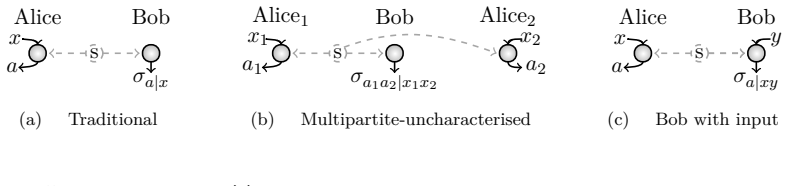
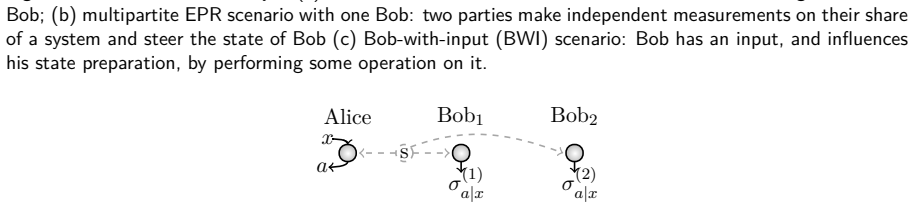
The authors articulate the concept of postquantum steering for scenarios with multiple quantum parties. They supply an algorithm that certifies postquantumness (and sometimes quantumness) of observed assemblages, together with a hierarchy of semidefinite programs that bounds the set of quantum assemblages from the outside. The framework demonstrates that postquantum steering is not merely permitted by the no-signaling principle but can arise within compositional theories beyond quantum theory. The work further reveals that the theory-independent description of steering prevents a direct connection with Bell nonlocality, for example that nonclassical Bell correlations do not imply nonclasssif
What carries the argument
The central object is the multi-party steering assemblage defined under no-signaling constraints, with characterised parties restricted to quantum descriptions; this object supports both the certification algorithm and the outer-bounding semidefinite-program hierarchy.
If this is right
- An algorithm now exists to certify postquantumness of assemblages in scenarios with several quantum parties.
- A hierarchy of semidefinite programs supplies outer bounds on the set of quantum multi-party assemblages.
- Postquantum steering can arise inside compositional theories that extend beyond quantum mechanics.
- Nonclassical Bell correlations do not imply nonclassical steering, owing to the independent description of steering.
Where Pith is reading between the lines
- Resource theories of steering will likely require generalisation to handle multiple characterised parties.
- The certification tools could be used to design experiments with several trusted quantum devices and one untrusted source.
- The observed separation suggests that steering and Bell nonlocality should be quantified as distinct resources in hybrid networks.
- Activation protocols relating steering to Bell correlations may need fresh examination in the multi-party setting.
Load-bearing premise
Characterised parties are assumed to describe their local systems through the quantum formalism, which allows a theory-independent treatment of the uncharacterised parties.
What would settle it
An explicit no-signaling assemblage involving two quantum parties and one uncharacterised party that the certification algorithm labels postquantum, yet yields only classical Bell correlations under all measurement choices, would confirm the decoupling; the opposite result that every postquantum assemblage forces a Bell violation would refute it.
Figures
read the original abstract
The study of stronger-than-quantum phenomena (i.e., postquantum) has enabled a deeper understanding of the scope of quantum theory. Much is known about the case of correlations in Bell scenarios, where the device-independent framework allowed us to explore its possibilities independently of the formalism of quantum theory. However, less is known about the phenomenon of Einstein-Podolsky-Rosen steering. Here, the `characterised parties' are assumed to describe their systems locally through the quantum formalism, which inconveniences a theory-independent description. In addition, a theorem by Gisin and Hughston, Josza and Wootters further hindered the discovery of the phenomenon. The study of postquantum steering, initiated about a decade ago, has been quite fruitful, including: the development of mathematical formalisms that frame the effect, resource theories that quantify it as a resource, and activation protocols that relate it to Bell correlations. However, all these results have a limitation in common: they apply to scenarios with only one quantum party. Here we articulate the concept of postquantum steering for scenarios with multiple quantum parties, bringing in the missing piece to the puzzle. We provide an algorithm to certify postquantumness, which in some cases also certifies quantumness. We also define a hierarchy of semidefinite programs that bounds the set of quantum assemblages from the outside. Moreover, we show that the study of postquantum steering is fundamentally relevant since it is not just a mere mathematical curiosity allowed by the no-signalling principle, but it may arise within compositional theories beyond quantum theory. Our work further discovers a peculiarity of steering: its theory-independent description fundamentally prevents a direct connection with Bell nonlocality -- e.g., nonclassical Bell correlations do not imply nonclassical steering.
Editorial analysis
A structured set of objections, weighed in public.
Referee Report
Summary. The manuscript extends the study of postquantum steering to scenarios with multiple characterized (quantum) parties. It introduces an algorithm for certifying postquantum steering (which in some cases also certifies quantumness), defines a hierarchy of semidefinite programs that outer-bounds the set of quantum assemblages, shows that postquantum steering can arise in compositional theories beyond quantum mechanics, and claims that the theory-independent description of steering fundamentally prevents a direct connection to Bell nonlocality, with the example that nonclassical Bell correlations do not imply nonclassical steering.
Significance. If the central results hold, the work is significant for completing the framework of postquantum steering beyond single-party cases, supplying concrete certification tools via the algorithm and SDP hierarchy, and linking the phenomenon to beyond-quantum compositional theories. The highlighted peculiarity of steering relative to Bell nonlocality could be important for distinguishing nonclassical resources, provided the non-implication is shown to be intrinsic rather than an artifact of the hybrid trust structure.
major comments (1)
- Abstract: the claim that the theory-independent description of steering 'fundamentally prevents a direct connection with Bell nonlocality' (e.g., nonclassical Bell correlations do not imply nonclassical steering) is presented as a key discovery. Because the construction relies on multiple characterized quantum parties plus one uncharacterized party, the manuscript must supply a concrete assemblage or correlation set exhibiting Bell nonlocality yet classical steering, together with an argument that the same non-implication survives when all parties are uncharacterized (subject only to no-signaling). Without this, the 'fundamentally prevents' phrasing risks being an artifact of the partial-trust model rather than a general feature of steering.
minor comments (2)
- Abstract: the reference to 'a theorem by Gisin and Hughston, Josza and Wootters' contains a likely typographical error in the name 'Josza' (should be 'Jozsa'); this should be corrected.
- Abstract: the final sentence is long and contains two distinct ideas (the peculiarity and the example); splitting it would improve readability.
Simulated Author's Rebuttal
We thank the referee for their careful reading and constructive feedback on our work extending postquantum steering to multiple characterized parties. We address the major comment below.
read point-by-point responses
-
Referee: Abstract: the claim that the theory-independent description of steering 'fundamentally prevents a direct connection with Bell nonlocality' (e.g., nonclassical Bell correlations do not imply nonclassical steering) is presented as a key discovery. Because the construction relies on multiple characterized quantum parties plus one uncharacterized party, the manuscript must supply a concrete assemblage or correlation set exhibiting Bell nonlocality yet classical steering, together with an argument that the same non-implication survives when all parties are uncharacterized (subject only to no-signaling). Without this, the 'fundamentally prevents' phrasing risks being an artifact of the partial-trust model rather than a general feature of steering.
Authors: We agree that an explicit example strengthens the presentation. In the revised manuscript we add a concrete no-signaling assemblage (new Section 4.1) involving two characterized parties and one uncharacterized party: when all three parties are treated as uncharacterized the resulting correlations violate a Bell inequality, yet the steering assemblage from the uncharacterized party to the two characterized parties admits a local hidden-state model and is therefore classical. This demonstrates the desired non-implication inside the hybrid trust model. We further argue that the theory-independent description of steering is defined precisely by the presence of characterized parties; the fully device-independent (all-uncharacterized) setting therefore lies outside the scope of steering by definition, so the non-implication is intrinsic to the steering framework rather than an artifact of partial trust. A clarifying paragraph has been added to the introduction and conclusion. revision: yes
Circularity Check
No significant circularity; new definitions, algorithms, and SDPs for multi-party postquantum steering are introduced independently.
full rationale
The paper defines postquantum steering for scenarios with multiple characterized quantum parties, supplies a certification algorithm, constructs an outer-bounding SDP hierarchy, and exhibits its appearance in compositional theories beyond quantum mechanics. The claimed peculiarity (theory-independent steering description blocks direct implication from Bell nonlocality) is derived from the hybrid trust structure and explicit constructions rather than by re-labeling fitted inputs or reducing via self-citation chains. Prior results on single-party steering are cited as background but are not load-bearing for the new multi-party claims; no equation or central statement is shown to equal its own inputs by construction. The derivation therefore remains self-contained against external benchmarks.
Axiom & Free-Parameter Ledger
axioms (2)
- domain assumption Characterised parties describe their systems locally through the quantum formalism
- standard math No-signalling principle
Lean theorems connected to this paper
-
IndisputableMonolith/Cost/FunctionalEquation.leanwashburn_uniqueness_aczel unclear?
unclearRelation between the paper passage and the cited Recognition theorem.
Theorem 6 (Postquantumness certification algorithm) and Definition 13 (hierarchy Q^k_T approximating quantum assemblages)
-
IndisputableMonolith/Foundation/RealityFromDistinction.leanreality_from_one_distinction contradicts?
contradictsCONTRADICTS: the theorem conflicts with this paper passage, or marks a claim that would need revision before publication.
Example 5 (PR-box correlations yielding postquantum steering) and Prop. 8 (PTP maps preserving quantum Bell correlations)
What do these tags mean?
- matches
- The paper's claim is directly supported by a theorem in the formal canon.
- supports
- The theorem supports part of the paper's argument, but the paper may add assumptions or extra steps.
- extends
- The paper goes beyond the formal theorem; the theorem is a base layer rather than the whole result.
- uses
- The paper appears to rely on the theorem as machinery.
- contradicts
- The paper's claim conflicts with a theorem or certificate in the canon.
- unclear
- Pith found a possible connection, but the passage is too broad, indirect, or ambiguous to say the theorem truly supports the claim.
Reference graph
Works this paper leans on
-
[1]
Discussion of probability relations between separated systems
Erwin Schr¨ odinger. “Discussion of probability relations between separated systems”. Math- ematical Proceedings of the Cambridge Philosophical Society31, 555–563 (1935)
work page 1935
-
[2]
Probability relations between separated systems
E. Schr¨ odinger. “Probability relations between separated systems”. Mathematical Pro- ceedings of the Cambridge Philosophical Society32, 446–452 (1936)
work page 1936
-
[3]
Steering, entangle- ment, nonlocality, and the Einstein-Podolsky-Rosen paradox
Howard M Wiseman, Steve James Jones, and Andrew C Doherty. “Steering, entangle- ment, nonlocality, and the Einstein-Podolsky-Rosen paradox”. Physical review letters98, 140402 (2007)
work page 2007
-
[4]
Cyril Branciard, Eric G Cavalcanti, Stephen P Walborn, Valerio Scarani, and Howard M Wiseman. “One-sided device-independent quantum key distribution: Security, feasibility, and the connection with steering”. Physical Review A85, 010301 (2012)
work page 2012
-
[5]
Self-testing through EPR-steering
Ivan ˇSupi´ c and Matty J Hoban. “Self-testing through EPR-steering”. New Journal of Physics18, 075006 (2016)
work page 2016
-
[6]
Rigidity of quantum steer- ing and one-sided device-independent verifiable quantum computation
Alexandru Gheorghiu, Petros Wallden, and Elham Kashefi. “Rigidity of quantum steer- ing and one-sided device-independent verifiable quantum computation”. New Journal of Physics19, 023043 (2017)
work page 2017
-
[7]
Quantum randomness extraction for various levels of characterization of the devices
Yun Zhi Law, Jean-Daniel Bancal, Valerio Scarani, et al. “Quantum randomness extraction for various levels of characterization of the devices”. Journal of Physics A: Mathematical and Theoretical47, 424028 (2014)
work page 2014
-
[8]
Optimal random- ness certification in the quantum steering and prepare-and-measure scenarios
Elsa Passaro, Daniel Cavalcanti, Paul Skrzypczyk, and Antonio Ac´ ın. “Optimal random- ness certification in the quantum steering and prepare-and-measure scenarios”. New Jour- nal of Physics17, 113010 (2015)
work page 2015
-
[9]
Joint measurability, einstein- podolsky-rosen steering, and bell nonlocality
Marco T´ ulio Quintino, Tam´ as V´ ertesi, and Nicolas Brunner. “Joint measurability, einstein- podolsky-rosen steering, and bell nonlocality”. Phys. Rev. Lett.113, 160402 (2014)
work page 2014
-
[10]
Joint measurability of generalized measurements implies classicality
Roope Uola, Tobias Moroder, and Otfried G¨ uhne. “Joint measurability of generalized measurements implies classicality”. Phys. Rev. Lett.113, 160403 (2014)
work page 2014
-
[11]
Quantitative relations between measurement incom- patibility, quantum steering, and nonlocality
D. Cavalcanti and P. Skrzypczyk. “Quantitative relations between measurement incom- patibility, quantum steering, and nonlocality”. Phys. Rev. A93, 052112 (2016)
work page 2016
-
[12]
Quantum nonlocality as an axiom
Sandu Popescu and Daniel Rohrlich. “Quantum nonlocality as an axiom”. Foundations of Physics24, 379–385 (1994)
work page 1994
-
[13]
Nicolas Brunner, Daniel Cavalcanti, Stefano Pironio, Valerio Scarani, and Stephanie Wehner. “Bell nonlocality”. Reviews of Modern Physics86, 419 (2014). 17
work page 2014
-
[14]
Ana Bel´ en Sainz, Nicolas Brunner, Daniel Cavalcanti, Paul Skrzypczyk, and Tam´ as V´ ertesi. “Postquantum steering”. Physical review letters115, 190403 (2015)
work page 2015
-
[15]
Stochastic quantum dynamics and relativity
Nicolas Gisin. “Stochastic quantum dynamics and relativity”. Helvetica Physica Acta62, 363–371 (1989)
work page 1989
-
[16]
A complete classification of quantum ensembles having a given density matrix
Lane P Hughston, Richard Jozsa, and William K Wootters. “A complete classification of quantum ensembles having a given density matrix”. Physics Letters A183, 14–18 (1993)
work page 1993
-
[17]
Bipar- tite postquantum steering in generalized scenarios
Ana Bel´ en Sainz, Matty J Hoban, Paul Skrzypczyk, and Leandro Aolita. “Bipar- tite postquantum steering in generalized scenarios”. Physical Review Letters125, 050404 (2020)
work page 2020
-
[18]
A formalism for steering with local quantum measurements
Ana Bel´ en Sainz, Leandro Aolita, Marco Piani, Matty J Hoban, and Paul Skrzypczyk. “A formalism for steering with local quantum measurements”. New Journal of Physics20, 083040 (2018)
work page 2018
-
[19]
Post-quantum steering is a stronger-than-quantum resource for information processing
Paulo J Cavalcanti, John H Selby, Jamie Sikora, Thomas D Galley, and Ana Bel´ en Sainz. “Post-quantum steering is a stronger-than-quantum resource for information processing”. npj Quantum Information8, 1–10 (2022)
work page 2022
-
[20]
Activation of post-quantum steering
Ana Bel´ en Sainz, Paul Skrzypczyk, and Matty J Hoban. “Activation of post-quantum steering”. New Journal of Physics27, 124508 (2025)
work page 2025
-
[21]
Activation of postquantumness in bipartite generalized einstein-podolsky-rosen scenarios
Beata Zjawin, Matty J Hoban, Paul Skrzypczyk, and Ana Bel´ en Sainz. “Activation of postquantumness in bipartite generalized einstein-podolsky-rosen scenarios”. Physical Re- view A110, 042212 (2024)
work page 2024
-
[22]
A hierarchy of semidefinite pro- grams for generalised Einstein-Podolsky-Rosen scenarios
Matty J. Hoban, Tom Drescher, and Ana Bel´ en Sainz. “A hierarchy of semidefinite pro- grams for generalised Einstein-Podolsky-Rosen scenarios”. Quantum9, 1591 (2025)
work page 2025
-
[23]
Every nonsignaling channel is common-cause realizable
Paulo J Cavalcanti, John H Selby, and Ana Bel´ en Sainz. “Every nonsignaling channel is common-cause realizable”. Physical Review A109, 042211 (2024)
work page 2024
-
[24]
Detection of entanglement in asymmetric quantum networks and multipartite quan- tum steering
Daniel Cavalcanti, Paul Skrzypczyk, GH Aguilar, RV Nery, PH Souto Ribeiro, and SP Wal- born. “Detection of entanglement in asymmetric quantum networks and multipartite quan- tum steering”. Nature communications6, 1–6 (2015)
work page 2015
-
[25]
Roope Uola, Ana CS Costa, H Chau Nguyen, and Otfried G¨ uhne. “Quantum steering”. Reviews of Modern Physics92, 015001 (2020)
work page 2020
-
[26]
Bounding the set of quantum correlations
Miguel Navascu´ es, Stefano Pironio, and Antonio Ac´ ın. “Bounding the set of quantum correlations”. Physical Review Letters98, 010401 (2007)
work page 2007
-
[27]
A convergent hierarchy of semidef- inite programs characterizing the set of quantum correlations
Miguel Navascu´ es, Stefano Pironio, and Antonio Ac´ ın. “A convergent hierarchy of semidef- inite programs characterizing the set of quantum correlations”. New Journal of Physics 10, 073013 (2008). [28]https://doi.org/10.5281/zenodo.19468921
-
[28]
Unified framework for correlations in terms of local quantum observables
A. Ac´ ın, R. Augusiak, D. Cavalcanti, C. Hadley, J. K. Korbicz, M. Lewenstein, Ll. Masanes, and M. Piani. “Unified framework for correlations in terms of local quantum observables”. Phys. Rev. Lett.104, 140404 (2010)
work page 2010
- [29]
-
[30]
CVX: MATLAB software for disciplined convex pro- gramming
Michael Grant and Stephen Boyd. “CVX: MATLAB software for disciplined convex pro- gramming”. url:http://cvxr.com/cvx
-
[31]
SDPT3 — a matlab software package for semidefinite programming, version 1.3
K. C. Toh, M. J. Todd, and R. H. T¨ ut¨ unc¨ u. “SDPT3 — a matlab software package for semidefinite programming, version 1.3”. Optimization Methods and Software11, 545– 581 (1999). 18
work page 1999
-
[32]
QETLAB: a MATLAB toolbox for quantum entanglement
Nathaniel Johnston. “QETLAB: a MATLAB toolbox for quantum entanglement”. url:http://qetlab.com
-
[33]
Extended non- local games and monogamy-of-entanglement games
Nathaniel Johnston, Rajat Mittal, Vincent Russo, and John Watrous. “Extended non- local games and monogamy-of-entanglement games”. Proceedings of the Royal Society A: Mathematical, Physical and Engineering Sciences472, 20160003 (2016)
work page 2016
-
[34]
Proposed exper- iment to test local hidden-variable theories
John F Clauser, Michael A Horne, Abner Shimony, and Richard A Holt. “Proposed exper- iment to test local hidden-variable theories”. Physical review letters23, 880 (1969). A Classical vs. quantum steering In this section we briefly discuss the boundary between classical and quantum steering in our scenarios, and how this differs from the existing literatur...
work page 1969
-
[35]
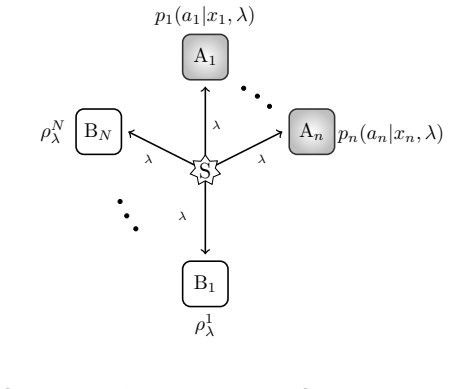
a classical system 14 Λ,
-
[36]
a probability distributionp(λ)forλ∈Λ,
-
[37]
a response function (normalised conditional probability distribution)p j(aj|xj,λ)for each Alice (j= 1 :n), and
-
[38]
a local (normalised) quantum stateρk λfor each Bob (k= 1 :N) such that: σ(k) a|x= ∑ λ∈Λ p(λ)ρk λ ∏ j=1:n pj(aj|xj,λ),∀k,a,x.(31) This classical model is depicted in Fig. 3. Remark 15.As a first remark, notice that an assemblage in our steering scenario admits of an LHS model if it also admits of an LHS model when described in the traditional framing of Eq...
discussion (0)
Sign in with ORCID, Apple, or X to comment. Anyone can read and Pith papers without signing in.