Recognition: unknown
Robust Hybrid Beamforming with Liquid Crystal Antennas and Liquid Neural Networks
Pith reviewed 2026-05-10 17:14 UTC · model grok-4.3
The pith
Liquid crystal antennas paired with liquid neural networks enable robust hybrid beamforming for sub-terahertz wireless systems.
A machine-rendered reading of the paper's core claim, the machinery that carries it, and where it could break.
Core claim
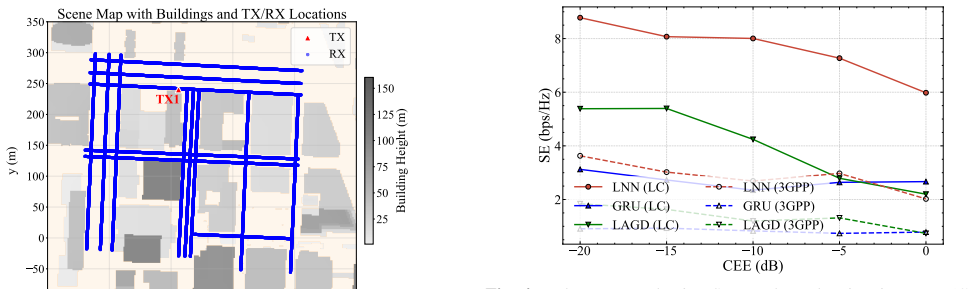
The authors establish that integrating reconfigurable liquid crystal antennas as the analog beamforming stage with ordinary differential equation-defined liquid neural networks for digital beamforming, further refined by manifold optimization, produces an 88.6 percent gain in spectral efficiency along with improved tolerance to imperfect channel estimates relative to learning-aided gradient descent and gated recurrent unit baselines, while delivering 1.9 times the spectral efficiency of the 3GPP TR 38.901 antenna model when tested on simulated 108 GHz New York urban propagation channels.
What carries the argument
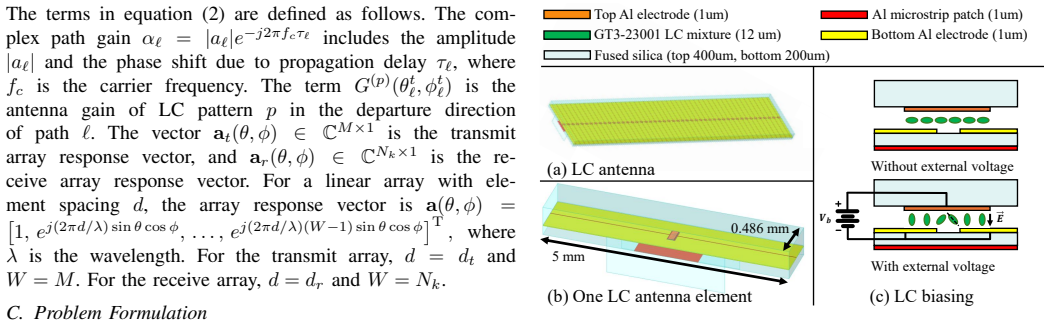
The hybrid beamforming architecture that places voltage-tunable liquid crystal antennas in the analog stage for permittivity-based beam steering and uses an ordinary differential equation liquid neural network to model temporal channel evolution for the digital stage.
If this is right
- Sub-terahertz systems can achieve usable data rates without depending on high-loss phase shifters at the analog stage.
- Liquid neural networks can capture and exploit the shortened channel coherence times that arise from higher Doppler spread at elevated carrier frequencies.
- Manifold optimization can compress the digital precoding search space enough to make real-time adaptation feasible.
- The framework maintains performance advantages even when channel estimates contain errors typical of high-frequency operation.
Where Pith is reading between the lines
- If liquid crystal antennas can be produced at scale with repeatable characteristics, they could simplify the deployment of dense sub-terahertz base stations.
- The continuous-time modeling approach may extend naturally to other frequency bands where propagation varies rapidly with mobility or environment.
- Hardware-software co-design of this form could reduce overall power consumption by avoiding always-on digital compensation for analog imperfections.
- Testing the same combination across multiple city layouts or with measured rather than simulated channels would reveal how sensitive the reported gains are to the specific propagation assumptions.
Load-bearing premise
The ray-tracing simulations at 108 GHz accurately represent real sub-terahertz propagation effects and the liquid crystal antenna hardware delivers the modeled voltage-driven beam steering without significant unaccounted losses or fabrication variations.
What would settle it
Direct over-the-air measurements of spectral efficiency using physical liquid crystal antenna prototypes and deployed liquid neural network controllers in a real 108 GHz urban environment, compared against the same baselines under identical imperfect channel conditions.
Figures

read the original abstract
Sub-terahertz (sub-THz) multi-user multiple-input multiple-output (MU-MIMO) systems unlock immense bandwidth for 6G wireless communications. However, practical deployment of wireless systems in sub-THz bands faces critical challenges such as increased atmospheric absorption, reduced channel coherence time due to increased Doppler spread at higher carrier frequencies, and hardware bottlenecks as low-loss sub-THz phase shifters are difficult to realize. To overcome the hardware and channel estimation challenges of sub-THz systems, this paper proposes a hybrid beamforming (BF) framework that integrates reconfigurable liquid crystal (LC) antennas with a liquid neural network (LNN) for transmitter. Specifically, we employ an LC antenna as the analog BF stage of a hybrid BF architecture, exploiting its voltage-driven permittivity tunability to achieve high-gain beam steering without the need for lossy phase shifters. For digital BF, we utilize an ordinary differential equations-defined LNN to learn temporal channel dynamics, and use a manifold optimization technique to compress the search space. We validated the proposed method on simulated site-specific 108 GHz ray-tracing channels in an urban scenario using NYURay, a ray-tracing simulator validated against 142 GHz propagation measurements. The 108 GHz carrier frequency matches the operating band of the LC antenna hardware. The proposed method achieves an 88.6\% spectral efficiency (SE) gain and higher robustness to imperfect channel estimation compared to the learning-aided gradient descent and gated recurrent unit machine learning baselines, and 1.9 times higher SE than the 3GPP TR~38.901 standard antenna model, highlighting the potential of LC-based hardware for sub-THz communications.
Editorial analysis
A structured set of objections, weighed in public.
Referee Report
Summary. The manuscript proposes a hybrid beamforming architecture for sub-THz MU-MIMO that uses reconfigurable liquid crystal (LC) antennas as the analog stage (exploiting voltage-tunable permittivity for beam steering) and liquid neural networks (LNNs defined by ODEs) for the digital stage to learn temporal channel dynamics, with manifold optimization to reduce complexity. It evaluates the scheme on 108 GHz site-specific urban ray-tracing channels generated by NYURay (validated against 142 GHz measurements) and reports an 88.6% spectral efficiency gain plus improved robustness to imperfect CSI relative to learning-aided gradient descent and GRU baselines, along with a 1.9× gain over the 3GPP TR 38.901 antenna model.
Significance. If the idealized LC hardware model and ray-tracing assumptions prove accurate, the work offers a hardware-aware approach to sub-THz beamforming that could mitigate phase-shifter losses and Doppler effects in 6G systems. The site-specific simulation methodology and direct comparison against a standardized antenna model are positive elements that ground the claims in realistic propagation data.
major comments (2)
- [Abstract and §IV] Abstract and §IV (Performance Evaluation): The reported 88.6% SE gain, robustness to imperfect CSI, and 1.9× improvement over 3GPP TR 38.901 all rest on an idealized LC antenna model (perfect voltage-driven permittivity tuning with zero insertion loss and ideal beam patterns) and NYURay traces at 108 GHz. No measured S-parameters, beam patterns, or hardware-in-the-loop results for the referenced LC devices are provided, nor is there sensitivity analysis to voltage-dependent losses or fabrication variation; if these assumptions fail, the quantitative margins are not guaranteed.
- [§III] §III (LNN and Manifold Optimization): The LNN is trained on simulated channels and manifold optimization is used to compress the search space, but the manuscript provides no ablation on LNN hyperparameters (e.g., ODE solver tolerances, hidden units, or training data volume) and no explicit quantification of how robustness to imperfect CSI varies with CSI error variance; these omissions make the 'higher robustness' claim difficult to assess independently of the specific simulation settings.
minor comments (2)
- [§IV] Figure captions and axis labels in §IV should explicitly state the number of Monte Carlo realizations and whether error bars represent standard deviation or confidence intervals.
- [§II] Clarify in §II whether the LC antenna model incorporates any frequency-dependent loss terms at 108 GHz or assumes frequency-flat behavior matching the 142 GHz validation data.
Simulated Author's Rebuttal
We thank the referee for the thorough and constructive review of our manuscript. We address each major comment in detail below, providing clarifications grounded in the paper's methodology and proposing targeted revisions to improve transparency and robustness of the claims.
read point-by-point responses
-
Referee: [Abstract and §IV] Abstract and §IV (Performance Evaluation): The reported 88.6% SE gain, robustness to imperfect CSI, and 1.9× improvement over 3GPP TR 38.901 all rest on an idealized LC antenna model (perfect voltage-driven permittivity tuning with zero insertion loss and ideal beam patterns) and NYURay traces at 108 GHz. No measured S-parameters, beam patterns, or hardware-in-the-loop results for the referenced LC devices are provided, nor is there sensitivity analysis to voltage-dependent losses or fabrication variation; if these assumptions fail, the quantitative margins are not guaranteed.
Authors: We appreciate the referee's emphasis on hardware realism. The LC antenna model is derived from established physical characterizations of liquid crystal permittivity tuning in the sub-THz regime, consistent with the operating frequency of the referenced devices and aligned with the validated NYURay simulator (cross-checked against 142 GHz measurements). While the study is simulation-based and does not include new hardware measurements, we will revise §IV to incorporate a sensitivity analysis quantifying the effects of insertion loss and fabrication variations on the reported spectral efficiency gains. This addition will explicitly bound the performance margins under non-ideal conditions and strengthen the interpretation of the 88.6% gain and 1.9× improvement over the 3GPP model. revision: partial
-
Referee: [§III] §III (LNN and Manifold Optimization): The LNN is trained on simulated channels and manifold optimization is used to compress the search space, but the manuscript provides no ablation on LNN hyperparameters (e.g., ODE solver tolerances, hidden units, or training data volume) and no explicit quantification of how robustness to imperfect CSI varies with CSI error variance; these omissions make the 'higher robustness' claim difficult to assess independently of the specific simulation settings.
Authors: We agree that systematic ablations and explicit robustness curves would improve reproducibility and allow independent assessment of the LNN's advantages. In the revised manuscript, we will expand §III with an ablation study varying key hyperparameters (ODE solver tolerances, hidden units, and training data volume) and their impact on convergence and spectral efficiency. We will also add a new plot in §IV showing spectral efficiency versus CSI error variance for the proposed LNN approach compared to the gradient descent and GRU baselines, thereby providing direct quantitative support for the improved robustness claim. revision: yes
Circularity Check
No significant circularity; results are simulation outputs on external channel data
full rationale
The paper's performance claims (88.6% SE gain, robustness, 1.9x improvement) are obtained by running the proposed LC+LNN hybrid beamformer on site-specific 108 GHz channels generated by the independent NYURay ray-tracing simulator. The LNN is trained to predict temporal dynamics on those channels, manifold optimization reduces the analog beamformer search space, and SE is computed end-to-end; none of these steps algebraically forces the reported margins by re-using fitted constants or self-referential definitions. The channel model and LC antenna response are taken as external inputs (validated against measurements in prior literature), and the numerical gains are falsifiable against other simulators or hardware. No self-citation chain or ansatz smuggling is required for the central quantitative results.
Axiom & Free-Parameter Ledger
free parameters (2)
- LNN training hyperparameters
- Manifold optimization parameters
axioms (2)
- domain assumption NYURay ray-tracing at 108 GHz produces channels representative of real sub-THz urban propagation
- domain assumption Liquid crystal antenna permittivity can be tuned by voltage to produce ideal high-gain beams without additional insertion loss or mutual coupling effects
Reference graph
Works this paper leans on
-
[1]
Millimeter wave and terahertz urban microcell propagation measurements and models,
Y . Xinget al., “Millimeter wave and terahertz urban microcell propagation measurements and models,”IEEE Commun. Lett., vol. 25, no. 12, pp. 3755–3759, 2021
2021
-
[2]
142 GHz multipath propagation measurements and path loss channel modeling in factory buildings,
S. Juet al., “142 GHz multipath propagation measurements and path loss channel modeling in factory buildings,” inICC 2023-IEEE International Conference on Communications, 2023, pp. 5048–5053
2023
-
[3]
A learning-aided flexible gradient descent approach to MISO beamforming,
Z. Yanget al., “A learning-aided flexible gradient descent approach to MISO beamforming,”IEEE Wirel. Commun. Lett., vol. 11, no. 9, pp. 1895–1899, 2022
2022
-
[4]
Study on channel model for frequencies from 0.5 to 100 GHz,
3GPP, “Study on channel model for frequencies from 0.5 to 100 GHz,” 3rd Generation Partnership Project, Technical Report TR 38.901, 2018
2018
-
[5]
Wireless communications and applications above 100 GHz: Opportunities and challenges for 6G and beyond,
T. S. Rappaportet al., “Wireless communications and applications above 100 GHz: Opportunities and challenges for 6G and beyond,”IEEE Access, vol. 7, pp. 78 729–78 757, 2019
2019
-
[6]
ISAC imaging by channel state information using ray tracing for next generation 6G,
A. Bazziet al., “ISAC imaging by channel state information using ray tracing for next generation 6G,”IEEE J. Sel. Top. Electromagnetics Ant. Prop., vol. 1, no. 1, pp. 135–149, 2025
2025
-
[7]
A. Shahidet al., “Large-scale AI in telecom: Charting the roadmap for innovation, scalability, and enhanced digital experiences,” 2025. [Online]. Available: https://arxiv.org/abs/2503.04184
-
[8]
Overview of millimeter wave communications for fifth-generation (5G) wireless networks—with a focus on propagation models,
T. S. Rappaportet al., “Overview of millimeter wave communications for fifth-generation (5G) wireless networks—with a focus on propagation models,”IEEE Transactions on antennas and propagation, vol. 65, no. 12, pp. 6213–6230, 2017
2017
-
[9]
Bridging physical and digital worlds: Embodied large AI for future wireless systems,
X. Wanget al., “Bridging physical and digital worlds: Embodied large AI for future wireless systems,” 2025. [Online]. Available: https://arxiv.org/abs/2506.24009
-
[10]
Terahertz communications and sensing for 6G and beyond: A comprehensive review,
W. Jianget al., “Terahertz communications and sensing for 6G and beyond: A comprehensive review,”IEEE Communications Surveys & Tutorials, vol. 26, no. 4, pp. 2326–2381, 2024
2024
-
[11]
Spatial-wideband effect in massive MIMO with appli- cation in mmwave systems,
B. Wanget al., “Spatial-wideband effect in massive MIMO with appli- cation in mmwave systems,”IEEE Communications Magazine, vol. 56, no. 12, pp. 134–141, 2018
2018
-
[12]
Beamforming codebook compensation for beam squint with channel capacity constraint,
M. Caiet al., “Beamforming codebook compensation for beam squint with channel capacity constraint,” 2017. [Online]. Available: https://arxiv.org/abs/1705.04441
-
[13]
Propagation measurement system and approach at 140 GHz-moving to 6G and above 100 GHz,
Y . Xinget al., “Propagation measurement system and approach at 140 GHz-moving to 6G and above 100 GHz,” in2018 IEEE Global Communications Conference (GLOBECOM), 2018, pp. 1–6
2018
-
[14]
Cost-effective millimeter-wave communications with lens antenna array,
Y . Zenget al., “Cost-effective millimeter-wave communications with lens antenna array,”IEEE Wireless Communications, vol. 24, no. 4, pp. 81–87, 2017
2017
-
[15]
Dynamic metasurface antennas for MIMO-OFDM receivers with bit-limited adcs,
H. Wanget al., “Dynamic metasurface antennas for MIMO-OFDM receivers with bit-limited adcs,”IEEE Transactions on Communications, vol. 69, no. 4, pp. 2643–2659, 2021
2021
-
[16]
Millimeter wave multi-beam antenna combining for 5G cellular link improvement in new york city,
S. Sunet al., “Millimeter wave multi-beam antenna combining for 5G cellular link improvement in new york city,” in2014 IEEE ICC. IEEE, 2014, pp. 5468–5473
2014
-
[17]
A liquid crystal tunable metamaterial unit cell for dynamic metasurface antennas,
P.-Y . Wanget al., “A liquid crystal tunable metamaterial unit cell for dynamic metasurface antennas,”IEEE Transactions on Antennas and Propagation, vol. 71, no. 1, pp. 1135–1140, 2023
2023
-
[18]
A liquid-crystal-based dynamic metasurface antenna for electrical beam-steering at 105 GHz,
P.-Y . Wanget al., “A liquid-crystal-based dynamic metasurface antenna for electrical beam-steering at 105 GHz,”IEEE Transactions on Antennas and Propagation, vol. 72, no. 6, pp. 5313–5318, Jun. 2024
2024
-
[19]
Robust deep learning-based physical layer communications: Strategies and approaches,
F. Zhuet al., “Robust deep learning-based physical layer communications: Strategies and approaches,”IEEE Network, vol. 40, no. 2, pp. 278–286, 2026
2026
-
[20]
Telemom: Consensus-driven telecom intelligence via mixture of models,
X. Wanget al., “Telemom: Consensus-driven telecom intelligence via mixture of models,” inProc. of 2025 IEEE 102nd Veh. Tech. Conf., 2025, pp. 1–6
2025
-
[21]
Robust beam-tracking for mmWave mobile communications,
S. Jayaprakasamet al., “Robust beam-tracking for mmWave mobile communications,”IEEE Communications Letters, vol. 21, no. 12, pp. 2654–2657, 2017
2017
-
[22]
Bayesian beamforming for mobile millimeter wave channel tracking in the presence of DOA uncertainty,
Y . Yanget al., “Bayesian beamforming for mobile millimeter wave channel tracking in the presence of DOA uncertainty,”IEEE Transactions on Communications, vol. 68, no. 12, pp. 7547–7562, 2020
2020
-
[23]
Beamforming inferring by conditional WGAN-GP for holographic antenna arrays,
F. Zhuet al., “Beamforming inferring by conditional WGAN-GP for holographic antenna arrays,”IEEE Wirel. Commun. Lett., vol. 13, no. 7, pp. 2023–2027, 2024
2023
-
[24]
A CNN-LSTM-based fusion separation deep neural network for 6G ultra-massive MIMO hybrid beamforming,
R. U. Murshedet al., “A CNN-LSTM-based fusion separation deep neural network for 6G ultra-massive MIMO hybrid beamforming,”IEEE Access, vol. 11, pp. 38 614–38 630, 2023
2023
-
[25]
Closed-form continuous-time neural networks,
R. Hasaniet al., “Closed-form continuous-time neural networks,”Nature Machine Intelligence, vol. 4, no. 11, pp. 992–1003, 2022
2022
-
[26]
Rethinking WMMSE: Can its complexity scale linearly with the number of BS antennas?
X. Zhaoet al., “Rethinking WMMSE: Can its complexity scale linearly with the number of BS antennas?”IEEE Trans. Signal Process., vol. 71, pp. 433–446, 2023
2023
-
[27]
Site-specific location calibration and validation of ray- tracing simulator NYURay at upper mid-band frequencies,
M. Yinget al., “Site-specific location calibration and validation of ray- tracing simulator NYURay at upper mid-band frequencies,”npj Wireless Technology, pp. 1–18, Mar. 2026
2026
-
[28]
Calibration of NYURay, a 3D mmWave and sub-THz Ray Tracer using Indoor, Outdoor, and Factory Channel Measurements,
O. Kanhereet al., “Calibration of NYURay, a 3D mmWave and sub-THz Ray Tracer using Indoor, Outdoor, and Factory Channel Measurements,” inIEEE ICC, Jun 2023, pp. 1–6
2023
-
[29]
Calibration of NYURay for ray tracing using 28, 73, and 142 GHz channel measurements conducted in indoor, outdoor, and factory scenarios,
O. Kanhereet al., “Calibration of NYURay for ray tracing using 28, 73, and 142 GHz channel measurements conducted in indoor, outdoor, and factory scenarios,”IEEE Trans. Antennas Propag., 2024
2024
-
[30]
Multi-stage location optimization through power delay profile alignment using site-specific wireless ray tracing,
M. Yinget al., “Multi-stage location optimization through power delay profile alignment using site-specific wireless ray tracing,” inProc. IEEE Global Commun. Conf., Taipei, Taiwan, Dec. 2025, pp. 1–6, accepted
2025
-
[31]
72 GHz millimeter wave indoor measurements for wireless and backhaul communications,
S. Nieet al., “72 GHz millimeter wave indoor measurements for wireless and backhaul communications,” in2013 IEEE 24th PIMRC. IEEE, 2013, pp. 2429–2433
2013
-
[32]
140 GHz urban microcell propagation measurements for spatial consistency modeling,
S. Juet al., “140 GHz urban microcell propagation measurements for spatial consistency modeling,” inICC 2021 - IEEE International Conference on Communications, 2021, pp. 1–6
2021
-
[33]
Tseet al.,Fundamentals of wireless communication
D. Tseet al.,Fundamentals of wireless communication. Cambridge university press, 2005
2005
-
[34]
Analytical framework of hybrid beamforming in multi-cell millimeter-wave systems,
S. Sunet al., “Analytical framework of hybrid beamforming in multi-cell millimeter-wave systems,”IEEE Transactions on Wireless Communica- tions, vol. 17, no. 11, pp. 7528–7543, 2018
2018
-
[35]
Using waste factor to optimize energy efficiency in multiple-input single-output (MISO) and multiple-input multiple-output (MIMO) systems,
M. Yinget al., “Using waste factor to optimize energy efficiency in multiple-input single-output (MISO) and multiple-input multiple-output (MIMO) systems,” inProc. of 2024 IEEE Global Commun. Conf., 2024, pp. 3170–3175
2024
-
[36]
Robust continuous-time beam tracking with liquid neural network,
F. Zhuet al., “Robust continuous-time beam tracking with liquid neural network,” inGLOBECOM 2024 - 2024 IEEE Global Communications Conference, 2024, pp. 4878–4883
2024
-
[37]
Robust beamforming with gradient-based liquid neural network,
X. Wanget al., “Robust beamforming with gradient-based liquid neural network,”IEEE Wireless Communications Letters, 2024
2024
-
[38]
Wireless Large AI Model: Shaping the AI-Native Future of 6G and Beyond
F. Zhuet al., “Wireless large AI model: Shaping the AI- native future of 6G and beyond,” 2025. [Online]. Available: https://arxiv.org/abs/2504.14653
work page internal anchor Pith review Pith/arXiv arXiv 2025
-
[39]
Liquid neural networks: Next-generation AI for telecom from first principles,
F. Zhuet al., “Liquid neural networks: Next-generation AI for telecom from first principles,”ZTE Commun., vol. 23, no. 2, pp. 76–84, 2025
2025
-
[40]
Massive MIMO in the UL/DL of cellular networks: How many antennas do we need?
J. Hoydiset al., “Massive MIMO in the UL/DL of cellular networks: How many antennas do we need?”IEEE J. Sel. Areas Commun., vol. 31, no. 2, pp. 160–171, 2013
2013
-
[41]
Robust Beamforming for RIS-aided Communications: Gradient-based Manifold Meta Learning,
F. Zhuet al., “Robust Beamforming for RIS-aided Communications: Gradient-based Manifold Meta Learning,”IEEE Trans. Wirel. Commun., 2024
2024
-
[42]
Energy-efficient beamforming for RISs-aided commu- nications: Gradient based meta learning,
X. Wanget al., “Energy-efficient beamforming for RISs-aided commu- nications: Gradient based meta learning,” inProc. 2024 IEEE Int. Conf. Commun. (ICC), Jun. 2024
2024
-
[43]
Site-specific propagation predictions of the radio channel in different environments using NYURay based on measurements and ray-tracing at upper mid-band frequencies,
M. Ying, “Site-specific propagation predictions of the radio channel in different environments using NYURay based on measurements and ray-tracing at upper mid-band frequencies,” Master’s thesis, New York University, 2025
2025
-
[44]
Urban outdoor propagation measurements and channel models at 6.75 GHz FR1(C) and 16.95 GHz FR3 upper mid-band spectrum for 5G and 6G,
D. Shakyaet al., “Urban outdoor propagation measurements and channel models at 6.75 GHz FR1(C) and 16.95 GHz FR3 upper mid-band spectrum for 5G and 6G,” inProc. IEEE Int. Conf. Commun., Montreal, Canada, Jun. 2025, pp. 3291–3296
2025
-
[45]
HoRAMA: Holistic reconstruction with automated material assignment for ray tracing using NYURay,
M. Yinget al., “HoRAMA: Holistic reconstruction with automated material assignment for ray tracing using NYURay,” inProc. IEEE Int. Conf. Commun., Glasgow, UK, Jun. 2026, pp. 1–6
2026
discussion (0)
Sign in with ORCID, Apple, or X to comment. Anyone can read and Pith papers without signing in.