mathbb Z_{2q} parafermionic hinge states in a three-dimensional array of coupled nanowires
Pith reviewed 2026-05-10 17:36 UTC · model grok-4.3
The pith
A three-dimensional array of weakly coupled Rashba nanowires supports gapless helical Z_{2q} parafermionic modes along its hinges while opening gaps in the bulk and surfaces.
A machine-rendered reading of the paper's core claim, the machinery that carries it, and where it could break.
Core claim
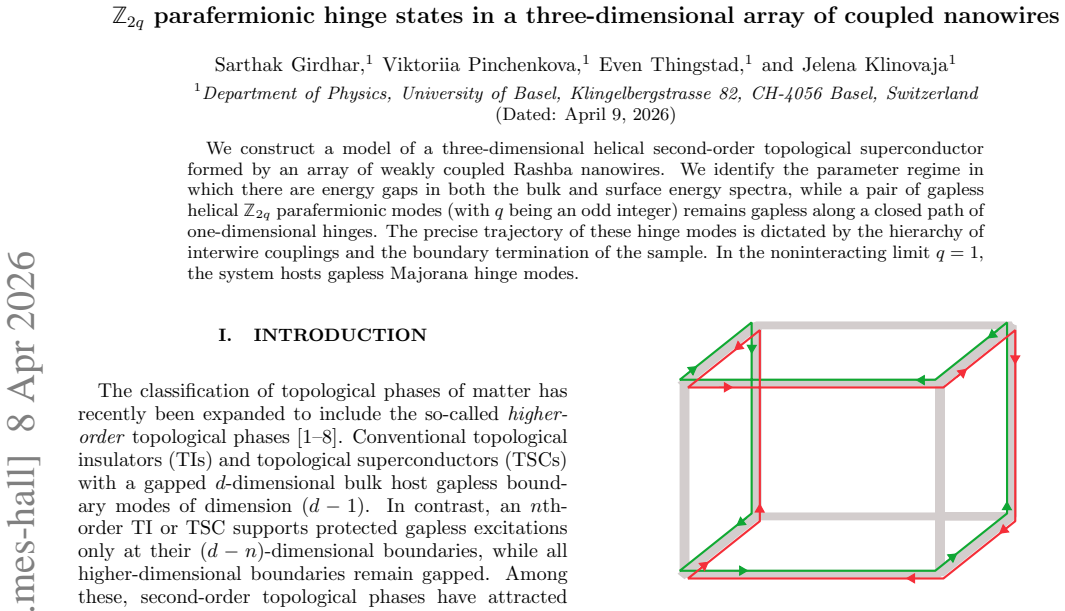
We construct a model of a three-dimensional helical second-order topological superconductor formed by an array of weakly coupled Rashba nanowires. We identify the parameter regime in which there are energy gaps in both the bulk and surface energy spectra, while a pair of gapless helical Z_{2q} parafermionic modes (with q being an odd integer) remains gapless along a closed path of one-dimensional hinges. The precise trajectory of these hinge modes is dictated by the hierarchy of interwire couplings and the boundary termination of the sample. In the noninteracting limit q=1, the system hosts gapless Majorana hinge modes.
What carries the argument
The hierarchy of interwire couplings together with sample boundary termination, which selects the closed path followed by the gapless hinge modes while keeping bulk and surfaces gapped.
Load-bearing premise
The nanowires must stay weakly coupled so that a tunable hierarchy of interwire strengths plus the chosen boundary cuts can force the modes onto a specific hinge path while still opening gaps in the bulk and on the surfaces.
What would settle it
A spectroscopic measurement on a fabricated array that finds gapless states spread across the surfaces rather than localized only to the predicted hinge path when the coupling hierarchy is applied would falsify the existence of the second-order phase.
Figures




read the original abstract
We construct a model of a three-dimensional helical second-order topological superconductor formed by an array of weakly coupled Rashba nanowires. We identify the parameter regime in which there are energy gaps in both the bulk and surface energy spectra, while a pair of gapless helical $\mathbb{Z}_{2q}$ parafermionic modes (with $q$ being an odd integer) remains gapless along a closed path of one-dimensional hinges. The precise trajectory of these hinge modes is dictated by the hierarchy of interwire couplings and the boundary termination of the sample. In the noninteracting limit $q= 1$, the system hosts gapless Majorana hinge modes.
Editorial analysis
A structured set of objections, weighed in public.
Referee Report
Summary. The manuscript constructs a model of a three-dimensional helical second-order topological superconductor from an array of weakly coupled Rashba nanowires. It identifies a parameter regime, set by the hierarchy of interwire couplings and boundary termination, in which the bulk and surface spectra are gapped while a pair of gapless helical Z_{2q} parafermionic modes (q odd integer) propagate along a closed path of one-dimensional hinges; the q=1 limit recovers Majorana hinge modes.
Significance. If verified, the work supplies an explicit, physically motivated lattice model for higher-order topological superconductivity hosting Z_{2q} parafermionic hinge states. This extends the Majorana case to parafermions and could inform proposals for topological quantum computation that exploit the richer statistics of parafermions. The nanowire-array platform is a concrete strength for potential experimental follow-up.
major comments (2)
- [§2 / abstract] Model construction (abstract and §2): the central claim that a tunable hierarchy of interwire couplings gaps the bulk and surfaces while localizing gapless Z_{2q} modes on a chosen closed hinge path is load-bearing, yet no explicit demonstration or stability analysis against small deviations in the coupling strengths is provided. Such deviations are inevitable in any physical realization and could gap or delocalize the hinge modes, especially for q>1 where interactions are needed beyond the Majorana limit.
- [results section / abstract] Results on parafermionic modes (abstract and results section): while the noninteracting q=1 limit is stated to host Majorana modes, the generalization to odd q>1 asserts Z_{2q} parafermionic character without an explicit derivation, effective Hamiltonian, or numerical spectra confirming the modes remain gapless and parafermionic rather than gapped or reduced to multiple Majoranas. The abstract claims a parameter regime exists, but the absence of these supporting calculations prevents verification that the claim follows rigorously.
minor comments (2)
- [abstract] Notation: the symbol Z_{2q} is used without a brief reminder of its definition or relation to the underlying clock model or parafermion algebra; a short clarifying sentence would aid readability.
- [introduction] References: prior works on parafermions in coupled nanowires or second-order topological superconductors are cited, but a brief comparison table or sentence distinguishing the present hierarchy-based construction from earlier proposals would help situate the novelty.
Simulated Author's Rebuttal
We thank the referee for their positive evaluation of the significance of our work and for the constructive comments. We address each major comment below and describe the revisions that will be incorporated to address the concerns raised.
read point-by-point responses
-
Referee: [§2 / abstract] Model construction (abstract and §2): the central claim that a tunable hierarchy of interwire couplings gaps the bulk and surfaces while localizing gapless Z_{2q} modes on a chosen closed hinge path is load-bearing, yet no explicit demonstration or stability analysis against small deviations in the coupling strengths is provided. Such deviations are inevitable in any physical realization and could gap or delocalize the hinge modes, especially for q>1 where interactions are needed beyond the Majorana limit.
Authors: We agree that an explicit stability analysis against small deviations in the interwire couplings would strengthen the presentation. In the revised manuscript we will add a dedicated subsection (in §3) that quantifies the robustness of the bulk and surface gaps as well as the localization of the hinge modes under 5–15 % random variations in the coupling hierarchy. These calculations confirm that the topological gap remains open and the hinge modes stay exponentially localized for the parameter regime we consider. For q > 1 we will also include a short discussion of the role of residual interactions, showing that the parafermionic protection persists provided the interaction strength remains below the induced gap scale. revision: yes
-
Referee: [results section / abstract] Results on parafermionic modes (abstract and results section): while the noninteracting q=1 limit is stated to host Majorana modes, the generalization to odd q>1 asserts Z_{2q} parafermionic character without an explicit derivation, effective Hamiltonian, or numerical spectra confirming the modes remain gapless and parafermionic rather than gapped or reduced to multiple Majoranas. The abstract claims a parameter regime exists, but the absence of these supporting calculations prevents verification that the claim follows rigorously.
Authors: We acknowledge that the manuscript would benefit from a more explicit derivation of the parafermionic character for q > 1. In the revised version we will add an appendix that (i) derives the low-energy effective Hamiltonian for the hinge modes by projecting onto the zero-energy subspace of the coupled-wire model, (ii) shows that the resulting theory is the Z_{2q} parafermion chain for odd q, and (iii) presents numerical diagonalization spectra for representative odd q = 3 and q = 5 on finite hinge segments, confirming the expected 2q-fold degeneracy and the persistence of gapless modes. These additions will make the generalization from the q = 1 Majorana case fully rigorous and verifiable. revision: yes
Circularity Check
No circularity: model construction with externally chosen parameters.
full rationale
The paper explicitly constructs a lattice model of weakly coupled Rashba nanowires and selects a hierarchy of interwire couplings plus boundary termination to open gaps in bulk and surface spectra while leaving Z_{2q} modes gapless on hinges. This is a direct model-building step whose spectrum follows from the Hamiltonian definition rather than any self-referential fit, self-citation chain, or ansatz smuggled from prior work. No equations reduce the claimed hinge-mode existence to the input parameters by construction, and the noninteracting q=1 Majorana limit is recovered as a special case without circularity. The result is therefore self-contained against external benchmarks.
Axiom & Free-Parameter Ledger
free parameters (1)
- interwire coupling hierarchy
axioms (1)
- domain assumption Weak-coupling limit between nanowires allows independent treatment of intra-wire and inter-wire terms
Reference graph
Works this paper leans on
-
[1]
W. A. Benalcazar, B. A. Bernevig, and T. L. Hughes, Quantized electric multipole insulators, Science357, 61 (2017)
work page 2017
-
[2]
W. A. Benalcazar, B. A. Bernevig, and T. L. Hughes, Electric multipole moments, topological multipole mo- ment pumping, and chiral hinge states in crystalline in- sulators, Phys. Rev. B96, 245115 (2017)
work page 2017
- [3]
-
[4]
Z. Song, Z. Fang, and C. Fang, (d−2)-dimensional edge states of rotation symmetry protected topological states, Phys. Rev. Lett.119, 246402 (2017)
work page 2017
-
[5]
Y. Peng, Y. Bao, and F. von Oppen, Boundary Green functions of topological insulators and superconductors, Phys. Rev. B95, 235143 (2017)
work page 2017
-
[6]
F. Schindler, A. M. Cook, M. G. Verginory, Z. Wang, S. S. P. Parkin, B. A. Bernevig, and T. Neupert, Higher-order topological insulators, Science Advances4, eaat0346 (2018)
work page 2018
- [7]
-
[8]
J. Langbehn, Y. Peng, L. Trifunovic, F. von Oppen, and P. W. Brouwer, Reflection-symmetric second-order topo- logical insulators and superconductors, Phys. Rev. Lett. 119, 246401 (2017)
work page 2017
-
[9]
L. Cai, R. Li, X. Wu, B. Huang, Y. Dai, and C. Niu, Second-order topological insulators and tunable topolog- ical phase transitions in honeycomb ferromagnets, Phys. Rev. B107, 245116 (2023)
work page 2023
- [10]
- [11]
-
[12]
Y. Peng and G. Refael, Floquet second-order topological insulators from nonsymmorphic space-time symmetries, Phys. Rev. Lett.123, 016806 (2019)
work page 2019
-
[13]
P. Chatterjee, A. K. Ghosh, A. K. Nandy, and A. Saha, Second-order topological superconductor via noncollinear magnetic texture, Phys. Rev. B109, L041409 (2024)
work page 2024
-
[14]
M. Subhadarshini, A. Mishra, and A. Saha, Engineering a second-order topological superconductor hosting tun- able Majorana corner modes in a magnet/d-wave super- conductor hybrid platform, Phys. Rev. B112, 125426 (2025)
work page 2025
- [15]
- [16]
-
[17]
Y. Peng and Y. Xu, Proximity-induced Majorana hinge modes in antiferromagnetic topological insulators, Phys. Rev. B99, 195431 (2019)
work page 2019
-
[18]
M. Kheirkhah, Z.-Y. Zhuang, J. Maciejko, and Z. Yan, Surface Bogoliubov-Dirac cones and helical Majorana hinge modes in superconducting Dirac semimetals, Phys. Rev. B105, 014509 (2022)
work page 2022
-
[19]
T. Pahomi, M. Sigrist, and A. Soluyanov, Braiding Ma- jorana corner modes in a second-order topological super- conductor, Physical Review Research 10.1103/physrevre- search.2.032068 (2019)
-
[20]
Y. You, T. Devakul, F. J. Burnell, and T. Neupert, Higher-order symmetry-protected topological states for interacting bosons and fermions, Phys. Rev. B98, 235102 (2018)
work page 2018
-
[21]
Y. You, D. Litinski, and F. von Oppen, Higher-order topological superconductors as generators of quantum codes, Phys. Rev. B100, 054513 (2019)
work page 2019
-
[22]
K. Laubscher, D. Loss, and J. Klinovaja, Fractional topo- logical superconductivity and parafermion corner states, Phys. Rev. Research1, 032017(R) (2019)
work page 2019
-
[23]
K. Laubscher, D. Loss, and J. Klinovaja, Majorana and parafermion corner states from two coupled sheets of bi- layer graphene, Phys. Rev. Research2, 013330 (2020)
work page 2020
-
[24]
J. May-Mann, Y. You, T. L. Hughes, and Z. Bi, Interaction-enabled fractonic higher-order topological phases, Phys. Rev. B105, 245122 (2022)
work page 2022
-
[25]
A. Hackenbroich, A. Hudomal, N. Schuch, B. A. Bernevig, and N. Regnault, Fractional chiral hinge in- sulator, Phys. Rev. B103, L161110 (2021)
work page 2021
-
[26]
J.-H. Zhang, S.-Q. Ning, Y. Qi, and Z.-C. Gu, Construc- tion and classification of crystalline topological super- conductor and insulators in three-dimensional interacting fermion systems, Phys. Rev. X15, 031029 (2025)
work page 2025
- [27]
-
[28]
J.-H. Zhang, Strongly correlated crystalline higher- order topological phases in two-dimensional systems: A coupled-wire study, Phys. Rev. B106, L020503 (2022)
work page 2022
-
[29]
K. Laubscher, P. Keizer, and J. Klinovaja, Frac- tional second-order topological insulator from a three- dimensional coupled-wires construction, Phys. Rev. B 107, 045409 (2023)
work page 2023
-
[30]
V. Pinchenkova, K. Laubscher, and J. Klinovaja, Frac- tional chiral second-order topological insulator from a three-dimensional array of coupled wires, Phys. Rev. B 112, 125425 (2025)
work page 2025
-
[31]
Y. Cao, V. Fatemi, S. Fang, K. Watanabe, T. Taniguchi, E. Kaxiras, and P. Jarillo-Herrero, Unconventional super- conductivity in magic-angle graphene superlattices, Na- ture556, 43 (2018)
work page 2018
-
[32]
Y. Cao, V. Fatemi, A. Demir, S. Fang, S. L. Tomarken, J. Y. Luo, J. D. Sanchez-Yamagishi, K. Watanabe, T. Taniguchi, E. Kaxiras, R. C. Ashoori, and P. Jarillo- Herrero, Correlated insulator behaviour at half-filling in magic-angle graphene superlattices, Nature556, 80 (2018)
work page 2018
-
[33]
R. Bistritzer and A. H. MacDonald, Moir´ e bands in twisted double-layer graphene, Proceedings of the Na- tional Academy of Sciences108, 12233 (2011)
work page 2011
-
[34]
A. Banerjee, Z. Hao, M. Kreidel, P. Ledwith, I. Phinney, J. M. Park, A. Zimmerman, M. E. Wesson, K. Watanabe, T. Taniguchi, R. M. Westervelt, A. Yacoby, P. Jarillo- Herrero, P. A. Volkov, A. Vishwanath, K. C. Fong, and P. Kim, Superfluid stiffness of twisted trilayer graphene superconductors, Nature638, 93 (2025)
work page 2025
-
[35]
M. Tanaka, J. ˆI.-j. Wang, T. H. Dinh, D. Rodan-Legrain, S. Zaman, M. Hays, A. Almanakly, B. Kannan, D. K. Kim, B. M. Niedzielski, K. Serniak, M. E. Schwartz, K. Watanabe, T. Taniguchi, T. P. Orlando, S. Gus- tavsson, J. A. Grover, P. Jarillo-Herrero, and W. D. Oliver, Superfluid stiffness of magic-angle twisted bilayer graphene, Nature638, 99 (2025)
work page 2025
-
[36]
A. Chew, Y. Wang, B. A. Bernevig, and Z.-D. Song, Higher-order topological superconductivity in twisted bi- layer graphene, Phys. Rev. B107, 094512 (2023)
work page 2023
-
[37]
Y.-T. Hsu, W. S. Cole, R.-X. Zhang, and J. D. Sau, Inversion-protected higher-order topological supercon- ductivity in monolayer WTe 2, Phys. Rev. Lett.125, 097001 (2020)
work page 2020
- [38]
- [39]
-
[40]
A. Kononov, M. Endres, G. Abulizi, K. Qu, J. Yan, D. G. Mandrus, K. Watanabe, T. Taniguchi, and C. Sch¨ onenberger, Superconductivity in type-II Weyl- semimetal WTe 2 induced by a normal metal contact, Journal of Applied Physics129, 113903 (2021)
work page 2021
-
[41]
T. Song, Y. Jia, G. Yu, Y. Tang, P. Wang, R. Singha, X. Gui, A. J. Uzan-Narovlansky, M. Onyszczak, K. Watanabe, T. Taniguchi, R. J. Cava, L. M. Schoop, N. P. Ong, and S. Wu, Unconventional superconducting quantum criticality in monolayer WTe 2, Nature Physics 20, 269 (2024)
work page 2024
-
[42]
T. Song, Y. Jia, G. Yu, Y. Tang, A. J. Uzan, Z. J. Zheng, H. Guan, M. Onyszczak, R. Singha, X. Gui, K. Watan- abe, T. Taniguchi, R. J. Cava, L. M. Schoop, N. P. Ong, and S. Wu, Unconventional superconducting phase di- agram of monolayer WTe 2, Phys. Rev. Res.7, 013224 (2025)
work page 2025
-
[43]
C. L. Kane, R. Mukhopadhyay, and T. C. Lubensky, Fractional quantum Hall effect in an array of quantum wires, Phys. Rev. Lett.88, 036401 (2002)
work page 2002
-
[44]
J. C. Y. Teo and C. L. Kane, From Luttinger liquid to non-abelian quantum Hall states, Phys. Rev. B89, 085101 (2014)
work page 2014
-
[45]
Giamarchi,Quantum Physics in One Dimension(Ox- ford University Press, Oxford, 2004)
T. Giamarchi,Quantum Physics in One Dimension(Ox- ford University Press, Oxford, 2004)
work page 2004
-
[46]
J. Klinovaja and D. Loss, Integer and fractional quantum Hall effect in a strip of stripes, Eur. Phys. J. B87, 171 (2014)
work page 2014
-
[47]
E. Sagi, Y. Oreg, A. Stern, and B. I. Halperin, Imprint of topological degeneracy in quasi-one-dimensional frac- tional quantum Hall states, Phys. Rev. B91, 245144 (2015)
work page 2015
-
[48]
P. M. Tam and C. L. Kane, Nondiagonal anisotropic quantum Hall states, Phys. Rev. B103, 035142 (2021)
work page 2021
-
[49]
K. Laubscher, C. S. Weber, D. M. Kennes, M. Ple- tyukhov, H. Schoeller, D. Loss, and J. Klinovaja, Frac- tional boundary charges with quantized slopes in inter- acting one-and two-dimensional systems, Phys. Rev. B 104, 035432 (2021)
work page 2021
-
[50]
J. Klinovaja, Y. Tserkovnyak, and D. Loss, Integer and fractional quantum anomalous Hall effect in a strip of stripes model, Phys. Rev. B91, 085426 (2015)
work page 2015
-
[51]
J. Klinovaja and Y. Tserkovnyak, Quantum spin Hall effect in strip of stripes model, Phys. Rev. B90, 115426 (2014)
work page 2014
-
[52]
E. Sagi and Y. Oreg, Non-abelian topological insula- tors from an array of quantum wires, Phys. Rev. B90, 201102(R) (2014)
work page 2014
-
[53]
T. Neupert, C. Chamon, C. Mudry, and R. Thomale, Wire deconstructionism of two-dimensional topological phases, Phys. Rev. B90, 205101 (2014)
work page 2014
-
[54]
R. A. Santos, C.-W. Huang, Y. Gefen, and D. B. Gutman, Fractional topological insulators: From sliding Luttinger liquids to Chern-Simons theory, Phys. Rev. B91, 205141 (2015)
work page 2015
-
[55]
E. Sagi and Y. Oreg, From an array of quantum wires to three-dimensional fractional topological insulators, Phys. Rev. B92, 195137 (2015)
work page 2015
-
[56]
Meng, Fractional topological phases in three- dimensional coupled-wire systems, Phys
T. Meng, Fractional topological phases in three- dimensional coupled-wire systems, Phys. Rev. B92, 115152 (2015)
work page 2015
-
[57]
G. Gorohovsky, R. G. Pereira, and E. Sela, Chiral spin liquids in arrays of spin chains, Phys. Rev. B91, 245139 (2015)
work page 2015
-
[58]
T. Meng, T. Neupert, M. Greiter, and R. Thomale, Coupled-wire construction of chiral spin liquids, Phys. Rev. B91, 241106 (2015)
work page 2015
-
[59]
E. Thingstad, P. Fromholz, F. Ronetti, D. Loss, and J. Klinovaja, Fractional spin quantum Hall effect in weakly coupled spin chain arrays, Phys. Rev. Res.6, 043200 (2024)
work page 2024
-
[60]
E. Sagi, A. Haim, E. Berg, F. von Oppen, and Y. Oreg, Fractional chiral superconductors, Phys. Rev. B96, 235144 (2017)
work page 2017
-
[61]
C. Li, H. Ebisu, S. Sahoo, Y. Oreg, and M. Franz, Cou- 16 pled wire construction of a topological phase with chiral tricritical Ising edge modes, Phys. Rev. B102, 165123 (2020)
work page 2020
-
[62]
R. S. K. Mong, D. J. Clarke, J. Alicea, N. H. Lindner, P. Fendley, C. Nayak, Y. Oreg, A. Stern, E. Berg, K. Sht- engel, and M. P. A. Fisher, Universal topological quan- tum computation from a superconductor-abelian quan- tum Hall heterostructure, Phys. Rev. X4, 011036 (2014)
work page 2014
-
[63]
N. H. Lindner, E. Berg, G. Refael, and A. Stern, Frac- tionalizing Majorana fermions: Non-abelian statistics on the edges of abelian quantum Hall states, Phys. Rev. X 2, 041002 (2012)
work page 2012
-
[64]
D. J. Clarke, J. Alicea, and K. Shtengel, Exotic non- abelian anyons from conventional fractional quantum Hall states, Nat. Commun.4, 1348 (2013)
work page 2013
-
[65]
Cheng, Superconducting proximity effect on the edge of fractional topological insulators, Phys
M. Cheng, Superconducting proximity effect on the edge of fractional topological insulators, Phys. Rev. B86, 195126 (2012)
work page 2012
-
[66]
C. P. Orth, R. P. Tiwari, T. Meng, and T. L. Schmidt, Non-abelian parafermions in time-reversal-invariant in- teracting helical systems, Phys. Rev. B91, 081406 (2015)
work page 2015
-
[67]
C. Fleckenstein, N. T. Ziani, and B. Trauzettel,Z 4 parafermions and semionic phases in one-dimensional fermionic systems, Phys. Rev. Lett.122, 066801 (2019)
work page 2019
-
[68]
Y. Oreg, E. Sela, and A. Stern, Fractional helical liquids and parafermion zero modes in interacting multichannel nanowires, Phys. Rev. B89, 115402 (2014)
work page 2014
-
[69]
J. Klinovaja and D. Loss, Parafermions in an interacting nanowire bundle, Phys. Rev. Lett.112, 246403 (2014)
work page 2014
-
[70]
M. Thakurathi, D. Loss, and J. Klinovaja, Floquet engi- neering topological many-body localized systems, Phys. Rev. B95, 155407 (2017)
work page 2017
- [71]
-
[72]
A. Calzona, T. Meng, M. Sassetti, and T. L. Schmidt, Topological superconductivity in helical Shiba chains, Phys. Rev. B98, 201110 (2018)
work page 2018
- [73]
-
[74]
F. Pientka, A. Keselman, E. Berg, A. Yacoby, A. Stern, and B. I. Halperin, Topological superconductivity in a planar Josephson junction, Phys. Rev. X7, 021032 (2017)
work page 2017
-
[75]
A. Fornieri, A. M. Whiticar, F. Setiawan, E. P. Mar´ ın, A. C. C. Drachmann, A. Keselman, S. Gronin, C. Thomas, T. Wang, R. Kallaher, G. C. Gardner, E. Berg, M. J. Manfra, A. Stern, C. M. Marcus, and F. Nichele, Evidence of topological superconductivity in planar Josephson junctions, Nature569, 89 (2019)
work page 2019
-
[76]
C. Schrade, A. A. Zyuzin, J. Klinovaja, and D. Loss, Proximity-inducedπJosephson junctions in topological insulators and kramers pairs of Majorana fermions, Phys. Rev. Lett.115, 237001 (2015)
work page 2015
-
[77]
S. Ryu, A. P. Schnyder, A. Furusaki, and A. W. W. Lud- wig, Topological insulators and superconductors: tenfold way and dimensional hierarchy, New Journal of Physics 12, 065010 (2010)
work page 2010
-
[78]
This leaves the indexγsuperfluous
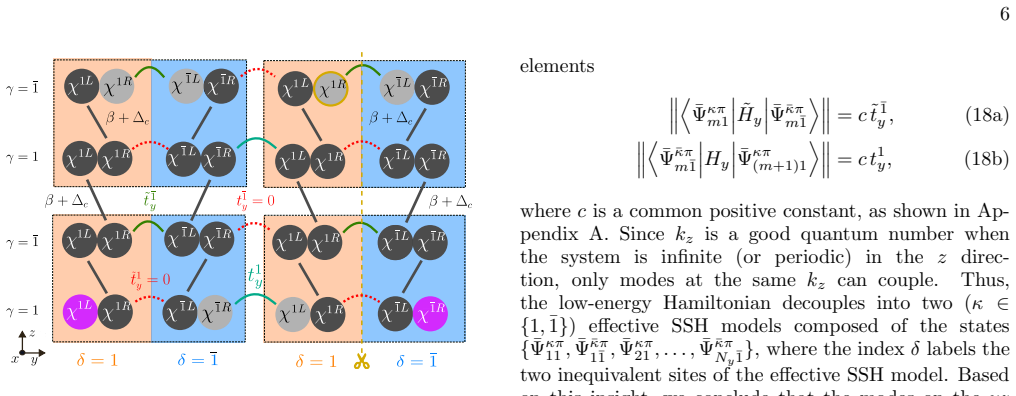
Since the symmetry betweenγ= 1 andγ= ¯1 is broken only by the termH y, we can find the eigenstates in terms of a momentumk z ∈(−π/a z, π/az), wherea z is the dis- tance between nearest neighbor wires in thezdirection. This leaves the indexγsuperfluous
-
[79]
Within the bosonization framework, the scattering is as- sociated with rapidly varying phase factor which sup- presses the term
-
[80]
Y. Oreg, E. Sela, and A. Stern, Fractional helical liquids in quantum wires, Phys. Rev. B89, 115402 (2014)
work page 2014
discussion (0)
Sign in with ORCID, Apple, or X to comment. Anyone can read and Pith papers without signing in.