Recognition: no theorem link
SCOT: Multi-Source Cross-City Transfer with Optimal-Transport Soft-Correspondence Objective
Pith reviewed 2026-05-12 01:23 UTC · model grok-4.3
The pith
SCOT recovers explicit soft correspondences between mismatched city regions via entropic optimal transport to improve multi-source transfer without ground-truth alignments.
A machine-rendered reading of the paper's core claim, the machinery that carries it, and where it could break.
Core claim
SCOT claims that entropic optimal transport can be used to learn explicit soft correspondences between unequal region sets of different cities, that an OT-weighted contrastive loss plus cycle reconstruction makes the transferred structure both sharper and more stable, and that balanced transport to a shared prototype hub extends the approach to the multi-source case, producing measurable gains in accuracy together with interpretable diagnostics of alignment quality.
What carries the argument
Sinkhorn-based entropic optimal transport that computes soft region correspondences, combined with an OT-weighted contrastive objective, cycle-style reconstruction regularizer, and balanced transport to a shared prototype hub guided by a target-induced prior.
If this is right
- Transfer accuracy and robustness improve consistently across real-world cities and prediction tasks.
- The learned transport couplings and hub assignments supply explicit diagnostics of alignment quality.
- Multi-source transfer is handled by aligning every source and the target to one shared prototype hub via balanced entropic transport.
- The OT-weighted contrastive objective sharpens transferable structure beyond what distribution-level alignment achieves.
- Cycle-style reconstruction stabilizes optimization under heterogeneous city data.
- The approach avoids reliance on heuristic anchor choices or implicit distribution matching.
Where Pith is reading between the lines
- The same soft-correspondence mechanism could be tested on other spatial transfer settings such as climate or traffic sensor networks whose grids do not match.
- If the recovered couplings prove reliable, they could serve as an unsupervised way to discover functional similarities between urban zones for planning applications.
- The framework suggests that optimal transport may be a general primitive for aligning heterogeneous spatial datasets when supervised matches are unavailable.
Load-bearing premise
Meaningful soft correspondences between incompatible region partitions of different cities exist and can be recovered via entropic optimal transport without any ground-truth region matches.
What would settle it
Running SCOT on city pairs whose region partitions are known to be randomly mismatched and observing that accuracy gains disappear while the learned couplings become uniform or uninterpretable would show the soft-correspondence premise does not hold in practice.
Figures







read the original abstract
Cross-city transfer improves prediction in label-scarce cities by leveraging labeled data from other cities, but it becomes challenging when cities adopt incompatible partitions and no ground-truth region correspondences exist. Existing approaches either rely on heuristic region matching, which is often sensitive to anchor choices, or perform distribution-level alignment that leaves correspondences implicit and can be unstable under strong heterogeneity. We propose SCOT, a cross-city representation learning framework that learns explicit soft correspondences between unequal region sets via Sinkhorn-based entropic optimal transport. SCOT further sharpens transferable structure with an OT-weighted contrastive objective and stabilizes optimization through a cycle-style reconstruction regularizer. For multi-source transfer, SCOT aligns each source and the target to a shared prototype hub using balanced entropic transport guided by a target-induced prototype prior. Across real-world cities and tasks, SCOT consistently improves transfer accuracy and robustness, while the learned transport couplings and hub assignments provide interpretable diagnostics of alignment quality.
Editorial analysis
A structured set of objections, weighed in public.
Referee Report
Summary. The manuscript proposes SCOT, a cross-city transfer learning framework that uses Sinkhorn-based entropic optimal transport to learn explicit soft correspondences between incompatible region partitions across cities without ground-truth matches. It augments the transport plan with an OT-weighted contrastive objective and a cycle-style reconstruction regularizer, and for multi-source settings aligns sources and target to a shared prototype hub via balanced entropic transport with a target-induced prior. The central claim is that this yields consistent accuracy and robustness gains on real-world urban tasks while the learned couplings and hub assignments supply interpretable diagnostics of alignment quality.
Significance. If the soft correspondences are verifiably meaningful rather than optimization artifacts and the reported gains prove robust, SCOT would offer a principled advance in handling heterogeneous partitions for urban transfer learning, moving beyond heuristic matching or implicit distribution alignment. The explicit interpretability of couplings is a potential strength for diagnostics in applied settings.
major comments (2)
- [Abstract and §3] Abstract and §3: The load-bearing premise that entropic OT recovers useful soft region correspondences between incompatible partitions (without any ground-truth matches) is asserted but supported only indirectly through downstream transfer accuracy. No direct validation—such as quantitative metrics on coupling fidelity, synthetic ground-truth benchmarks, or ablations isolating the OT component from the contrastive loss and cycle regularizer—is provided, so gains could arise from the auxiliary objectives alone.
- [§4] §4 (Experiments): The evaluation reports accuracy improvements but supplies no details on baselines, number of runs, statistical tests, ablation results on the cycle regularizer or hub prior, or robustness checks under varying heterogeneity. This prevents verification of the 'consistent' and 'robust' claims and leaves the interpretability of the learned couplings untested.
minor comments (2)
- The notation for the shared prototype hub, transport couplings, and target-induced prior would benefit from a consolidated symbol table or explicit pseudocode to improve readability.
- Figure captions and axis labels in the experimental plots could more explicitly indicate which components (e.g., OT vs. contrastive) are ablated or compared.
Simulated Author's Rebuttal
We thank the referee for the thoughtful and constructive comments on our manuscript. We address each of the major comments in detail below, and we will incorporate revisions to address the concerns raised.
read point-by-point responses
-
Referee: [Abstract and §3] Abstract and §3: The load-bearing premise that entropic OT recovers useful soft region correspondences between incompatible partitions (without any ground-truth matches) is asserted but supported only indirectly through downstream transfer accuracy. No direct validation—such as quantitative metrics on coupling fidelity, synthetic ground-truth benchmarks, or ablations isolating the OT component from the contrastive loss and cycle regularizer—is provided, so gains could arise from the auxiliary objectives alone.
Authors: We acknowledge the referee's point that the support for the utility of the entropic OT soft correspondences is primarily through downstream performance. To provide more direct evidence, we will add synthetic experiments with ground-truth correspondences to measure the quality of the recovered soft matches, as well as ablations isolating the OT objective from the contrastive and cycle components. These will be added to the revised manuscript in an expanded §3 and §4. revision: yes
-
Referee: [§4] §4 (Experiments): The evaluation reports accuracy improvements but supplies no details on baselines, number of runs, statistical tests, ablation results on the cycle regularizer or hub prior, or robustness checks under varying heterogeneity. This prevents verification of the 'consistent' and 'robust' claims and leaves the interpretability of the learned couplings untested.
Authors: We appreciate this feedback on the experimental rigor. We agree that additional details are required to allow verification of the consistency and robustness claims. In the revision, we will: provide a complete description of all baselines; report results averaged over multiple independent runs (with standard deviations); include statistical significance tests; add ablations isolating the cycle regularizer and hub prior; and perform robustness checks under varying degrees of partition heterogeneity. We will also add quantitative metrics to support the interpretability of the learned couplings. These enhancements will be included in the revised §4. revision: yes
Circularity Check
No significant circularity: SCOT combines standard OT primitives with new objectives without self-referential reduction
full rationale
The derivation applies Sinkhorn entropic OT to recover soft correspondences between region partitions, then augments it with an OT-weighted contrastive loss and cycle reconstruction regularizer. These steps use established optimal-transport machinery and introduce explicit new loss terms rather than fitting a parameter to data and relabeling the fit as a prediction. No equation reduces a claimed output to an input by construction, no uniqueness theorem is imported from self-citation, and no ansatz is smuggled via prior work. The central claim therefore remains an independent modeling choice whose performance can be evaluated against external benchmarks.
Axiom & Free-Parameter Ledger
axioms (2)
- domain assumption Entropic optimal transport produces useful soft correspondences between heterogeneous region partitions
- ad hoc to paper Cycle-style reconstruction regularizer stabilizes optimization of the transport plan
invented entities (1)
-
shared prototype hub
no independent evidence
Reference graph
Works this paper leans on
-
[1]
Alqahtani, S., Lalwani, G., Zhang, Y., Romeo, S., and Mansour, S. Using optimal transport as alignment objective for fine-tuning multilingual contextualized embeddings.arXiv preprint arXiv:2110.02887,
-
[2]
Bao, H., Zhou, X., Xie, Y., Li, Y., and Jia, X. Storm-gan: spatio-temporal meta-gan for cross-city estimation of human mobility responses to covid-19. InProceedings of the 2022 IEEE International Conference on Data Mining, ICDM 2022, Orlando, FL, USA, November 28 - December 1, pp. 1–10,
work page 2022
-
[3]
Brody, S., Alon, U., and Yahav, E. How atten- tive are graph attention networks?arXiv preprint arXiv:2105.14491,
-
[4]
When transfer learning meets cross-city urban flow prediction: Spatio-temporal adaptation matters
Fang, Z., Wu, D., Pan, L., Chen, L., and Gao, Y. When transfer learning meets cross-city urban flow prediction: Spatio-temporal adaptation matters. InProceedings of the 2022 IEEE International Conference on Acoustics, Speech and Signal Processing, ICASSP 2022, Sands Expo & Convention Centre, Singapore, May 22-27, volume 22, pp. 2030–2036,
work page 2022
-
[5]
Transferable graph structure learning for graph-based traffic forecasting across cities
Jin, Y., Chen, K., and Yang, Q. Transferable graph structure learning for graph-based traffic forecasting across cities. InProceedings of the Twenty-Ninth ACM SIGKDD Conference on Knowledge Discovery and Data Mining, KDD 2023, Long Beach, CA, USA, Au- gust 6-10, pp. 1032–1043,
work page 2023
- [6]
-
[7]
Modeling network- level traffic flow transitions on sparse data
Lei, X., Mei, H., Shi, B., and Wei, H. Modeling network- level traffic flow transitions on sparse data. InProceed- ings of the Twenty-Eighth ACM SIGKDD Conference on Knowledge Discovery and Data Mining, KDD 2022, Washington DC Convention Center, USA, August 14- 18, pp. 835–845,
work page 2022
-
[8]
Li, M., Tang, Y., and Ma, W. Few-sample traffic pre- diction with graph networks using locale as relational inductive biases.IEEE Transactions on Intelligent Transportation Systems, 24(2):1894–1908,
work page 1908
-
[9]
Diffusion Convolutional Recurrent Neural Network: Data-Driven Traffic Forecasting
Li, Y., Yu, R., Shahabi, C., and Liu, Y. Diffusion convo- lutional recurrent neural network: Data-driven traffic forecasting.arXiv preprint arXiv:1707.01926,
-
[10]
Frequency enhanced pre-training for cross-city few-shot traffic forecasting
Liu, Z., Ding, J., and Zheng, G. Frequency enhanced pre-training for cross-city few-shot traffic forecasting. arXiv preprint arXiv:2406.02614,
-
[11]
Spatio-temporal graph few-shot learning with cross- city knowledge transfer
11 SCOT: Multi-Source Cross-City Transfer with Optimal-Transport Soft-Correspondence Objectives Lu, B., Gan, X., Zhang, W., Yao, H., Fu, L., and Wang, X. Spatio-temporal graph few-shot learning with cross- city knowledge transfer. InProceedings of the Twenty- Eighth ACM SIGKDD Conference on Knowledge Dis- covery and Data Mining, KDD 2022, Washington DC Co...
work page 2022
-
[12]
Tang, Y., Qu, A., Chow, A. H., Lam, W. H., Wong, S. C., and Ma, W. Domain adversarial spatial-temporal net- work: A transferable framework for short-term traffic forecasting across cities. InProceedings of the Thirty- First ACM International Conference on Information and Knowledge Management, CIKM 2022, Atlanta, GA, USA, October 17-21, pp. 1905–1915,
work page 2022
-
[13]
Veličković, P., Cucurull, G., Casanova, A., Romero, A., Lio, P., and Bengio, Y. Graph attention networks. arXiv preprint arXiv:1710.10903,
work page internal anchor Pith review Pith/arXiv arXiv
-
[14]
Wang, L., Geng, X., Ma, X., Liu, F., and Yang, Q. Cross- city transfer learning for deep spatio-temporal predic- tion.Proceedings of the Twenty-Eighth International Joint Conference on Artificial Intelligence, IJCAI 2019, Macao, China, August 10-16, pp. 1893–1899,
work page 2019
-
[15]
Areatransfer: A cross-city crowd flow prediction frame- work based on transfer learning
Wei, X., Guo, T., Yu, H., Li, Z., Guo, H., and Li, X. Areatransfer: A cross-city crowd flow prediction frame- work based on transfer learning. InProceedings of the International Conference on Smart Computing and Communications, ICSCC 2021, New York, USA, De- cember 29, pp. 238–253. Springer,
work page 2021
-
[16]
Transfer knowledge between cities
Wei, Y., Zheng, Y., and Yang, Q. Transfer knowledge between cities. InProceedings of the Twenty-Second ACM SIGKDD International Conference on Knowledge Discovery and Data Mining, KDD 2016, San Francisco, California, USA, August 13-17, pp. 1905–1914,
work page 2016
-
[17]
Graph wavenet for deep spatial-temporal graph model- ing.arXiv preprint arXiv:1906.00121,
Wu, Z., Pan, S., Long, G., Jiang, J., and Zhang, C. Graph wavenet for deep spatial-temporal graph model- ing.arXiv preprint arXiv:1906.00121,
-
[18]
Can-st: Clustering adaptive normalization for spatio-temporal ood learning
Yang, M., An, Y., Deng, J., Li, X., Xu, B., Zhong, J., Lu, X., and Gong, Y. Can-st: Clustering adaptive normalization for spatio-temporal ood learning. In Proceedings of the Thirty-Fourth International Joint Conference on Artificial Intelligence, pp. 3543–3551, 2025a. Yang, M., Li, X., Xu, B., Nie, X., Zhao, M., Zhang, C., Zheng, Y., and Gong, Y. Stda: Sp...
work page 2019
-
[19]
Yu, B., Yin, H., and Zhu, Z. Spatio-temporal graph convolutional networks: A deep learning framework for traffic forecasting.arXiv preprint arXiv:1709.04875,
-
[20]
13 SCOT: Multi-Source Cross-City Transfer with Optimal-Transport Soft-Correspondence Objectives A Related Work A.1 Cross-city transfer. Cross-city transfer learning tackles data scarcity and high labeling costs in urban computing by transferring knowledge from well-instrumented source cities to label-scarce targets. FLORAL demonstrates early cross-city mu...
work page 2016
-
[21]
and transferable graph structure learning (TransGTR) (Jin et al., 2023), alongside region-level transfer with connectivity/parameter generation (CARPG) (Yang et al.,
work page 2023
-
[22]
and one-stage embedding-plus-alignment frameworks (CoRE) (Chen et al.). Overall, the key challenge is local and selective alignment across unequal, non-corresponding region sets while preserving city-internal structure and task-relevant semantics, motivating our approach. A.2 Spatio-temporal representation learning. Spatio-temporal representation learning...
work page 2025
-
[23]
and task-specific self-supervised objectives for traffic forecasting (Ji et al., 2023). However, these methods are mainly developed for single-city or homogeneous node sets and often assume aligned node identities or comparable graph structures; in cross-city settings with heterogeneous partitions, unequal region counts, and no natural correspondence, str...
work page 2023
-
[24]
and Sinkhorn-type objectives/divergences that are GPU-friendly and balance geometric sensitivity with statistical stability (Genevay et al., 2018; Feydy et al., 2019). OT is also a core tool for distribution alignment in domain adaptation and transfer: OT-based DA aligns source and target by optimizing a coupling with optional structure-preserving regular...
work page 2018
-
[25]
and SuperGAT (Kim & Oh, 2022), keeping all alignment objectives and training hyperparameters unchanged. Table 10 shows only marginal variation across encoders, indicating that the representational capacity of the backbone is not the performance bottleneck and that the alignment module is the primary driver of cross-city transfer quality. Downstream readou...
work page 2022
-
[26]
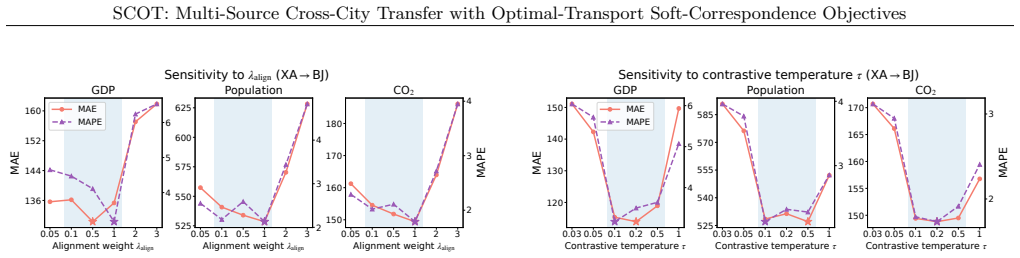
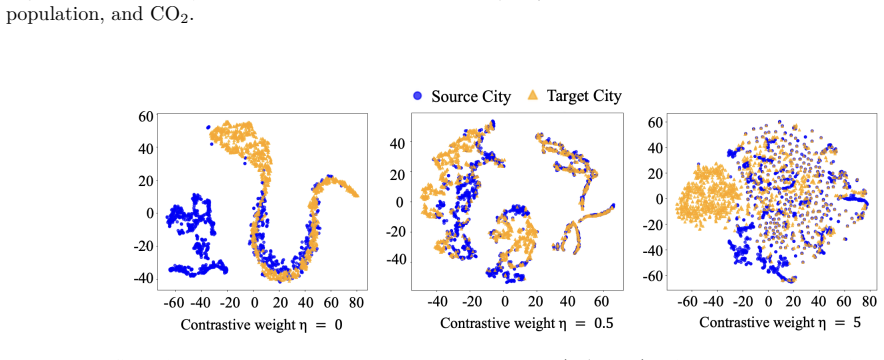
Figure 19: t-SNE visualization of region embeddings under different alignment weightsλalign (XA→BJ). Blue circles denote source regions and orange triangles denote target regions. I.3 Sensitivity toτ. Figure 20 visualizes how the contrastive temperatureτshapes alignment. With smallτ(0.03), the two cities are less interleaved, suggesting weaker corresponde...
work page 2008
discussion (0)
Sign in with ORCID, Apple, or X to comment. Anyone can read and Pith papers without signing in.