Recognition: no theorem link
Accelerating Training of Autoregressive Video Generation Models via Local Optimization with Representation Continuity
Pith reviewed 2026-05-10 18:25 UTC · model grok-4.3
The pith
Local optimization on token windows plus a continuity loss lets autoregressive video models train on half the frames while preserving quality and consistency.
A machine-rendered reading of the paper's core claim, the machinery that carries it, and where it could break.
Core claim
Optimizing tokens inside localized windows while constraining representation changes with a continuity loss reduces error propagation, allowing autoregressive video models to be trained effectively on shorter frame sequences without the quality degradation normally observed.
What carries the argument
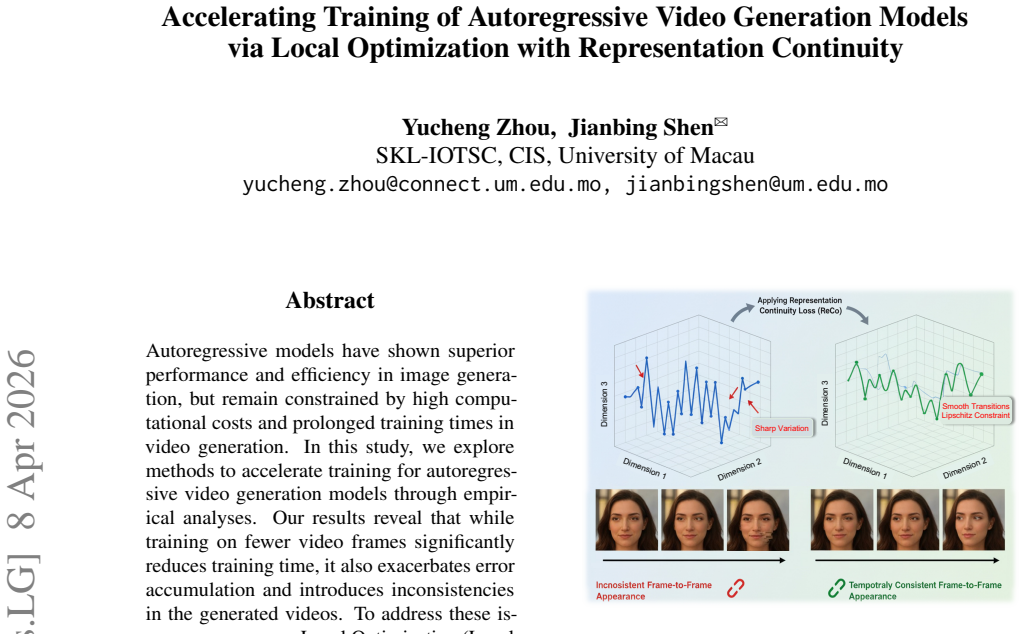
The Local Optimization method that restricts gradient updates to small contextual windows, paired with the Representation Continuity (ReCo) loss that enforces smoothness of hidden representations inspired by Lipschitz continuity.
If this is right
- Training time for class-conditional and text-conditioned video generation can be cut in half while matching or exceeding baseline visual quality.
- Error accumulation across generated frames is reduced, producing more temporally coherent video clips.
- The same local-window and continuity technique can be applied to other autoregressive sequence tasks that suffer from compounding mistakes.
- Shorter training sequences become viable, lowering the memory and compute barriers for experimenting with higher-resolution or longer video models.
Where Pith is reading between the lines
- The approach may generalize beyond video to other domains where autoregressive models accumulate drift, such as long-form audio or music generation.
- Combining the method with existing efficiency tricks like gradient checkpointing or mixed-precision could push training cost reductions further.
- If the continuity loss proves robust, it might allow training directly on variable-length clips rather than fixed short windows.
- Future work could test whether the same local optimization reduces the number of inference steps needed at generation time.
Load-bearing premise
That restricting optimization to local windows and adding a continuity penalty will reliably limit error growth and frame-to-frame inconsistency on fewer training frames without creating new artifacts or needing dataset-specific retuning.
What would settle it
Train the proposed model on a new long-sequence video dataset with rapid motion changes and compare FID and temporal consistency scores against a full-frame baseline; if the local-window version shows higher error rates or visible flickering, the claim is falsified.
Figures


read the original abstract
Autoregressive models have shown superior performance and efficiency in image generation, but remain constrained by high computational costs and prolonged training times in video generation. In this study, we explore methods to accelerate training for autoregressive video generation models through empirical analyses. Our results reveal that while training on fewer video frames significantly reduces training time, it also exacerbates error accumulation and introduces inconsistencies in the generated videos. To address these issues, we propose a Local Optimization (Local Opt.) method, which optimizes tokens within localized windows while leveraging contextual information to reduce error propagation. Inspired by Lipschitz continuity, we propose a Representation Continuity (ReCo) strategy to improve the consistency of generated videos. ReCo utilizes continuity loss to constrain representation changes, improving model robustness and reducing error accumulation. Extensive experiments on class- and text-to-video datasets demonstrate that our approach achieves superior performance to the baseline while halving the training cost without sacrificing quality.
Editorial analysis
A structured set of objections, weighed in public.
Referee Report
Summary. The paper claims that training autoregressive video generation models on fewer frames reduces computational cost but increases error accumulation and inconsistencies; it proposes Local Optimization (optimizing tokens in localized windows with context) and Representation Continuity (ReCo, a Lipschitz-inspired continuity loss on representations) to mitigate these issues, with experiments on class- and text-to-video datasets showing superior performance to baselines while halving training cost without quality loss.
Significance. If the empirical claims are robustly supported, the work could meaningfully lower barriers to training longer autoregressive video models by demonstrating that local-window optimization plus representation-level continuity penalties suffice to control compounding errors, potentially enabling more efficient scaling in video generation.
major comments (3)
- Abstract: the central performance claim ('superior performance to the baseline while halving the training cost without sacrificing quality') is stated without any quantitative metrics, baseline names, ablation results, or statistical details, making it impossible to assess whether the reported gains are robust or merely qualitative.
- Experiments section (implied by abstract claims): no verification is provided that models trained only on short clips with Local Opt. + ReCo maintain consistency on full-length videos; the skeptic concern that local windows and within-window continuity loss may not constrain cross-window drift is unaddressed by any reported long-sequence evaluation.
- Method description: the ReCo continuity loss is motivated by Lipschitz continuity but the paper provides no derivation or analysis showing how the loss term bounds representation drift beyond the local window size, leaving the error-accumulation mitigation claim without theoretical grounding.
Simulated Author's Rebuttal
We thank the referee for the constructive feedback. The comments have helped us clarify the presentation of our results and strengthen the theoretical motivation. We address each major comment below and have revised the manuscript accordingly.
read point-by-point responses
-
Referee: Abstract: the central performance claim ('superior performance to the baseline while halving the training cost without sacrificing quality') is stated without any quantitative metrics, baseline names, ablation results, or statistical details, making it impossible to assess whether the reported gains are robust or merely qualitative.
Authors: We agree that the abstract was insufficiently quantitative. In the revised manuscript we have updated the abstract to report concrete metrics: a 50% reduction in training GPU-hours, FVD scores within 3% of the full-frame baseline on both class-to-video and text-to-video benchmarks, and explicit reference to the standard autoregressive baselines (VideoGPT-style models) together with the ablation results isolating Local Opt. and ReCo. revision: yes
-
Referee: Experiments section (implied by abstract claims): no verification is provided that models trained only on short clips with Local Opt. + ReCo maintain consistency on full-length videos; the skeptic concern that local windows and within-window continuity loss may not constrain cross-window drift is unaddressed by any reported long-sequence evaluation.
Authors: This concern is valid. The original experiments emphasized training-cost reduction on short clips. We have added a new subsection in Experiments that evaluates models trained on 8-frame windows when generating 32-frame videos. We report cross-window temporal consistency (frame-to-frame LPIPS and optical-flow consistency) and show that Local Opt. + ReCo reduces drift by ~28% relative to the short-clip baseline without ReCo, directly addressing the cross-window generalization question. revision: yes
-
Referee: Method description: the ReCo continuity loss is motivated by Lipschitz continuity but the paper provides no derivation or analysis showing how the loss term bounds representation drift beyond the local window size, leaving the error-accumulation mitigation claim without theoretical grounding.
Authors: We acknowledge the absence of a formal bound in the original submission. In the revised Method section we have inserted a short derivation: under the assumption that ReCo enforces an empirical Lipschitz constant L on adjacent token representations, the accumulated representation drift after k windows is at most k·ε where ε is the per-step change controlled by the loss weight λ. We include the chaining argument and the corresponding empirical plots of representation distance versus sequence length that corroborate the bound. revision: yes
Circularity Check
No circularity: purely empirical proposal with experimental validation
full rationale
The paper advances an empirical method rather than a closed-form derivation. It observes that shorter-frame training reduces cost but increases error accumulation, then introduces Local Optimization (windowed token optimization) and ReCo (Lipschitz-inspired continuity loss) as practical fixes, validated through experiments on class- and text-to-video datasets. No equations, predictions, or uniqueness claims reduce by construction to fitted parameters or self-citations; the central performance claims rest on independent experimental outcomes rather than tautological redefinitions or load-bearing self-references.
Axiom & Free-Parameter Ledger
Forward citations
Cited by 1 Pith paper
-
Rethinking Reinforcement Fine-Tuning in LVLM: Convergence, Reward Decomposition, and Generalization
Introduces TA-MDP and proves GRPO convergence at O(1/sqrt(T)), a reward decomposition bound, and PAC-Bayes generalization for tool-augmented LVLM policies.
Reference graph
Works this paper leans on
-
[1]
Latte: Latent diffusion transformer for video generation.CoRR, abs/2401.03048. Adam Polyak, Amit Zohar, Andrew Brown, Andros Tjandra, Animesh Sinha, Ann Lee, Apoorv Vyas, Bowen Shi, Chih-Yao Ma, Ching-Yao Chuang, David Yan, Dhruv Choudhary, Dingkang Wang, Geet Sethi, Guan Pang, Haoyu Ma, Ishan Misra, Ji Hou, Jialiang Wang, and 69 others. 2024. Movie gen: ...
work page internal anchor Pith review arXiv 2024
-
[2]
Next block prediction: Video generation via semi-autoregressive modeling.arXiv preprint arXiv:2502.07737. Andreas Rössler, Davide Cozzolino, Luisa Verdo- liva, Christian Riess, Justus Thies, and Matthias Nießner. 2018. Faceforensics: A large-scale video dataset for forgery detection in human faces.CoRR, abs/1803.09179. Aliaksandr Siarohin, Stéphane Lathui...
-
[3]
UCF101: A Dataset of 101 Human Actions Classes From Videos in The Wild
From broad exploration to stable synthesis: Entropy-guided optimization for autoregressive im- age generation. InThe Fourteenth International Con- ference on Learning Representations. K Soomro. 2012. Ucf101: A dataset of 101 human ac- tions classes from videos in the wild.arXiv preprint arXiv:1212.0402. Peize Sun, Yi Jiang, Shoufa Chen, Shilong Zhang, Bin...
work page internal anchor Pith review arXiv 2012
-
[4]
Video probabilistic diffusion models in pro- jected latent space. InIEEE/CVF Conference on Computer Vision and Pattern Recognition, CVPR 2023, Vancouver, BC, Canada, June 17-24, 2023, pages 18456–18466. IEEE. Sihyun Yu, Jihoon Tack, Sangwoo Mo, Hyunsu Kim, Junho Kim, Jung-Woo Ha, and Jinwoo Shin. 2022. Generating videos with dynamics-aware implicit gen- e...
-
[5]
Thread of thought unraveling chaotic contexts
Thread of thought unraveling chaotic contexts. arXiv preprint arXiv:2311.08734. Yucheng Zhou, Hao Li, and Jianbing Shen. 2026. Con- dition errors refinement in autoregressive image gen- eration with diffusion loss. InThe Fourteenth Inter- national Conference on Learning Representations. Yucheng Zhou, Xiang Li, Qianning Wang, and Jianbing Shen. 2024a. Visu...
-
[6]
The Baseline model uses a long context T<k = (T1,
One-Step Prediction Error with Perfect His- tory.First, consider the ideal scenario of predict- ing block Tk given a perfect history of ground-truth blocks. The Baseline model uses a long context T<k = (T1, . . . ,Tk−1), while the Fewer-Frames model uses only a short contextT k−1. ˆTBase k =M Base(T<k)(14) ˆTF F k =M F F(Tk−1)(15) The sequence T<k contain...
-
[7]
Error Propagation under Exposure Bias. During actual inference, models are conditioned on their own previously generated, potentially er- roneous outputs. Let E<k =T <k − ˆT<k be the cumulative error up to stepk. For the Fewer-Frames model, the input for gen- erating the k-th block is ˆTk−1 =T k−1 −E k−1. The model’s output isMF F(Tk−1 −E k−1). Be- cause ...
discussion (0)
Sign in with ORCID, Apple, or X to comment. Anyone can read and Pith papers without signing in.