When is randomization advantageous in quantum simulation?
Pith reviewed 2026-05-10 17:47 UTC · model grok-4.3
The pith
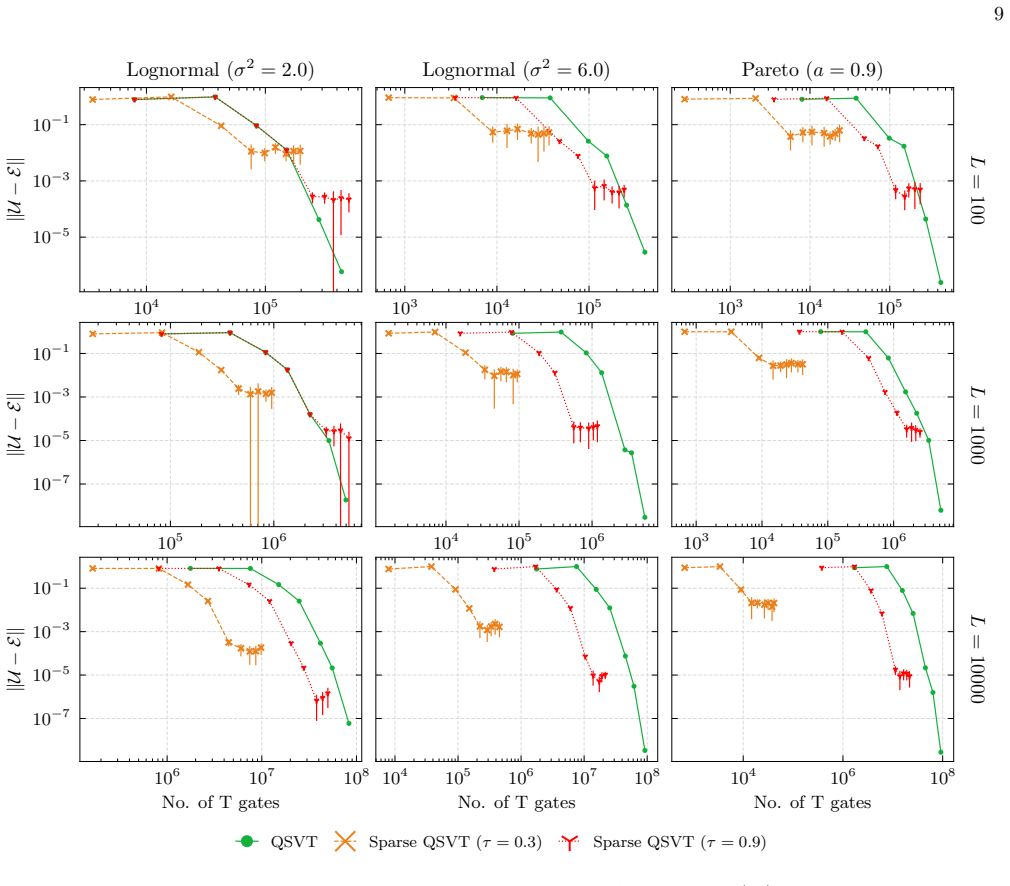
Randomization lowers gate counts for quantum Hamiltonian simulation with many uneven terms, but only until moderate precision where deterministic methods become cheaper.
A machine-rendered reading of the paper's core claim, the machinery that carries it, and where it could break.
Core claim
A sparse-QSVT construction based on composite stochastic decompositions reduces gate counts by up to an order of magnitude for Hamiltonians that contain many terms and highly inhomogeneous coefficient distributions; this gain is restricted to moderate-precision regimes, with deterministic block-encoding methods becoming more efficient once the target error drops below approximately 10^{-3}, as stochastic and approximation errors propagate through the QSVT procedure. The comparison is performed on ensembles of random Hamiltonians whose term count, locality, and coefficient dispersion are controlled to maximize the potential benefit of randomization, thereby establishing an upper bound rather,
What carries the argument
The composite stochastic decomposition inside sparse-QSVT, which applies deterministic treatment to dominant terms and stochastic sampling to smaller contributions while propagating errors through block-encoding.
If this is right
- Gate counts drop by up to a factor of ten for Hamiltonians with many terms and large coefficient spread in the moderate-error regime.
- Deterministic methods overtake the randomized approach once the target error falls below approximately 10^{-3}.
- The reported reduction constitutes an upper bound because the model Hamiltonians omit commutation patterns that real systems possess.
- The moderate-precision window where randomization helps overlaps partially with quantum-chemistry Hamiltonians, though additional structure in those systems is expected to shrink the window.
- Realistic quantum-chemistry Hamiltonians contain commutation patterns absent from the model, which further favor deterministic methods.
Where Pith is reading between the lines
- Hybrid algorithms could adaptively switch from randomized to deterministic sampling once a desired precision is approached, minimizing total cost across the full workflow.
- Future work should quantify how commutation relations in molecular Hamiltonians shift the crossover error and whether they can be exploited to improve the deterministic baseline.
- Low-precision randomized simulations may serve as a fast initial step before a high-accuracy deterministic refinement on the same hardware.
- The error-propagation analysis developed here can be reused to compare other stochastic quantum algorithms against their deterministic counterparts.
Load-bearing premise
The random Hamiltonian ensembles are built with controlled dispersion and no extra commutation relations, so they maximize rather than reflect the typical advantage randomization would have on real systems.
What would settle it
Run both the randomized sparse-QSVT and a standard deterministic QSVT on the same 100-term Hamiltonian with coefficient ratios of 10,000, measuring total gate count at target errors of 10^{-2}, 10^{-3}, and 10^{-4} to determine whether the crossover occurs near 10^{-3}.
Figures




read the original abstract
We study the regimes in which Hamiltonian simulation benefits from randomization. We introduce a sparse-QSVT construction based on composite stochastic decompositions, where dominant terms are treated deterministically and smaller contributions are sampled stochastically. Crucially, we analyze how stochastic and approximation errors propagate through block-encoding and QSVT procedures. To benchmark this approach, we construct ensembles of random Hamiltonians with controlled coefficient dispersion, locality, and number of terms, designed to favor randomization, and therefore providing an upper bound on its practical advantage. For Hamiltonians with many terms and highly inhomogeneous coefficient distributions, randomized methods reduce gate counts by up to an order of magnitude. However, this advantage is confined to moderate-precision regimes: as the target error decreases, deterministic methods become more efficient, with a crossover near $\varepsilon \sim 10^{-3}$. Although this regime partially overlaps with quantum chemistry Hamiltonians, realistic systems exhibit additional structure, such as commutation patterns, not captured by our model, which are expected to further favor deterministic approaches.
Editorial analysis
A structured set of objections, weighed in public.
Referee Report
Summary. The manuscript introduces a sparse-QSVT construction for Hamiltonian simulation that combines deterministic treatment of dominant terms with stochastic sampling of smaller contributions via composite decompositions. It derives bounds on the propagation of stochastic sampling errors and approximation errors through block-encoding and QSVT, then benchmarks gate counts on ensembles of random Hamiltonians with controlled term count, coefficient dispersion, and locality. These ensembles are deliberately constructed to favor randomization and are presented as supplying an upper bound on practical advantage. The central claim is that randomized methods yield up to an order-of-magnitude gate-count reduction for Hamiltonians with many terms and highly inhomogeneous coefficients, but only in moderate-precision regimes, with deterministic methods becoming preferable near a crossover of ε ∼ 10^{-3}.
Significance. If the quantitative crossover holds, the work supplies a useful, explicit guide for choosing between randomized and deterministic simulation strategies, grounded in gate-count expressions that depend on term count, dispersion, and target error. Strengths include the use of standard QSVT and block-encoding lemmas for error bounds, fully specified synthetic ensembles that enable reproducible numerical results, and the paper's explicit framing of its findings as an upper bound due to the ensemble design. The stress-test concern about unmodeled commutation structure in real Hamiltonians does not undermine the manuscript because the abstract and benchmark section already acknowledge that realistic quantum-chemistry systems contain additional structure expected to favor deterministic methods further.
major comments (1)
- [error-bound derivation] § on stochastic error propagation (error-bound derivation): the combined bound on stochastic plus QSVT approximation error is derived from standard lemmas, but the manuscript should clarify whether the variance reduction from sampling assumes statistical independence across terms; any residual dependence in the composite decomposition would tighten or loosen the reported crossover point.
minor comments (2)
- [Abstract] The abstract states the crossover near ε ∼ 10^{-3} without specifying whether ε is the absolute or relative simulation error; a one-sentence clarification would prevent ambiguity for readers comparing to quantum-chemistry targets.
- [benchmark section] The benchmark section describes the ensemble parameters (term count, dispersion, locality) in prose; a compact table listing the exact ranges and number of instances per ensemble would improve reproducibility and allow direct comparison with the gate-count plots.
Simulated Author's Rebuttal
We thank the referee for their careful reading, positive assessment of the work, and the constructive comment on the error-bound derivation. We address the point below and will incorporate the requested clarification in the revised manuscript.
read point-by-point responses
-
Referee: [error-bound derivation] § on stochastic error propagation (error-bound derivation): the combined bound on stochastic plus QSVT approximation error is derived from standard lemmas, but the manuscript should clarify whether the variance reduction from sampling assumes statistical independence across terms; any residual dependence in the composite decomposition would tighten or loosen the reported crossover point.
Authors: We agree that an explicit statement on this point improves clarity. In the derivation of the combined stochastic-plus-approximation error bound (Section III), the variance reduction for the sampled terms follows the standard formula for the sum of independent random variables. Our composite decomposition partitions the smaller-magnitude terms into disjoint groups that are sampled independently, which justifies the independence assumption. In the revised manuscript we will add a short paragraph in the error-propagation subsection stating this assumption explicitly and noting that any residual positive correlations would increase the effective variance, which could shift the reported crossover to a modestly higher value of ε. Because the synthetic ensembles are deliberately constructed to maximize the advantage of randomization (highly inhomogeneous coefficients, no commutation structure), the crossover near ε ∼ 10^{-3} already constitutes a conservative upper bound on the regime where randomization is beneficial. The main conclusions of the paper remain unchanged. revision: yes
Circularity Check
No significant circularity; gate-count results are direct evaluations on explicitly parameterized ensembles
full rationale
The paper defines ensembles of random Hamiltonians by choosing explicit input parameters (number of terms, coefficient dispersion, locality) and then applies closed-form gate-count expressions for both randomized (stochastic sampling of small terms) and deterministic methods, including error propagation through block-encoding and QSVT. The reported order-of-magnitude reduction and the ε ∼ 10^{-3} crossover are obtained by plugging those chosen parameters into the expressions; no parameter is fitted to the final performance metric, no result is renamed as a prediction, and the construction is openly labeled as supplying an upper bound. No load-bearing self-citation, self-definitional loop, or ansatz smuggled via prior work appears in the derivation chain. The central claim therefore remains a direct computation on the stated model rather than a tautological restatement of its inputs.
Axiom & Free-Parameter Ledger
axioms (1)
- standard math Standard error bounds for block-encoding and quantum signal processing hold when stochastic and approximation errors are added in the usual way.
Lean theorems connected to this paper
-
IndisputableMonolith/Cost/FunctionalEquation.leanwashburn_uniqueness_aczel (J uniqueness) unclear?
unclearRelation between the paper passage and the cited Recognition theorem.
We introduce a sparse-QSVT construction based on composite stochastic decompositions... Theorems 1–3 on LCU error propagation and estimator variance proxy Varcoeff[Ĥ]
-
IndisputableMonolith/Foundation/RealityFromDistinction.leanreality_from_one_distinction unclear?
unclearRelation between the paper passage and the cited Recognition theorem.
ensembles of random Hamiltonians with controlled coefficient dispersion, locality, and number of terms—designed to favor randomization
What do these tags mean?
- matches
- The paper's claim is directly supported by a theorem in the formal canon.
- supports
- The theorem supports part of the paper's argument, but the paper may add assumptions or extra steps.
- extends
- The paper goes beyond the formal theorem; the theorem is a base layer rather than the whole result.
- uses
- The paper appears to rely on the theorem as machinery.
- contradicts
- The paper's claim conflicts with a theorem or certificate in the canon.
- unclear
- Pith found a possible connection, but the passage is too broad, indirect, or ambiguous to say the theorem truly supports the claim.
Reference graph
Works this paper leans on
-
[1]
qDRIFT The qDRIFT protocol [43], subsequently refined in Refs. [45–48], approximates time evolution by sampling Hamiltonian terms according to their relative weights. We define the sampling probabilities as pj = |cj| λ .(3) 3 At each step, an indexjis sampled independently ac- cording to the distribution{p j}, and the corresponding unitary exp −i cj pj Hj...
-
[2]
This is similar to the hybrid method from Refs
SparSto SparSto [34] interpolates between deterministic Trot- terization and qDRIFT by sampling a sparsification ˆH of the Hamiltonian at each time step, where a sparsi- fication is composed by only a subset of all the terms. This is similar to the hybrid method from Refs. [47, 50– 52], but with an error bound that explicitly depend on the probability dis...
-
[3]
Feynman, Simulating physics with computers, Int J Theor Phys21, 467–488 (1982)
R. Feynman, Simulating physics with computers, Int J Theor Phys21, 467–488 (1982)
work page 1982
-
[4]
M. Troyer and U.-J. Wiese, Computational complexity and fundamental limitations to fermionic quantum monte carlo simulations, Phys. Rev. Lett.94, 170201 (2005)
work page 2005
-
[5]
Lloyd, Universal quantum simulators, Science273, 1073 (1996)
S. Lloyd, Universal quantum simulators, Science273, 1073 (1996)
work page 1996
-
[6]
A. M. Childs, D. Maslov, Y. Nam, N. J. Ross, and Y. Su, Toward the first quantum simulation with quan- tum speedup, Proceedings of the National Academy of Sciences115, 9456–9461 (2018)
work page 2018
-
[7]
E. F. Dumitrescu, A. J. McCaskey, G. Hagen, G. R. Jansen, T. D. Morris, T. Papenbrock, R. C. Pooser, D. J. Dean, and P. Lougovski, Cloud quantum computing of an atomic nucleus, Phys. Rev. Lett.120, 210501 (2018)
work page 2018
-
[8]
A. Roggero and J. Carlson, Dynamic linear response quantum algorithm, Phys. Rev. C100, 034610 (2019)
work page 2019
-
[9]
O. Kiss, M. Grossi, P. Lougovski, F. Sanchez, S. Val- lecorsa, and T. Papenbrock, Quantum computing of the 6Li nucleus via ordered unitary coupled clusters, Phys. Rev. C106, 034325 (2022)
work page 2022
-
[10]
C. Gu, M. Heinz, O. Kiss, and T. Papenbrock, Toward scalable quantum computations of atomic nuclei, Phys. Rev. C113, 034321 (2026)
work page 2026
-
[11]
T. I. Andersen, N. Astrakhantsev, A. H. Karamlou, J. Berndtsson, J. Motruk, A. Szasz, J. A. Gross, A. Schuckert, T. Westerhout, Y. Zhang, E. Forati, D. Rossi, B. Kobrin, A. Di Paolo, A. R. Klots, I. Droz- dov, V. Kurilovich, A. Petukhov, L. B. Ioffe, A. Elben, A. Rath, V. Vitale, B. Vermersch, R. Acharya, L. A. Beni, K. Anderson, M. Ansmann, F. Arute, K. ...
work page 2025
-
[12]
W. Hofstetter and T. Qin, Quantum simulation of strongly correlated condensed matter systems, Journal of Physics B: Atomic, Molecular and Optical Physics51, 082001 (2018)
work page 2018
-
[13]
N. Keenan, N. F. Robertson, T. Murphy, S. Zhuk, and J. Goold, Evidence of kardar-parisi-zhang scaling on a digital quantum simulator, npj Quantum Information9, 10.1038/s41534-023-00742-4 (2023)
-
[14]
A. Miessen, D. J. Egger, I. Tavernelli, and G. Mazzola, Benchmarking digital quantum simulations above hun- dreds of qubits using quantum critical dynamics, PRX Quantum5, 040320 (2024)
work page 2024
-
[15]
O. Kiss, D. Teplitskiy, M. Grossi, and A. Mandarino, Statistics of topological defects across a phase transition in a digital superconducting quantum processor, Quan- tum Science and Technology10, 035037 (2025)
work page 2025
-
[16]
S. P. Jordan, K. S. M. Lee, and J. Preskill, Quan- tum algorithms for quantum field theories, Science336, 1130–1133 (2012)
work page 2012
-
[17]
A. F. Shaw, P. Lougovski, J. R. Stryker, and N. Wiebe, Quantum Algorithms for Simulating the Lat- tice Schwinger Model, Quantum4, 306 (2020)
work page 2020
-
[18]
N. Klco, A. Roggero, and M. J. Savage, Standard model physics and the digital quantum revolution: thoughts about the interface, Reports on Progress in Physics85, 064301 (2022)
work page 2022
- [19]
-
[20]
Y. Su, D. W. Berry, N. Wiebe, N. Rubin, and R. Bab- bush, Fault-tolerant quantum simulations of chemistry in first quantization, PRX Quantum2, 040332 (2021)
work page 2021
-
[21]
D. S. Abrams and S. Lloyd, Quantum algorithm provid- ing exponential speed increase for finding eigenvalues and eigenvectors, Phys. Rev. Lett.83, 5162 (1999)
work page 1999
- [22]
-
[23]
N. S. Blunt, L. Caune, R. Izs´ ak, E. T. Campbell, and N. Holzmann, Statistical phase estimation and error mit- igation on a superconducting quantum processor, PRX Quantum4, 040341 (2023)
work page 2023
-
[24]
O. Kiss, U. Azad, B. Requena, A. Roggero, D. Wakeham, and J. M. Arrazola, Early Fault-Tolerant Quantum Algo- rithms in Practice: Application to Ground-State Energy Estimation, Quantum9, 1682 (2025)
work page 2025
-
[25]
Y. Dong, L. Lin, and Y. Tong, Ground-state prepara- tion and energy estimation on early fault-tolerant quan- tum computers via quantum eigenvalue transformation of unitary matrices, PRX Quantum3, 040305 (2022)
work page 2022
-
[26]
Z. Li, X. Liu, H. Wang, S. Ashhab, J. Cui, H. Chen, X. Peng, and J. Du, Quantum simulation of resonant transitions for solving the eigenproblem of an effective 12 water hamiltonian, Phys. Rev. Lett.122, 090504 (2019)
work page 2019
- [27]
-
[28]
O. Kiss, M. Grossi, and A. Roggero, Quantum error mit- igation for fourier moment computation, Phys. Rev. D 111, 034504 (2025)
work page 2025
-
[29]
B. Hall, A. Roggero, A. Baroni, and J. Carlson, Sim- ulation of collective neutrino oscillations on a quantum computer, Phys. Rev. D104, 063009 (2021)
work page 2021
-
[30]
V. Amitrano, A. Roggero, P. Luchi, F. Turro, L. Vespucci, and F. Pederiva, Trapped-ion quantum sim- ulation of collective neutrino oscillations, Phys. Rev. D 107, 023007 (2023)
work page 2023
- [31]
-
[32]
A. Roggero, A. C. Y. Li, J. Carlson, R. Gupta, and G. N. Perdue, Quantum computing for neutrino-nucleus scat- tering, Phys. Rev. D101, 074038 (2020)
work page 2020
-
[33]
W. Du, J. P. Vary, X. Zhao, and W. Zuo, Quantum sim- ulation of nuclear inelastic scattering, Phys. Rev. A104, 012611 (2021)
work page 2021
-
[34]
M. Illa and M. J. Savage, Multi-neutrino entanglement and correlations in dense neutrino systems, Phys. Rev. Lett.130, 221003 (2023)
work page 2023
- [36]
-
[37]
G. H. Low and I. L. Chuang, Optimal hamiltonian sim- ulation by quantum signal processing, Phys. Rev. Lett. 118, 010501 (2017)
work page 2017
-
[38]
H. F. Trotter, On the product of semi-groups of opera- tors, Proc. Amer. Math. Soc.10, 545 (1959)
work page 1959
-
[39]
M. Suzuki, Generalized Trotter’s formula and systematic approximants of exponential operators and inner deriva- tions with applications to many-body problems, Commu- nications in Mathematical Physics51, 183 (1976)
work page 1976
-
[40]
M. Suzuki, Fractal decomposition of exponential opera- tors with applications to many-body theories and Monte Carlo simulations, Physics Letters A146, 319 (1990)
work page 1990
-
[41]
A. M. Childs, Y. Su, M. C. Tran, N. Wiebe, and S. Zhu, Theory of Trotter Error with Commutator Scaling, Phys- ical Review X11, 011020 (2021)
work page 2021
- [42]
-
[43]
R. Babbush, J. McClean, D. Wecker, A. Aspuru-Guzik, and N. Wiebe, Chemical basis of trotter-suzuki errors in quantum chemistry simulation, Phys. Rev. A91, 022311 (2015)
work page 2015
-
[44]
A. Schubert and C. B. Mendl, Trotter error with com- mutator scaling for the fermi-hubbard model, Phys. Rev. B108, 195105 (2023)
work page 2023
-
[45]
Campbell, Random compiler for fast hamiltonian sim- ulation, Phys
E. Campbell, Random compiler for fast hamiltonian sim- ulation, Phys. Rev. Lett.123, 070503 (2019)
work page 2019
-
[46]
A. M. Childs, A. Ostrander, and Y. Su, Faster quantum simulation by randomization, Quantum3, 182 (2019)
work page 2019
- [48]
-
[49]
O. Kiss, M. Grossi, and A. Roggero, Importance sam- pling for stochastic quantum simulations, Quantum7, 977 (2023)
work page 2023
-
[50]
Tighter error bounds for the qdrift algorithm.arXiv preprint arXiv:2506.17199, 2025
I. David, I. Sinayskiy, and F. Petruccione, Tighter er- ror bounds for the qdrift algorithm, arXiv preprint arXiv:2506.17199 (2025)
-
[51]
C.-F. Chen, H.-Y. Huang, R. Kueng, and J. A. Tropp, Concentration for random product formulas, PRX Quan- tum2, 040305 (2021)
work page 2021
-
[52]
M. Hagan and N. Wiebe, Composite Quantum Simula- tions, Quantum7, 1181 (2023)
work page 2023
-
[53]
Phase estimation with partially randomized time evolution, 2025
J. G¨ unther, F. Witteveen, A. Schmidhuber, M. Miller, M. Christandl, and A. Harrow, Phase estimation with partially randomized time evolution, arXiv preprint arXiv:2503.05647 (2025)
- [54]
-
[55]
E. Granet and H. Dreyer, Hamiltonian dynamics on digi- tal quantum computers without discretization error, npj Quantum Information10, 10.1038/s41534-024-00877-y (2024)
-
[56]
C. Kiumi and B. Koczor, Te-pai: exact time evolution by sampling random circuits, Quantum Science and Tech- nology10, 045071 (2025)
work page 2025
-
[57]
P. K. Faehrmann, M. Steudtner, R. Kueng, M. Kieferov´ a, and J. Eisert, Randomizing multi-product formulas for Hamiltonian simulation, Quantum6, 806 (2022)
work page 2022
-
[58]
G. H. Low and I. L. Chuang, Hamiltonian Simulation by Qubitization, Quantum3, 163 (2019)
work page 2019
-
[59]
G. H. Low and I. L. Chuang, Optimal Hamiltonian Sim- ulation by Quantum Signal Processing, Physical Review Letters118, 010501 (2017)
work page 2017
-
[60]
A. Gily´ en, Y. Su, G. H. Low, and N. Wiebe, Quantum singular value transformation and beyond: exponential improvements for quantum matrix arithmetics, inPro- ceedings of the 51st Annual ACM SIGACT Symposium on Theory of Computing, STOC 2019 (Association for Computing Machinery, New York, NY, USA, 2019) p. 193–204
work page 2019
-
[61]
J. M. Martyn, Z. M. Rossi, A. K. Tan, and I. L. Chuang, Grand unification of quantum algorithms, PRX Quan- tum2, 040203 (2021)
work page 2021
-
[62]
A. M. Childs and N. Wiebe, Hamiltonian simulation us- ing linear combinations of unitary operations, Quantum Info. Comput.12, 901–924 (2012)
work page 2012
- [63]
-
[64]
K. Wan, M. Berta, and E. T. Campbell, Randomized quantum algorithm for statistical phase estimation, Phys. Rev. Lett.129, 030503 (2022)
work page 2022
-
[65]
J. Peetz, S. E. Smart, and P. Narang, Quantum simula- tion via stochastic combination of unitaries, npj Quan- tum Information 10.1038/s41534-025-01168-w (2026)
-
[66]
N. J. Ross and P. Selinger, Optimal ancilla-free clifford+t approximation of z-rotations, Quantum Info. Comput. 16, 901–953 (2016). 13
work page 2016
-
[67]
U. Azad and S. Fomichev, Pennylane quantum chemistry datasets,https://pennylane.ai/datasets/ collection/qchem(2023)
work page 2023
-
[68]
T. Goubault de Brugi` ere, M. Baboulin, B. Valiron, S. Martiel, and C. Allouche, Decoding techniques applied to the compilation of cnot circuits for nisq architectures, Science of Computer Programming214, 102726 (2022)
work page 2022
-
[69]
S. Bravyi and A. Kitaev, Universal quantum computa- tion with ideal clifford gates and noisy ancillas, Physical Review A71, 10.1103/physreva.71.022316 (2005)
-
[70]
A. G. Fowler, M. Mariantoni, J. M. Martinis, and A. N. Cleland, Surface codes: Towards practical large- scale quantum computation, Physical Review A86, 10.1103/physreva.86.032324 (2012)
-
[71]
Gottesman, Theory of fault-tolerant quantum compu- tation, Physical Review A57, 127–137 (1998)
D. Gottesman, Theory of fault-tolerant quantum compu- tation, Physical Review A57, 127–137 (1998)
work page 1998
-
[72]
F. Tacchino, A. Chiesa, S. Carretta, and D. Gerace, Quantum computers as universal quantum simulators: State-of-the-art and perspectives, Advanced Quantum Technologies3, 10.1002/qute.201900052 (2019)
-
[73]
M. Amy, D. Maslov, M. Mosca, and M. Roetteler, A meet-in-the-middle algorithm for fast synthesis of depth-optimal quantum circuits, IEEE Transactions on Computer-Aided Design of Integrated Circuits and Sys- tems32, 818–830 (2013)
work page 2013
-
[74]
A. Barenco, C. H. Bennett, R. Cleve, D. P. DiVincenzo, N. Margolus, P. Shor, T. Sleator, J. A. Smolin, and H. Weinfurter, Elementary gates for quantum computa- tion, Phys. Rev. A52, 3457 (1995)
work page 1995
-
[75]
T. Khattar and C. Gidney, Rise of conditionally clean an- cillae for efficient quantum circuit constructions, Quan- tum (2024)
work page 2024
-
[76]
M. M¨ ott¨ onen, J. J. Vartiainen, V. Bergholm, and M. M. Salomaa, Transformation of quantum states using uni- formly controlled rotations, Quantum Info. Comput.5, 467–473 (2005). Appendix A: Error propagation in LCU We analyze how imperfections in thePrepareandSe- lectoracles propagate through the LCU block-encoding and the subsequent QSVT transformation...
work page 2005
discussion (0)
Sign in with ORCID, Apple, or X to comment. Anyone can read and Pith papers without signing in.