Exploring topological phases with extended Su-Schrieffer-Heeger models
Pith reviewed 2026-05-10 17:22 UTC · model grok-4.3
The pith
The Su-Schrieffer-Heeger model supports topological phases that become more sophisticated when the model is extended in dimensionality, unit cell size, or with additional physical terms.
A machine-rendered reading of the paper's core claim, the machinery that carries it, and where it could break.
Core claim
The SSH model describes a 1D tight-binding lattice with alternating nearest-neighbor amplitudes and supports a topological phase with zero energy eigenstates localized at each end. Extensions by increasing dimensionality, enlarging the unit cell, or adding extra terms give rise to more sophisticated topological phenomena, as illustrated through case studies from existing literature where properties of topological origin are elaborated.
What carries the argument
Extended Su-Schrieffer-Heeger models obtained by modifying the original 1D alternating hopping lattice through added dimensions, larger unit cells, or physical effect terms, which carry the argument by exhibiting various boundary-localized modes and topological invariants.
If this is right
- Models with increased dimensionality support topological phases in two or more dimensions with protected edge or surface states.
- Enlarged unit cells allow for models with multiple bands and more complex topological classifications.
- Adding extra terms representing physical effects introduces new types of topological protection or phase transitions.
- These extended models provide concrete examples for studying phenomena absent in the minimal 1D SSH case.
Where Pith is reading between the lines
- The SSH framework acts as a simple base from which many known topological systems can be derived by systematic modifications.
- Experimental realizations could involve cold atoms or photonic lattices tuned to match the extended Hamiltonians.
- Further work might classify all possible extensions using symmetry indicators or topological invariants.
Load-bearing premise
That the chosen case studies from the literature cover a representative range of extensions and capture their key topological properties adequately.
What would settle it
A calculation or simulation of an extended SSH Hamiltonian showing no zero-energy boundary modes where the review predicts them would challenge the corresponding case study.
Figures




read the original abstract
The Su-Schrieffer-Heeger (SSH) model describes a tight-binding one-dimensional (1D) lattice with alternating nearest-neighbor amplitudes. Despite its mathematically simple and physically intuitive structure, the SSH model is capable of supporting a 1D topological phase that is characterized by the presence of zero energy eigenstates (zero modes) localized at each end of the lattice. For this reason, many studies in the area of topological phases of matter often consider the SSH model as a subject for various extensions that give rise to more sophisticated topological phenomena. The purpose of this article is to review, in sufficient detail, existing approaches to extending the SSH model. This includes extensions by increasing the dimensionality of the lattice, enlarging the size of its unit cell, or adding extra terms that represent various physical effects. For each approach, some extended SSH models studied in relevant existing literature are discussed as case studies. Noteworthy properties of such models, which are of topological origin, are further comprehensively elaborated.
Editorial analysis
A structured set of objections, weighed in public.
Referee Report
Summary. The manuscript is a review of the Su-Schrieffer-Heeger (SSH) model and its extensions for exploring topological phases of matter. It begins by recalling that the basic 1D SSH chain supports a topological phase with zero-energy edge-localized modes, then systematically examines three classes of extensions—increasing lattice dimensionality, enlarging the unit cell, and adding extra terms that encode additional physical effects—using selected case studies drawn from the existing literature to illustrate the resulting topological phenomena and invariants.
Significance. If the coverage is balanced and the case studies are accurately summarized, the review provides a useful entry point and reference for researchers working on 1D and higher-dimensional topological insulators and superconductors. By organizing extensions around a single, well-understood parent model, it can help readers map how simple modifications generate richer phenomenology such as higher-order topology, non-Hermitian effects, or fractionalized excitations.
minor comments (3)
- The abstract states that the review covers extensions 'in sufficient detail,' yet the manuscript does not include an explicit statement of selection criteria for the case studies or a table summarizing the topological invariants and edge-state properties across all discussed models; adding such a table would improve usability.
- Several figures (e.g., those depicting band structures or edge-mode wavefunctions for the extended models) lack labels for the topological phase boundaries or the value of the relevant winding number; this reduces clarity when the text refers to 'the topological regime.'
- The reference list appears to omit a few recent works on non-Hermitian extensions of the SSH model (post-2022) that are directly relevant to the 'adding extra terms' section; a brief check against current literature would strengthen completeness.
Simulated Author's Rebuttal
We thank the referee for their positive assessment of the manuscript as a useful entry point and reference for researchers studying topological phases via extensions of the SSH model. We appreciate the recommendation for minor revision. No specific major comments were provided in the report.
Circularity Check
No significant circularity: review of external literature
full rationale
The manuscript is a review that summarizes established results on the SSH model and its extensions from the existing literature. It presents no new derivations, predictions, or fitted parameters of its own; all case studies and noteworthy topological properties are explicitly drawn from cited external works. No load-bearing step reduces by construction to self-definition, self-citation chains, or renaming of inputs. The central claims restate well-known facts (zero-energy edge modes in the topological phase) without internal circular logic.
Axiom & Free-Parameter Ledger
axioms (1)
- domain assumption The SSH model is a tight-binding 1D lattice with alternating nearest-neighbor amplitudes that supports zero-energy end states in its topological phase.
Reference graph
Works this paper leans on
-
[1]
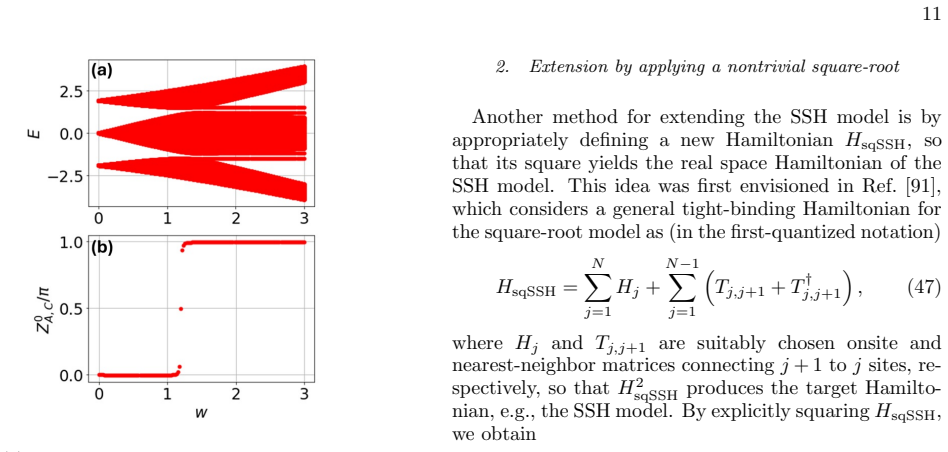
Extension by changing the periodicity of the hopping amplitudes As was schematically shown in Fig. 1, the real space Hamiltonian of the SSH model consists of two alter- nating hopping amplitudesvandw. One of the most 10 FIG. 9. The single particle energy spectrum of the SSH3 model under (a,b,c) PBC and (d) OBC at varying values of w. The system parameters...
-
[2]
Extension by applying a nontrivial square-root Another method for extending the SSH model is by appropriately defining a new HamiltonianH sqSSH, so that its square yields the real space Hamiltonian of the SSH model. This idea was first envisioned in Ref. [91], which considers a general tight-binding Hamiltonian for the square-root model as (in the first-q...
-
[3]
T. Jungwirth, Q. Niu, and A. H. MacDonald, Anoma- lous Hall Effect in Ferromagnetic Semiconductors, Phys. Rev. Lett.88, 207208 (2002)
work page 2002
-
[4]
M. Onoda and N. Nagaosa, Quantized Anomalous Hall Effect in Two-Dimensional Ferromagnets: Quantum Hall Effect in Metals, Phys. Rev. Lett.90, 206601 (2003)
work page 2003
-
[5]
C. X. Liu, X. L. Qi, X. Dai, Z. Fang, and S. C. Zhang, Quantum Anomalous Hall Effect in Hg1−yMnyTe Quan- tum Wells, Phys. Rev. Lett.101, 146802 (2008)
work page 2008
-
[6]
R. Yu, W. Zhang, H. Zhang, S. Zhang, X. Dai, and Z. Fang, Quantized Anomalous Hall Effect in Magnetic Topological Insulators, Science329, 61 (2010)
work page 2010
-
[7]
C. L. Kane and E. J. Mele, Quantum Spin Hall Effect in Graphene, Phys. Rev. Lett.95, 226801 (2005)
work page 2005
-
[8]
B. A. Bernevig, T. L. Hughes, and S. C. Zhang, Quan- tum spin Hall effect and topological phase transition in HgTe quantum wells, Science314, 1757 (2006)
work page 2006
-
[9]
C. L. Kane and E. J. Mele,Z 2 Topological Order and the Quantum Spin Hall Effect, Phys. Rev. Lett.95, 146802 (2005)
work page 2005
-
[10]
M. K¨ onig, S. Wiedmann, C. Br¨ une, A. Roth, H. Buh- mann, L. W. Molenkamp, X.-L. Qi, and S.-C. Zhang, Quantum Spin Hall Insulator State in HgTe Quantum Wells, Science318, 766 (2007)
work page 2007
- [11]
-
[12]
H. Zhang, C.-X. Liu, X.-L. Qi, X. Dai, Z. Fang, and S.-C. Zhang, Topological insulators in Bi 2Se3, Bi 2Te3 and Sb 2Te3 with a single Dirac cone on the surface, Nat. Phys.5, 438 (2009)
work page 2009
-
[13]
Y. Xia, D. Qian, D. Hsieh, L. Wray, A. Pal, H. Lin, A. Bansil, D. Grauer, Y. S. Hor, R. J. Cava, and M. Z. Hasan, Observation of a large-gap topological- insulator class with a single Dirac cone on the surface, Nat. Phys.5, 398 (2009)
work page 2009
-
[14]
Y. L. Chen, J. G. Analytis, J. H. Chu, Z. K. Liu, S. K. Mo, X. L. Qi, H. J. Zhang, D. H. Lu, X. Dai, Z. Fang, S. C. Zhang, I. R. Fisher, Z. Hus- sain, Z. X. Shen, Experimental Realization of a Three-Dimensional Topological Insulator, Bi 2Te3, Sci- ence325, 178 (2009)
work page 2009
-
[15]
A. Y. Kitaev, Fault-tolerant quantum computation by anyons, Ann. Phys.303, 2-30 (2003)
work page 2003
- [16]
-
[17]
A. P. Schnyder, S. Ryu, A. Furusaki, and A. W. W. Lud- wig, Classification of topological insulators and super- conductors in three spatial dimensions, Phys. Rev. B78, 195125 (2008)
work page 2008
-
[18]
S. Ryu, A. Schnyder, A. Furusaki, and A. Ludwig, Topo- logical insulators and superconductors: ten-fold way and dimensional hierarchy, New J. Phys.12, 065010 (2010)
work page 2010
- [19]
-
[20]
B. Wang, T. Chen, and X. Zhang, Experimental ob- servation of topologically protected bound states with vanishing chern numbers in a two-dimensional quantum walk, Phys. Rev. Lett.121, 100501 (2018)
work page 2018
-
[21]
C. Chen, X. Ding, J. Qin, Y. He, Y.-H. Luo, M.- C. Chen, C. Liu, X.-L. Wang, W.-J. Zhang, H. Li, et al., Observation of topologically protected edge states in a photonic two-dimensional quantum walk. Phys. Rev. Lett.121, 100502 (2018)
work page 2018
-
[22]
M. Xiao, G. Ma, Z. Yang, P. Sheng, Z. Q. Zhang, and C. T. Chan, Geometric phase and band inversion in pe- riodic acoustic systems. Nat. Phys.11, 240–244 (2015)
work page 2015
-
[23]
B. K. Stuhl, H.-I. Lu, L. M. Aycock, D. Genkina, and I. B. Spielman. Visualizing edge states with an atomic bose gas in the quantum hall regime, Science349, 1514–1518 (2015)
work page 2015
-
[24]
E. J. Meier, F. A. An, and B. Gadway, Ob- servation of the topological soliton state in the Su–Schrieffer–Heeger, Nat. Commun.7, 13986 (2016)
work page 2016
-
[25]
N. Goldman, J. C. Budich, and P. Zoller, Topological quantum matter with ultracold gases in optical lattices, Nat. Phys.12, 639–645 (2016)
work page 2016
- [26]
-
[27]
E. J. Meier, F. A. An, A. Dauphin, M. Maffei, P. Massig- nan, T. L. Hughes, and B. Gadway, Observation of the topological anderson insulator in disordered atomic wires, Science362, 929–933 (2018)
work page 2018
-
[28]
X. Li, Y. Meng, X. Wu, S. Yan, Y. Huang, S. Wang, and W. Wen, Su-Schrieffer-Heeger model inspired acoustic interface states and edge states, Appl. Phys. Lett.113, 203501 (2018)
work page 2018
-
[29]
M. Kiczynski, S. K. Gorman, H. Geng, M. B. Donnelly, Y. Chung, Y. He, J. G. Keizer, and M. Y. Simmons, Engineering topological states in atom-based semicon- ductor quantum dots, Nature606, 694 (2022)
work page 2022
-
[30]
Y. B.-Ocampo, B. M.-Montanez, A. M. M.-Arg¨ uello, and R. A. M.- S´ anchez. Twofold topological phase tran- sitions induced by third-nearest-neighbor interactions in 1d chains, Phys. Rev. B109, 104111 (2024)
work page 2024
-
[31]
Y. E. Kraus, Y. Lahini, Z. Ringel, M. Verbin, and O. Zil- berberg, Topological States and Adiabatic Pumping in Quasicrystals, Phys. Rev. Lett.109, 106402 (2012). 22
work page 2012
- [32]
-
[33]
Longhi, Topological pumping of edge states via adi- abatic passage, Phys
S. Longhi, Topological pumping of edge states via adi- abatic passage, Phys. Rev. B99, 155150 (2019)
work page 2019
- [34]
-
[35]
S. Nakajima, T. Tomita, S. Taie, T. Ichinose, H. Ozawa, L. Wang, M. Troyer, and Y. Takahashi, Topological Thouless pumping of ultracold fermions, Nat. Phys.12, 296 (2016)
work page 2016
-
[36]
L. Wang, M. Troyer, and X. Dai, Topological Charge Pumping in a One-Dimensional Optical Lattice, Phys. Rev. Lett.111, 026802 (2013)
work page 2013
- [37]
-
[38]
H. Wang, L. Zhou, and J. Gong, Interband coherence induced correction to adiabatic pumping in periodically driven systems, Phys. Rev. B91, 085420 (2015)
work page 2015
-
[39]
Y. Ke, X. Qin, F. Mei, H. Zhong, Y. S. Kivshar, and C. Lee, Topological phase transitions and Thou- less pumping of light in photonic waveguide arrays, Laser Photon. Rev.10, 995 (2016)
work page 2016
-
[40]
H. H. Yap, L. Zhou, J.-S. Wang, and J. Gong, Com- putational study of the two-terminal transport of Flo- quet quantum Hall insulators, Phys. Rev. B96, 165443 (2017)
work page 2017
-
[41]
Y. Ke, X. Qin, Y. S. Kivshar, and C. Lee, Multiparti- cle Wannier states and Thouless pumping of interacting bosons, Phys. Rev. A95, 063630 (2017)
work page 2017
-
[42]
S. Hu, Y. Ke, Y. Deng, and C. Lee, Dispersion- suppressed topological Thouless pumping, Phys. Rev. B100, 064302 (2019)
work page 2019
-
[43]
L. Lin, Y. Ke, and C. Lee, Interaction-induced topo- logical bound states and Thouless pumping in a one- dimensional optical lattice, Phys. Rev. A 101, 023620 (2020)
work page 2020
-
[44]
S. Hu, Y. Ke, and C. Lee, Topological quantum trans- port and spatial entanglement distribution via a disor- dered bulk channel, Phys. Rev. A101, 052323 (2020)
work page 2020
-
[45]
N. Lang and H. P. Buchle, Topological networks for quantum communication between distant qubits, npj Quantum Information3, 47 (2017)
work page 2017
- [46]
-
[47]
F. Mei, G. Chen, L. Tian, S.-L. Zhu, and S. Jia, Robust quantum state transfer via topological edge states in superconducting qubit chains, Phys. Rev. A98, 012331 (2018)
work page 2018
-
[48]
R. W. Bomantara and J Gong, Quantum computation via Floquet topological edge modes, Phys. Rev. B98, 165421 (2018)
work page 2018
- [49]
-
[50]
S. Tan, R. W. Bomantara, and J. Gong, High-fidelity and long-distance entangled-state transfer with Floquet topological edge modes, Phys. Rev. A102, 022608 (2020)
work page 2020
-
[51]
R. W. Bomantara and J. Gong, Combating quasi- particle poisoning with multiple Majorana fermions in a periodically-driven quantum wire, J. Phys.: Con- dens. Matter32, 435301 (2020)
work page 2020
-
[52]
R. W. Bomantara and J. Gong, Measurement-only quantum computation with Floquet Majorana corner modes, Phys. Rev. B101, 085401 (2020)
work page 2020
-
[53]
A. Matthies, J. Park, E. Berg, and A. Rosch, Stability of floquet majorana box qubits, Phys. Rev. Lett.128, 127702 (2022)
work page 2022
-
[54]
A. H. Safwan and R. W. Bomantara, J. Phys. A: Math. Theor.58, 335302 (2025)
work page 2025
- [55]
-
[56]
C. Weeks and M. Franz, Topological Insulators on the Lieb and Perovskite Lattices, Phys. Rev. B82, 085310 (2010)
work page 2010
- [57]
-
[58]
N. H. Lindner, G. Refael, and V. Galitski, Nat. Phys.7, 490 (2011)
work page 2011
-
[59]
D. Y. H. Ho and J. Gong, Topological effects in chi- ral symmetric driven systems, Phys. Rev. B90, 195419 (2014)
work page 2014
-
[60]
L. Fu, C. L. Kane, and E. J. Mele, Topological Insula- tors in Three Dimensions, Phys. Rev. Lett.98, 106803 (2007)
work page 2007
-
[61]
J. E. Moore and L. Balents, Topological invariants of time-reversal-invariant band structures, Phys. Rev. B 75, 121306(R) (2007)
work page 2007
-
[62]
Roy, Topological phases and the quantum spin Hall effect in three dimensions, Phys
R. Roy, Topological phases and the quantum spin Hall effect in three dimensions, Phys. Rev. B79, 195322 (2009)
work page 2009
-
[63]
P. Roushan, J. Seo, C. V. Parker, Y. S. Hor, D. Hsieh, D. Qian, A. Richardella, M. Z. Hasan, R. J. Cava, and A. Yazdani, Topological surface states protected from backscattering by chiral spin texture, Nature460, 1106–1109 (2009)
work page 2009
-
[64]
M. Z. Hasan and C. L. Kane, Colloquium: Topological insulators, Rev. Mod. Phys.82, 3045 (2010)
work page 2010
- [65]
-
[66]
A. Y. Kitaev, Unpaired majorana fermions in quantum wires, Physics-uspekhi44, 131 (2001)
work page 2001
-
[67]
Fendley, Parafermionic edge zero modes in Zn- invariant spin chains, J
P. Fendley, Parafermionic edge zero modes in Zn- invariant spin chains, J. Stat. Mech. P11020 (2012)
work page 2012
-
[68]
S. Ganeshan, K. Sun and S. D. Sarma, Topological Zero- Energy Modes in Gapless Commensurate Aubry-Andr´ e- Harper Models, Phys. Rev. Lett.110, 180403 (2013)
work page 2013
-
[69]
R. W. Bomantara, G. N. Raghava, L. Zhou, and J. Gong, Floquet topological semimetal phases of an ex- tended kicked Harper model, Phys. Rev. E93, 022209 (2016)
work page 2016
-
[70]
R. W. Bomantara and J. Gong, Generating con- trollable type-II Weyl points via periodic driving, Phys. Rev. B94, 235447 (2016)
work page 2016
-
[71]
H. Q. Wang, M. N. Chen, R. W. Bomantara, J. Gong, and D. Y. Xing, Line nodes and surface Majorana flat bands in static and kickedp-wave superconducting 23 Harper model, Phys. Rev. B95, 075136 (2017)
work page 2017
-
[72]
E. Prodan and H. S.-Baldes, Bulk and Boundary In- variants for Complex Topological Insulators: From K- Theory to Physics, Mathematical Physics Studies (Vol. 185), Springer, Cham (2016)
work page 2016
-
[73]
W. P. Su, J. R. Schrieffer, and A. J. Heeger, Solitons in Polyacetylene, Phys. Rev. Lett.42, 1698 (1979)
work page 1979
-
[74]
Zak, Berry’s phase for energy bands in solids, Phys
J. Zak, Berry’s phase for energy bands in solids, Phys. Rev. Lett.62, 2747 (1988)
work page 1988
-
[75]
P. Delplace, D. Ullmo, and G. Montambaux, The Zak phase and the existence of edge states in graphene, Phys. Rev. B84, 195452 (2011)
work page 2011
-
[76]
R. Jackiw and C. Rebbi, Solitons with fermion number 1 2, Phys. Rev. D13, 3398 (1975)
work page 1975
- [77]
- [78]
-
[79]
S.-Q. Shen, Topological Insulators: Dirac Equation in Condensed Matter, 2nd ed., (Springer Singapore, 2017)
work page 2017
-
[80]
K.-Y. Yang, Y.-M. Lu, and Y. Ran, Quantum Hall ef- fects in a Weyl semimetal: Possible application in py- rochlore iridates, Phys. Rev. B84, 075129 (2011)
work page 2011
discussion (0)
Sign in with ORCID, Apple, or X to comment. Anyone can read and Pith papers without signing in.