The Principle of Maximum Heterogeneity Optimises Productivity in Distributed Production Systems Across Biology, Economics, and Computing
Pith reviewed 2026-05-10 16:49 UTC · model grok-4.3
The pith
Any performance-optimising distributed production system converges toward greater agent heterogeneity within environmental limits and communication-determined scales.
A machine-rendered reading of the paper's core claim, the machinery that carries it, and where it could break.
Core claim
The central claim is the Principle of Maximum Heterogeneity: any distributed production system optimising for performance will converge on an increasingly heterogeneous configuration; environmental demands place an upper bound on the degree of heterogeneity required; and the communication topology determines the spatial scale over which heterogeneity spreads, with this principle applying recursively across all layers of nested production systems.
What carries the argument
The Principle of Maximum Heterogeneity, which states that performance optimisation drives increasing agent heterogeneity in distributed production systems, subject to environmental bounds and communication topology.
Load-bearing premise
That well-understood findings from biology, economics, neuroscience, and computing can be captured in one simple joint model of distributed production systems.
What would settle it
A controlled distributed system in which forcing greater homogeneity under fixed environmental demands and topology raises rather than lowers measured productivity.
Figures










read the original abstract
The world is full of systems of distributed agents, collaborating and competing in complex ways: firms and workers specialise within economies, neurons adapt their tuning across brain circuits, and species compete and coexist within ecosystems. In that context, individual research fields built theories explaining how comparative advantage drives trade specialisation, how balanced neural representations emerge from sensory coding, and how biodiversity sustains ecological productivity. Here we propose that many of these well-understood findings across fields can be captured in one simple joint cross-disciplinary model, which we call the Distributed Production System. It captures how agent heterogeneity, resource constraints, communication topology, and task structure jointly determine the productivity, efficiency, and robustness of distributed systems across biology, economics, neuroscience, and computing. This model reveals that a small set of underlying laws generates the complex dynamics observed across fields. These can be summarised in our Principle of Maximum Heterogeneity: any distributed production system optimising for performance will converge on an increasingly heterogeneous configuration; environmental demands place an upper bound on the degree of heterogeneity required; and the communication topology determines the spatial scale over which heterogeneity spreads, with this principle applying recursively across all layers of nested production systems. Beyond explaining existing systems, these principles act as a blueprint for constructing ideal ones. We demonstrate this by suggesting specific redesigns for compute systems executing large-scale AI. In total, The Principle of Maximum Heterogeneity reveals a unique convergence of complex phenomena across fields onto simple underlying design principles with important predictive value for future distributed production systems.
Editorial analysis
A structured set of objections, weighed in public.
Referee Report
Summary. The paper proposes a unified 'Distributed Production System' model integrating agent heterogeneity, resource constraints, communication topology, and task structure to explain productivity, efficiency, and robustness across biology, economics, neuroscience, and computing. It introduces the Principle of Maximum Heterogeneity: performance-optimizing systems converge on increasingly heterogeneous configurations, with environmental demands bounding the required heterogeneity and communication topology setting the spatial scale, applying recursively to nested systems. The principle is positioned as explanatory for existing phenomena (e.g., specialization, neural tuning, biodiversity) and as a blueprint for redesigning systems such as large-scale AI compute.
Significance. If the model were formally specified and the principle derived with validation against domain-specific results, the work could offer a cross-disciplinary framework with predictive value for distributed systems and practical guidance for AI infrastructure. The synthesis attempt across fields is ambitious and could encourage interdisciplinary thinking if the unification is demonstrated rather than asserted.
major comments (3)
- [Abstract] Abstract: the manuscript states that the Distributed Production System 'captures how agent heterogeneity, resource constraints, communication topology, and task structure jointly determine' outcomes and 'reveals' the Principle of Maximum Heterogeneity, yet supplies no state variables, objective function, equations, or derivation steps showing how the principle follows from these elements. This is load-bearing for the central claim.
- [Abstract] Abstract: the unification claim that 'many of these well-understood findings across fields can be captured in one simple joint cross-disciplinary model' is asserted without reproducing or deriving any specific established result (e.g., comparative advantage, balanced neural representations, or biodiversity-productivity relations) inside the model.
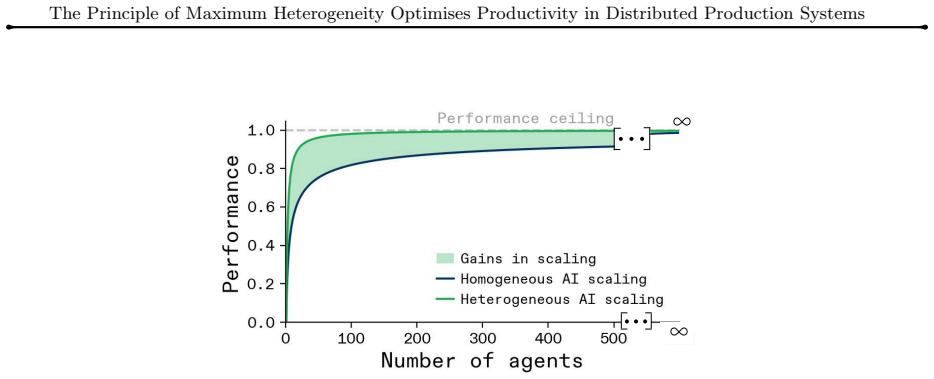
- [Abstract] Abstract: the application to 'suggesting specific redesigns for compute systems executing large-scale AI' is mentioned but no concrete redesigns, metrics, or evaluation steps are provided to support the claim of improved productivity or robustness.
minor comments (2)
- [Abstract] The description of the Principle of Maximum Heterogeneity is presented in a single dense sentence; breaking it into enumerated components would improve readability.
- [Abstract] Terms such as 'nested production systems' and 'spatial scale over which heterogeneity spreads' are introduced without explicit definition or prior context.
Simulated Author's Rebuttal
We thank the referee for the constructive and detailed comments. These highlight opportunities to make the formal structure, unification, and applications more explicit. We address each major comment below and will revise the manuscript accordingly.
read point-by-point responses
-
Referee: [Abstract] Abstract: the manuscript states that the Distributed Production System 'captures how agent heterogeneity, resource constraints, communication topology, and task structure jointly determine' outcomes and 'reveals' the Principle of Maximum Heterogeneity, yet supplies no state variables, objective function, equations, or derivation steps showing how the principle follows from these elements. This is load-bearing for the central claim.
Authors: We agree that the abstract does not reference the formal elements. The full manuscript defines the Distributed Production System with state variables for agent heterogeneity distributions, resource constraint vectors, communication topology as adjacency matrices, and task structures as allocation functions. Productivity is the objective function to be maximized subject to these constraints and environmental bounds. The Principle of Maximum Heterogeneity is obtained by showing that the optimum occurs at the highest feasible heterogeneity level, with topology determining the spatial extent and recursion applying to nested subsystems. We will revise the abstract to include a concise statement of these components and reference the derivation steps in the main text. revision: yes
-
Referee: [Abstract] Abstract: the unification claim that 'many of these well-understood findings across fields can be captured in one simple joint cross-disciplinary model' is asserted without reproducing or deriving any specific established result (e.g., comparative advantage, balanced neural representations, or biodiversity-productivity relations) inside the model.
Authors: We accept that explicit reproduction of domain results is needed to substantiate the unification. In revision we will add a section that derives simplified instances inside the model: a two-agent case recovering comparative advantage via optimal heterogeneity under resource constraints; a sensory coding example yielding balanced neural representations as the heterogeneity optimum; and a resource-partitioning case reproducing positive biodiversity-productivity relations. These will be presented as direct consequences of the same optimization rather than assertions. revision: yes
-
Referee: [Abstract] Abstract: the application to 'suggesting specific redesigns for compute systems executing large-scale AI' is mentioned but no concrete redesigns, metrics, or evaluation steps are provided to support the claim of improved productivity or robustness.
Authors: The manuscript outlines redesigns such as heterogeneous processor pools and topology-aware interconnects that increase feasible heterogeneity. To make this concrete we will expand the relevant section with explicit metrics (productivity as aggregate throughput, robustness as performance under node failure) and evaluation steps consisting of agent-based simulations of the DPS model on representative large-scale training workloads, comparing against homogeneous baselines. revision: yes
Circularity Check
No load-bearing derivation chain present to inspect for circularity
full rationale
The provided abstract and context describe a proposed model and principle but supply no equations, state variables, objective function, or explicit derivation steps. Without a concrete chain of the form 'from inputs A we derive result B via equation X' it is impossible to exhibit any reduction of a claimed prediction to its inputs by construction. The paper therefore cannot be scored for circularity under the required criteria; it is treated as self-contained in the absence of inspectable steps.
Axiom & Free-Parameter Ledger
axioms (1)
- domain assumption Distributed production systems optimize for performance
invented entities (2)
-
Principle of Maximum Heterogeneity
no independent evidence
-
Distributed Production System
no independent evidence
Reference graph
Works this paper leans on
-
[1]
Princeton University Press, Princeton, NJ, 1944
John von Neumann and Oskar Morgenstern.Theory of Games and Economic Behavior. Princeton University Press, Princeton, NJ, 1944
work page 1944
-
[2]
Non-cooperative games.Annals of Mathematics, 54(2):286–295, 1951
John Nash. Non-cooperative games.Annals of Mathematics, 54(2):286–295, 1951
work page 1951
-
[3]
John H Kagel and Dan Levin. The winner’s curse and public information in common value auctions.The American economic review, pages 894–920, 1986
work page 1986
-
[4]
Image scoring and cooperation in a cleaner fish mutualism.Nature, 441(7096):975–978, 2006
Redouan Bshary and Alexandra S Grutter. Image scoring and cooperation in a cleaner fish mutualism.Nature, 441(7096):975–978, 2006
work page 2006
-
[5]
Luc-Alain Giraldeau, Catherine Soos, and Guy Beauchamp. A test of the producer- scrounger foraging game in captive flocks of spice finches, loncbura punctulata.Behavioral Ecology and Sociobiology, 34(4):251–256, 1994
work page 1994
-
[6]
Kayson Fakhar, Danyal Akarca, Andrea I Luppi, Stuart Oldham, Fatemeh Hadaeghi, Petra E Vértes, Ed Bullmore, Claus Hilgetag, and Duncan Astle. Human cortical networks trade communication efficiency for computational reliability.bioRxiv, pages 2025–12, 2025
work page 2025
-
[7]
A mathematical theory of communication.The Bell System Technical Journal, 27(3):379–423, 1948
Claude E Shannon. A mathematical theory of communication.The Bell System Technical Journal, 27(3):379–423, 1948
work page 1948
-
[8]
Geoffrey B West, James H Brown, and Brian J Enquist. A general model for the origin of allometric scaling laws in biology.Science, 276(5309):122–126, 1997
work page 1997
-
[9]
Mikail Khona, Sarthak Chandra, and Ila Fiete. Global modules robustly emerge from local interactions and smooth gradients.Nature, 640(8057):155–164, 2025
work page 2025
-
[10]
Lukas B. Freund. Superstar teams. CESifo Working Paper 12303, Center for Economic Studies and Ifo Institute (CESifo), 1 2025
work page 2025
-
[11]
Brain-like process- ing pathways form in models with heterogeneous experts
Jack Cook, Danyal Akarca, Rui Ponte Costa, and Jascha Achterberg. Brain-like process- ing pathways form in models with heterogeneous experts. InThe Thirty-ninth Annual Conference on Neural Information Processing Systems, 2025
work page 2025
-
[12]
Putting ricardo to work.Journal of Economic Perspectives, 26(2):65–90, 2012
Jonathan Eaton and Samuel Kortum. Putting ricardo to work.Journal of Economic Perspectives, 26(2):65–90, 2012
work page 2012
-
[13]
How heterogeneity shapes dynamics and computation in the brain.Neuron, 2025
David Dahmen, Axel Hutt, Giacomo Indiveri, Ann Kennedy, Jeremie Lefebvre, Luca Maz- zucato, Adilson E Motter, Rishikesh Narayanan, Melika Payvand, Henrike Planert, et al. How heterogeneity shapes dynamics and computation in the brain.Neuron, 2025
work page 2025
-
[14]
Shinya Ito, Darrell Haufler, Javier Galván Fraile, Kael Dai, Joseph Aman, Guozhang Chen, Claudio Mirasso, Wolfgang Maass, and Anton Arkhipov. Deep-learning-assisted simulation of a cortical circuit: integrating anatomy, physiology and function.bioRxiv, 2026
work page 2026
-
[15]
Jascha Achterberg, Danyal Akarca, DJ Strouse, John Duncan, and Duncan E Astle. Spa- tially embedded recurrent neural networks reveal widespread links between structural and functional neuroscience findings.Nature Machine Intelligence, 5(12):1369–1381, 2023
work page 2023
-
[16]
Samuel J Gershman, Eric J Horvitz, and Joshua B Tenenbaum. Computational ratio- nality: A converging paradigm for intelligence in brains, minds, and machines.Science, 349(6245):273–278, 2015. 82 The Principle of Maximum Heterogeneity Optimises Productivity in Distributed Production Systems
work page 2015
-
[17]
Mental labour.Nature human behaviour, 2(12):899– 908, 2018
Wouter Kool and Matthew Botvinick. Mental labour.Nature human behaviour, 2(12):899– 908, 2018
work page 2018
-
[18]
arXiv preprint 22 arXiv:2510.27434 (2025)
Pengfei Sun, Jascha Achterberg, Zhe Su, Dan FM Goodman, and Danyal Akarca. Ex- ploiting heterogeneous delays for efficient computation in low-bit neural networks.arXiv preprint arXiv:2510.27434, 2025
-
[19]
JaschaAchterberg, DanyalAkarca, MoatazAssem, MoritzHeimbach, DuncanEAstle, and John Duncan. Building artificial neural circuits for domain-general cognition: a primer on brain-inspired systems-level architecture. InAAAI 2023 Spring Symposium on the Evaluation and Design of Generalist Systems (EDGeS), 2023
work page 2023
-
[20]
Danyal Akarca, Petra E Vértes, Edward T Bullmore, and Duncan E Astle. A generative network model of neurodevelopmental diversity in structural brain organization.Nature communications, 12(1):4216, 2021
work page 2021
-
[21]
Production networks: A primer.Annual Review of Economics, 11(1):635–663, 2019
Vasco M Carvalho and Alireza Tahbaz-Salehi. Production networks: A primer.Annual Review of Economics, 11(1):635–663, 2019
work page 2019
-
[22]
Depth-width tradeoffs in approximating natural functions with neural networks
Itay Safran and Ohad Shamir. Depth-width tradeoffs in approximating natural functions with neural networks. InInternational conference on machine learning, pages 2979–2987. PMLR, 2017
work page 2017
-
[23]
Kai Olav Ellefsen, Jean-Baptiste Mouret, and Jeff Clune. Neural modularity helps organ- isms evolve to learn new skills without forgetting old skills.PLOS Computational Biology, 11(4):e1004128, 2015
work page 2015
-
[24]
Lorenzo Caliendo and Esteban Rossi-Hansberg. The impact of trade on organization and productivity.The quarterly journal of economics, 127(3):1393–1467, 2012
work page 2012
-
[25]
The heterogeneity–diversity–system perfor- mance nexus.National Science Review, 10(7):nwad109, 2023
Nico Eisenhauer, Raúl Ochoa-Hueso, et al. The heterogeneity–diversity–system perfor- mance nexus.National Science Review, 10(7):nwad109, 2023
work page 2023
-
[26]
Heterogeneity and efficiency in the brain.Proceedings of the IEEE, 103(8):1346–1358, 2015
Vijay Balasubramanian. Heterogeneity and efficiency in the brain.Proceedings of the IEEE, 103(8):1346–1358, 2015
work page 2015
-
[27]
M. O. Hill. Diversity and evenness: A unifying notation and its consequences.Ecology, 54(2):427–432, 1973
work page 1973
-
[28]
Entropy and diversity.Oikos, 113(2):363–375, 2006
Lou Jost. Entropy and diversity.Oikos, 113(2):363–375, 2006
work page 2006
-
[29]
Mismeasuring biological diversity: Response to hoffmann and hoffmann (2008)
Lou Jost. Mismeasuring biological diversity: Response to hoffmann and hoffmann (2008). Ecological Economics, 68(4):925–928, 2009
work page 2008
-
[30]
Tom Leinster and Christina A. Cobbold. Measuring diversity: The importance of species similarity.Ecology, 93(3):477–489, 2012. Concepts and Synthesis. Corresponding Editor: J. D. Reeve
work page 2012
-
[31]
Cambridge University Press, 2021
Tom Leinster.Entropy and Diversity: The Axiomatic Approach. Cambridge University Press, 2021
work page 2021
-
[32]
Thedefinitionandmeasurement of heterogeneity.Translational Psychiatry, 10(1):299, 2020
AbrahamNunes, ThomasTrappenberg, andMartinAlda. Thedefinitionandmeasurement of heterogeneity.Translational Psychiatry, 10(1):299, 2020
work page 2020
-
[33]
JB Yoder, E Clancey, S Des Roches, JM Eastman, L Gentry, W Godsoe, TJ Hagey, D Jochimsen, BP Oswald, JBAJ Robertson, et al. Ecological opportunity and the origin of adaptive radiations.Journal of Evolutionary Biology, 23(8):1581–1596, 2010. 83 The Principle of Maximum Heterogeneity Optimises Productivity in Distributed Production Systems
work page 2010
-
[34]
Shigeo Yachi and Michel Loreau. Biodiversity and ecosystem productivity in a fluctuating environment: The insurance hypothesis.Proceedings of the National Academy of Sciences, 96(4):1463–1468, 1999
work page 1999
-
[35]
Michel Loreau, Nicolas Mouquet, and Andrew Gonzalez. Biodiversity as spatial insur- ance in heterogeneous landscapes.Proceedings of the National Academy of Sciences, 100(22):12765–12770, 2003
work page 2003
-
[36]
Population diversity and the portfolio effect in an exploited species.Nature, 465:609–612, 2010
Daniel E Schindler, Ray Hilborn, Brendan Chasco, et al. Population diversity and the portfolio effect in an exploited species.Nature, 465:609–612, 2010
work page 2010
-
[37]
Shanafelt, Ulf Dieckmann, Matthias Jonas, Oskar Franklin, Michel Loreau, and Charles Perrings
David W. Shanafelt, Ulf Dieckmann, Matthias Jonas, Oskar Franklin, Michel Loreau, and Charles Perrings. Biodiversity, productivity, and the spatial insurance hypothesis revisited. Journal of Theoretical Biology, 380:426–435, 2015
work page 2015
-
[38]
The human visual cortex.Annual Review of Neuroscience, 27(1):649–677, 2004
Kalanit Grill-Spector and Rafael Malach. The human visual cortex.Annual Review of Neuroscience, 27(1):649–677, 2004
work page 2004
-
[39]
DavidHHubelandTorstenNWiesel. Receptivefields, binocularinteractionandfunctional architecture in the cat’s visual cortex.The Journal of Physiology, 160(1):106–154, 1962
work page 1962
-
[40]
A simple coding procedure enhances a neuron’s information capacity
Simon Laughlin. A simple coding procedure enhances a neuron’s information capacity. Zeitschrift für Naturforschung c, 36(9-10):910–912, 1981
work page 1981
-
[41]
Yongrong Qiu, Zhijian Zhao, David Klindt, Magdalena Kautzky, Klaudia P Szatko, Frank Schaeffel, Katharina Rifai, Katrin Franke, Laura Busse, and Thomas Euler. Natural environment statistics in the upper and lower visual field are reflected in mouse retinal specializations.Current Biology, 31(15):3233–3247, 2021
work page 2021
-
[42]
EM Wells-Gray, SS Choi, A Bries, and N Doble. Variation in rod and cone density from the fovea to the mid-periphery in healthy human retinas using adaptive optics scanning laser ophthalmoscopy.Eye, 30(8):1135–1143, 2016
work page 2016
-
[43]
Ashley X Zhou, John Duncan, and Daniel J Mitchell. The default mode subnetworks’ involvement in diverse cognitive transitions suggests a role in external update of internal models.Current Opinion in Behavioral Sciences, 65:101567, 2025
work page 2025
-
[44]
Moataz Assem, Matthew F Glasser, David C Van Essen, and John Duncan. A domain- general cognitive core defined in multimodally parcellated human cortex.Cerebral Cortex, 30(8):4361–4380, 2020
work page 2020
-
[45]
John Duncan. Construction and use of mental models: Organizing principles for the science of brain and mind.Neuropsychologia, 207:109062, 2025
work page 2025
-
[46]
Con- scious processing and the global neuronal workspace hypothesis.Neuron, 105(5):776–798, 2020
George A Mashour, Pieter Roelfsema, Jean-Pierre Changeux, and Stanislas Dehaene. Con- scious processing and the global neuronal workspace hypothesis.Neuron, 105(5):776–798, 2020
work page 2020
-
[47]
John Duncan. The multiple-demand (md) system of the primate brain: mental programs for intelligent behaviour.Trends in cognitive sciences, 14(4):172–179, 2010
work page 2010
-
[48]
John Duncan, Moataz Assem, and Sneha Shashidhara. Integrated intelligence from dis- tributed brain activity.Trends in cognitive sciences, 24(10):838–852, 2020
work page 2020
-
[49]
Cambridge Library Collection - British and Irish History, 19th Century
David Ricardo.On the Principles of Political Economy, and Taxation. Cambridge Library Collection - British and Irish History, 19th Century. Cambridge University Press, 2015. 84 The Principle of Maximum Heterogeneity Optimises Productivity in Distributed Production Systems
work page 2015
-
[50]
Luis Garicano. Hierarchies and the organization of knowledge in production.Journal of Political Economy, 108(5):874–904, 2000
work page 2000
-
[51]
Problemsolvingbyheterogeneousagents.Journal of Economic Theory, 97(1):123–163, 2001
LuHongandScottE.Page. Problemsolvingbyheterogeneousagents.Journal of Economic Theory, 97(1):123–163, 2001
work page 2001
-
[52]
Lu Hong and Scott E. Page. Groups of diverse problem solvers can outperform groups of high-ability problem solvers.Proceedings of the National Academy of Sciences, 101(46):16385–16389, 2004
work page 2004
-
[53]
Labor specialization and the extent of the market.Journal of Political Economy, 97(3):692–705, 1989
Sunwoong Kim. Labor specialization and the extent of the market.Journal of Political Economy, 97(3):692–705, 1989
work page 1989
-
[54]
Luis Garicano and Thomas N. Hubbard. Specialization, firms, and markets: The division of labor within and between law firms.Journal of Law, Economics, and Organization, 25(2):339–371, 2009
work page 2009
-
[55]
Portfolio selection.The Journal of Finance, 7(1):77–91, 1952
Harry Markowitz. Portfolio selection.The Journal of Finance, 7(1):77–91, 1952
work page 1952
-
[56]
Rae, Oriol Vinyals, and Laurent Sifre
Jordan Hoffmann, Sebastian Borgeaud, Arthur Mensch, Elena Buchatskaya, Trevor Cai, Eliza Rutherford, Diego de Las Casas, Lisa Anne Hendricks, Johannes Welbl, Aidan Clark, Tom Hennigan, Eric Noland, Katie Millican, George van den Driessche, Bogdan Damoc, Aurelia Guy, Simon Osindero, Karen Simonyan, Erich Elsen, Jack W. Rae, Oriol Vinyals, and Laurent Sifre...
work page 2022
-
[57]
George Cybenko. Approximation by superpositions of a sigmoidal function.Mathematics of Control, Signals and Systems, 2(4):303–314, 1989
work page 1989
-
[58]
Kasso A. Okoudjou, editor.Finite Frame Theory: A Complete Introduction to Over- completeness, volume 73 ofProceedings of Symposia in Applied Mathematics. American Mathematical Society, Providence, Rhode Island, 2016. AMS Short Course, January 8–9, 2015, San Antonio, Texas
work page 2016
-
[59]
Ronald A. DeVore. Nonlinear approximation.Acta Numerica, 7:51–150, 1998
work page 1998
-
[60]
Nonlinear approximation with dictionaries: Direct estimates.Journal of Approximation Theory, 2018
Rémi Gribonval and Morten Nielsen. Nonlinear approximation with dictionaries: Direct estimates.Journal of Approximation Theory, 2018
work page 2018
-
[61]
Neural heterogeneity promotes robust learning.Nature communications, 12(1):5791, 2021
Nicolas Perez-Nieves, Vincent CH Leung, Pier Luigi Dragotti, and Dan FM Goodman. Neural heterogeneity promotes robust learning.Nature communications, 12(1):5791, 2021
work page 2021
-
[62]
Algorithm-hardware co-design of neuromorphic networks with dual memory pathways
PengfeiSun, ZheSu, JaschaAchterberg, GiacomoIndiveri, DanFMGoodman, andDanyal Akarca. Algorithm-hardware co-design of neuromorphic networks with dual memory path- ways.arXiv preprint arXiv:2512.07602, 2025
work page internal anchor Pith review Pith/arXiv arXiv 2025
-
[63]
Scaling Laws for Neural Language Models
Jared Kaplan, Sam McCandlish, Tom Henighan, Tom B Brown, Benjamin Chess, Rewon Child, Scott Gray, Alec Radford, Jeffrey Wu, and Dario Amodei. Scaling laws for neural language models.arXiv preprint arXiv:2001.08361, 2020
work page internal anchor Pith review Pith/arXiv arXiv 2001
-
[64]
Toward maximum diversification.The Journal of Portfolio Management, pages 40–51, 2008
Yves Choueifaty and Yves Coignard. Toward maximum diversification.The Journal of Portfolio Management, pages 40–51, 2008
work page 2008
-
[65]
Glenn R Carroll. Concentration and specialization: Dynamics of niche width in popula- tions of organizations.American Journal of Sociology, 90(6):1262–1283, 1985
work page 1985
-
[66]
Glenn R Carroll and Anand Swaminathan. Why the microbrewery movement? organiza- tional dynamics of resource partitioning in the us brewing industry.American Journal of Sociology, 106(3):715–762, 2000. 85 The Principle of Maximum Heterogeneity Optimises Productivity in Distributed Production Systems
work page 2000
-
[67]
Jayanth R Banavar, Amos Maritan, and Igor Volkov. Applications of the principle of maximum entropy: from physics to ecology.Journal of Physics: Condensed Matter, 22(6):063101, 2010
work page 2010
-
[68]
NVIDIA vera rubin POD: Seven chips, five rack-scale systems, one AI supercomputer
Rohil Bhargava, Taylor Allison, and Harry Petty. NVIDIA vera rubin POD: Seven chips, five rack-scale systems, one AI supercomputer. NVIDIA Technical Blog, March 2026. Accessed: 2026-03-26
work page 2026
-
[69]
The hardware lottery.Communications of the ACM, 64(12):58–65, 2021
Sara Hooker. The hardware lottery.Communications of the ACM, 64(12):58–65, 2021
work page 2021
-
[70]
Cristina Silvano, Daniele Ielmini, Fabrizio Ferrandi, Leandro Fiorin, Serena Curzel, Luca Benini, FrancescoConti, AngeloGarofalo, CristianZambelli, EnricoCalore, etal. Asurvey on deep learning hardware accelerators for heterogeneous hpc platforms.ACM Computing Surveys, 57(11):1–39, 2025
work page 2025
-
[71]
Efficient neuromorphic signal processing with loihi 2
Garrick Orchard, E Paxon Frady, Daniel Ben Dayan Rubin, Sophia Sanborn, Sumit Bam Shrestha, Friedrich T Sommer, and Mike Davies. Efficient neuromorphic signal processing with loihi 2. In2021 IEEE workshop on signal processing systems (SiPS), pages 254–259. IEEE, 2021
work page 2021
-
[72]
Norm Jouppi, George Kurian, Sheng Li, Peter Ma, Rahul Nagarajan, Lifeng Nai, Nishant Patil, Suvinay Subramanian, Andy Swing, Brian Towles, et al. TPU v4: An optically reconfigurable supercomputer for machine learning with hardware support for embeddings. InProceedings of the 50th annual international symposium on computer architecture, pages 1–14, 2023
work page 2023
-
[73]
Neural inference at the frontier of energy, space, and time.Science, 382(6668):329–335, 2023
Dharmendra S Modha, Filipp Akopyan, Alexander Andreopoulos, Rathinakumar Ap- puswamy, John V Arthur, Andrew S Cassidy, Pallab Datta, Michael V DeBole, Steven K Esser, Carlos Ortega Otero, et al. Neural inference at the frontier of energy, space, and time.Science, 382(6668):329–335, 2023
work page 2023
-
[74]
Brett J Kagan. The CL1 as a platform technology to leverage biological neural system functions.Nature Reviews Bioengineering, 3(9):724–725, 2025
work page 2025
-
[75]
Richard S. Sutton. The bitter lesson, 2019. Blog post
work page 2019
-
[76]
Athena: Enabling codesign for next- generation ai/ml architectures
Mark Plagge, Ben Feinberg, John McFarland, Fred Rothganger, Sapan Agarwal, Amro Awad, Clayton Hughes, and Suma G Cardwell. Athena: Enabling codesign for next- generation ai/ml architectures. In2022 IEEE International Conference on Rebooting Computing (ICRC), pages 13–23. IEEE, 2022
work page 2022
-
[77]
Device codesign using re- inforcement learning
Suma G Cardwell, Karan Patel, Catherine D Schuman, J Darby Smith, Jaesuk Kwon, Andrew Maicke, Jared Arzate, and Jean Anne C Incorvia. Device codesign using re- inforcement learning. In2024 IEEE International Symposium on Circuits and Systems (ISCAS), pages 1–5. IEEE, 2024
work page 2024
-
[78]
A graph placement methodology for fast chip design.Nature, 594(7862):207–212, 2021
Azalia Mirhoseini, Anna Goldie, Mustafa Yazgan, Joe Wenjie Jiang, Ebrahim Songhori, Shen Wang, Young-Joon Lee, Eric Johnson, Omkar Pathak, Azade Nova, et al. A graph placement methodology for fast chip design.Nature, 594(7862):207–212, 2021
work page 2021
-
[79]
Chipformer: Transferable chip placement via offline decision transformer
Yao Lai, Jinxin Liu, Zhentao Tang, Bin Wang, Jianye Hao, and Ping Luo. Chipformer: Transferable chip placement via offline decision transformer. InInternational Conference on Machine Learning, pages 18346–18364. PMLR, 2023
work page 2023
-
[80]
Xun Jiang, Yuxiang Zhao, Yibo Lin, Runsheng Wang, Ru Huang, et al. Circuitnet 2.0: An advanced dataset for promoting machine learning innovations in realistic chip design environment. InThe Twelfth International Conference on Learning Representations, 2024. 86 The Principle of Maximum Heterogeneity Optimises Productivity in Distributed Production Systems
work page 2024
discussion (0)
Sign in with ORCID, Apple, or X to comment. Anyone can read and Pith papers without signing in.