Quantifying Injection-Driven Mass Transfer within Porous Media via Time-Elapsed X-ray micro-Computed Tomography
Pith reviewed 2026-05-10 18:33 UTC · model grok-4.3
The pith
Three analytical methods for mass transfer in porous media from microCT images produce average coefficients within one order of magnitude.
A machine-rendered reading of the paper's core claim, the machinery that carries it, and where it could break.
Core claim
Our analysis finds that all three analytical approaches estimate average mass transfer coefficients within one order of magnitude of one another at the same solvent injection rate. However, the similarity between the estimates of each approach diverges when approximating more complex phenomena, such as aqueous solute concentration profiles. Ultimately, the utility of one approach over another is determined by the desired level of system detail, at the cost of the computational resources required to achieve it. Higher phenomenological resolution requires greater computational processing and refinement due to increased sensitivity to measurement and processing noise, as well as outlier events.
What carries the argument
The three analytical frameworks—Slice-Averaged Concentration (SAC), Non-Classified per-Cluster (NPC), and Classified per-Cluster (CPC)—combined with a volume-ratio filtering technique to isolate mass transfer events in microCT data.
If this is right
- Researchers can choose simpler methods for average rates without significant loss in accuracy for basic estimates.
- Methods requiring more detail demand more computation and are more prone to noise effects.
- Estimates remain consistent across injection rates when using the filtering technique.
- The approaches are suitable for matching computational resources to needed physical insight in mass transfer studies.
Where Pith is reading between the lines
- Similar agreement might hold for other dissolving systems like CO2 in water or oil recovery processes.
- Integrating these methods with larger-scale simulations could improve predictions for field applications.
- Testing the filter on synthetic data with known mass transfer would validate its bias removal.
- The divergence in complex profiles suggests room for hybrid approaches that combine strengths of each method.
Load-bearing premise
The volume-ratio filtering technique successfully removes biases from dissolution-driven cluster remobilization without discarding valid mass-transfer events or introducing new artifacts.
What would settle it
Running the three filtered approaches on additional microCT datasets at varying injection rates and finding that the average mass transfer coefficients differ by more than one order of magnitude would falsify the core comparability claim.
Figures




read the original abstract
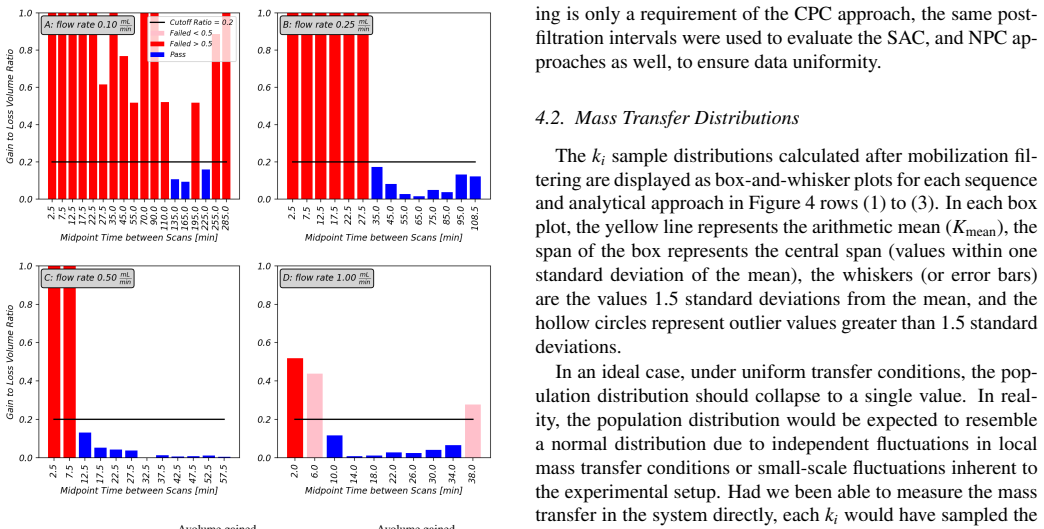
Understanding interphase mass transfer is essential for a variety of applications in porous media, ranging from groundwater remediation to geologic energy storage. While X-ray micro-Computed Tomography (microCT) provides critical in situ observations, analyzing mass transfer requires models and workflows compatible with the limited spatial and temporal resolution. Current literature presents three analytical frameworks for evaluating interphase mass transfer using microCT data: the Slice-Averaged Concentration (SAC) approach, the Non-Classified per-Cluster (NPC) approach, and the Classified per-Cluster (CPC) approach. This study evaluates the results of all three approaches across four sets of time-lapse tomography sequences that observe hydrogen dissolution at varying solvent injection rates. To mitigate biases arising from dissolution-driven cluster remobilization, we introduce a volume-ratio filtering technique to all workflows to ensure that estimates more accurately reflect true mass transfer events. Our analysis finds that all three analytical approaches estimate average mass transfer coefficients within one order of magnitude of one another at the same solvent injection rate. However, the similarity between the estimates of each approach diverges when approximating more complex phenomena, such as aqueous solute concentration profiles. Ultimately, the utility of one approach over another is determined by the desired level of system detail, at the cost of the computational resources required to achieve it. Higher phenomenological resolution requires greater computational processing and refinement due to increased sensitivity to measurement and processing noise, as well as outlier events. We anticipate that the findings will provide a framework for researchers to match analytical approaches to their available computational resources and desired level of physical detail.
Editorial analysis
A structured set of objections, weighed in public.
Referee Report
Summary. The paper compares three analytical frameworks—Slice-Averaged Concentration (SAC), Non-Classified per-Cluster (NPC), and Classified per-Cluster (CPC)—for quantifying interphase mass transfer from time-lapse X-ray microCT images of hydrogen dissolution in porous media. It introduces a volume-ratio filtering technique to reduce biases from dissolution-driven cluster remobilization and reports that the three methods yield average mass transfer coefficients within one order of magnitude for the same solvent injection rates, while diverging in their ability to capture complex phenomena like solute concentration profiles. The work discusses trade-offs between phenomenological resolution and computational demands.
Significance. If the filtering approach is shown to be robust, the study supplies a practical decision framework for matching analysis methods to computational resources and desired physical detail in porous-media mass-transfer studies. Credit is given for the experimental time-lapse microCT sequences acquired at multiple injection rates and for the explicit side-by-side evaluation of three existing workflows.
major comments (2)
- [Methods section describing the volume-ratio filtering technique] The volume-ratio filtering technique (introduced to mitigate dissolution-driven cluster remobilization) is central to the reported order-of-magnitude agreement among SAC, NPC, and CPC, yet the manuscript supplies no sensitivity analysis, synthetic-data validation, or quantitative justification for the chosen ratio threshold. Different thresholds could systematically alter cluster retention and averaging differently across the three methods, undermining the claim that the agreement reflects true mass-transfer behavior rather than filter-induced convergence.
- [Abstract and Results] The abstract and results state that all three approaches produce average mass-transfer coefficients within one order of magnitude, but provide no numerical values, error bars, or explicit description of how noise and outliers were handled after filtering. This absence makes it impossible to evaluate whether the reported agreement is statistically meaningful or sensitive to processing choices.
minor comments (2)
- [Abstract] The abstract refers to “four sets of time-lapse tomography sequences” without stating the specific injection rates or the number of time points per sequence; adding these details would improve context for the comparative findings.
- [Introduction] Notation for the three approaches (SAC, NPC, CPC) is introduced without a concise table summarizing their key differences in cluster handling and averaging; such a table would aid readers.
Simulated Author's Rebuttal
We thank the referee for their constructive and detailed comments, which have helped us identify areas where the manuscript can be strengthened. We address each major comment point-by-point below and outline the revisions we will make.
read point-by-point responses
-
Referee: [Methods section describing the volume-ratio filtering technique] The volume-ratio filtering technique (introduced to mitigate dissolution-driven cluster remobilization) is central to the reported order-of-magnitude agreement among SAC, NPC, and CPC, yet the manuscript supplies no sensitivity analysis, synthetic-data validation, or quantitative justification for the chosen ratio threshold. Different thresholds could systematically alter cluster retention and averaging differently across the three methods, undermining the claim that the agreement reflects true mass-transfer behavior rather than filter-induced convergence.
Authors: We agree that the lack of a sensitivity analysis for the volume-ratio threshold represents a gap in the current manuscript. The threshold was selected based on preliminary examination of the time-lapse sequences to exclude clusters exhibiting clear remobilization while preserving those primarily undergoing dissolution. To address the referee's concern rigorously, we will add a dedicated sensitivity study to the revised Methods section. This will test a range of ratio thresholds, quantify their differential impact on cluster retention and mass-transfer estimates across the SAC, NPC, and CPC frameworks, and include synthetic data validation where feasible to demonstrate robustness. These additions will clarify that the reported agreement is not an artifact of the specific filter choice. revision: yes
-
Referee: [Abstract and Results] The abstract and results state that all three approaches produce average mass-transfer coefficients within one order of magnitude, but provide no numerical values, error bars, or explicit description of how noise and outliers were handled after filtering. This absence makes it impossible to evaluate whether the reported agreement is statistically meaningful or sensitive to processing choices.
Authors: We concur that providing explicit numerical values, error bars, and processing details is necessary for a complete evaluation. In the revised manuscript, we will update both the abstract and Results section to report the specific average mass-transfer coefficient values (including their orders of magnitude) for each method at the tested injection rates. We will also incorporate error bars reflecting temporal or replicate variability and add a clear description of post-filtering procedures, including quantitative criteria for identifying and handling noise from imaging artifacts as well as outliers (e.g., via deviation thresholds from expected dissolution behavior). This will allow readers to assess the statistical robustness of the agreement. revision: yes
Circularity Check
No circularity: empirical comparison of image-processing workflows on experimental data
full rationale
The manuscript is an experimental study that applies three existing data-analysis workflows (SAC, NPC, CPC) to time-lapse microCT image sequences and introduces a volume-ratio filter as a preprocessing step. The reported result—that the three workflows yield mass-transfer coefficients within one order of magnitude—is an observed numerical outcome from the processed experimental volumes, not a mathematical derivation, fitted parameter, or self-referential definition. No equations are presented whose outputs are forced by construction to equal their inputs, and no load-bearing premise rests on a self-citation chain. The filter choice affects which events are retained, but the agreement among methods remains a contingent empirical finding rather than a tautology.
Axiom & Free-Parameter Ledger
axioms (2)
- domain assumption X-ray microCT provides critical in situ observations of phase distributions and mass transfer at sufficient spatial and temporal resolution.
- ad hoc to paper The volume-ratio filtering technique isolates true mass-transfer events by removing only dissolution-driven remobilization artifacts.
Reference graph
Works this paper leans on
-
[1]
Blunt, Multiphase Flow in Permeable Media: A Pore Scale Perspective
M. Blunt, Multiphase Flow in Permeable Media: A Pore Scale Perspective. (Cambridge University Press,(2017)). https://doi.org/10.1017/9781316145098
-
[2]
T. Bultreys, W. De Boever, and V. Cnudde, Imaging and image-based fluid transport modeling at the pore scale in geological materials: A practical introduction to the current state-of-the-art. Earth-Science Reviews . 155 pp. 93-128 (2016) http://dx.doi.org/10.1016/j.earscirev.2016.02.001
-
[3]
Y. Chow, G. Maitland, and J. Trusler, Erratum to “Interfacial tensions of (H2O & H2) and (H2O & CO2 & H2) systems at temperatures of (298 to 448) K and pressures up to 45 MPa” [Fluid Phase Equil. 475 (2018) 37-44] em\ Fluid Phase Equilibrium 503 (2020) https://doi.org/10.1016/j.fluid.2019.112315
-
[4]
Clark, Transport and Modeling of Environmental Engineers and Scientists
M. Clark, Transport and Modeling of Environmental Engineers and Scientists. (Wiley Publications,(2011)), ISBN: 978-0-470-26072-2
work page 2011
-
[5]
F. Crotogino, G. Schneider,and D. Evans, Renewable energy storage in geological formations Proceedings of the Institution of Mechanical Engineers, Part A: Journal of Power and Energy 232: pp. 100-114 (2017) doi:10.1177/0957650917731181
-
[6]
E. Cussler, Diffusion: Mass Transfer in Fluid Systems (Cambridge University Press,(2009)), ISBN: 9780521871211
work page 2009
-
[7]
J. Donaldson, J. Istok, M. Humphrey, K. O'Reilly, C. Hawelka, and D. Mohr, Development and testing of a Kinetic Model for Oxygen and Transport in Porous media in the presence of Trapped Gas. Groundwater . 35 pp. 270-279 (1997). https://doi.org/10.1111/j.1745-6584.1997.tb00084.x
-
[8]
H. Geistlinger, A. Beckmann, and D. Lazik, Mass transfer between a multicomponent trapped gas phase and a mobile water phase: experiment and theory, Water Resources Research , 41 (2005), pp. 1-15, https://doi.org/10.1029/2004WR003885
-
[9]
P. I. Guntorp, Y. Ghorbani, P. Koch, and J. Rosenkranz, X-ray Microcomputed Tomography ( CT) for Mineral Characterization: A Review of Data Analysis Methods. Minerals . 9 183 (2019) https://doi.org/10.3390/min9030183
-
[10]
A. Herring, E. Harper, L. Andersson, A. Sheppard, B. Bay, and D. Wildenschild, Effect of fluid topology on residual nonwetting phase trapping: Implications for geologic CO _2 sequestration. Advances in Water Resources . 62, pp. 47-58 (2013) https://doi.org/10.1016/j.advwatres.2013.09.015
-
[11]
A. Herring, A. Sheppard, L. Andersson, and D. Wildenschild, Impact of wettability alteration on 3-D nonwetting phase trapping and transport. International Journal of Greenhouse Gas Control . 46 pp. 175-186 (2016,3) https://www.sciencedirect.com/science/article/pii/S1750583615301754
work page 2016
-
[12]
Water Resources Research55, 555–573 (2019) https://doi.org/10.1029/2018WR022780
A. Herring, V. Robins, and A. Sheppard, Topological Persistence for Relating Microstructure and Capillary Fluid Trapping in Sandstones. Water Resources Research . 55, 555-573 (2019,1) https://agupubs.onlinelibrary.wiley.com/doi/full/10.1029/2018WR022780
-
[13]
S. Higgs, Y. Wang, C. Sun, J. Ennis-King, S. Jackson, R. Armstrong, and P. Mostaghimi, Comparative analysis of hydrogen, methane, and nitrogen relative permeability: Implications for Underground Hydrogen Storage. Journal of Energy Storage 73 108827 (2023) https://doi.org/10.1016/j.est.2023.108827
-
[14]
Y. Hu, A. Patmonoaji, H. Xu, K. Kaito, S. Matsushita, and T. Suekane, Pore-scale investigation on non-aqueous phase liquid dissolution and mass transfer in 2D and 3D porous media. International Journal of Heat and Mass Transfer . 169. 120901 (2021) https://doi.org/10.1016/j.ijheatmasstransfer.2021.120901
-
[15]
Y. Hu, C. Zhang, A. Patmonoaji, Y. She, S. Matsushita, and T. Suekane, Pore-scale investigation of wettability on residual non-aqueous phase liquid dissolution in natural porous media. Science of the Total Environment . 787 147406 (2021) https://doi.org/10.1016/j.scitotenv.2021.147406
-
[16]
R. Huang, A. Herring, and A. Sheppard, Effect of Saturation and Image Resolution on Representative Elementary Volume and Topological Quantification: An Experimental Study on Bentheimer Sandstone Using Micro-CT. Transp. Porous Media 137 pp. 489-518, (2021), https://doi.org/10.1007/s11242-021-01571-9
- [17]
-
[18]
(Cambridge University Press, 2022), https://www.ipcc.ch/report/ar6/wg2/
IPCC Climate Change 2022: Impacts, Adaptation and Vulnerability. (Cambridge University Press, 2022), https://www.ipcc.ch/report/ar6/wg2/
work page 2022
-
[19]
L. Jiang, B. Wu, Y. Song, M. Yang, D. Wang, Y. Liu, and Z. Xue, Mass transfer coefficient measurement during flush in CO _2 -filled packed bed by X-ray CT Scanning International Journal of Heat and Mass Transfer . 115 pp. 615-624, (2017). https://doi.org/10.1016/j.ijheatmasstransfer.2017.08.012
-
[20]
King, (1980) textit Separation Processes , 2nd ed
C. King, (1980) textit Separation Processes , 2nd ed. McGraw-Hill Chemical Engineering Series. ISBN: 0-07-034612-7
work page 1980
-
[21]
S. Krevor, R. Pini, L. Zuo, and S. Benson, Relative permeability and trapping of CO _2 and water in sandstone rocks at reservoir conditions. Water Resources Research . 48 (2012) https://agupubs.onlinelibrary.wiley.com/doi/full/10.1029/2011WR010859
-
[22]
S. Li, X. Wang, L. Jiang, L. Wang, Y. Zhang, B. Wu, Dynamic Characterization of interface and mass transfer of CO _2 -brine during CO _2 Storage in saline aquifer Gas Science and Engineering . 143 205717 (2025) https://doi.org/10.1016/j.jgsce.2025.205717
-
[23]
Q. Lin, S.J. Neethling, K.J. Dobson, L. Courtois, and P.D. Lee, Quantifying and minimising systematic and random errors in X-ray micro-tomography based volume measurements, Computers & Geosciences 77, pp. 1-7 (2015) https://doi.org/10.1016/j.cageo.2014.12.008
-
[24]
R. Liyanage, J. Cen, S. C. M. Krevor, J. P. Crawshaw, and R. Pini, Multidimensional Observations of Dissolution-Driven Convection in Simple Porous Media Using X-Ray CT Scanning, Transp. Porous Media 126, 355 (2019) https://doi.org/10.1007/s11242-018-1158-3
-
[25]
P. Lv, Y. Chang, F. Liu, Y. Liu, B. Wang, X. Guo, and Y. Song, CO _2 -brine mass transfer patterns and interface dynamics under geological storage conditions, International Journal of Heat and Mass Transfer . 222, 125184 (2024), https://doi.org/10.1016/j.ijheatmasstransfer.2024.125184
-
[26]
C. Miller, M. Poirier-McNeil, and A. Mayer, Dissolution of Trapped Nonaqueous Phase Liquids: Mass Transfer Characteristics. Water Resources Research . 26, 2783-2796 (1990) https://agupubs.onlinelibrary.wiley.com/doi/abs/10.1029/wr026i011p02783
-
[27]
N. Muhammed, B. Haq, D. Al Shehri, A. Al-Ahmed, M. Rahman, and E. Zaman, A review on underground hydrogen storage: Insight into geological sites, influencing factors and future outlook. Energy Reports . 8 pp. 461-499 (2022), https://www.sciencedirect.com/science/article/pii/S2352484721014414
work page 2022
-
[28]
Gaseous Carbon Waste Streams Utilization: Status and Research Needs
National Academies of Sciences, Engineering, and Medicine 2019. Gaseous Carbon Waste Streams Utilization: Status and Research Needs. Washington, DC: The National Academies Press. https://doi.org/10.17226/25232
-
[29]
A. Patmonoaji and T. Suekane, Investigation of CO _2 dissolution via mass transfer inside a porous medium. Advances in Water Resources . 110 pp. 97-106 (2017), https://doi.org/10.1016/j.advwatres.2017.10.008
-
[30]
A. Patmonoaji, Y. Hu, M. Nasir, C. Zhang, and T. Suekane, Effects of Dissolution Fingering on Mass Transfer Rate in Three-Dimensional Porous Media. Water Resources Research 57 (2021), https://doi.org/10.1029/2020WR029353
-
[31]
A. Patmonoaji, M. Tahta, J. Tuasikal, Y. She, Y. Hu, and T. Suekane, Dissolution mass transfer of trapped gases in porous media: A correlation of Sherwood, Reynolds, and Schmidt numbers. International Journal Of Heat And Mass Transfer . 205 pp. 123860 (2023), https://www.sciencedirect.com/science/article/pii/S0017931023000169
work page 2023
-
[32]
S. Powers, L. Abriola, and W. Weber, Jr., An Experimental Investigation of Nonaquesous Liquid Dissolution in Saturated Subsurface Systems: Steady State Mass Transfer Rates. Water Resources Research 28 pp.2691-2705 (1992) https://doi.org/10.1029/92WR00984
-
[33]
S. Schlüter, A. Sheppard, K. Brown, and D. Wildenschild, Image processing of multiphase images obtained via X-ray microtomography: A review. Water Resources Research . 50, 3615-3639 (2014) https://agupubs.onlinelibrary.wiley.com/doi/10.1002/2014WR015256
-
[34]
E. Seagren, B. Rittmann, and A. Valocchi, An experimental investigation of NAPL pool dissolution enhancement by flushing Journal of Contaminant Hydrology . 37, 111-137 (1999) https://doi.org/10.1016/S0169-7722(98)00157-0
-
[35]
A. Sheppard, R. Sok, and H. Averdunk, Techniques for image enhancement and segmentation of tomographic images of porous materials. Physica A: Statistical Mechanics And Its Applications . 339, 145-151 (2004), https://www.sciencedirect.com/science/article/pii/S037843710400370X, Proceedings of the International Conference New Materials and Complexity
work page 2004
-
[36]
D. Wildenschild, C. Vaz, M. Rivers, D. Rikard, and B. Christensen, Using X-ray computed tomography in hydrology: systems, resolutions, and limitations. Journal Of Hydrology . 267, 285-297 (2002), https://www.sciencedirect.com/science/article/pii/S0022169402001579
work page 2002
-
[37]
D. Wildenschild and A. Sheppard, X-ray imaging and analysis techniques for quantifying pore-scale structure and processes in subsurface porous medium systems. Advances In Water Resources . 51 pp. 217-246 (2013,1),https://www.sciencedirect.com/science/article/pii/S0309170812002060#bi0010
work page 2013
-
[38]
C. Zahasky and S. Krevor, Global geologic carbon storage requirements of climate change mitigation scenarios. Energy Environ. Sci. . 13, 1561-1567 (2020,6), https://www.pubs.rsc.org/en/content/articlelanding/2020/ee/d0ee00674b
work page 2020
-
[39]
A. Sheppard, R. Sok, and H. Averdunk, Techniques for image enhancement and segmentation of tomographic images of porous materials. Physica A: Statistical Mechanics And Its Applications . 339, 145-151 (2004), Proceedings of the International Conference New Materials and Complexity
work page 2004
discussion (0)
Sign in with ORCID, Apple, or X to comment. Anyone can read and Pith papers without signing in.