Interaction-driven transport in a non-degenerate mixture of Dirac and massive fermions at charge neutrality point
Pith reviewed 2026-05-10 17:16 UTC · model grok-4.3
The pith
A mixture of massless Dirac and massive fermions at charge neutrality exhibits a temperature-driven crossover in conductivity from a constant value to a suppressed non-Drude form due to inter-species scattering.
A machine-rendered reading of the paper's core claim, the machinery that carries it, and where it could break.
Core claim
The conductivity undergoes a distinct crossover as temperature increases: at low temperatures, transport is dominated by massless Dirac carriers, yielding a temperature-independent conductivity reminiscent of graphene's charge neutrality point. As the temperature rises, massive holes become thermally excited, and their mutual Coulomb scattering with Dirac carriers induces a negative, non-Drude correction to the conductivity. Short-range interactions produce stronger suppression than long-range ones, and the effect grows monotonically with temperature, with the self-consistent chemical potential turning transport into a direct probe of inter-species quantum friction.
What carries the argument
The mutual Coulomb scattering between massless Dirac fermions and thermally excited massive holes under the constraint of charge neutrality that generates a temperature-dependent negative correction to conductivity.
If this is right
- Short-range interparticle interactions produce a stronger suppression of conductivity than long-range Coulomb interactions.
- The negative correction to conductivity increases monotonically as temperature rises.
- The self-consistent determination of the chemical potential by charge neutrality makes the transport response an intrinsic indicator of inter-species quantum friction.
- HgTe quantum wells at the charge neutrality point offer a clean and tunable system for studying interaction-driven transport without Galilean invariance.
Where Pith is reading between the lines
- Measurements of conductivity as a function of temperature in HgTe quantum wells could reveal the predicted crossover and allow extraction of the interaction strength.
- The approach could be applied to other two-dimensional systems that host coexisting massless and massive carriers to identify similar interaction effects.
- If disorder is weak, the theory predicts that inter-species scattering should dominate the temperature dependence of conductivity in the higher-T regime.
Load-bearing premise
The carriers remain non-degenerate and thermally activated such that the chemical potential adjusts solely to enforce charge neutrality without being fixed externally or dominated by disorder scattering.
What would settle it
If conductivity measurements in HgTe quantum wells at charge neutrality show a temperature-independent value persisting even after massive carriers are thermally excited, or fail to exhibit the expected negative correction from inter-species scattering, the proposed crossover mechanism would be falsified.
Figures



read the original abstract
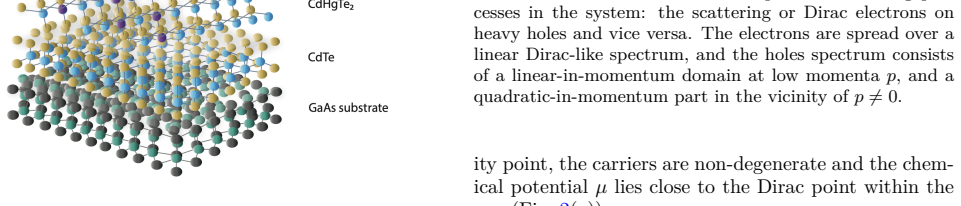
The interplay between distinct carrier species in systems with broken Galilean invariance gives rise to a rich landscape of interaction-driven transport phenomena. Here, we develop a comprehensive theory for the electrical conductivity of a non-degenerate two-dimensional mixture of massless Dirac and massive fermions, a system realized in HgTe quantum wells tuned to the charge neutrality point. In this regime, all carriers are thermally activated, enabling a self-consistent, temperature-dependent interplay between the two species. We demonstrate that the conductivity undergoes a distinct crossover as temperature increases: at low temperatures, transport is dominated by massless Dirac carriers, yielding a temperature-independent conductivity reminiscent of graphene's charge neutrality point. As the temperature rises, massive holes become thermally excited, and their mutual Coulomb scattering with Dirac carriers induces a negative, non-Drude correction to the conductivity. We show that this correction is governed by the dominant scattering mechanism: short-range interparticle interactions yield a stronger suppression than long-range Coulomb interactions, and it scales monotonically with temperature. Crucially, the charge neutrality condition ensures that the chemical potential is not externally pinned but is determined self-consistently, making the system's transport response an intrinsic probe of inter-species quantum friction. Our findings establish HgTe quantum wells at charge neutrality as a clean, highly tunable platform for isolating and quantitatively studying interaction-driven transport in the absence of Galilean invariance, offering a direct pathway to explore regimes where interparticle collisions dominate over disorder.
Editorial analysis
A structured set of objections, weighed in public.
Referee Report
Summary. The manuscript develops a theory for electrical conductivity in a non-degenerate 2D mixture of massless Dirac and massive fermions at charge neutrality, realized in HgTe quantum wells. It predicts a temperature crossover: low-T transport dominated by Dirac carriers yields T-independent conductivity similar to graphene CNP; at higher T, thermally excited massive holes scatter with Dirac carriers via Coulomb interactions, producing a negative non-Drude correction whose magnitude depends on short- vs. long-range scattering and increases monotonically with T. The chemical potential is determined self-consistently by charge neutrality without external pinning.
Significance. If the central results hold, the work provides a clean, tunable platform in HgTe wells for isolating interaction-driven transport and quantum friction in systems lacking Galilean invariance. The self-consistent neutrality condition and recovery of the known low-T Dirac plateau are strengths; the distinction between scattering mechanisms offers falsifiable predictions for experiment.
major comments (2)
- The derivation of the negative non-Drude correction from inter-species Coulomb scattering is not shown with explicit Boltzmann transport equations or relaxation-time expressions; without these, it is impossible to verify that the correction is negative, scales with T, and is stronger for short-range than long-range interactions (central claim in the abstract).
- The non-degenerate limit and self-consistent chemical potential are asserted to fix all parameters via charge neutrality alone, but no explicit expression for the T-dependent mu or the resulting carrier densities is provided to confirm the absence of hidden parameters or disorder pinning.
minor comments (2)
- Notation for the two carrier species and their scattering rates should be introduced with a table or clear definitions early in the text to aid readability.
- A figure plotting the predicted conductivity vs. T for short- and long-range cases would strengthen the crossover claim.
Simulated Author's Rebuttal
We thank the referee for the careful reading of our manuscript and the constructive comments. We address each major comment below.
read point-by-point responses
-
Referee: The derivation of the negative non-Drude correction from inter-species Coulomb scattering is not shown with explicit Boltzmann transport equations or relaxation-time expressions; without these, it is impossible to verify that the correction is negative, scales with T, and is stronger for short-range than long-range interactions (central claim in the abstract).
Authors: We agree that the explicit Boltzmann transport equations and relaxation-time expressions for the inter-species scattering were omitted from the original manuscript. In the revised version we will add a dedicated subsection (or appendix) presenting the two-component Boltzmann equation, the form of the Coulomb collision integral between Dirac and massive carriers, and the resulting conductivity correction obtained in the relaxation-time approximation. This will explicitly show the negative sign of the correction, its monotonic increase with temperature in the non-degenerate regime, and the stronger suppression for short-range interactions relative to long-range Coulomb scattering. revision: yes
-
Referee: The non-degenerate limit and self-consistent chemical potential are asserted to fix all parameters via charge neutrality alone, but no explicit expression for the T-dependent mu or the resulting carrier densities is provided to confirm the absence of hidden parameters or disorder pinning.
Authors: We acknowledge that the explicit functional form of the temperature-dependent chemical potential μ(T) and the resulting carrier densities were not written out in the main text. In the revision we will include the self-consistent neutrality condition in the non-degenerate limit together with the closed-form expressions for μ(T), n_Dirac(T), and n_massive(T) obtained from the Fermi-Dirac integrals. These expressions confirm that the only external parameter is temperature (plus the fixed band-structure parameters of the HgTe well) and that no additional pinning or disorder scale is introduced. revision: yes
Circularity Check
No significant circularity; derivation is self-contained
full rationale
The paper constructs its conductivity results from standard Boltzmann transport equations applied to a two-species non-degenerate mixture, with the chemical potential fixed self-consistently by charge neutrality (a conventional constraint, not a fitted parameter). Low-T Dirac-dominated plateau reproduces known graphene neutrality results without redefinition, while the high-T negative correction arises directly from inter-species Coulomb scattering rates weighted by momentum relaxation. No equation reduces to its input by construction, no self-citation supplies a uniqueness theorem or ansatz that forces the outcome, and the central crossover is an independent prediction testable against HgTe transport data. The framework remains externally falsifiable and does not rename empirical patterns or smuggle assumptions via prior work.
Axiom & Free-Parameter Ledger
axioms (2)
- domain assumption Non-degenerate regime with thermally activated carriers
- domain assumption Charge neutrality fixes chemical potential self-consistently
Reference graph
Works this paper leans on
-
[1]
K. S. Novoselov, A. K. Geim, S. V. Morozov, D. Jiang, Y. Zhang, S. V. Dubonos, I. V. Grigorieva, and A. A. Firsov, Science306, 666 (2004)
work page 2004
-
[2]
V. Skákalová, A. B. Kaiser, J. S. Yoo, D. Obergfell, and S. Roth, Phys. Rev. B80, 153404 (2009)
work page 2009
- [3]
-
[4]
C. Tan, D. Y. H. Ho, L. Wang, J. I. A. Li, I. Yudhistira, D. A. Rhodes, T. Taniguchi, K. Watanabe, K. Shep- ard, P. L. McEuen, C. R. Dean, S. Adam, and J. Hone, Science Advances8, eabi8481 (2022)
work page 2022
-
[5]
D. A. Bandurin, A. Principi, I. Y. Phinney, T. Taniguchi, K. Watanabe, and P. Jarillo-Herrero, Phys. Rev. Lett.129, 206802 (2022)
work page 2022
-
[6]
V. M. Kovalev, A. V. Parafilo, O. V. Kibis, and I. G. Savenko, Phys. Rev. B109, 245414 (2024)
work page 2024
-
[7]
D.S.Eliseev, A.V.Parafilo, V.M.Kovalev, O.V.Kibis, and I. G. Savenko, Phys. Rev. B110, L041301 (2024)
work page 2024
-
[8]
E. H. Hwang and S. Das Sarma, Phys. Rev. B67, 115316 (2003)
work page 2003
-
[9]
K. E. Nagaev and A. A. Manoshin, Phys. Rev. B102, 155411 (2020)
work page 2020
-
[10]
K. E. Nagaev, Phys. Rev. B106, 085411 (2022)
work page 2022
-
[11]
C. L. Kane and E. J. Mele, Phys. Rev. Lett.95, 146802 (2005)
work page 2005
-
[12]
C. L. Kane and E. J. Mele, Phys. Rev. Lett.95, 226801 (2005)
work page 2005
- [13]
- [14]
-
[15]
M. V. Entin, L. I. Magarill, E. B. Olshanetsky, Z. D. Kvon, N. N. Mikhailov, and S. A. Dvoretsky, Journal of Experimental and Theoretical Physics117, 933 (2013)
work page 2013
-
[16]
B. Büttner, C. X. Liu, G. Tkachov, E. G. Novik, C. Brüne, H. Buhmann, E. M. Hankiewicz, P. Recher, B. Trauzettel, S. C. Zhang, and L. W. Molenkamp, Na- ture Physics7, 418 (2011)
work page 2011
-
[17]
D. A. Kozlov, Z. D. Kvon, N. N. Mikhailov, and S. A. Dvoretsky, JETP Letters96, 730 (2013)
work page 2013
-
[18]
Z. D. Kvon, E. B. Olshanetsky, D. A. Kozlov, N. N. Mikhailov, and S. A. Dvoretskii, JETP Letters87, 502 (2008)
work page 2008
-
[19]
G. M. Gusev, D. A. Kozlov, A. D. Levin, Z. D. Kvon, N. N. Mikhailov, and S. A. Dvoretsky, Phys. Rev. B96, 045304 (2017)
work page 2017
-
[20]
S. S. Krishtopenko, W. Desrat, K. E. Spirin, C. Con- sejo, S. Ruffenach, F. Gonzalez-Posada, B. Jouault, W. Knap, K. V. Maremyanin, V. I. Gavrilenko, G. Boissier, J. Torres, M. Zaknoune, E. Tournié, and F. Teppe, Phys. Rev. B99, 121405 (2019)
work page 2019
-
[21]
A. Shuvaev, V. Dziom, J. Gospodarič, E. G. Novik, A. A. Dobretsova, N. N. Mikhailov, Z. D. Kvon, and A. Pimenov, Nanomaterials12, 10.3390/nano12142492 (2022)
- [22]
-
[23]
O. V. Kibis, J. Exp. Theor. Phys.88, 527 (1999)
work page 1999
-
[24]
O. V. Kibis, Phys. Solid State43, 2336 (2001)
work page 2001
-
[25]
O. V. Kibis, Physica E12, 741 (2002)
work page 2002
- [26]
-
[27]
K. S. Novoselov, A. K. Geim, S. V. Morozov, D. Jiang, M. I. Katsnelson, I. V. Grigorieva, S. V. Dubonos, and A. A. Firsov, Nature438, 197 (2005)
work page 2005
-
[28]
S. Das Sarma, S. Adam, E. H. Hwang, and E. Rossi, Rev. Mod. Phys.83, 407 (2011)
work page 2011
- [29]
-
[30]
A. V. Snegirev, V. M. Kovalev, M. V. Entin, E. B. Ol- shanetsky, G. M. Gusev, N. N. Mikhailov, and Z. D. Kvon, Phys. Rev. Research7, 043169 (2025)
work page 2025
-
[31]
K. S. Novoselov, Z. Jiang, Y. Zhang,et al., Science315, 1379 (2007)
work page 2007
- [32]
- [33]
-
[34]
C. R. Becker, Physica Status Solidi B251, 1125 (2014)
work page 2014
discussion (0)
Sign in with ORCID, Apple, or X to comment. Anyone can read and Pith papers without signing in.