From Clicking to Moving: Embodied Micro-Movements as a New Modality for Data Literacy Learning
Pith reviewed 2026-05-10 17:49 UTC · model grok-4.3
The pith
Kinetiq replaces mouse clicks with full-body micro-movements to raise enjoyment and motivation in data literacy tasks while keeping learning gains the same.
A machine-rendered reading of the paper's core claim, the machinery that carries it, and where it could break.
Core claim
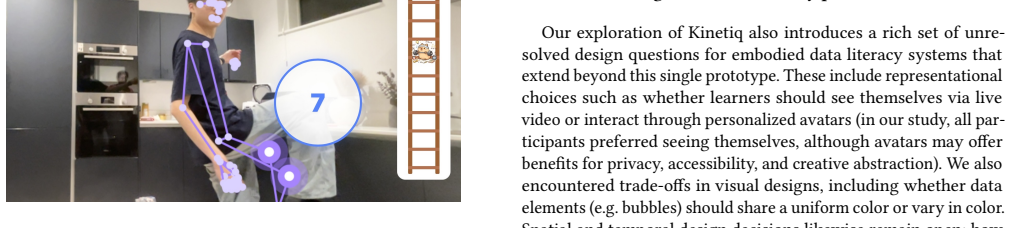
Kinetiq integrates fun, full-body micro-movements directly into data and numeracy problem solving so that learners interact through natural gestures instead of selecting answers with a mouse. In a within-subjects comparison, users reported significantly higher affective valence, enjoyment, engagement, and motivation than on conventional platforms while showing comparable learning gains. The system is delivered as a cross-platform web and mobile application that supports these movements in everyday constrained spaces.
What carries the argument
The task-integrated movement paradigm that maps each data problem-solving step to a specific natural full-body gesture such as reaching or elbowing.
If this is right
- Data literacy instruction can shift from passive clicking to physical gestures without sacrificing measured learning outcomes.
- Everyday web and mobile devices can support full-body learning in small rooms or offices.
- Affective benefits such as higher motivation may encourage longer voluntary practice sessions in numeracy topics.
Where Pith is reading between the lines
- If the benefits remain after repeated exposure, the same movement mapping could be applied to other abstract domains such as basic statistics or programming concepts.
- Health-related side effects of reduced sitting time during learning sessions become a measurable outcome worth tracking in future trials.
- Designers may need to calibrate gesture intensity to avoid raising cognitive load once problem difficulty increases.
Load-bearing premise
The observed gains in enjoyment and motivation come from the micro-movements themselves and would not disappear once the approach feels familiar or when tasks become longer and more demanding.
What would settle it
A multi-week repeated-use study that tracks whether affective gains persist after novelty fades and whether accuracy or speed drops on harder problems that require sustained physical effort.
Figures


read the original abstract
Widespread digital learning has expanded access to education but has resulted in highly sedentary, click-based interaction, contributing to digital fatigue, reduced cognitive flexibility, and health risks associated with prolonged passive screen time. Meanwhile, data literacy has become an essential competency in a data-driven society, yet it is typically taught through passive, disembodied interfaces that offer little physical engagement. We present Kinetiq (Kinetic+IQ), a novel system that integrates fun, full-body micro-movements directly into data and numeracy problem solving. Instead of selecting answers with a mouse, learners interact through natural gestures such as reaching, dodging, heading, elbowing, or knee-raising, thus turning abstract data problem-solving into embodied experiences that integrate thinking with movement. In a preliminary within-subjects study comparing Kinetiq with conventional platforms, participants reported significantly higher affective valence, enjoyment, engagement, and motivation, while maintaining comparable learning gains. We contribute: (1) a task-integrated movement paradigm for data learning, (2) a cross-platform web and mobile app system enabling full-body learning in constrained everyday spaces, and (3) preliminary empirical evidence that embodied micro-movements can enrich the affective experience of data literacy learning.
Editorial analysis
A structured set of objections, weighed in public.
Referee Report
Summary. The manuscript introduces Kinetiq, a system integrating full-body micro-movements (e.g., reaching, dodging, knee-raising) directly into data literacy and numeracy problem-solving tasks as an alternative to sedentary click-based interfaces. Its central empirical claim, drawn from a preliminary within-subjects study, is that participants experienced significantly higher affective valence, enjoyment, engagement, and motivation with Kinetiq while achieving comparable learning gains to conventional platforms. The paper contributes a task-integrated movement paradigm, a cross-platform implementation for constrained spaces, and initial evidence supporting embodied micro-movements for data literacy education.
Significance. If the affective benefits can be shown to arise specifically from the embodied micro-movement integration rather than from novelty or physical effort, the work could meaningfully advance HCI approaches to data literacy by addressing digital fatigue and sedentary learning. The system's design for everyday spaces represents a practical contribution that may influence accessible educational interfaces.
major comments (2)
- [Abstract] Abstract: The preliminary within-subjects study is presented without any statistical details, sample size, task descriptions, p-values, effect sizes, or information on counterbalancing and order-effect controls. These omissions make it impossible to evaluate the reliability of the 'significantly higher' affective outcomes or to rule out confounds.
- [Abstract] Abstract: The design compares Kinetiq only against a familiar click-based baseline and includes no yoked control for novelty (e.g., a novel but sedentary interaction) or for increased physical effort. Consequently, the reported affective advantages cannot yet be attributed specifically to the embodied micro-movement paradigm rather than to first-exposure effects.
minor comments (1)
- [Abstract] The abstract refers to both 'full-body micro-movements' and gestures such as knee-raising; a brief clarification of the intended scope of 'micro-movements' versus larger gestures would improve precision.
Simulated Author's Rebuttal
We thank the referee for their constructive and insightful comments on our manuscript. We address each major comment point by point below, indicating the revisions we will make to strengthen the paper while maintaining the integrity of our preliminary findings.
read point-by-point responses
-
Referee: [Abstract] Abstract: The preliminary within-subjects study is presented without any statistical details, sample size, task descriptions, p-values, effect sizes, or information on counterbalancing and order-effect controls. These omissions make it impossible to evaluate the reliability of the 'significantly higher' affective outcomes or to rule out confounds.
Authors: We agree that the abstract would be improved by including key statistical details to enhance transparency and allow readers to better evaluate the results. The full manuscript already reports these elements in the Methods and Results sections, including the sample size, task descriptions, statistical tests with p-values, effect sizes, and counterbalancing procedures (randomized order within the within-subjects design to mitigate order effects). In the revised manuscript, we will expand the abstract to concisely incorporate this information while preserving its length and focus, making the summary self-contained. revision: yes
-
Referee: [Abstract] Abstract: The design compares Kinetiq only against a familiar click-based baseline and includes no yoked control for novelty (e.g., a novel but sedentary interaction) or for increased physical effort. Consequently, the reported affective advantages cannot yet be attributed specifically to the embodied micro-movement paradigm rather than to first-exposure effects.
Authors: This is a fair and important observation regarding causal attribution. Our work is explicitly framed as a preliminary study comparing the new embodied system against the standard click-based baseline to assess initial feasibility, usability in constrained spaces, and affective outcomes. We did not include additional yoked conditions for novelty or effort in this initial experiment. In the revision, we will add a dedicated paragraph in the Discussion section acknowledging these potential confounds, tempering the claims to reflect comparison against the conventional interface rather than isolating the embodied component, and outlining specific directions for future controlled studies (e.g., novel sedentary interfaces and matched-effort non-embodied conditions). This will provide a more balanced interpretation without overclaiming. revision: partial
Circularity Check
No circularity: empirical system description with no derivations or self-referential reductions
full rationale
The paper introduces the Kinetiq system and reports results from a preliminary within-subjects study comparing affective and learning outcomes against conventional platforms. No equations, parameters, derivations, or mathematical claims appear in the provided text. The central empirical claim rests on direct participant reports rather than any fitted input renamed as prediction or self-citation chain. The derivation chain is therefore self-contained with no reductions to inputs by construction.
Axiom & Free-Parameter Ledger
axioms (1)
- domain assumption Embodied micro-movements can be integrated into abstract data tasks to improve affective experience without reducing learning gains
Reference graph
Works this paper leans on
-
[1]
Philipp Burckhardt, Rebecca Nugent, and Christopher R. Genovese. 2021. Teach- ing Statistical Concepts and Modern Data Analysis With a Computing-Integrated Learning Environment.Journal of Statistics and Data Science Education29, sup1 (2021), S61–S73. arXiv:https://doi.org/10.1080/10691898.2020.1854637 doi:10.1080/ 10691898.2020.1854637
-
[2]
Junyi Chu, Kristine Zheng, and Judith E Fan. 2025. What makes people think a puzzle is fun to solve?Proceedings of the Annual Meeting of the Cognitive Science Society47, 0 (2025)
work page 2025
-
[3]
Julie Corliss. 2024. How much do you sit, stand, and move each day? - Harvard Health — health.harvard.edu. https://www.health.harvard.edu/heart-health/how- much-do-you-sit-stand-and-move-each-day
work page 2024
-
[4]
Andrea T. Duran, Ciaran P. Friel, Maria A. Serafini, Ipek Ensari, Ying Kuen Cheung, and Keith M. Diaz. 2023. Breaking Up Prolonged Sitting to Improve Cardiometabolic Risk: Dose–Response Analysis of a Randomized Crossover Trial. Medicine & Science in Sports & Exercise55, 5 (May 2023), 847–855. doi:10.1249/ MSS.0000000000003109
work page 2023
-
[5]
Danyang Fan, Gene S-H Kim, Olivia Tomassetti, Shloke Nirav Patel, Sile O’Modhrain, Victor R Lee, and Sean Follmer. 2024. Tangible Stats: An Embodied and Multimodal Platform for Teaching Data and Statistics to Blind and Low Vision Students. InExtended Abstracts of the CHI Conference on Human Factors in Computing Systems(Honolulu, HI, USA)(CHI EA ’24). Asso...
-
[6]
Matthew P. J. Habgood and Shaaron E. Ainsworth. 2011. Motivating children to learn effectively: Exploring the value of intrinsic integration in educational games. Journal of the Learning Sciences20, 2 (2011), 169–206. doi:10.1080/10508406.2010. 508029
-
[7]
Robin Hunicke, Marc LeBlanc, and Robert Zubek. 2004. MDA: A Formal Approach to Game Design and Game Research. InProceedings of the AAAI Workshop on Challenges in Game AI, Vol. 4. 1–5
work page 2004
-
[8]
Zachary Jason. 2017. Bored Out of Their Minds. https://www.gse.harvard.edu/ ideas/ed-magazine/17/01/bored-out-their-minds. [Accessed 12-07-2025]
work page 2017
-
[9]
Xiaoyan Li and Marjaana Kangas. 2024. A systematic literature review of playful learning in primary education: teachers’ pedagogical activities.Education 3-130, 0 (2024), 1–16. arXiv:https://doi.org/10.1080/03004279.2024.2416954 doi:10.1080/ 03004279.2024.2416954
- [10]
-
[11]
2019.The joy of movement: How exercise helps us find happiness, hope, connection, and courage
Kelly McGonigal. 2019.The joy of movement: How exercise helps us find happiness, hope, connection, and courage. Penguin
work page 2019
-
[12]
Xiao-Li Meng. 2009. Statistics: Your chance for happiness (or misery) | Depart- ment of Statistics — statistics.fas.harvard.edu. https://statistics.fas.harvard.edu/ statistics-your-chance-happiness-or-misery. [Accessed 07-02-2026]
work page 2009
-
[13]
Miriam Novack and Susan Goldin-Meadow. 2015. Learning from gesture: How our hands change our minds.Educational Psychology Review27, 3 (Sept. 2015), 405–412. doi:10.1007/s10648-015-9325-3
-
[14]
Anthony John Onwuegbuzie and Nancy L. Leech. 2003. Assessment in Statistics Courses: More than a tool for evaluation.Assessment & Evaluation in Higher Edu- cation28 (2003), 115 – 127. https://api.semanticscholar.org/CorpusID:143587956
work page 2003
-
[15]
World Health Organization. 2020. Who Guidelines on Physical Activity and Sedentary Behavior. https://iris.who.int/bitstream/handle/10665/336656/ 9789240015128-eng.pdf?sequence=1. [Accessed 12-07-2025]
work page 2020
-
[16]
Mirko Schmidt, Valentin Benzing, and Mario Kamer. 2016. Classroom-based physical activity improves children’s executive function.PLoS ONE11, 8 (2016), e0167501. doi:10.1371/journal.pone.0167501
-
[17]
Lawrence Shapiro and Shannon Spaulding. 2025. Embodied Cognition. InThe Stanford Encyclopedia of Philosophy(Summer 2025 ed.), Edward N. Zalta and Uri Nodelman (Eds.). Metaphysics Research Lab, Stanford University
work page 2025
-
[18]
C. E. Smith, S. Lee, T. D. Allen, M. L. Wallace, R. Andel, O. M. Buxton, S. R. Patel, and D. M. Almeida. 2024. Designing work for healthy sleep: A multidimensional, latent transition approach to employee sleep health.Journal of Occupational Health Psychology29, 6 (2024), 409–430. doi:10.1037/ocp0000375
-
[19]
Trustpilot. [n. d.]. Trustpilot Reviews: Experience the power of customer reviews — trustpilot.com. https://www.trustpilot.com [Accessed 07-02-2026]
work page 2026
-
[20]
Spiridoula Vazou, Caterina Pesce, Kimberley D Lakes, and Ann Smiley-Oyen
-
[21]
More than one road leads to Rome: A narrative review and meta-analysis of physical activity intervention effects on children’s cognition.Frontiers in Psychology9 (2020), 2079. doi:10.3389/fpsyg.2018.02079
-
[22]
Margaret Wilson. 2002. Six views of embodied cognition.Psychonomic Bulletin & Review9, 4 (2002), 625–636. doi:10.3758/BF03196322
discussion (0)
Sign in with ORCID, Apple, or X to comment. Anyone can read and Pith papers without signing in.