Recognition: unknown
LogAct: Enabling Agentic Reliability via Shared Logs
Pith reviewed 2026-05-10 17:04 UTC · model grok-4.3
The pith
LogAct turns each LLM agent into a deconstructed state machine that writes to a shared log, making actions visible and blockable before execution while enabling consistent recovery from failures.
A machine-rendered reading of the paper's core claim, the machinery that carries it, and where it could break.
Core claim
By deconstructing agents into state machines that play a shared log, agentic actions become visible before execution, pluggable decoupled voters can stop them prior to running, and recovery remains consistent after agent or environment failure. The log further enables agentic introspection by letting agents analyze their execution history via LLM inference, which supports semantic variants of recovery, health checks, and optimization.
What carries the argument
The shared log, where each agent operates as a deconstructed state machine so actions are recorded visibly before execution and can be inspected or halted by external components.
If this is right
- Agents recover efficiently and correctly from failures using the shared log.
- Agents debug their own performance by analyzing their execution history through LLM inference.
- Token usage in agent swarms can be optimized via introspection on the log.
- All unwanted actions for a target model can be stopped on a representative benchmark with only a 3% drop in benign utility.
Where Pith is reading between the lines
- The shared log could function as an audit trail for cross-organization agent oversight in production deployments.
- Multiple independent voters on the log open the door to distributed governance of agent actions without central control.
- Because the approach preserves original agent behavior, it could be layered onto existing agent frameworks with low integration cost.
- In high-failure distributed environments the log might provide a foundation for atomicity guarantees similar to database transaction logs.
Load-bearing premise
A practical shared log can be maintained across asynchronous agents and environments such that actions remain reliably visible and blockable before execution while preserving the agents' original behavior.
What would settle it
Run a test with multiple asynchronous agents where at least one action executes without first appearing in the shared log or where recovery after an injected crash produces inconsistent state.
Figures



read the original abstract
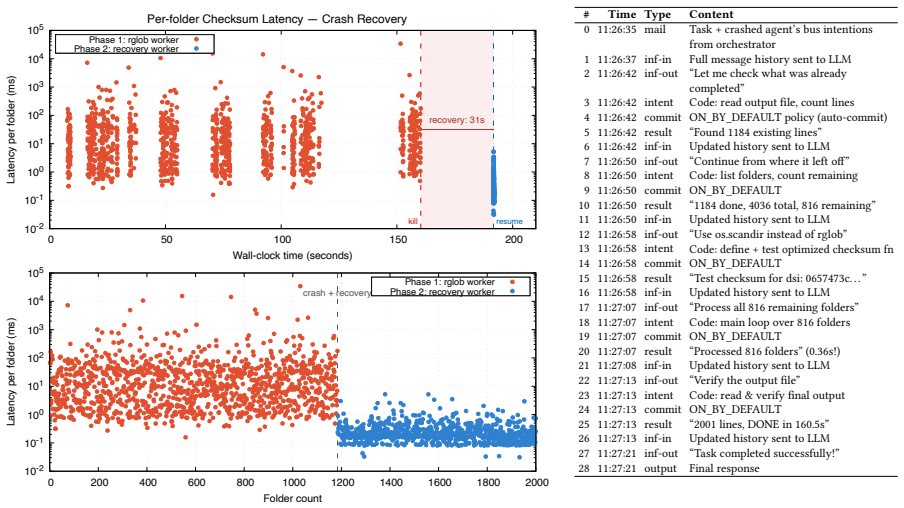
Agents are LLM-driven components that can mutate environments in powerful, arbitrary ways. Extracting guarantees for the execution of agents in production environments can be challenging due to asynchrony and failures. In this paper, we propose a new abstraction called LogAct, where each agent is a deconstructed state machine playing a shared log. In LogAct, agentic actions are visible in the shared log before they are executed; can be stopped prior to execution by pluggable, decoupled voters; and recovered consistently in the case of agent or environment failure. LogAct enables agentic introspection, allowing the agent to analyze its own execution history using LLM inference, which in turn enables semantic variants of recovery, health check, and optimization. In our evaluation, LogAct agents recover efficiently and correctly from failures; debug their own performance; optimize token usage in swarms; and stop all unwanted actions for a target model on a representative benchmark with just a 3% drop in benign utility.
Editorial analysis
A structured set of objections, weighed in public.
Referee Report
Summary. The paper proposes LogAct, an abstraction in which LLM-driven agents are deconstructed into state machines that append actions to a shared log before any environment mutation occurs. This design makes actions visible and blockable by decoupled voters prior to execution, supports consistent recovery on replay after failures, and enables semantic introspection via LLM analysis of the log for debugging, health checks, and optimization. The evaluation claims that LogAct agents recover efficiently and correctly, debug their own performance, optimize token usage in swarms, and stop all unwanted actions on a representative benchmark with only a 3% drop in benign utility.
Significance. If the implementation and evaluation hold, LogAct offers a practical mechanism for adding reliability, safety, and observability to asynchronous agentic systems, which could influence production deployments of LLM agents where failures and unwanted behaviors are common risks.
major comments (2)
- [Evaluation] Evaluation section: the claims of efficient recovery, self-debugging, token optimization, and stopping all unwanted actions with a 3% benign-utility drop are stated without any description of the benchmark, target model, number of trials, definitions of 'unwanted actions,' or error analysis, so the quantitative results cannot be assessed or reproduced.
- [Design] LogAct design (shared-log abstraction): the central guarantee that actions are appended and visible before environment mutation, enabling pre-execution blocking and consistent recovery, is not accompanied by an argument or implementation detail addressing asynchrony, crashes, or potential lost updates; if eventual consistency or agent-side buffering is used, some actions could execute before becoming blockable, undermining the recovery and stopping results.
minor comments (1)
- [Abstract] Abstract: 'a representative benchmark' is referenced but never named or characterized.
Simulated Author's Rebuttal
We thank the referee for the constructive and insightful comments. We agree that additional details are needed in both the evaluation and design sections to support the claims. We address each major comment below and will revise the manuscript accordingly.
read point-by-point responses
-
Referee: [Evaluation] Evaluation section: the claims of efficient recovery, self-debugging, token optimization, and stopping all unwanted actions with a 3% benign-utility drop are stated without any description of the benchmark, target model, number of trials, definitions of 'unwanted actions,' or error analysis, so the quantitative results cannot be assessed or reproduced.
Authors: We agree that the current manuscript does not provide sufficient methodological details in the evaluation section. In the revised version, we will expand this section to include a full description of the benchmark, the target models employed, the number of trials, precise definitions of 'unwanted actions,' and an error analysis. These additions will enable assessment and reproduction of the reported results on recovery, self-debugging, token optimization, and action stopping. revision: yes
-
Referee: [Design] LogAct design (shared-log abstraction): the central guarantee that actions are appended and visible before environment mutation, enabling pre-execution blocking and consistent recovery, is not accompanied by an argument or implementation detail addressing asynchrony, crashes, or potential lost updates; if eventual consistency or agent-side buffering is used, some actions could execute before becoming blockable, undermining the recovery and stopping results.
Authors: We acknowledge that the manuscript lacks an explicit argument and implementation details on how the shared-log abstraction maintains its guarantees under asynchrony, crashes, and lost updates. In the revision, we will add a dedicated subsection that specifies the consistency model, durability mechanisms for log appends, barriers to prevent execution prior to visibility, and recovery protocols that preserve pre-execution blocking even in the presence of failures. This will clarify that the design avoids premature execution. revision: yes
Circularity Check
No circularity: independent system design with no self-referential derivations
full rationale
The paper presents LogAct as a novel architectural abstraction in which agents are modeled as deconstructed state machines that append actions to a shared log before environment mutation. This enables visibility, blocking by voters, and consistent recovery. No equations, fitted parameters, predictions, or first-principles derivations appear in the provided text. The central claims (recovery, introspection, unwanted-action stopping with 3% utility drop) are presented as consequences of the proposed implementation rather than reductions to prior self-citations or tautological fits. Evaluation results are described as empirical outcomes from the system, not forced by construction. The design is self-contained against external benchmarks and does not invoke uniqueness theorems or ansatzes from the authors' prior work.
Axiom & Free-Parameter Ledger
axioms (2)
- domain assumption Agents can be deconstructed into state machines whose actions can be recorded in a shared log before execution
- domain assumption A shared log can be maintained consistently across asynchronous agents and environments
invented entities (1)
-
LogAct
no independent evidence
Reference graph
Works this paper leans on
-
[1]
[n. d.]. Restate: Durable Building Blocks for Code.https://restate.dev. Accessed: 2025
2025
-
[2]
[n. d.]. Temporal: Durable Execution Platform.https://temporal.io. Accessed: 2025
2025
-
[3]
Mahesh Balakrishnan, Jason Flinn, Chen Shen, Mihir Dharamshi, Ahmed Jafri, Xiao Shi, Santosh Ghosh, Hazem Hassan, Aaryaman Sagar, Rhed Shi, Jingming Liu, Filip Gruszczynski, Xianan Zhang, Huy Hoang, Ahmed Yossef, Francois Richard, and Yee Jiun Song. 2020. Vir- tual Consensus in Delos. InProceedings of the 14th USENIX Symposium on Operating Systems Design ...
2020
-
[4]
Mahesh Balakrishnan, Dahlia Malkhi, Vijayan Prabhakaran, Ted Wob- ber, Michael Wei, and John D. Davis. 2012. CORFU: A Shared Log Design for Flash Clusters. InProceedings of the 9th USENIX Symposium on Networked Systems Design and Implementation (NSDI)
2012
-
[5]
Davis, Sriram Rao, Tao Zou, and Aviad Zuck
Mahesh Balakrishnan, Dahlia Malkhi, Ted Wobber, Ming Wu, Vijayan Prabhakaran, Michael Wei, John D. Davis, Sriram Rao, Tao Zou, and Aviad Zuck. 2013. Tango: Distributed Data Structures over a Shared Log. InProceedings of the 24th ACM Symposium on Operating Systems Principles (SOSP)
2013
-
[6]
Mahesh Balakrishnan, Chen Shen, Ahmed Jafri, Suyog Mapara, David Geraghty, Jason Flinn, Vidhya Venkat, Ivailo Nedelchev, Santosh Ghosh, Mihir Dharamshi, Jingming Liu, Filip Gruszczynski, Jun Li, Rounak Tibrewal, Ali Zaveri, Rajeev Nagar, Ahmed Yossef, Francois Richard, and Yee Jiun Song. 2021. Log-structured Protocols in De- los. InProceedings of the 28th...
2021
-
[7]
Bernstein, Colin W
Philip A. Bernstein, Colin W. Reid, and Sudipto Das. 2011. Hyder – A Transactional Record Manager for Shared Flash. InProceedings of the 5th Biennial Conference on Innovative Data Systems Research (CIDR). 9–20
2011
-
[8]
Bhat, Tony Hong, Xuhao Luo, Jiyu Hu, Aishwarya Gane- san, and Ramnatthan Alagappan
Shreesha G. Bhat, Tony Hong, Xuhao Luo, Jiyu Hu, Aishwarya Gane- san, and Ramnatthan Alagappan. 2025. Low End-to-End Latency atop a Speculative Shared Log with Fix-Ante Ordering. InProceedings of the 19th USENIX Symposium on Operating Systems Design and Imple- mentation (OSDI). 465–481
2025
-
[9]
Brewer, and John Wilkes
Brendan Burns, Brian Grant, David Oppenheimer, Eric A. Brewer, and John Wilkes. 2016. Borg, Omega, and Kubernetes.Commun. ACM59, 5 (2016), 50–57
2016
-
[10]
Mani Chandy and Leslie Lamport
K. Mani Chandy and Leslie Lamport. 1985. Distributed Snapshots: Determining Global States of Distributed Systems.ACM Transactions on Computer Systems (TOCS)3, 1 (1985), 63–75
1985
-
[11]
Sahana Chennabasappa, Cyrus Nikolaidis, Daniel Song, David Molnar, Stephanie Ding, Shengye Wan, Spencer Whitman, Lauren Deason, Nicholas Doucette, Abraham Montilla, Alekhya Gampa, Beto de Paola, Dominik Gabi, James Crnkovich, Jean-Christophe Testud, Kat He, Rashnil Chaturvedi, Wu Zhou, and Joshua Saxe. 2025. LlamaFirewall: An Open Source Guardrail System ...
-
[12]
Byung-Gon Chun, Petros Maniatis, Scott Shenker, and John Kubiatow- icz. 2007. Attested Append-Only Memory: Making Adversaries Stick to Their Word. InProceedings of the 21st ACM Symposium on Operating Systems Principles (SOSP). 189–204
2007
-
[13]
Edoardo Debenedetti, Ilia Shumailov, Tianqi Fan, Jamie Hayes, Nicholas Carlini, Daniel Fabian, Christoph Kern, Chongyang Shi, An- dreas Terzis, and Florian Tramèr. 2025. Defeating Prompt Injections by Design.CoRRabs/2503.18813 (2025)
work page internal anchor Pith review arXiv 2025
-
[14]
Edoardo Debenedetti, Jie Zhang, Mislav Balunovic, Luca Beurer- Kellner, Marc Fischer, and Florian Tramèr. 2024. AgentDojo: A Dy- namic Environment to Evaluate Prompt Injection Attacks and De- fenses for LLM Agents. InProceedings of the 38th Conference on Neural Information Processing Systems (NeurIPS), Datasets and Benchmarks Track
2024
-
[15]
Patrick Th. Eugster. 2007. Type-Based Publish/Subscribe: Concepts and Experiences.ACM Transactions on Programming Languages and Systems29, 1 (2007), 6
2007
-
[16]
Eugster, Pascal A
Patrick Th. Eugster, Pascal A. Felber, Rachid Guerraoui, and Anne- Marie Kermarrec. 2003. The Many Faces of Publish/Subscribe.Comput. Surveys35, 2 (2003), 114–131
2003
-
[17]
Jim Gray and Leslie Lamport. 2006. Consensus on Transaction Commit. ACM Transactions on Database Systems31, 1 (2006), 133–160
2006
-
[18]
Andreas Haeberlen, Petr Kouznetsov, and Peter Druschel. 2007. PeerRe- view: Practical Accountability for Distributed Systems. InProceedings of the 21st ACM Symposium on Operating Systems Principles (SOSP). 175–188
2007
-
[19]
Hakan Inan, Kartikeya Upasani, Jianfeng Chi, Rashi Rungta, Krithika Iyer, Yuning Mao, Michael Tontchev, Qing Hu, Brian Fuller, Davide Testuggine, and Madian Khabsa. 2023. Llama Guard: LLM-based Input- Output Safeguard for Human-AI Conversations.CoRRabs/2312.06674 (2023)
work page internal anchor Pith review arXiv 2023
-
[20]
Zhipeng Jia and Emmett Witchel. 2021. Boki: Stateful Serverless Com- puting with Shared Logs. InProceedings of the 28th ACM Symposium on Operating Systems Principles (SOSP). 691–707
2021
-
[21]
Gonzalez, Hao Zhang, and Ion Stoica
Woosuk Kwon, Zhuohan Li, Siyuan Zhuang, Ying Sheng, Lianmin Zheng, Cody Hao Yu, Joseph E. Gonzalez, Hao Zhang, and Ion Stoica
-
[22]
InProceedings of the 29th ACM Symposium on Operating Systems Principles (SOSP)
Efficient Memory Management for Large Language Model Serv- ing with PagedAttention. InProceedings of the 29th ACM Symposium on Operating Systems Principles (SOSP). 611–626
-
[23]
Leslie Lamport. 1998. The Part-Time Parliament.ACM Transactions on Computer Systems16, 2 (1998), 133–169
1998
-
[24]
Shostak, and Marshall C
Leslie Lamport, Robert E. Shostak, and Marshall C. Pease. 1982. The Byzantine Generals Problem.ACM Transactions on Programming Languages and Systems4, 3 (1982), 382–401
1982
-
[25]
Douceur, Jacob R
Dave Levin, John R. Douceur, Jacob R. Lorch, and Thomas Moscibroda
-
[26]
InProceedings of the 6th USENIX Symposium on Networked Systems Design and Implementation (NSDI)
TrInc: Small Trusted Hardware for Large Distributed Systems. InProceedings of the 6th USENIX Symposium on Networked Systems Design and Implementation (NSDI). 1–14
-
[27]
Faleiro, Juno Kim, Soham Sankaran, Daniel J
Joshua Lockerman, Jose M. Faleiro, Juno Kim, Soham Sankaran, Daniel J. Abadi, James Aspnes, Siddhartha Sen, and Mahesh Balakrish- nan. 2018. The FuzzyLog: A Partially Ordered Shared Log. InProceed- ings of the 13th USENIX Symposium on Operating Systems Design and Implementation (OSDI)
2018
-
[28]
Bhat, Jiyu Hu, Ramnatthan Alagappan, and Aishwarya Ganesan
Xuhao Luo, Shreesha G. Bhat, Jiyu Hu, Ramnatthan Alagappan, and Aishwarya Ganesan. 2024. LazyLog: A New Shared Log Abstraction for Low-Latency Applications. InProceedings of the 30th ACM Symposium on Operating Systems Principles (SOSP). 296–312
2024
-
[29]
Mohan, Don Haderle, Bruce G
C. Mohan, Don Haderle, Bruce G. Lindsay, Hamid Pirahesh, and Pe- ter M. Schwarz. 1992. ARIES: A Transaction Recovery Method Support- ing Fine-Granularity Locking and Partial Rollbacks Using Write-Ahead Logging.ACM Transactions on Database Systems17, 1 (1992), 94–162
1992
-
[30]
Jayashree Mohan, Amar Phanishayee, and Vijay Chidambaram. 2021. CheckFreq: Frequent, Fine-Grained DNN Checkpointing. InProceed- ings of the 19th USENIX Conference on File and Storage Technologies (FAST). 203–216
2021
-
[31]
Schneider
Fred B. Schneider. 1990. Implementing Fault-Tolerant Services Using the State Machine Approach: A Tutorial.Comput. Surveys22, 4 (1990), 299–319
1990
-
[32]
Noah Shinn, Federico Cassano, Ashwin Gopinath, Karthik Narasimhan, and Shunyu Yao. 2023. Reflexion: Language Agents with Verbal Rein- forcement Learning. InProceedings of the 37th Conference on Neural Information Processing Systems (NeurIPS)
2023
-
[33]
Xingyao Wang, Yangyi Chen, Lifan Yuan, Yizhe Zhang, Yunzhu Li, Hao Peng, and Heng Ji. 2024. Executable Code Actions Elicit Better LLM Agents. InProceedings of the 41st International Conference on Machine Learning (ICML)
2024
-
[34]
Rossbach, Ittai Abraham, Maithem Munshed, Medhavi Dhawan, Jim Stabile, Udi Wieder, Scott 13 Fritchie, Steven Swanson, Michael J
Michael Wei, Amy Tai, Christopher J. Rossbach, Ittai Abraham, Maithem Munshed, Medhavi Dhawan, Jim Stabile, Udi Wieder, Scott 13 Fritchie, Steven Swanson, Michael J. Freedman, and Dahlia Malkhi
-
[35]
InProceed- ings of the 14th USENIX Symposium on Networked Systems Design and Implementation (NSDI)
vCorfu: A Cloud-Scale Object Store on a Shared Log. InProceed- ings of the 14th USENIX Symposium on Networked Systems Design and Implementation (NSDI). 35–49
-
[36]
Simon Willison. 2023. The Dual LLM Pattern for Building AI Assistants That Can Resist Prompt Injection.https://simonwillison.net/2023/Apr/ 25/dual-llm-pattern/
2023
-
[37]
Narasimhan, and Yuan Cao
Shunyu Yao, Jeffrey Zhao, Dian Yu, Nan Du, Izhak Shafran, Karthik R. Narasimhan, and Yuan Cao. 2023. ReAct: Synergizing Reasoning and Acting in Language Models. InProceedings of the 11th International Conference on Learning Representations (ICLR)
2023
-
[38]
Gonzalez, Clark W
Lianmin Zheng, Liangsheng Yin, Zhiqiang Xie, Chuyue Sun, Jeff Huang, Cody Hao Yu, Shiyi Cao, Christos Kozyrakis, Ion Stoica, Joseph E. Gonzalez, Clark W. Barrett, and Ying Sheng. 2024. SGLang: Efficient Execution of Structured Language Model Programs. InPro- ceedings of the 38th Conference on Neural Information Processing Systems (NeurIPS)
2024
-
[39]
Zhiting Zhu, Zhipeng Jia, Newton Ni, Dixin Tang, and Emmett Witchel
-
[40]
InProceedings of the 20th European Conference on Computer Systems (EuroSys)
Impeller: Stream Processing on Shared Logs. InProceedings of the 20th European Conference on Computer Systems (EuroSys). 637–653. 14
discussion (0)
Sign in with ORCID, Apple, or X to comment. Anyone can read and Pith papers without signing in.