Crossing Seam Blockade
Pith reviewed 2026-05-10 18:19 UTC · model grok-4.3
The pith
A crossing seam in molecular configuration space can completely block an open reaction channel like singlet fission in H4 due to electronic quantum geometry.
A machine-rendered reading of the paper's core claim, the machinery that carries it, and where it could break.
Core claim
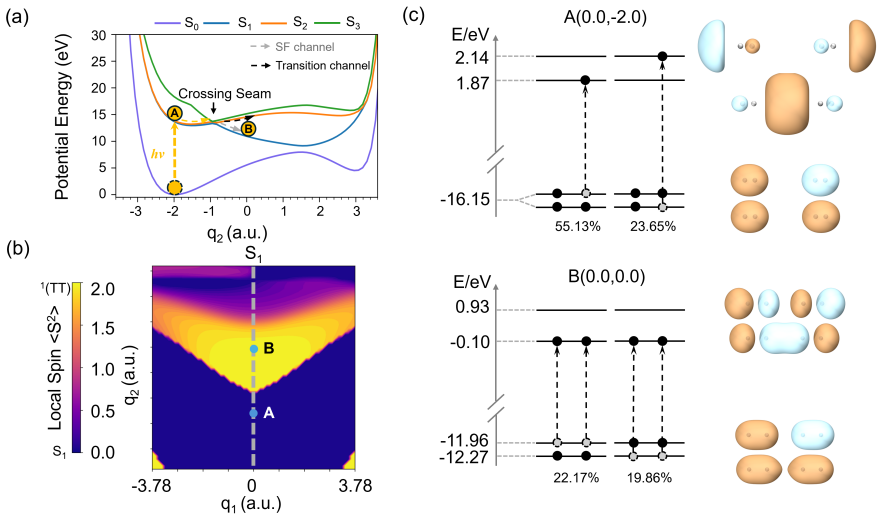
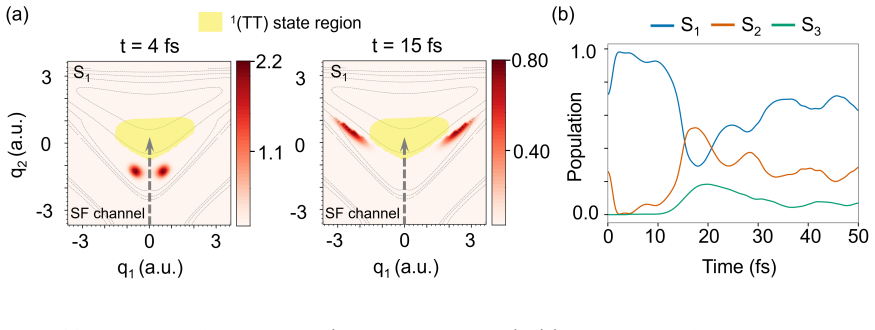
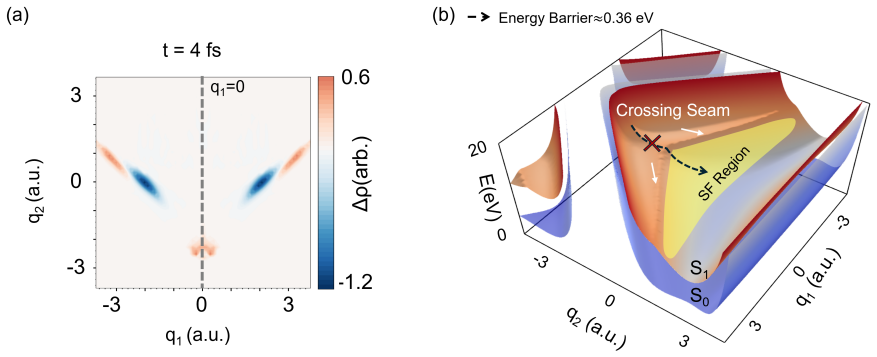
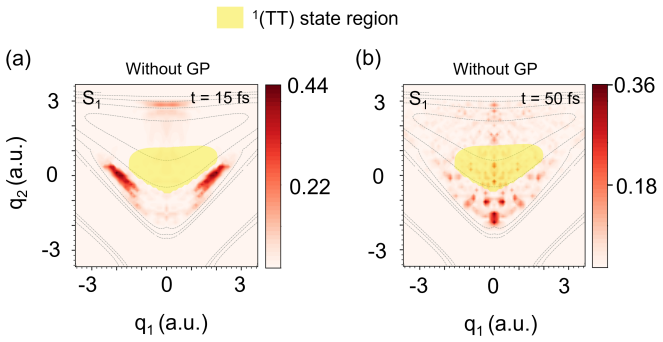
We report that an open reaction channel can be completely blocked by a crossing seam in the molecular configuration space. Specifically, the singlet fission channel in the hydrogen chain H4 is blocked due to electronic quantum geometry, as shown by numerically exact ab initio nonadiabatic full quantum geometrical molecular dynamics simulations. This provides a chemically intuitive picture to understand the effect.
What carries the argument
The crossing seam in the molecular configuration space, which through electronic quantum geometry effects prevents the nonadiabatic transitions necessary for the reaction to proceed.
If this is right
- The singlet fission channel in H4 is completely suppressed despite being open.
- Electronic quantum geometry offers a new way to control photochemical reaction pathways.
- This blockade mechanism may apply to other processes involving degeneracies and near-degeneracies.
- It could elucidate the mechanism of singlet fission in more complex systems.
Where Pith is reading between the lines
- If this holds, designing crossing seams could be a strategy to inhibit unwanted photochemical reactions.
- Similar effects might be observable in larger molecular systems or under different conditions.
- Experimental verification in H4 or analogous systems could confirm the blockade.
Load-bearing premise
The numerically exact ab initio simulations on H4 capture the real quantum dynamics without numerical artifacts or model limitations that could cause the apparent complete blockade.
What would settle it
Detection of singlet fission products or signatures in H4 that contradict the predicted complete blockade, such as through spectroscopic observation of fission products.
Figures
read the original abstract
Electronic degeneracies and near-degeneracies including conical intersections and avoided crossings, typically accompanied by strong vibronic couplings and nonadiabatic transitions, play fundamental roles in photochemical, photophysical and photobiological processes. However, its implications on excited-state chemical reactivities are not fully understood. In this theoretical study, we report a surprising phenomena that an open reaction channel can be completely blocked by a crossing seam in the molecular configuration space. Specifically, by numerically exact ab initio nonadiabatic full quantum geometrical molecular dynamics simulations, we show that the singlet fission channel in the hydrogen chain H4, previously identified as a minimal model for singlet fission, is blocked due to electronic quantum geometry. We provide a chemically intuitive picture to understand this effect. Our results not only reveal a new mechanism for controlling photochemical reactions, but may also elucidate the mechanism of singlet fission.
Editorial analysis
A structured set of objections, weighed in public.
Referee Report
Summary. The manuscript claims that crossing seams in molecular configuration space can completely block an otherwise open reaction channel, with the singlet fission pathway in the minimal H4 model being rendered inaccessible due to electronic quantum geometry. This is demonstrated via numerically exact ab initio nonadiabatic full quantum geometrical molecular dynamics simulations, accompanied by a chemically intuitive explanation, with implications for controlling photochemical reactivity and understanding singlet fission.
Significance. If the complete blockade holds, the work identifies a geometry-enforced mechanism that can strictly suppress a reaction channel without energetic barriers, offering a new principle for photochemical control. The use of numerically exact simulations on a minimal model provides a concrete, falsifiable demonstration that strengthens the claim beyond qualitative arguments.
major comments (1)
- [Results and Discussion (H4 singlet fission simulations)] The central claim of complete blockade (i.e., transmission amplitude identically zero rather than merely suppressed) rests on finite-time numerically exact dynamics. No analytic argument (such as a symmetry-protected decoupling or vanishing overlap derived from the quantum geometric phase) or explicit long-time limit is provided to establish that the observed absence of population transfer is not a slow but non-zero process whose rate falls below the inverse simulation length. This distinction is load-bearing for the 'complete' qualifier in the title and abstract.
minor comments (2)
- [Abstract and Methods] The abstract and methods description omit key simulation parameters (propagation time, basis set, convergence thresholds, and quantitative criterion for 'complete' blockade such as population threshold or transmission probability bound). Adding these would allow independent verification.
- [Theoretical Framework] Notation for the quantum geometric quantities (e.g., Berry phase or connection) should be defined explicitly when first introduced to aid readers unfamiliar with the specific formulation used in the nonadiabatic dynamics.
Simulated Author's Rebuttal
We thank the referee for their careful reading and for identifying the critical distinction between finite-time numerical suppression and a rigorously complete blockade. We address this point directly below and will revise the manuscript to strengthen the supporting evidence.
read point-by-point responses
-
Referee: The central claim of complete blockade (i.e., transmission amplitude identically zero rather than merely suppressed) rests on finite-time numerically exact dynamics. No analytic argument (such as a symmetry-protected decoupling or vanishing overlap derived from the quantum geometric phase) or explicit long-time limit is provided to establish that the observed absence of population transfer is not a slow but non-zero process whose rate falls below the inverse simulation length. This distinction is load-bearing for the 'complete' qualifier in the title and abstract.
Authors: We agree that finite-time simulations, however accurate, do not by themselves prove that the transmission amplitude is identically zero for all future times. In the revised manuscript we will add three elements: (i) propagation times extended by at least an order of magnitude beyond those shown in the original figures, with the singlet-fission population remaining zero to machine precision; (ii) an explicit discussion of the long-time limit obtained by inspecting the structure of the time-evolution operator under the seam-constrained Hamiltonian; and (iii) a symmetry argument, derived from the electronic quantum geometric phase accumulated when encircling the crossing seam, that demonstrates destructive interference and a vanishing overlap integral between the initial and fission channels. These additions will convert the present numerical observation into a geometrically protected selection rule while preserving the chemically intuitive picture already present in the manuscript. revision: yes
Circularity Check
No significant circularity; central claim rests on direct numerical simulation results
full rationale
The paper's derivation chain consists of performing numerically exact ab initio nonadiabatic full quantum geometrical molecular dynamics simulations on the H4 system to observe the singlet fission channel blockade. This is presented as an empirical outcome of the simulations rather than any mathematical derivation, ansatz, or fitted parameter that reduces to the inputs by construction. No self-definitional equations, fitted-input predictions, load-bearing self-citations, or uniqueness theorems imported from prior author work are invoked to establish the complete blockade. The chemically intuitive picture is supplied post-simulation as an explanatory aid, not as a foundational assumption. The result is therefore self-contained against the external benchmark of the reported quantum dynamics trajectories.
Axiom & Free-Parameter Ledger
Lean theorems connected to this paper
-
IndisputableMonolith/Cost/FunctionalEquation.leanwashburn_uniqueness_aczel unclear?
unclearRelation between the paper passage and the cited Recognition theorem.
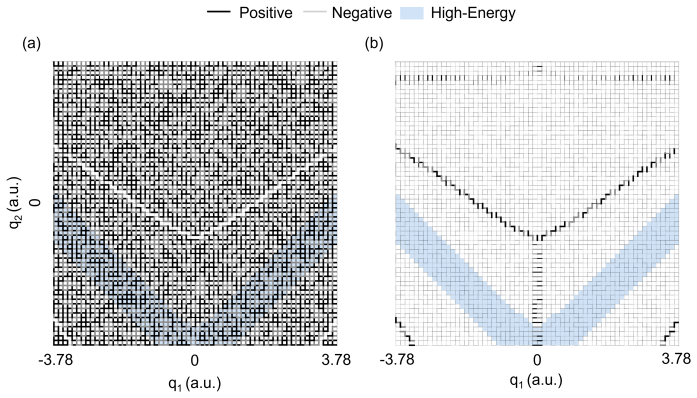
the nuclear wavepacket is trapped in the vicinity of the S1–S2 crossing seam... the electronic intrastate overlap matrix... drops significantly to nearly zero... inhibiting the singlet fission channel
-
IndisputableMonolith/Foundation/RealityFromDistinction.leanreality_from_one_distinction unclear?
unclearRelation between the paper passage and the cited Recognition theorem.
by numerically exact ab initio nonadiabatic full quantum geometrical molecular dynamics simulations
What do these tags mean?
- matches
- The paper's claim is directly supported by a theorem in the formal canon.
- supports
- The theorem supports part of the paper's argument, but the paper may add assumptions or extra steps.
- extends
- The paper goes beyond the formal theorem; the theorem is a base layer rather than the whole result.
- uses
- The paper appears to rely on the theorem as machinery.
- contradicts
- The paper's claim conflicts with a theorem or certificate in the canon.
- unclear
- Pith found a possible connection, but the passage is too broad, indirect, or ambiguous to say the theorem truly supports the claim.
Reference graph
Works this paper leans on
-
[1]
Domcke, W.; Yarkony, D. R.; Köppel, H.Conical Intersections: Theory, Computation and Experiment; Advanced Series in Physical Chemistry; WORLD SCIENTIFIC, 2011; Vol. 17
work page 2011
-
[2]
Baer, M., Billing, G. D., Eds.Advances in Chemical Physics: Volume 124: The Role of Degenerate States in Chemistry; Advances in Chemical Physics v. 124; J. Wiley & Sons: Hoboken, N.J, 2002
work page 2002
-
[3]
Nakamura, H.Nonadiabatic Transition: Concepts, Basic Theories and Applications, 2nd ed.; WORLD SCIENTIFIC, 2012
work page 2012
-
[4]
Domcke, W.; Yarkony, D. R. Role of Conical Intersections in Molecular Spectroscopy and Photoinduced Chemical Dynamics.Annual Review of Physical Chemistry2012,63, 325–352
-
[5]
Zur Quantentheorie Der Molekeln.Annalen der Physik1927,389, 457–484
Born, M.; Oppenheimer, R. Zur Quantentheorie Der Molekeln.Annalen der Physik1927,389, 457–484
-
[6]
Tannor, D. J.Introduction to Quantum Mechanics: A Time-Dependent Perspective; University Science Books: Sausalito, Calif, 2007
work page 2007
-
[7]
Photoisomerization in Rhodopsin.Biochemistry (Moscow) 2001,66, 1197–1209
Kandori, H.; Shichida, Y.; Yoshizawa, T. Photoisomerization in Rhodopsin.Biochemistry (Moscow) 2001,66, 1197–1209
work page 2001
-
[8]
M.; Manzoni, C.; Brida, D.; Tomasello, G.; Orlandi, G.; Kukura, P.; Mathies, R
Polli, D.; Altoè, P.; Weingart, O.; Spillane, K. M.; Manzoni, C.; Brida, D.; Tomasello, G.; Orlandi, G.; Kukura, P.; Mathies, R. A.; Garavelli, M.; Cerullo, G. Conical Intersection Dynamics of the Primary Photoisomerization Event in Vision.Nature2010,467, 440–443. 15
-
[9]
Barbatti, M.; Aquino, A. J. A.; Szymczak, J. J.; Nachtigallová, D.; Hobza, P.; Lischka, H. Relaxation Mechanisms of UV-photoexcited DNA and RNA Nucleobases.Proceedings of the National Academy of Sciences2010,107, 21453–21458
-
[10]
I.; Picchiotti, A.; Pola, M.; Dijkstra, A
Prokhorenko, V. I.; Picchiotti, A.; Pola, M.; Dijkstra, A. G.; Miller, R. J. D. New Insights into the Photophysics of DNA Nucleobases.The Journal of Physical Chemistry Letters2016,7, 4445–4450
-
[11]
Yu.; Qu, Z.-W.; Zhu, H.; Schinke, R
Grebenshchikov, S. Yu.; Qu, Z.-W.; Zhu, H.; Schinke, R. New Theoretical Investigations of the Photodis- sociation of Ozone in the Hartley, Huggins, Chappuis, and Wulf Bands.Physical Chemistry Chemical Physics2007,9, 2044
work page 2044
-
[12]
Yarkony, D. R. Intersecting Conical Intersection Seams in Tetra-Atomic Molecules: The S1 –S0 Internal Conversion in HNCO.Molecular Physics2001,99, 1463–1467
-
[13]
Fazzi, D.; Grancini, G.; Maiuri, M.; Brida, D.; Cerullo, G.; Lanzani, G. Ultrafast Internal Conversion in a Low Band Gap Polymer for Photovoltaics: Experimental and Theoretical Study.Physical Chemistry Chemical Physics2012,14, 6367
-
[15]
Yang, Y.; Shen, L.; Zhang, D.; Yang, W. Conical Intersections from Particle–Particle Random Phase and Tamm–Dancoff Approximations.The Journal of Physical Chemistry Letters2016,7, 2407–2411
-
[16]
Yue, L.; Liu, Y.; Zhu, C. Performance of TDDFT with and without Spin-Flip in Trajectory Surface Hopping Dynamics:Cis–TransAzobenzene Photoisomerization.Physical Chemistry Chemical Physics 2018,20, 24123–24139
work page 2018
-
[17]
Guan, Y.; Xie, C.; Guo, H.; Yarkony, D. R. Enabling a Unified Description of Both Internal Conversion and Intersystem Crossing in Formaldehyde: A Global Coupled Quasi-Diabatic Hamiltonian for Its S0 , S1 , and T1 States.Journal of Chemical Theory and Computation2021,17, 4157–4168
-
[18]
Hu, D.; Huo, P. Ab Initio Molecular Cavity Quantum Electrodynamics Simulations Using Machine Learning Models.Journal of Chemical Theory and Computation2023,19, 2353–2368
-
[19]
Pollak, E.; Cao, J. The Effect of an Optical Cavity on Diabatic Tunneling in an Ensemble of Symmetric Double-Well Systems.The Journal of Chemical Physics2025,163, 234111. 16
-
[20]
Jiang, H.; Zhang, J.; Wang, T.; Peng, J.; Jin, C.; Zou, X.; Zhu, P.; Jiang, T.; Lan, Z.; Yong, H.; He, F.; Xiang, D. Super-Resolution Femtosecond Electron Diffraction Reveals Electronic and Nuclear Dynamics at Conical Intersections.Nature Communications2025,16, 6703
-
[21]
Zhang, J.; Liu, H.; Lin, C.; Xu, C.; Gu, F.; Gelin, M. F.; Lan, Z. Understanding of Molecular Motions in Nonadiabatic Photoisomerization Dynamics of Cis-Stilbene with on-the-Fly Simulation of Transient Absorption Pump–Probe Spectra.The Journal of Chemical Physics2025,163, 244109
-
[22]
Duston, T.; Bradbury, N. C.; Tao, Z.; Subotnik, J. E. Conical Intersections and Electronic Momentum as Viewed from Phase Space Electronic Structure Theory.The Journal of Physical Chemistry Letters 2025,16, 8994–9003
work page 2025
-
[23]
Berry, M. V. Quantal Phase Factors Accompanying Adiabatic Changes.Proceedings of the Royal Society of London. A. Mathematical and Physical Sciences1984,392, 45–57
-
[24]
Mead, C. A. The Geometric Phase in Molecular Systems.Reviews of Modern Physics1992,64, 51–85
-
[25]
Ryabinkin, I. G.; Izmaylov, A. F. Geometric Phase Effects in Dynamics Near Conical Intersections: Symmetry Breaking and Spatial Localization.Physical Review Letters2013,111, 220406
-
[26]
G.; Joubert-Doriol, L.; Izmaylov, A
Ryabinkin, I. G.; Joubert-Doriol, L.; Izmaylov, A. F. Geometric Phase Effects in Nonadiabatic Dynamics near Conical Intersections.Accounts of Chemical Research2017,50, 1785–1793
-
[27]
Farag, M. H.; Mandal, A.; Huo, P. Polariton Induced Conical Intersection and Berry Phase.Physical Chemistry Chemical Physics2021,23, 16868–16879
-
[28]
C.; Yamaguchi, Y.; Schaefer, H
Handy, N. C.; Yamaguchi, Y.; Schaefer, H. F. The Diagonal Correction to the Born–Oppenheimer Approximation: Its Effect on the Singlet–Triplet Splitting of CH2 and Other Molecular Effects.The Journal of Chemical Physics1986,84, 4481–4484
-
[29]
Baer, M.Beyond Born–Oppenheimer: Conical Intersections and Electronic Nonadiabatic Coupling Terms, 1st ed.; Wiley, 2006
work page 2006
-
[30]
Dynamical Theory of Crystal Lattices.American Journal of Physics 1955,23, 474–474
Born, M.; Huang, K.; Lax, M. Dynamical Theory of Crystal Lattices.American Journal of Physics 1955,23, 474–474
work page 1955
-
[31]
Matselyukh, D. T.; Despré, V.; Golubev, N. V.; Kuleff, A. I.; Wörner, H. J. Decoherence and Revival in Attosecond Charge Migration Driven by Non-Adiabatic Dynamics.Nature Physics2022,18, 1206–1213
-
[32]
Nakamura, H.; Truhlar, D. G. The Direct Calculation of Diabatic States Based on Configurational Uniformity.The Journal of Chemical Physics2001,115, 10353–10372. 17
-
[33]
Subotnik, J. E.; Yeganeh, S.; Cave, R. J.; Ratner, M. A. Constructing Diabatic States from Adiabatic States: Extending Generalized Mulliken–Hush to Multiple Charge Centers with Boys Localization.The Journal of Chemical Physics2008,129, 244101
-
[34]
Köuppel, H.; Domcke, W.; Cederbaum, L. S. InAdvances in Chemical Physics, 1st ed.; Prigogine, I., Rice, S. A., Eds.; Wiley, 1984; Vol. 57; pp 59–246
work page 1984
-
[35]
Köppel, H.Advanced Series in Physical Chemistry; WORLD SCIENTIFIC, 2004; Vol. 15; pp 175–204
work page 2004
-
[36]
Gu, B. A Discrete-Variable Local Diabatic Representation of Conical Intersection Dynamics.Journal of Chemical Theory and Computation2023,19, 6557–6563
-
[37]
Gu, B. Nonadiabatic Conical Intersection Dynamics in the Local Diabatic Representation with Strang Splitting and Fourier Basis.Journal of Chemical Theory and Computation2024,20, 2711–2718
-
[38]
Zhu, X.; Gu, B. Making Peace with Random Phases: Ab Initio Conical Intersection Quantum Dynamics in Random Gauges.The Journal of Physical Chemistry Letters2024,15, 8487–8493
-
[39]
Quantum Geometrical Molecular Dynamics.Science Advances2025,11, eadz3711
Xie, Y.; Liu, R.; Gu, B. Quantum Geometrical Molecular Dynamics.Science Advances2025,11, eadz3711
-
[40]
Sha, M.; Gu, B. Exponential Convergence of the Local Diabatic Representation for Nonadiabatic Eigen- value Problems.Physical Chemistry Chemical Physics2026, 10.1039.D5CP03524D
-
[41]
Pope, M.; Swenberg, C. E.; Pope, M.Electronic Processes in Organic Crystals and Polymers, 2nd ed.; Monographs on the Physics and Chemistry of Materials #56; Oxford University Press: New York, 1999
work page 1999
- [42]
-
[43]
Smith, M. B.; Michl, J. Recent Advances in Singlet Fission.Annual Review of Physical Chemistry2013, 64, 361–386
-
[44]
Diradical Character View of Singlet Fission.The Journal of Physical Chemistry Letters2012,3, 145–150
Minami, T.; Nakano, M. Diradical Character View of Singlet Fission.The Journal of Physical Chemistry Letters2012,3, 145–150
-
[45]
Nakano,M.; Minami,T.; Fukui,H.; Kishi,R.; Shigeta,Y.; Champagne,B.FullConfigurationInteraction Calculations of the Second Hyperpolarizabilities of the H4 Model Compound: Summation-over-states Analysis and Interplay with Diradical Characters.The Journal of Chemical Physics2012,136, 024315
-
[46]
Nakano, M. Open-Shell-Character-Based Molecular Design Principles: Applications to Nonlinear Optics and Singlet Fission.The Chemical Record2017,17, 27–62. 18
-
[47]
Thalmann, K. S.; Ismail, K. M.; Kathir, R. K.; Rodrigues, D. J. L.; Thoss, M.; Martín Pendás, Á.; Coto, P. B. Role of the Radical Character in Singlet Fission: An Ab Initio and Quantum Chemical Topology Analysis.The Journal of Physical Chemistry A2024, acs.jpca.4c06380
-
[48]
Claudino, D.; Peng, B.; Kowalski, K.; Humble, T. S. Modeling Singlet Fission on a Quantum Computer. The Journal of Physical Chemistry Letters2023,14, 5511–5516
-
[49]
Berne, B. J.; Ciccotti, G.; Coker, D. F. Classical and Quantum Dynamics in Condensed Phase Simu- lations. Classical and Quantum Dynamics in Condensed Phase Simulations. LERICI, Villa Marigola, 1998
work page 1998
-
[50]
Tully, J. C. Ehrenfest Dynamics with Quantum Mechanical Nuclei.Chemical Physics Letters2023,816, 140396
-
[51]
J.; Liebel, M.; Schnedermann, C.; Wende, T.; Kehoe, T
Musser, A. J.; Liebel, M.; Schnedermann, C.; Wende, T.; Kehoe, T. B.; Rao, A.; Kukura, P. Evidence for Conical Intersection Dynamics Mediating Ultrafast Singlet Exciton Fission.Nature Physics2015, 11, 352–357
-
[52]
Dunning, T. H. Gaussian Basis Sets for Use in Correlated Molecular Calculations. I. The Atoms Boron through Neon and Hydrogen.The Journal of Chemical Physics1989,90, 1007–1023
-
[53]
Kendall, R. A.; Dunning, T. H.; Harrison, R. J. Electron Affinities of the First-Row Atoms Revisited. Systematic Basis Sets and Wave Functions.The Journal of Chemical Physics1992,96, 6796–6806
-
[54]
Chauvin, R., Lepetit, C., Silvi, B., Alikhani, E., Eds.Applications of Topological Methods in Molecular Chemistry; Challenges and Advances in Computational Chemistry and Physics; Springer International Publishing: Cham, 2016; Vol. 22
work page 2016
-
[55]
Martín Pendás, A.; Francisco, E. Local Spin and Open Quantum Systems: Clarifying Misconceptions, Unifying Approaches.Physical Chemistry Chemical Physics2021,23, 8375–8392
-
[56]
Zirzlmeier, J.; Lehnherr, D.; Coto, P. B.; Chernick, E. T.; Casillas, R.; Basel, B. S.; Thoss, M.; Tyk- winski, R. R.; Guldi, D. M. Singlet Fission in Pentacene Dimers.Proceedings of the National Academy of Sciences2015,112, 5325–5330
-
[57]
Theoretical Modeling of Singlet Fission.Chemical Reviews2018,118, 7164–7207
Casanova, D. Theoretical Modeling of Singlet Fission.Chemical Reviews2018,118, 7164–7207
-
[58]
Roseiro, P.; Robert, V. Environmental Effects on the Singlet Fission Phenomenon: A Model Hamiltonian-based Study.Physical Chemistry Chemical Physics2022,24, 15945–15950. 19
-
[59]
G.; Cargo, M.; Carrington, T.; Mitchell, K
Littlejohn, R. G.; Cargo, M.; Carrington, T.; Mitchell, K. A.; Poirier, B. A General Framework for Discrete Variable Representation Basis Sets.The Journal of Chemical Physics2002,116, 8691–8703
-
[60]
Light, J. C.; Carrington, T. InAdvances in Chemical Physics, 1st ed.; Prigogine, I., Rice, S. A., Eds.; Wiley, 2000; Vol. 114; pp 263–310
work page 2000
-
[61]
Von Busch, H.; Dev, V.; Eckel, H.-A.; Kasahara, S.; Wang, J.; Demtröder, W.; Sebald, P.; Meyer, W. Unambiguous Proof for Berry’s Phase in the Sodium Trimer: Analysis of the Transition A 2 E′ ′←X 2 E′.Physical Review Letters1998,81, 4584–4587
-
[62]
Xie, C.; Ma, J.; Zhu, X.; Yarkony, D. R.; Xie, D.; Guo, H. Nonadiabatic Tunneling in Photodissociation of Phenol.Journal of the American Chemical Society2016,138, 7828–7831
-
[63]
Yuan, D.; Guan, Y.; Chen, W.; Zhao, H.; Yu, S.; Luo, C.; Tan, Y.; Xie, T.; Wang, X.; Sun, Z.; Zhang, D. H.; Yang, X. Observation of the Geometric Phase Effect in the H + HD→H2 + D Reaction. Science2018,362, 1289–1293
-
[64]
Xie, Y.; Gu, B. Linked Product Approximation to the Global Electronic Overlap Matrix.Journal of Chemical Theory and Computation2025,21, 9249–9258
-
[65]
Tully, J. C. Mixed Quantum–Classical Dynamics.Faraday Discussions1998,110, 407–419
-
[66]
Sun, Q. et al. Recent Developments in the PySCF Program Package.The Journal of Chemical Physics 2020,153, 024109
work page 2020
-
[67]
PyQED: A Python Framework for Ab Initio Geometric Quantum Dynamics
Xie, Y.; Zhu, X.; Gu, B. PyQED: A Python Framework for Ab Initio Geometric Quantum Dynamics. Chin. J. Chem. Phys.2026, 20 21
work page 2026
discussion (0)
Sign in with ORCID, Apple, or X to comment. Anyone can read and Pith papers without signing in.