Recognition: 2 theorem links
· Lean TheoremIntroducing Echo Networks for Computational Neuroevolution
Pith reviewed 2026-05-10 18:04 UTC · model grok-4.3
The pith
Echo Networks represent recurrent neural networks solely as a connection matrix to allow matrix computations for mutation and recombination in evolution.
A machine-rendered reading of the paper's core claim, the machinery that carries it, and where it could break.
Core claim
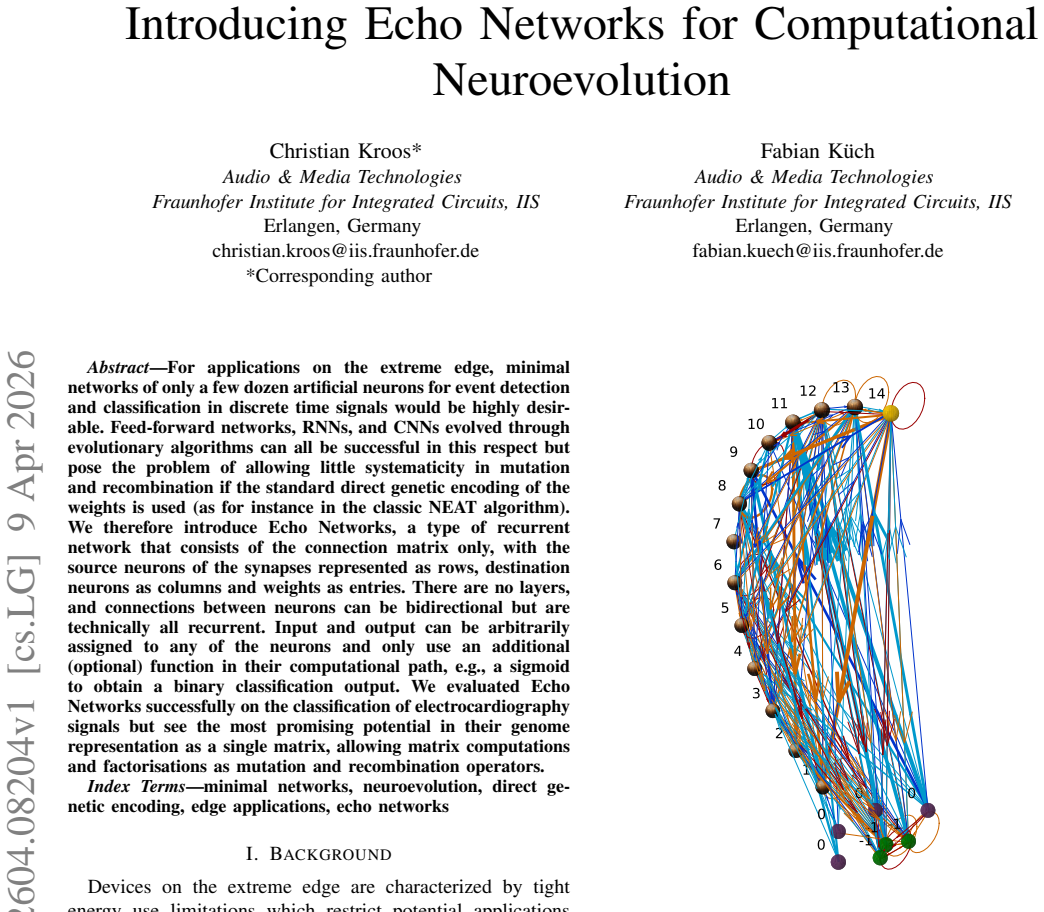
Echo Networks are a type of recurrent network that consists of the connection matrix only, with the source neurons of the synapses represented as rows, destination neurons as columns and weights as entries. There are no layers, and connections between neurons can be bidirectional but are technically all recurrent. Input and output can be arbitrarily assigned to any of the neurons and only use an additional optional function in their computational path. The genome representation as a single matrix allows matrix computations and factorisations as mutation and recombination operators.
What carries the argument
The connection matrix, which encodes the full network as rows for source neurons, columns for destination neurons, and entries for weights, serving as the genome for direct matrix-based evolutionary operators.
If this is right
- Mutations and recombinations can be performed systematically through matrix factorisations rather than manipulating individual weights.
- Very small networks of only a few dozen neurons become feasible to evolve for event detection and classification in discrete time signals.
- Inputs and outputs can be placed on any neuron without requiring fixed layer structures.
- The same matrix representation supports evaluation on tasks such as electrocardiography signal classification.
Where Pith is reading between the lines
- The single-matrix genome could be paired with existing linear-algebra libraries to accelerate the evolutionary search process itself.
- Absence of layers may simplify direct hardware mapping of evolved Echo Networks onto low-power chips.
- Matrix operators might be chosen to enforce additional constraints such as sparsity or stability during evolution.
Load-bearing premise
Representing the network as a single connection matrix will allow for more systematic mutation and recombination using matrix computations and factorisations compared to direct genetic encoding in standard neuroevolution algorithms.
What would settle it
A head-to-head comparison on the same electrocardiography classification task in which standard direct-encoding neuroevolution produces networks of equal or better accuracy and smaller size than Echo Networks evolved with matrix operators.
Figures


read the original abstract
For applications on the extreme edge, minimal networks of only a few dozen artificial neurons for event detection and classification in discrete time signals would be highly desirable. Feed-forward networks, RNNs, and CNNs evolved through evolutionary algorithms can all be successful in this respect but pose the problem of allowing little systematicity in mutation and recombination if the standard direct genetic encoding of the weights is used (as for instance in the classic NEAT algorithm). We therefore introduce Echo Networks, a type of recurrent network that consists of the connection matrix only, with the source neurons of the synapses represented as rows, destination neurons as columns and weights as entries. There are no layers, and connections between neurons can be bidirectional but are technically all recurrent. Input and output can be arbitrarily assigned to any of the neurons and only use an additional (optional) function in their computational path, e.g., a sigmoid to obtain a binary classification output. We evaluated Echo Networks successfully on the classification of electrocardiography signals but see the most promising potential in their genome representation as a single matrix, allowing matrix computations and factorisations as mutation and recombination operators.
Editorial analysis
A structured set of objections, weighed in public.
Referee Report
Summary. The manuscript introduces Echo Networks, a recurrent network architecture represented solely as a single connection matrix (rows as source neurons, columns as destination neurons, entries as weights), with no layers and all connections treated as recurrent. Inputs and outputs can be assigned to any neurons, optionally with an activation function. The authors report successful evaluation on ECG signal classification and emphasize the genome's matrix form as enabling systematic mutation and recombination via matrix computations and factorizations, in contrast to direct encodings such as NEAT.
Significance. If concrete matrix-based operators can be defined and empirically shown to improve evolutionary search efficiency or diversity for small networks, the work could advance neuroevolution for extreme-edge applications by providing an algebraically tractable genome representation. The clean matrix formulation itself is a conceptual strength that could support reproducible implementations and future algebraic analyses of topology and weights.
major comments (2)
- [Abstract] Abstract: The claim of having 'evaluated Echo Networks successfully' on electrocardiography signal classification is unsupported by any quantitative results, performance metrics, baseline comparisons, or methodological details, preventing assessment of whether the network form actually works for the stated task.
- [Abstract] Abstract (genome representation paragraph): The central motivation—that the single-matrix genome enables 'more systematic mutation and recombination using matrix computations and factorisations' compared to direct genetic encoding—is load-bearing for the paper's contribution, yet the manuscript provides no operator definitions, pseudocode, concrete examples (e.g., application of SVD, NMF, or other factorizations to weights or topology), or any evolutionary runs comparing performance, diversity, or convergence against NEAT-style encodings.
minor comments (2)
- [Network definition] The computational model for neuron activation and signal propagation through the matrix is described at a high level but lacks an explicit update equation or small worked example that would clarify how bidirectional connections are handled in discrete time.
- [Introduction] The manuscript would benefit from a brief discussion of related matrix-based or algebraic neuroevolution approaches to better situate the novelty of the Echo Network genome representation.
Simulated Author's Rebuttal
We thank the referee for the detailed and constructive report. The comments highlight two areas where the current manuscript is insufficiently explicit: the lack of quantitative support for the ECG evaluation claim and the absence of concrete operator definitions or comparisons for the matrix genome. We agree on both points and will revise the abstract, add a dedicated methods/results subsection with metrics and baselines, and include example matrix operators with pseudocode. A full comparative study of evolutionary performance remains future work, but we can provide initial definitions and small-scale runs in the revision.
read point-by-point responses
-
Referee: [Abstract] Abstract: The claim of having 'evaluated Echo Networks successfully' on electrocardiography signal classification is unsupported by any quantitative results, performance metrics, baseline comparisons, or methodological details, preventing assessment of whether the network form actually works for the stated task.
Authors: We accept this criticism. The current abstract asserts successful evaluation without supporting numbers or details. The full manuscript contains a brief experimental section on ECG classification, but it is indeed qualitative and lacks the requested metrics, baselines (e.g., against NEAT or standard RNNs), and methodological specifics. In the revision we will (1) replace the abstract sentence with a concise statement of key results (accuracy, network size, training time), (2) expand the experimental section to include quantitative tables, confusion matrices, and direct comparisons, and (3) add a short methods paragraph describing the ECG dataset, preprocessing, and fitness function. This will allow readers to assess whether the Echo Network form is effective for the task. revision: yes
-
Referee: [Abstract] Abstract (genome representation paragraph): The central motivation—that the single-matrix genome enables 'more systematic mutation and recombination using matrix computations and factorisations' compared to direct genetic encoding—is load-bearing for the paper's contribution, yet the manuscript provides no operator definitions, pseudocode, concrete examples (e.g., application of SVD, NMF, or other factorizations to weights or topology), or any evolutionary runs comparing performance, diversity, or convergence against NEAT-style encodings.
Authors: We agree that the manuscript currently only states the potential of the matrix representation without demonstrating concrete operators. The core contribution of the paper is the introduction of the Echo Network as a single-matrix genome; the claim about systematic mutation/recombination is presented as the most promising direction rather than a completed result. In the revision we will add a new subsection that (a) defines two simple matrix operators (element-wise mutation with a Gaussian mask and recombination via block-wise concatenation or low-rank approximation using truncated SVD), (b) supplies pseudocode for each, and (c) reports a small-scale evolutionary experiment (population size 50, 100 generations) on a toy classification task comparing diversity and convergence against a NEAT baseline. A comprehensive study of search efficiency on larger problems is acknowledged as future work and will be noted as such. revision: partial
Circularity Check
No circularity: conceptual introduction with no derivation chain or fitted predictions
full rationale
The manuscript introduces Echo Networks as a matrix-only recurrent architecture and notes its potential for matrix-based mutation/recombination operators, but supplies no equations, derivations, predictions, or first-principles results that could reduce to their own inputs. The single empirical result (ECG classification) is a direct demonstration of functionality, not a prediction derived from fitted parameters or self-referential definitions. No self-citations, uniqueness theorems, or ansatzes are invoked in a load-bearing way. The central claim about systematic operators remains unelaborated and therefore cannot be circular.
Axiom & Free-Parameter Ledger
axioms (1)
- domain assumption Neural networks can be effectively represented and evolved using a single connection matrix without explicit layers.
invented entities (1)
-
Echo Networks
no independent evidence
Reference graph
Works this paper leans on
-
[1]
Designing neural networks through neuroevolution,
K. O. Stanley, J. Clune, J. Lehman, and R. Miikkulainen, “Designing neural networks through neuroevolution,”Nature Machine Intelligence, vol. 1, no. 1, pp. 24–35, 2019
work page 2019
-
[2]
Evolving neural networks through augmenting topologies,
K. O. Stanley and R. Miikkulainen, “Evolving neural networks through augmenting topologies,”Evolutionary Computation, vol. 10, no. 2, pp. 99–127, 2002
work page 2002
-
[3]
Correspondence between neuroevolution and gradient descent,
S. Whitelam, V . Selin, S.-W. Park, and I. Tamblyn, “Correspondence between neuroevolution and gradient descent,”Nature Communications, vol. 12, no. 1, p. 6317, 2021
work page 2021
-
[4]
The Loss Surfaces of Multilayer Networks,
A. Choromanska, M. Henaff, M. Mathieu, G. Ben Arous, and Y . Le- Cun, “The Loss Surfaces of Multilayer Networks,” inProceedings of the Eighteenth International Conference on Artificial Intelligence and Statistics, ser. Proceedings of Machine Learning Research, G. Lebanon and S. V . N. Vishwanathan, Eds., vol. 38. San Diego, California, USA: PMLR, 2015, pp...
work page 2015
-
[5]
Compositional pattern producing networks: A novel abstraction of development,
K. O. Stanley, “Compositional pattern producing networks: A novel abstraction of development,”Genetic Programming and Evolvable Ma- chines, vol. 8, no. 2, pp. 131–162, 2007
work page 2007
-
[6]
K. A. De Jong,Evolutionary Computation: A Unified Approach. The MIT Press, 2006
work page 2006
-
[7]
An experimental unification of reservoir computing methods,
D. Verstraeten, B. Schrauwen, M. d’Haene, and D. Stroobandt, “An experimental unification of reservoir computing methods,”Neural Net- works, vol. 20, no. 3, pp. 391–403, 2007
work page 2007
-
[8]
W. Maass, T. Natschl ¨ager, and H. Markram, “Real-time computing without stable states: A new framework for neural computation based on perturbations,”Neural omputation, vol. 14, no. 11, pp. 2531–2560, 2002
work page 2002
-
[9]
Harnessing nonlinearity: Predicting chaotic systems and saving energy in wireless communication,
H. Jaeger and H. Haas, “Harnessing nonlinearity: Predicting chaotic systems and saving energy in wireless communication,”Science, vol. 304, no. 5667, pp. 78–80, 2004
work page 2004
-
[10]
Neural networks and physical systems with emergent collective computational abilities
J. J. Hopfield, “Neural networks and physical systems with emergent collective computational abilities.”Proceedings of the National Academy of Sciences, vol. 79, no. 8, pp. 2554–2558, 1982
work page 1982
-
[11]
Dense associative memory for pat- tern recognition,
D. Krotov and J. J. Hopfield, “Dense associative memory for pat- tern recognition,”Advances in Neural Information Processing Systems, vol. 29, 2016
work page 2016
-
[12]
Hopfield Networks is All You Need
H. Ramsauer, B. Sch ¨afl, J. Lehner, P. Seidl, M. Widrich, T. Adler, L. Gruber, M. Holzleitner, M. Pavlovi ´c, G. K. Sandveet al., “Hopfield networks is all you need,”arXiv preprint arXiv:2008.02217, 2020
work page internal anchor Pith review arXiv 2008
-
[13]
Neuroevolution for sound event detection in real life audio: A pilot study,
C. Kroos and M. Plumbley, “Neuroevolution for sound event detection in real life audio: A pilot study,”Detection and Classification of Acoustic Scenes and Events (DCASE 2017) Proceedings 2017, 2017
work page 2017
-
[14]
PTB-XL, a large publicly available electrocardiography dataset,
P. Wagner, N. Strodthoff, R.-D. Bousseljot, D. Kreiseler, F. I. Lunze, W. Samek, and T. Schaeffter, “PTB-XL, a large publicly available electrocardiography dataset,”Scientific Data, vol. 7, no. 1, pp. 1–15, 2020
work page 2020
-
[15]
G. Wang, G. Cheng, and T. R. Carr, “The application of improved NeuroEvolution of Augmenting Topologies neural network in Marcellus Shale lithofacies prediction,”Computers & Geosciences, vol. 54, pp. 50– 65, 2013
work page 2013
-
[16]
Reducing bias and inefficiency in the selection algorithm,
J. E. Bakeret al., “Reducing bias and inefficiency in the selection algorithm,” inProceedings of the Second International Conference on Genetic Algorithms, vol. 206, 1987, pp. 14–21
work page 1987
-
[17]
K. A. De Jong,An analysis of the behavior of a class of genetic adaptive systems. University of Michigan, 1975
work page 1975
-
[18]
Learning internal representations by error propagation,
D. E. Rumelhart, G. E. Hinton, and R. J. Williams, “Learning internal representations by error propagation,” Institute for Cognitive Science, University of California, San Diego, Tech. Rep., 1985
work page 1985
-
[19]
Pearlmutter, Don Syme, Frank Wood, and Philip Torr
A. G. Baydin, B. A. Pearlmutter, D. Syme, F. Wood, and P. Torr, “Gradients without backpropagation,”arXiv preprint arXiv:2202.08587, 2022
-
[20]
The forward-forward algorithm: Some preliminary investigations
G. Hinton, “The forward-forward algorithm: Some preliminary investi- gations,”arXiv preprint arXiv:2212.13345, vol. 2, no. 3, p. 5, 2022
discussion (0)
Sign in with ORCID, Apple, or X to comment. Anyone can read and Pith papers without signing in.