Evaluating the performance of a weak-field homodyne receiver in quadrature phase-shift keying optical communication
Pith reviewed 2026-05-10 16:50 UTC · model grok-4.3
The pith
Weak-field homodyne receivers blend wave and particle features to serve as a practical alternative to standard optical homodyne detection in phase-encoded communication.
A machine-rendered reading of the paper's core claim, the machinery that carries it, and where it could break.
Core claim
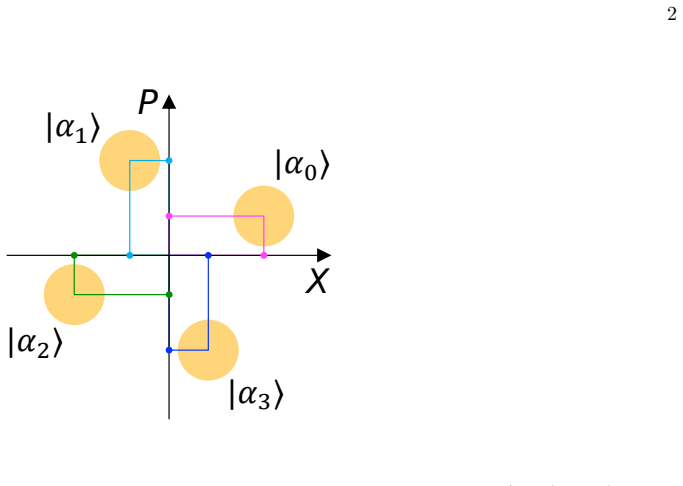
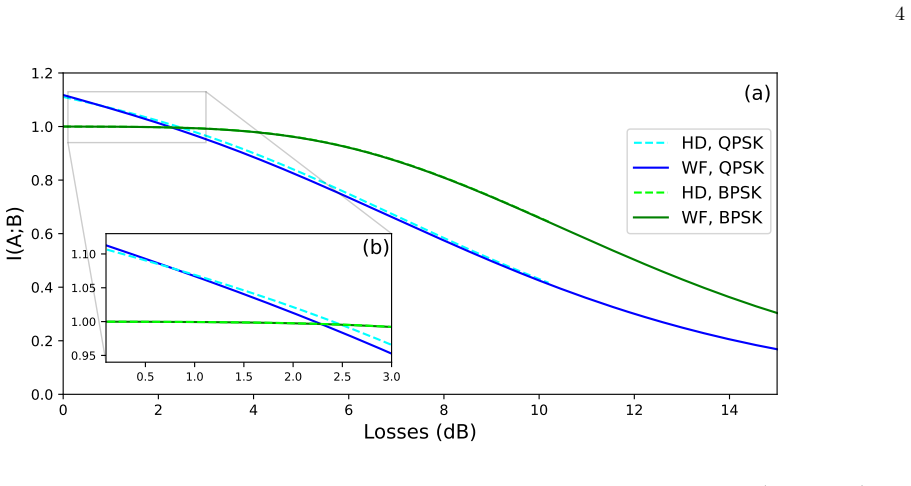
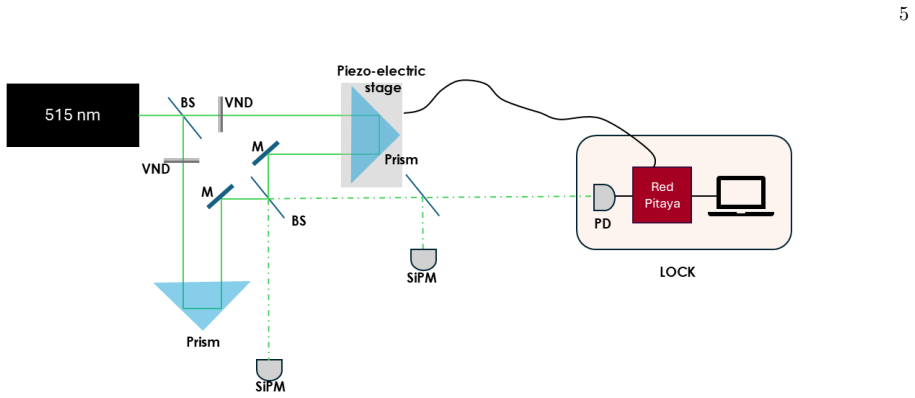
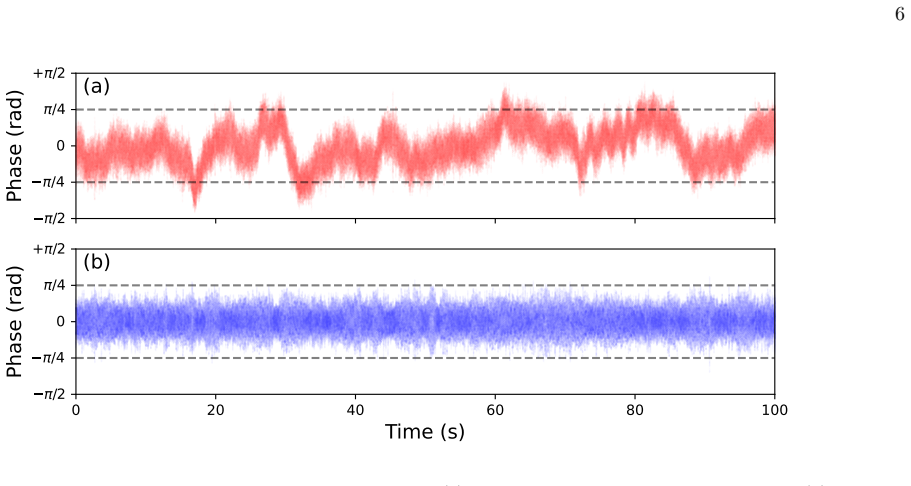
We have demonstrated that weak-field receivers, merging wave-like and particle-like features, can be considered as a valid alternative to already existing receivers, such as optical homodyne detection. To better emphasize the potential of our receiver, in this work we consider a proof of concept for quaternary communication based on coherent states with the same amplitude and different phase values. The encoding in phase requires a fine control of phase noise obtained through a feedback system. The results achieved in terms of mutual information and secret key generation rate encourage further increase of the alphabet towards an approximately continuous phase modulation.
What carries the argument
The weak-field homodyne receiver that combines continuous wave-like field detection with discrete particle-like photon counting to decode phase shifts among equal-amplitude coherent states.
If this is right
- Quaternary phase encoding becomes feasible once the feedback loop suppresses phase fluctuations to the required level.
- Mutual information extracted from the four states approaches the theoretical limit set by homodyne detection.
- Secret-key rates remain positive, indicating the scheme can support secure quantum communication links.
- Performance trends support extension to larger phase alphabets that approach continuous modulation.
Where Pith is reading between the lines
- The same receiver architecture might be adapted to other discrete modulation formats without redesigning the optical front end.
- Integration with existing fiber links could be simpler than full homodyne systems because lower local-oscillator power is needed.
- If phase stabilization scales with alphabet size, the approach could reduce the hardware overhead for continuous-variable quantum key distribution.
- Laboratory demonstrations with higher mean photon numbers would test whether the advantage persists outside the weak-field regime.
Load-bearing premise
The feedback system provides sufficient phase-noise suppression for reliable encoding and decoding of the four phase values in the experimental or simulated setup.
What would settle it
A side-by-side measurement in which the weak-field receiver yields a mutual information value at least 10 percent lower than the ideal homodyne benchmark at the same mean photon number would falsify the claim of comparable performance.
Figures
read the original abstract
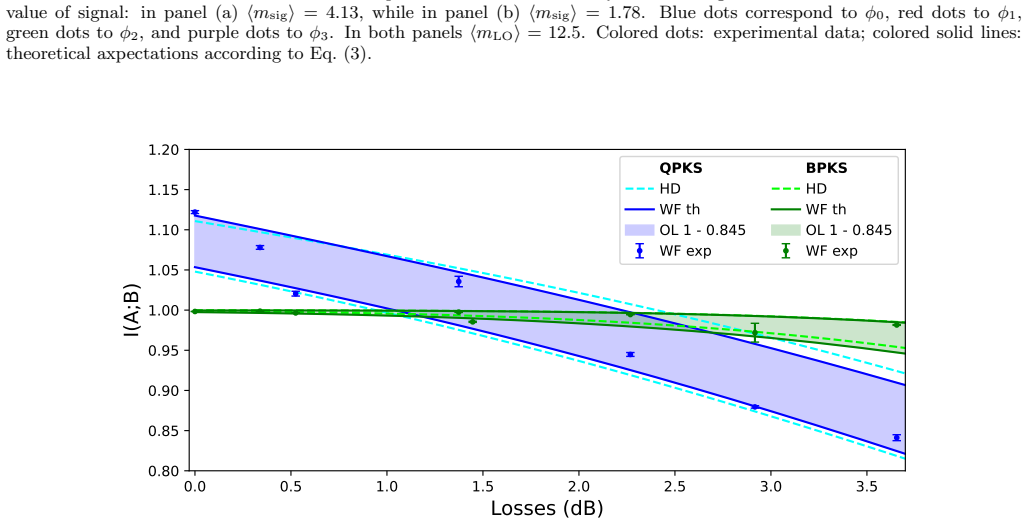
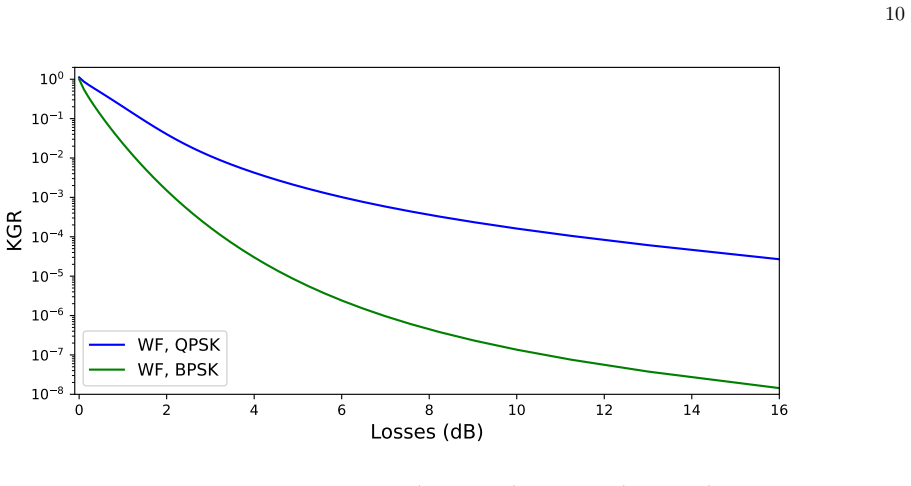
Quantum communication protocols require efficient detection schemes to maximize the information transfer rate between the sender and the receiver. To this aim, we have demonstrated that weak-field receivers, merging wave-like and particle-like features, can be considered as a valid alternative to already existing receivers, such as optical homodyne detection. To better emphasize the potential of our receiver, in this work we consider a proof of concept for quaternary communication based on coherent states with the same amplitude and different phase values. The encoding in phase requires a fine control of phase noise obtained through a feedback system. The results achieved in terms of mutual information and secret key generation rate encourage further increase of the alphabet towards an approximately continuous phase modulation.
Editorial analysis
A structured set of objections, weighed in public.
Referee Report
Summary. The manuscript presents a proof-of-concept for a weak-field homodyne receiver applied to quaternary phase-shift keying (QPSK) communication with coherent states of fixed amplitude but four distinct phases. It highlights the merging of wave-like and particle-like detection features and argues that the scheme constitutes a valid alternative to conventional optical homodyne receivers, supported by reported values of mutual information and secret-key generation rate. Phase encoding is stated to require active feedback for phase-noise control.
Significance. If the quantitative results on mutual information and secret-key rate are shown to exceed or match the homodyne benchmark under properly quantified residual phase noise, the work would offer a concrete experimental route toward hybrid detection schemes that could improve information rates in quantum optical links. The explicit use of feedback-stabilized phase encoding and the focus on finite-alphabet coherent-state communication provide a falsifiable test of the receiver's practicality.
major comments (1)
- [Abstract and §3] Abstract and §3 (experimental setup): the central claim that the weak-field receiver is a 'valid alternative' to standard homodyne detection rests entirely on the reported mutual-information and secret-key-rate figures, yet no measured residual phase variance, loop bandwidth, or resulting symbol-error probability is supplied. In the shot-noise-limited weak-field regime any uncorrected phase jitter directly mixes the I and Q quadratures, so the unquantified performance of the feedback loop is load-bearing for the distinguishability of the four equiphase states.
minor comments (1)
- [Introduction] Notation for the four phase states and the definition of the weak-field regime should be introduced with explicit equations rather than descriptive text only.
Simulated Author's Rebuttal
We thank the referee for the constructive feedback on our manuscript. The comments correctly identify the need for explicit characterization of the phase-stabilization loop to support claims about the weak-field receiver's performance relative to standard homodyne detection. We have revised the manuscript to incorporate the requested quantitative details from our experimental data.
read point-by-point responses
-
Referee: [Abstract and §3] Abstract and §3 (experimental setup): the central claim that the weak-field receiver is a 'valid alternative' to standard homodyne detection rests entirely on the reported mutual-information and secret-key-rate figures, yet no measured residual phase variance, loop bandwidth, or resulting symbol-error probability is supplied. In the shot-noise-limited weak-field regime any uncorrected phase jitter directly mixes the I and Q quadratures, so the unquantified performance of the feedback loop is load-bearing for the distinguishability of the four equiphase states.
Authors: We agree that the performance of the active phase-noise feedback must be quantified to substantiate the distinguishability of the four equiphase states and the validity of the weak-field receiver as an alternative. The reported mutual-information and secret-key-rate values were computed directly from the experimentally recorded quadrature samples; any residual phase jitter is therefore already embedded in those figures. To address the referee's concern explicitly, we have added to the revised Section 3 (and a new supplementary figure) the measured residual phase variance extracted from the feedback error signal, the servo loop bandwidth, and the symbol-error probability inferred from the observed quadrature histograms. These additions confirm that phase jitter remains low enough to avoid significant I-Q mixing, thereby reinforcing that the achieved rates are obtained under well-controlled phase encoding. revision: yes
Circularity Check
No circularity: results rest on external experimental validation rather than self-referential definitions or fits
full rationale
The paper reports measured or simulated mutual information and secret-key rates for a weak-field homodyne receiver applied to QPSK coherent states, positioning the scheme as an alternative to standard homodyne detection. No equations are presented that define a quantity in terms of itself (e.g., no per-period scale fitted from data then re-used as a prediction of the same ratio). The feedback loop for phase-noise control is stated as a prerequisite but is not derived from the reported rates; the rates themselves are the output of the setup rather than inputs that force the conclusion. Self-citations, if present, are not load-bearing for the central performance claim, which is supported by direct comparison to homodyne benchmarks outside the derivation. The chain therefore remains non-circular.
Axiom & Free-Parameter Ledger
Reference graph
Works this paper leans on
-
[1]
Cariolaro G 2015Quantum Communications(Springer International Publishing)
-
[2]
Flamini F, Spagnolo N and Sciarrino F 2019 Photonic quantum information processing: a reviewRep. Prog. Phys.82 016001
work page 2019
-
[3]
Cozzolino D, Da Lio B, Bacco D and Oxenløwe L K 2019 High-Dimensional Quantum Communication: Benefits, Progress, and Future ChallengesAdv. Quantum Technol.21970073
work page 2019
-
[4]
Arrazola J M and L¨ utkenhaus N 2014 Quantum communication with coherent states and linear opticsPhys. Rev. A90 042335
work page 2014
-
[5]
Arrazola J M and Karasamanis M and L¨ utkenhaus N 2016 Practical quantum retrieval gamesPhys. Rev. A93062311
work page 2016
-
[6]
DiMario M T, Kunz L, Banaszek K and Becerra F E 2019 Optimized communication strategies with binary coherent states over phase noise channelsnpj Quantum Inf.565
work page 2019
-
[7]
Grosshans F and Grangier P 2002 Continuous Variable Quantum Cryptography Using Coherent StatesPhys. Rev. Lett. 88057902
work page 2002
-
[8]
Diamanti E, Lo H-K, Qi B and Yuan Z 2016 Practical challenges in quantum key distributionnpj Quantum Inf.216025
work page 2016
-
[9]
Cattaneo M, Paris M G A and Olivares S 2018 Hybrid quantum key distribution using coherent states and photon-number- resolving detectorsPhys. Rev. A98012333
work page 2018
-
[10]
Sanvito A, Cassina S, Lamperti M, Notarnicola M N, Olivares S and Allevi A (2024) Assessing a binary quantum channel exploiting a Silicon photomultiplier based hybrid receiverOpt. Express32, 39846-39859
work page 2024
-
[11]
Mazzocchi A, Notarnicola M N, Cassina S, Lamperti M, Olivares S and Allevi A (2025) Implementation of a hybrid SiPM receiver for applications to continuous-variable quantum key distribution with binary modulationInt. J. Quantum Inform. -, 2540011
work page 2025
-
[12]
Izumi S, Takeoka M, Fujiwara M, Dalla Pozza N, Assalini A, Ema K and Sasaki M 2012 Displacement receiver for phase- shift-keyed coherent statesPhys. Rev. A86042328
work page 2012
-
[13]
M¨ uller C R and Marquardt Ch 2015 A robust quantum receiver for phase shift keyed signalsNew J. Phys.17032003
work page 2015
-
[14]
Bina M, Allevi A, Bondani M and Olivares S 2017 Homodyne-like detection for coherent state-discrimination in the presence of phase noiseOpt. Express2510685-10692
work page 2017
-
[15]
Notarnicola M N, Olivares S, Forestieri E, Parente E, Pot` ı L and Secondini M 2024 Probabilistic Amplitude Shaping for Continuous-Variable Quantum Key Distribution With Discrete Modulation Over a Wiretap ChannelIEEE Trans. Commun.72375-386
work page 2024
- [16]
-
[17]
Leverrier A and Grangier P 2009 Unconditional security proof of long-distance continuous-variable quantum key distribu- tion with discrete modulationPhys. Rev. Lett.102180504
work page 2009
-
[18]
Hirano T, Ichikawa T, Matsubara T, Ono M, Oguri Y, Namiki R, Kasai K, Matsumoto R and Tsurumaruand T 2017 Implementation of continuous-variable quantum key distribution with discrete modulationQuantum Sci. Technol.2, 024010
work page 2017
-
[19]
Ghorai S, Grangier P, Diamanti E and Leverrier A 2019 Asymptotic Security of Continuous-Variable Quantum Key Distribution with a Discrete ModulationPhys. Rev. X9021059
work page 2019
-
[20]
Kunz L, DiMario M T, Becerra F E and Banaszek K 2019 Beating the Standard Quantum Limit for Binary Constellations in the Presence of Phase Noise in21st International Conference on Transparent Optical Networks (ICTON), Angers, France
work page 2019
-
[21]
Notarnicola M N and Olivares S 2025 Employing Weak-Field Homodyne Detection for Optical CommunicationsIEEE J. Sel. Areas Commun.431524-1535
work page 2025
-
[22]
Becerra F E, Fan J and Migdall A 2013 Implementation of generalized quantum measurements for unambiguous discrimi- nation of multiple non-orthogonal coherent statesNat. Commun.42028
work page 2013
-
[23]
Becerra F E, Fan J, Baumgartner G, Goldhar J, Kosloski J T and Migdall A 2013 Experimental demonstration of a receiver beating the standard quantum limit for multiple nonorthogonal state discriminationNat. Photonics7147–152
work page 2013
-
[24]
Banaszek K, Kunz L, Jachura M and Jarzyna M 2020 Quantum Limits in Optical CommunicationsIEEE J. Lightwave Technol.382741-2754
work page 2020
-
[25]
Sych D and Leuchs G 2010 Coherent state quantum key distribution with multi letter phase-shift keyingNew J. Phys.12 053019
work page 2010
-
[26]
Chesi G, Malinverno L, Allevi A, Santoro R, Caccia M and Bondani M 2019 Measuring nonclassicality with silicon photomultipliersOpt. Lett.441371-1374
work page 2019
-
[27]
Cassina S, Allevi A, Mascagna V, Prest M, Vallazza E and Bondani M 2021 Exploiting the wide dynamic range of silicon photomultipliers for quantum optics applicationsEPJ Quantum Technol.84
work page 2021
-
[28]
H¨ ager C, Graell i Amat A, Alvarado A and Agrell E 2013 Design of APSK constellations for coherent optical channels with nonlinear phase noiseIEEE Trans. Commun.613362-3373
work page 2013
-
[29]
Thomas C M, Weidner M Y and Durrani S H 1974 Digital amplitude-phase keying with M-ary alphabetsIEEE Trans. Commun.22168-180 13
work page 1974
-
[30]
Biglieri E 1984 High-level modulation and coding for nonlinear satellite channels,IEEE Trans. Commun.32616-626
work page 1984
-
[31]
De Gaudenzi R, Guill´ en i F` abregas A and Martinez A 2006 Performance analysis of turbo-coded APSK modulations over nonlinear satellite channelsIEEE Trans. Wireless Commun.52396-2407
work page 2006
-
[32]
Sung W, Kang S, Kim P, Chang D I and Shin D J 2009 Performance analysis of APSK modulation for DVB-S2 transmission over nonlinear channelsInt. J. Commun. Syst. Network27295-311
work page 2009
-
[33]
Notarnicola M N 2025 Quantum communications in continuous variable systemsInt. J. Quantum Inf.232550003
work page 2025
-
[34]
Cover T M 1999Elements of information theory(John Wiley & Sons)
-
[35]
Colavolpe G, Foggi T, Forestieri E and Secondini M 2011 Impact of Phase Noise and Compensation Techniques in Coherent Optical SystemsJ. Lightwave Technol.292790-2800
work page 2011
-
[36]
https:// pyrpl.readthedocs.io/en/latest/
-
[37]
Neuhaus L, Metzdorff R, Chua S, Jacqmin T, Briant T, Heidmann A, Cohadon P-F, Deleglise S 2017 PyRPL (Python Red Pitaya Lockbox) — An open-source software package for FPGA-controlled quantum optics experimentsConference on Lasers and Electro-Optics Europe&European Quantum Electronics Conference (CLEO/Europe-EQEC), Munich, Germany 1-1
work page 2017
-
[38]
Cassina S, Pozzoli A and Allevi A 2025 Statistical characterization of discrete amplitude-modulated coherent states at telecom wavelengths by means of an up-conversion-based photon-number-resolving detectorOpt. Express3351351-51361
work page 2025
-
[39]
Riley W J 2008 Handbook of frequency stability analysisNatl. Inst. Stand. Technol. Spec. Publ.1065
work page 2008
-
[40]
Bondani M, Allevi A, Agliati A and Andreoni A 2009 Self-consistent characterization of light statisticsJ. Mod. Opt.56 226-231
work page 2009
-
[41]
Cassina S, Notarnicola M N, Olivares S and Allevi A 2025 On the application of a Silicon photomultiplier-based receiver for binary phase-shift-keying protocolsPhys. Lett. A541130403
work page 2025
-
[42]
Lin J, Sun Y, Wu W, Huang K, Liang Y, Yan M and Zeng H 2022 High-speed photon-number-resolving detection via a GHz-gated SiPMOpt. Express307501–7510
work page 2022
-
[43]
Peri A, Gualandi G, Bertapelle T, Sabatini M, Corrielli G, Pi´ etri Y, Marangon D G, Vallone G, Villoresi P, Osellame R and Avesani M 2026 High-performance heterodyne receiver for quantum information processing in a laser written integrated photonic platformAdv. Photonics8016009
work page 2026
discussion (0)
Sign in with ORCID, Apple, or X to comment. Anyone can read and Pith papers without signing in.