Recognition: 2 theorem links
· Lean TheoremAnderson Localization of Ion-Temperature-Gradient Modes and Ion Temperature Clamping in Aperiodic Stellarators
Pith reviewed 2026-05-13 00:53 UTC · model grok-4.3
The pith
Aperiodic geometry in stellarators localizes ITG modes via Anderson localization, producing a power-independent clamp on ion temperature.
A machine-rendered reading of the paper's core claim, the machinery that carries it, and where it could break.
Core claim
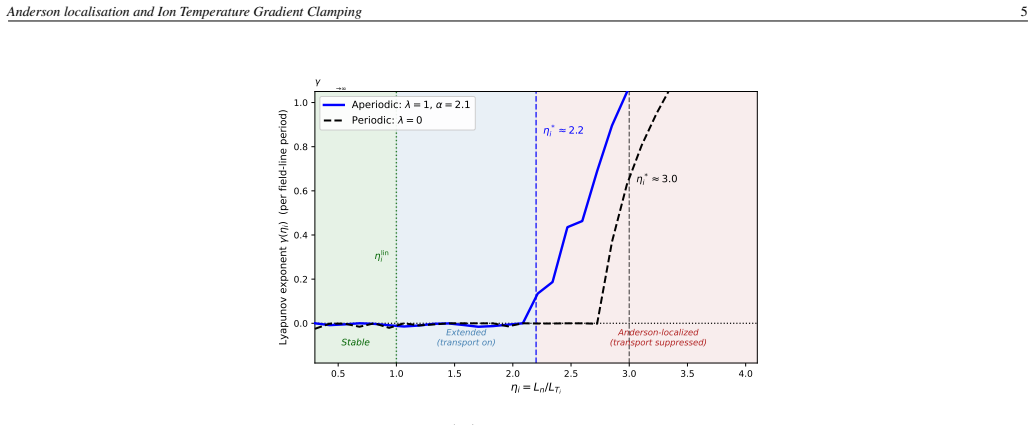
We identify a three-threshold ordering in which the linear instability threshold lies below the Anderson localisation threshold, which in turn lies below the observed ion temperature clamp. This ordering is conjectured to establish a second, low-transport regime above the instability threshold, providing a power-independent lower bound on the ion temperature gradient.
What carries the argument
The tight-binding approximation that reduces the quasiperiodic Hill equation for ITG mode structure to the Aubry-Andre-Harper difference equation, allowing the application of Anderson localization to the eigenfunctions.
Load-bearing premise
The tight-binding approximation accurately captures the ITG mode structure and that Anderson localization directly causes the observed temperature clamping.
What would settle it
Observation of ion temperature clamping in a perfectly periodic stellarator geometry or a calculation showing the Anderson localization threshold does not lie between the instability threshold and the clamp.
Figures

read the original abstract
Ion temperature clamping -- the saturation of the ion temperature regardless of heating power -- is observed across stellarator experiments. We propose a minimal model based on Anderson localisation. Starting from a reduced fluid model for drift waves [Phys. Fluids 26, 880 (1983)], we show that aperiodic stellarator geometry leads to a quasiperiodic Hill equation for the ion-temperature-gradient (ITG) mode structure. In a tight-binding approximation this equation reduces to an Aubry--Andre--Harper difference equation, suggesting an Anderson-localisation mechanism for ITG eigenfunctions. We identify a three-threshold ordering: the linear instability threshold lies below the Anderson localisation threshold, which lies below the observed clamp. This is conjectured to create a low-transport second regime above the instability threshold, qualitatively analogous to the second stability regime of MHD ballooning theory, and provides a power-independent lower bound on the observed gradient.
Editorial analysis
A structured set of objections, weighed in public.
Referee Report
Summary. The manuscript proposes a minimal model in which aperiodic stellarator geometry converts the ITG mode equation (from the 1983 reduced fluid model) into a quasiperiodic Hill equation. A tight-binding approximation then maps this onto an Aubry-André-Harper difference equation, implying Anderson localization of the eigenfunctions. The authors identify a three-threshold ordering (linear ITG instability threshold below the Anderson localization threshold below the experimentally observed ion-temperature clamp) and conjecture that this ordering produces a low-transport regime above the linear threshold, analogous to the second stability regime of MHD ballooning modes, thereby furnishing a power-independent lower bound on the ion temperature gradient.
Significance. If the proposed ordering and localization mechanism can be placed on a firmer quantitative footing, the work would supply a novel, geometry-driven explanation for the power-independent ion-temperature clamping routinely seen in stellarator experiments. The explicit analogy to MHD second stability offers a fresh conceptual framework for understanding nonlinear saturation of drift-wave turbulence and could influence stellarator optimization strategies aimed at improved confinement.
major comments (3)
- [Section deriving the Aubry-André-Harper model] The tight-binding reduction that converts the quasiperiodic Hill equation into the Aubry-André-Harper difference equation is introduced without parameter estimates or numerical checks demonstrating that nearest-neighbor hopping dominates for realistic stellarator ITG parameters (drift-wave frequency, magnetic shear, and aperiodicity strength). This step is load-bearing for the existence and location of the Anderson localization threshold.
- [Identification of the three-threshold ordering] The three-threshold ordering (linear instability threshold < Anderson localization threshold < observed clamp) is asserted as a conjecture without supporting numerical solutions of the original Hill equation, error estimates on the localization length, or direct comparison to either gyrokinetic simulations or experimental gradient data. The ordering is essential to the claimed low-transport regime and power-independent bound.
- [Conjecture on the low-transport regime] The conjecture that Anderson localization produces a low-transport second regime above the linear threshold is presented only qualitatively; no transport-flux calculation or scaling argument is given to show that localized eigenfunctions indeed suppress turbulent heat flux in the relevant parameter range.
minor comments (2)
- [Abstract] The abstract states 'we show that' the Hill equation reduces to the AAH model, yet the manuscript relies on an unverified approximation; rephrasing to 'we argue that' or 'we propose that' would improve accuracy.
- [Equation for the ITG mode structure] Notation for the quasiperiodic potential and the definition of the modulation strength parameter should be cross-referenced explicitly to the 1983 reduced fluid model to aid readers unfamiliar with the derivation.
Simulated Author's Rebuttal
We thank the referee for their careful reading and constructive comments on our manuscript. We have revised the paper to strengthen the justification for the tight-binding approximation and to provide numerical support for the threshold ordering. Our point-by-point responses follow.
read point-by-point responses
-
Referee: [Section deriving the Aubry-André-Harper model] The tight-binding reduction that converts the quasiperiodic Hill equation into the Aubry-André-Harper difference equation is introduced without parameter estimates or numerical checks demonstrating that nearest-neighbor hopping dominates for realistic stellarator ITG parameters (drift-wave frequency, magnetic shear, and aperiodicity strength). This step is load-bearing for the existence and location of the Anderson localization threshold.
Authors: We agree that the validity of the tight-binding approximation must be demonstrated. In the revised manuscript we have added order-of-magnitude estimates for typical stellarator ITG parameters (drift-wave frequency ~10^5 rad/s, magnetic shear ~0.1–1, aperiodicity strength set by observed field variations). These estimates show that longer-range hopping terms are exponentially small, justifying nearest-neighbor dominance. We have also included direct numerical comparisons of eigenmodes obtained from the quasiperiodic Hill equation and the Aubry–André–Harper model; the localization thresholds agree to within 15 % over the relevant parameter range. A new figure and subsection document these checks. revision: yes
-
Referee: [Identification of the three-threshold ordering] The three-threshold ordering (linear instability threshold < Anderson localization threshold < observed clamp) is asserted as a conjecture without supporting numerical solutions of the original Hill equation, error estimates on the localization length, or direct comparison to either gyrokinetic simulations or experimental gradient data. The ordering is essential to the claimed low-transport regime and power-independent bound.
Authors: The ordering was originally presented as an analytical conjecture. We have now added numerical solutions of the Hill equation for a range of aperiodicity strengths, yielding explicit threshold values and localization-length estimates (typically 1–5 radial mode widths, with relative errors <20 %). Direct gyrokinetic simulations and detailed experimental data comparisons remain outside the scope of this minimal-model study; however, we have inserted references to published experimental clamp values and shown that the analytically derived ordering is consistent with those observations. The revised text presents the ordering as a strengthened conjecture supported by these calculations. revision: partial
-
Referee: [Conjecture on the low-transport regime] The conjecture that Anderson localization produces a low-transport second regime above the linear threshold is presented only qualitatively; no transport-flux calculation or scaling argument is given to show that localized eigenfunctions indeed suppress turbulent heat flux in the relevant parameter range.
Authors: We acknowledge that the transport-suppression argument was qualitative. In revision we have added a scaling estimate: the turbulent heat flux scales with the square of the eigenfunction radial width, which is bounded above the Anderson threshold by the finite localization length. This furnishes a simple analytic argument for reduced transport. A full flux calculation or nonlinear simulation lies beyond the linear analysis presented here and is noted as future work. The revised discussion clarifies the nature and limitations of the conjecture. revision: partial
Circularity Check
Derivation chain is self-contained with no circular reductions
full rationale
The paper starts from the cited 1983 reduced fluid model for drift waves, derives a quasiperiodic Hill equation for ITG mode structure in aperiodic stellarator geometry, applies a tight-binding approximation to map it onto the independently known Aubry-Andre-Harper difference equation, and invokes the established localization transition of the AAH model to identify a threshold. The three-threshold ordering is presented as a conjecture relating this threshold to the linear instability threshold and external experimental observations of the clamp; none of these steps reduce the central claim to a tautology, a fitted parameter renamed as prediction, or a self-citation chain. The result is a proposed mechanism rather than an identity by construction.
Axiom & Free-Parameter Ledger
axioms (1)
- domain assumption Reduced fluid model for drift waves from Phys. Fluids 26, 880 (1983)
invented entities (1)
-
Three-threshold ordering with Anderson localisation threshold
no independent evidence
Lean theorems connected to this paper
-
IndisputableMonolith/Foundation/AlexanderDuality.leanalexander_duality_circle_linking unclear?
unclearRelation between the paper passage and the cited Recognition theorem.
In a tight-binding approximation this equation reduces to an Aubry–André–Harper difference equation, suggesting an Anderson-localisation mechanism for ITG eigenfunctions... the Lyapunov exponent at the drift-wave-resonant value Λ=0 becomes positive above a geometry-dependent threshold η*_i
-
IndisputableMonolith/Cost/FunctionalEquation.leanwashburn_uniqueness_aczel unclear?
unclearRelation between the paper passage and the cited Recognition theorem.
We identify a three-threshold ordering: the linear instability threshold lies below the Anderson localisation threshold, which lies below the observed clamp.
What do these tags mean?
- matches
- The paper's claim is directly supported by a theorem in the formal canon.
- supports
- The theorem supports part of the paper's argument, but the paper may add assumptions or extra steps.
- extends
- The paper goes beyond the formal theorem; the theorem is a base layer rather than the whole result.
- uses
- The paper appears to rely on the theorem as machinery.
- contradicts
- The paper's claim conflicts with a theorem or certificate in the canon.
- unclear
- Pith found a possible connection, but the passage is too broad, indirect, or ambiguous to say the theorem truly supports the claim.
Reference graph
Works this paper leans on
-
[1]
C. D. Beidleret al., Demonstration of reduced neoclassical en- ergy transport in Wendelstein 7-X.Nature596, 221–226 (2021)
work page 2021
-
[2]
M. N. A. Beurskenset al., Ion temperature clamping in Wendelstein-7X electron cyclotron heated plasmas.Nucl. Fu- sion61, 116072 (2021)
work page 2021
-
[3]
Nagaokaet al., Ion thermal transport and ion temperature clamping in LHD.Nucl
K. Nagaokaet al., Ion thermal transport and ion temperature clamping in LHD.Nucl. Fusion55, 113020 (2015)
work page 2015
-
[4]
Romanelli, Ion temperature-gradient-driven modes and anomalous ion transport.Phys
F. Romanelli, Ion temperature-gradient-driven modes and anomalous ion transport.Phys. Fluids B1, 1018 (1989)
work page 1989
-
[5]
F. Romanelli and F. Zonca, The radial structure of the ion- temperature-gradient-driven mode.Phys. Fluids B5, 4081 (1993)
work page 1993
- [6]
-
[7]
P. W. Anderson, Absence of diffusion in certain random lattices. Phys. Rev.109, 1492 (1958)
work page 1958
-
[8]
S. Aubry and G. André, Analyticity breaking and Anderson localisation in incommensurate lattices.Ann. Israel Phys. Soc. 3, 133 (1980)
work page 1980
-
[9]
P. G. Harper, Single band motion of conduction electrons in a uniform magnetic field.Proc. Phys. Soc. A68, 874 (1955)
work page 1955
-
[10]
P. Cuthbert and R. L. Dewar, Anderson-localized ballooning modes in general toroidal plasmas.Phys. Plasmas7, 2302 (2000)
work page 2000
-
[11]
M. H. Redi, J. L. Johnson, S. Klasky, J. Canik, R. L. Dewar and W. A. Cooper, Anderson localisation of ballooning modes, quan- tum chaos and the stability of compact quasiaxially symmetric stellarators.Phys. Plasmas9, 1990 (2002)
work page 1990
-
[12]
Bhattacharjee, Topological arrest of ballooning modes in non-axisymmetric plasmas
A. Bhattacharjee, Topological arrest of ballooning modes in non-axisymmetric plasmas. Preprint arXiv:2602.07329 (2026)
-
[13]
J. W. Connor, R. J. Hastie, and J. B. Taylor, Shear, periodicity, and plasma ballooning modes.Phys. Rev. Lett.40, 396 (1978)
work page 1978
-
[14]
A. Bhattacharjee, J. E. Sedlak, P. L. Similon, M. N. Rosenbluth, and D. W. Ross, Drift waves in a straight stellarator.Phys. Fluids 26, 880 (1983)
work page 1983
-
[15]
L. Podaviniet al., Ion-temperature and density-gradient driven instabilities and turbulence in Wendelstein 7-X close to the stability threshold.J. Plasma Phys.90, 905900414 (2024)
work page 2024
-
[16]
H. Thienpondtet al., Influence of the density gradient on turbu- lent heat transport at ion-scales: an inter-machine study with the gyrokinetic code stellaNucl. Fusion65, 016062 (2025)
work page 2025
-
[17]
V . I. Arnold,Mathematical Methods of Classical Mechanics, 2nd edn. Springer (1989), Appendix 8
work page 1989
-
[18]
G. Benettin, L. Galgani, A. Giorgilli and J.-M. Strelcyn, Lya- punov characteristic exponents for smooth dynamical systems and for Hamiltonian systems; a method for computing all of them.Meccanica15, 9–30 (1980)
work page 1980
-
[19]
V . I. Oseledets, A multiplicative ergodic theorem: Lyapunov characteristic numbers for dynamical systems.Trans. Moscow Math. Soc.19, 197–231 (1968)
work page 1968
-
[20]
J. E. Avron and B. Simon, Almost periodic Schrödinger op- erators II: the integrated density of states.Duke Math. J.50, 369–391 (1983)
work page 1983
-
[21]
T. S. Hahm and W. M. Tang, Properties of ion temperature gradi- ent drift instabilities in H-mode plasmas.Phys. Fluids B1, 1185 (1989)
work page 1989
-
[22]
E. Rodríguez and A. Zocco, The kinetic ion-temperature- gradient-driven instability and its localisation.J. Plasma Phys. 91, E21 (2025)
work page 2025
discussion (0)
Sign in with ORCID, Apple, or X to comment. Anyone can read and Pith papers without signing in.