Nucleation of Sachdev-Ye-Kitaev Clusters in One Spatial Dimension
Pith reviewed 2026-05-10 17:04 UTC · model grok-4.3
The pith
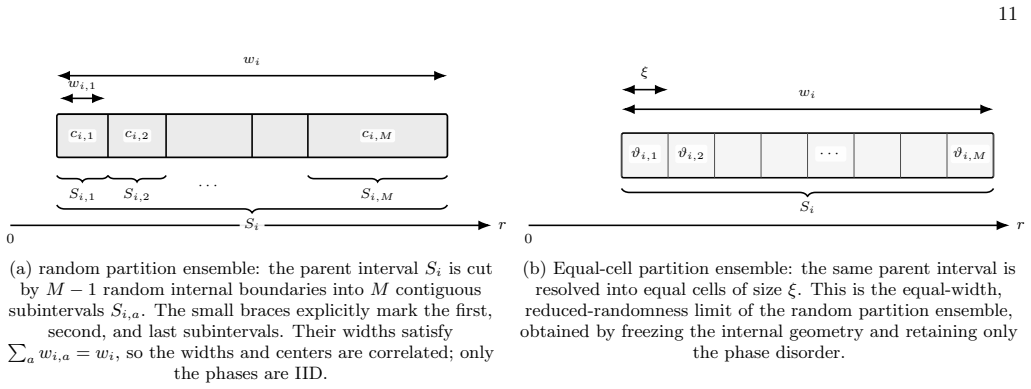
Subdividing each localization volume into M microscopic pieces with independent random phases converts projected interactions into a sparse network of SYK clusters whose boundaries follow real-space orbital overlaps.
A machine-rendered reading of the paper's core claim, the machinery that carries it, and where it could break.
Core claim
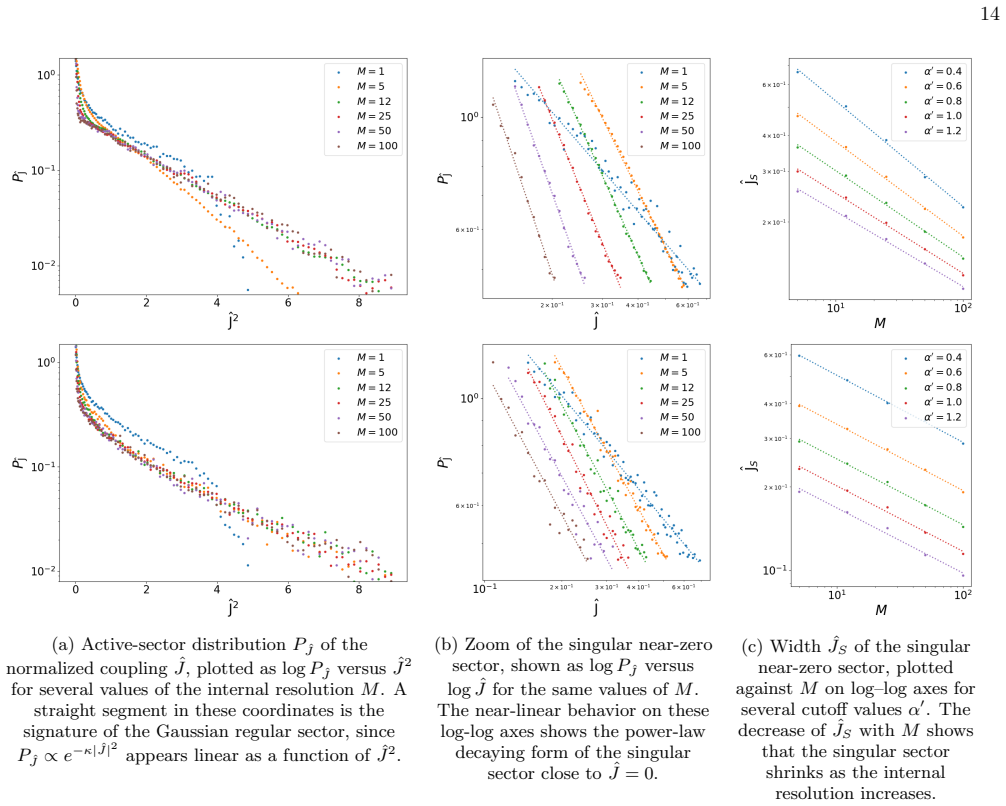
When a local interaction is projected onto coarse-grained localized orbitals in one dimension, the resulting four-fermion couplings have a finite probability of vanishing and a non-Gaussian distribution for the nonzero entries, together with geometric correlations. Subdividing each localization volume into M microscopic segments equipped with independent random phases causes the distribution of nonzero couplings to converge to the complex-Gaussian SYK form as M increases. In the large-M limit the network is sparse yet asymptotically canonical: strong SYK couplings form connected clusters whose boundaries are set by the real-space overlap of the underlying orbitals. The interaction tensor can
What carries the argument
The subdivision of each localization volume into M microscopic pieces equipped with independent random phases; this operation erases geometric correlations and non-Gaussianity in the projected four-fermion tensor while leaving the sparsity pattern fixed by orbital overlaps.
If this is right
- As M increases the nonzero couplings become statistically closer to the complex-Gaussian SYK distribution.
- The pattern of missing or very weak couplings stays determined by the real-space overlap of the localized orbitals.
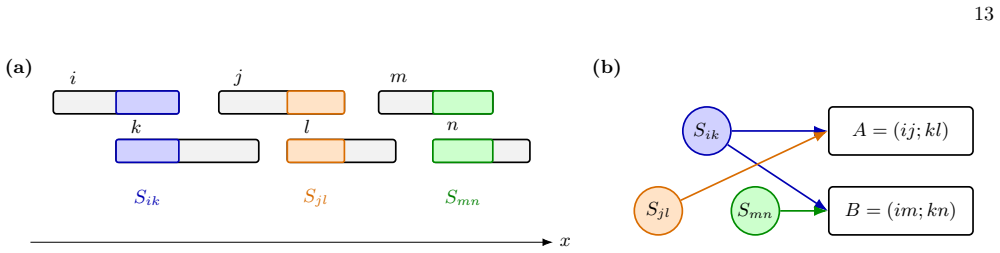
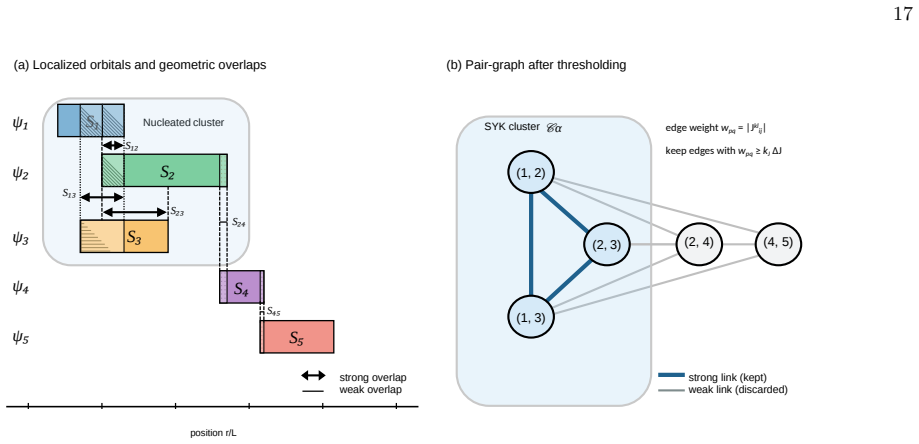
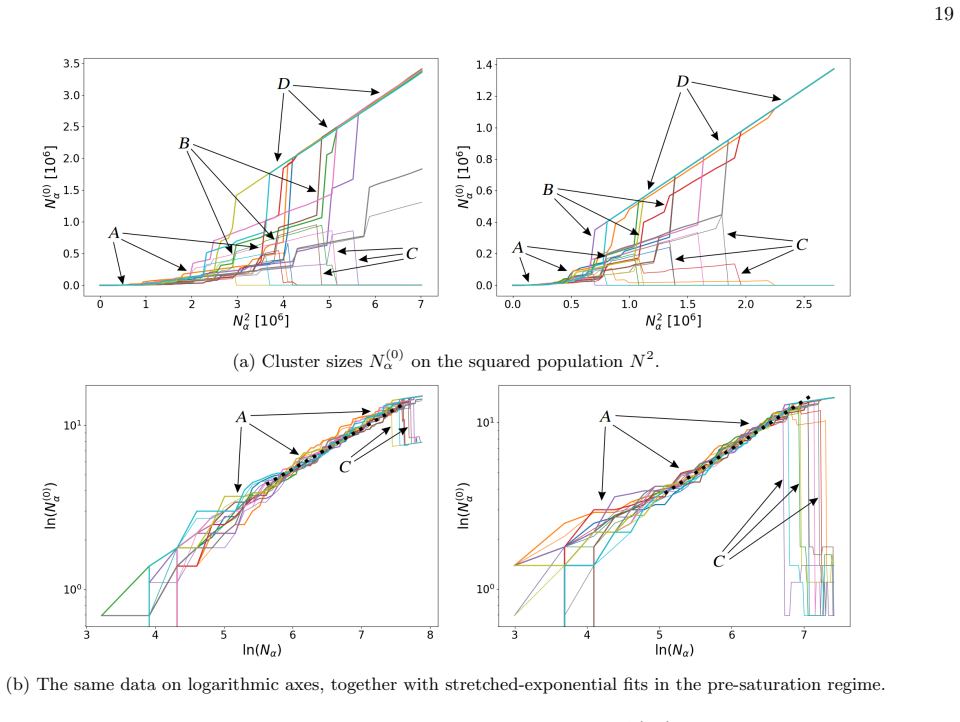
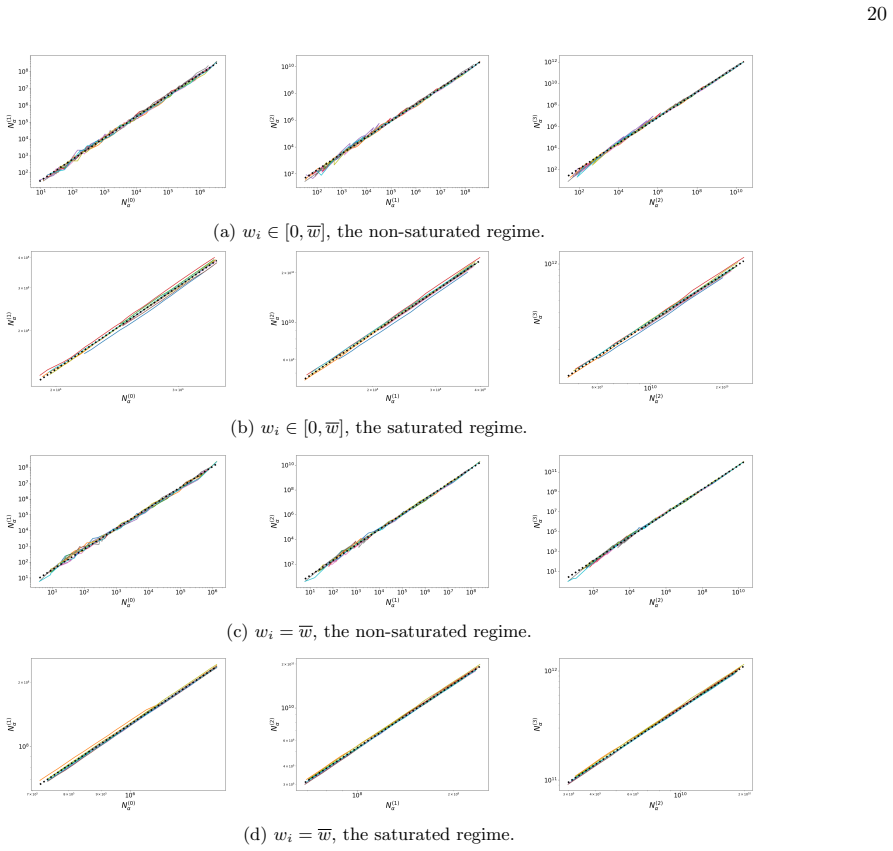
- SYK clusters can be identified and followed by mapping the interaction tensor to a graph in pair space and measuring connected components together with clique and simplex counts.
- The construction supplies a minimal phenomenological theory that predicts clear experimental signatures for the nucleation and growth of SYK clusters in one dimension.
Where Pith is reading between the lines
- The same subdivision procedure might be applied in higher dimensions to produce SYK clusters whose connectivity reflects higher-dimensional orbital overlaps.
- Experimental systems could test the predicted cluster growth by tuning microscopic resolution or disorder strength and measuring many-body spectral statistics inside putative clusters.
- The graph representation raises the possibility that a percolation transition in M or in overlap strength controls the onset of fully connected SYK behavior.
- Similar mechanisms of emergent randomness from projected interactions could be examined in other models that combine localization with random-phase averaging.
Load-bearing premise
That subdividing each localization volume into M smaller pieces with independent random phases is sufficient to produce the SYK distribution and cluster structure without additional lattice-scale effects or non-random phase correlations dominating the projection.
What would settle it
Numerical histograms of the nonzero coupling magnitudes computed for increasing M on a one-dimensional chain of localized orbitals; the histograms should approach a Gaussian shape while the locations of near-zero couplings remain fixed by the orbital-overlap pattern.
Figures
read the original abstract
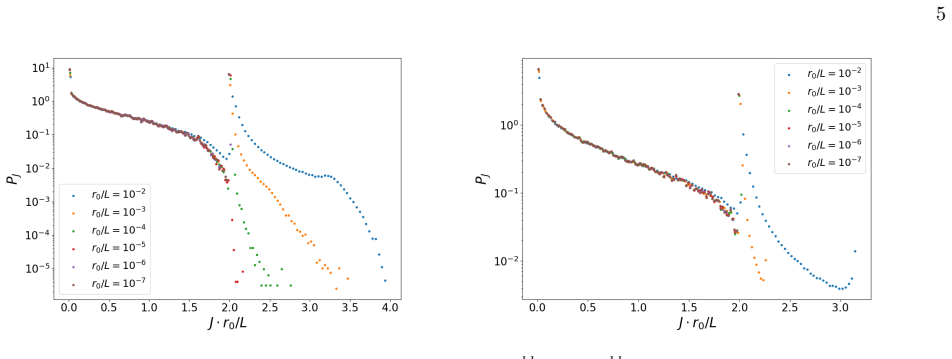
We study how Sachdev-Ye-Kitaev (SYK) interactions can arise from localized single-particle states on a system that is effectively one dimensional. If a local interaction is projected onto coarse localized orbitals, the resulting couplings do not immediately follow the standard SYK distribution. Instead, they have a finite probability of being exactly zero, a broad non-Gaussian distribution for the nonzero values, and strong correlations coming from the geometry of the localized states. We then show that this changes when each localization volume is resolved into $M>1$ smaller microscopic pieces with random phases. As $M$ increases, the distribution of the nonzero couplings moves toward the complex-Gaussian SYK form. At the same time, the large-$M$ limit is a sparse but asymptotically canonical SYK network: the nonzero couplings create SYK clusters, while the pattern of missing or very weak couplings is still determined by the real-space overlap of the localized orbitals. Finally, we map the interaction tensor to a graph in pair space. This makes it possible to follow the formation, merger, and growth of SYK clusters, which we characterize using connected components and clique/simplex counts. The result is a minimal real-space phenomenological theory of SYK-cluster formation, providing clear experimental criteria.
Editorial analysis
A structured set of objections, weighed in public.
Referee Report
Summary. The paper studies the emergence of SYK-like interactions from projecting a local interaction onto localized single-particle orbitals in an effectively one-dimensional system. Direct projection produces couplings with a finite probability of exact zeros, a broad non-Gaussian distribution for the nonzero entries, and geometric correlations inherited from orbital overlaps. The central construction resolves each localization volume into M microscopic pieces carrying independent random phases; as M increases, the distribution of nonzero couplings approaches the complex-Gaussian SYK form. In the large-M limit the network remains sparse, with nonzero couplings forming SYK clusters whose connectivity is still set by real-space orbital overlaps. The interaction tensor is mapped to a graph in pair space, enabling quantitative tracking of cluster nucleation, merger, and growth via connected-component analysis and clique/simplex counting. The result is presented as a minimal real-space phenomenological theory with experimental implications.
Significance. If the central construction is robust, the work supplies a concrete, tunable mechanism by which SYK clusters can nucleate from localized orbitals in one dimension without requiring fine-tuned all-to-all couplings. The graph-theoretic characterization of clusters (connected components together with clique and simplex statistics) is a clear methodological strength that converts an abstract interaction tensor into falsifiable, spatially resolved predictions. The approach also yields explicit experimental criteria (e.g., dependence on localization length and microscopic phase disorder), which is valuable for potential solid-state or cold-atom realizations. These elements elevate the manuscript beyond a purely formal exercise.
major comments (2)
- [§3] §3 (projection step) and the large-M analysis: the claim that independent random phases on M subdivisions suffice to erase all non-Gaussian cumulants and 1D geometric correlations must be supported by an explicit calculation (or high-precision numerical histogram) of at least the fourth cumulant of the nonzero couplings as a function of M. Without this, residual pairwise phase correlations arising from the spatially decaying orbital overlaps could survive the M→∞ limit and prevent the network from becoming asymptotically canonical SYK.
- [§4–5] §4–5 (cluster statistics): the reported connected-component and clique counts are sensitive to the numerical threshold used to declare a coupling “nonzero.” The manuscript should demonstrate that the scaling of cluster size and simplex density with M is stable under reasonable variations of this threshold (e.g., 10^{-3} versus 10^{-4} times the typical coupling magnitude) and should report the fraction of couplings that fall below the threshold as M increases.
minor comments (2)
- [Abstract] The abstract states that the nonzero couplings “move toward the complex-Gaussian SYK form” but does not specify which moments or cumulants are being compared; a single sentence quantifying the convergence (e.g., “the kurtosis approaches 3 within 5 % for M=32”) would improve clarity.
- [§5] Notation for the interaction tensor J_{ijkl} versus the pair-space graph edges should be introduced once and used consistently; occasional switches between “coupling” and “edge weight” obscure the mapping in §5.
Simulated Author's Rebuttal
We thank the referee for the careful reading of our manuscript and for the constructive comments, which highlight important points for strengthening the presentation. We address each major comment below and will revise the manuscript accordingly.
read point-by-point responses
-
Referee: [§3] §3 (projection step) and the large-M analysis: the claim that independent random phases on M subdivisions suffice to erase all non-Gaussian cumulants and 1D geometric correlations must be supported by an explicit calculation (or high-precision numerical histogram) of at least the fourth cumulant of the nonzero couplings as a function of M. Without this, residual pairwise phase correlations arising from the spatially decaying orbital overlaps could survive the M→∞ limit and prevent the network from becoming asymptotically canonical SYK.
Authors: We agree that an explicit verification of the fourth cumulant is required to rigorously confirm the suppression of non-Gaussianity and geometric correlations. The original manuscript relied on central-limit arguments for the phase averaging together with numerical sampling of the coupling distribution. In the revision we will add a dedicated panel (or supplementary figure) displaying the normalized fourth cumulant of the nonzero couplings versus M, together with high-precision histograms for representative M values. These additional calculations, which we have now performed, show that the cumulant decays at least as fast as 1/M, consistent with the asymptotic SYK limit and the erasure of residual 1D correlations. revision: yes
-
Referee: [§4–5] §4–5 (cluster statistics): the reported connected-component and clique counts are sensitive to the numerical threshold used to declare a coupling “nonzero.” The manuscript should demonstrate that the scaling of cluster size and simplex density with M is stable under reasonable variations of this threshold (e.g., 10^{-3} versus 10^{-4} times the typical coupling magnitude) and should report the fraction of couplings that fall below the threshold as M increases.
Authors: We acknowledge that quantitative cluster statistics can depend on the precise cutoff used to identify nonzero couplings. In the revised manuscript we will include a robustness analysis (new figure or subsection) that recomputes the connected-component sizes and simplex densities for thresholds 10^{-3} and 10^{-4} times the rms coupling magnitude. We will also report the fraction of couplings falling below each threshold as a function of M; this fraction decreases with increasing M as the distribution concentrates. The scaling trends remain stable across the tested thresholds, confirming that our conclusions on cluster nucleation and growth are not artifacts of the cutoff choice. revision: yes
Circularity Check
No significant circularity; SYK statistics emerge from explicit random-phase projection construction
full rationale
The derivation begins from a concrete physical setup: projecting a local interaction onto localized single-particle orbitals in 1D, then subdividing each localization volume into M microscopic pieces carrying independent random phases. The approach of the nonzero couplings to the complex-Gaussian SYK distribution is shown by direct computation of moments or histograms in the large-M limit, while sparsity is inherited from the real-space orbital overlaps. This is a bottom-up model with stated assumptions (random phases, projection) that are independent of the target SYK form; the result is not presupposed by definition, fitted to data, or justified solely by self-citation. The subsequent graph mapping in pair space is a representational tool for tracking clusters and does not alter the input-output relation. No load-bearing step reduces to its own inputs by construction.
Axiom & Free-Parameter Ledger
free parameters (1)
- M
axioms (2)
- domain assumption Local interactions can be projected onto coarse localized orbitals in an effectively one-dimensional system.
- ad hoc to paper Each localization volume can be resolved into M smaller microscopic pieces carrying independent random phases.
Reference graph
Works this paper leans on
-
[1]
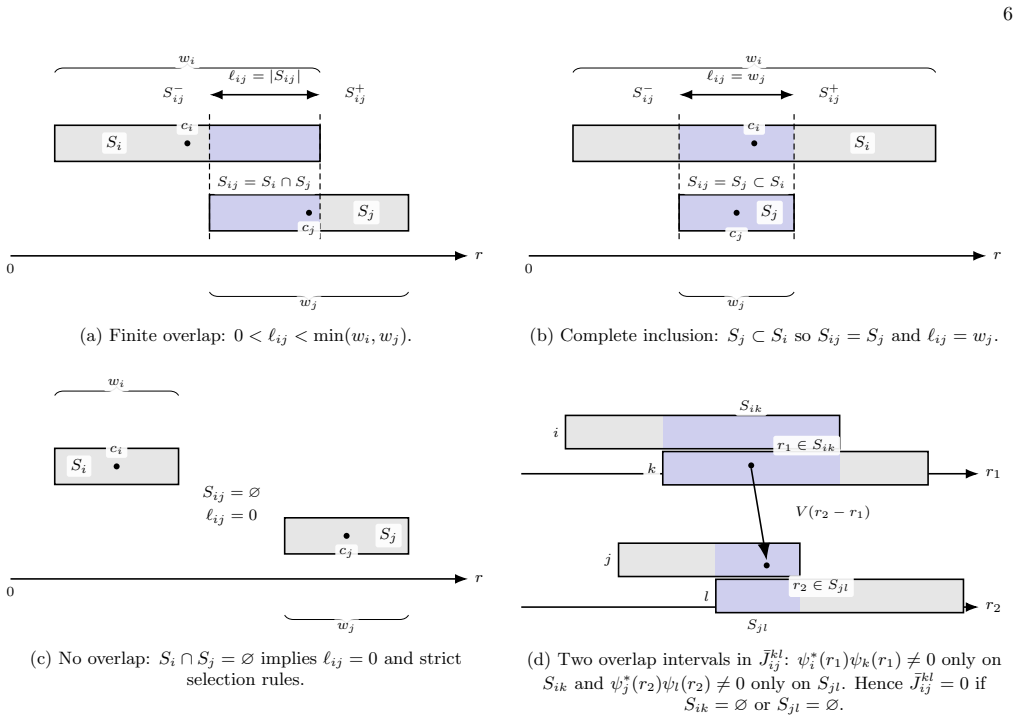
Constant-width benchmark (w i = wL). For two independent centersc 1, c2 uniform on [0, L], the absolute separationd≡ |c 1 −c 2|has the triangular densityp d(d) = 2(L−d)/L 2 on 0≤d≤L. For given widthsw 1 andw 2 the overlap length is given by ℓ= 0 , Σw <2d Σw/2−d, ∆w <2d <Σw w< , 2d <∆w (21) with the notations Σw≡w 1 +w 2, ∆w≡ |w 1 −w 2|, w< = min(w1,...
-
[2]
Variable-width ensemble. For the variable-width ensemble with IID widthsw i ∼ Unif[0, wL], the overlap-length distribution can be ob- tained by averaging the conditional law Eq.(22) over w1, w2. Below, we instead give a direct geometric deriva- tion that separates partial-overlap and full-inclusion con- figurations and yields the closed forms. In the vari...
-
[3]
=w− 7 24 w2 ≃wfor the variable-width ensemble. This yields a parametrically larger density of nonzero (and hence potentially strong) matrix elements in the constant-width case and therefore a faster approach to percolation. While Fig.7 diagnoses which pair channels become con- nected by strong couplings, Fig.8 probes how densely they are connected inside ...
-
[4]
Subir Sachdev and Jinwu Ye,Gapless spin-fluid ground state in a random quantum Heisenberg magnet, Phys. Rev. Lett. 70, 3339 (1993)
work page 1993
-
[5]
Kitaev,A simple model of quantum holography, KITP seminar, part 1 (2015); part 2 (2015)
A. Kitaev,A simple model of quantum holography, KITP seminar, part 1 (2015); part 2 (2015)
work page 2015
-
[6]
Sachdev,Bekenstein-Hawking entropy and strange metals, Phys
S. Sachdev,Bekenstein-Hawking entropy and strange metals, Phys. Rev. X 5, 041025 (2015)
work page 2015
-
[7]
Juan Maldacena and Douglas Stanford,Remarks on the Sachdev-Ye-Kitaev model, Phys. Rev. D 94, 106002 (2016)
work page 2016
-
[8]
J. Maldacena, D. Stanford, and Z. Yang,Conformal sym- metry and its breaking in two-dimensional nearly Anti- de Sitter space, Prog. Theor. Exp. Phys. 2016, 12C104 (2016)
work page 2016
-
[9]
A. Kitaev and S. J. Suh,The soft mode in the Sachdev- Ye-Kitaev model and its gravity dual, JHEP 05, 183 (2018)
work page 2018
-
[10]
Y. Gu, A. Kitaev, S. Sachdev, and G. Tarnopolsky,Notes on the complex Sachdev-Ye-Kitaev model, JHEP 02, 157 (2020)
work page 2020
-
[11]
D. Chowdhury, A. Georges, O. Parcollet, and S. Sachdev, Sachdev-Ye-Kitaev models and beyond: Window into non-Fermi liquids, Rev. Mod. Phys. 94, 035004 (2022)
work page 2022
-
[12]
Garc´ ıa-Garc´ ıa and Jacobus J
Antonio M. Garc´ ıa-Garc´ ıa and Jacobus J. M. Ver- baarschot,Spectral and thermodynamic properties of the Sachdev-Ye-Kitaev model, Phys. Rev. D 94, 126010 (2016)
work page 2016
-
[13]
Garc´ ıa-Garc´ ıa and Jacobus J
Antonio M. Garc´ ıa-Garc´ ıa and Jacobus J. M. Ver- baarschot,Analytical spectral density of the Sachdev-Ye- Kitaev model at finiteN, Phys. Rev. D 96, 066012 (2017)
work page 2017
-
[14]
Garc´ ıa-Garc´ ıa, Yiyang Jia, and Jacobus J
Antonio M. Garc´ ıa-Garc´ ıa, Yiyang Jia, and Jacobus J. M. Verbaarschot,Universality and Thouless energy in the supersymmetric Sachdev-Ye-Kitaev model, Phys. Rev. D 97, 106003 (2018)
work page 2018
-
[15]
Garc´ ıa-Garc´ ıa, Yiyang Jia, Dario Rosa, and Jacobus J
Antonio M. Garc´ ıa-Garc´ ıa, Yiyang Jia, Dario Rosa, and Jacobus J. M. Verbaarschot,Sparse Sachdev-Ye-Kitaev model, quantum chaos, and gravity duals, Phys. Rev. D 103, 106002 (2021)
work page 2021
-
[16]
Dmitry Bagrets, Alexander Altland, and Alex Kamenev, Power-law out-of-time-order correlation functions in the SYK model, Nucl. Phys. B 921, 727 (2017)
work page 2017
-
[17]
Alexander Altland and Dmitry Bagrets,Quantum ergod- icity in the SYK model, Nucl. Phys. B 930, 45 (2018)
work page 2018
-
[18]
Alexander Altland, Dmitry Bagrets, and Alex Kamenev, Sachdev-Ye-Kitaev non-Fermi-liquid correlations in nanoscopic quantum transport, Phys. Rev. Lett. 123, 226801 (2019)
work page 2019
-
[19]
Alexander Altland, Dmitry Bagrets, and Alex Kamenev, Quantum criticality of granular Sachdev-Ye-Kitaev mat- ter, Phys. Rev. Lett. 123, 106601 (2019)
work page 2019
-
[20]
Tigran A. Sedrakyan and Konstantin B. Efetov,Super- bosonization in disorder and chaos: Role of anomalies, Phys. Rev. B 96, 054208 (2017)
work page 2017
-
[21]
Tigran A. Sedrakyan and Konstantin B. Efetov,Super- symmetry method for interacting chaotic and disordered systems: The Sachdev-Ye-Kitaev model, Phys. Rev. B 102, 075146 (2020)
work page 2020
- [22]
-
[23]
J. C. Flores, Transport in models with correlated diago- nal and off-diagonal disorder, J. Phys.: Condens. Matter 1, 8471 (1989)
work page 1989
-
[24]
D. H. Dunlap, H.-L. Wu, and P. W. Phillips, Absence of localization in a random-dimer model, Phys. Rev. Lett. 65, 88 (1990)
work page 1990
-
[25]
P. Phillips and H.-L. Wu, Localization and its absence: A new metallic state for conducting polymers, Science 252, 1805 (1991)
work page 1991
- [26]
-
[27]
T. Sedrakyan, Localization-delocalization transition in a presence of correlated disorder: The random dimer model, Phys. Rev. B 69, 085109 (2004)
work page 2004
-
[28]
T. Sedrakyan and A. Ossipov, Localization- delocalization transition in the quasi-one-dimensional ladder chain with correlated disorder, Phys. Rev. B 70, 214206 (2004)
work page 2004
-
[29]
T. A. Sedrakyan, J. P. Kestner, and S. Das Sarma, Pro- posed signature of Anderson localization and correlation- induced delocalization in an N-leg optical lattice, Phys. Rev. A 84, 053621 (2011)
work page 2011
-
[30]
D. I. Pikulin and M. Franz,Black hole on a chip: Pro- posal for a physical realization of the Sachdev-Ye-Kitaev model in a solid-state system, Phys. Rev. X 7, 031006 (2017)
work page 2017
-
[31]
´Etienne Lantagne-Hurtubise, Chengshu Li, and Marcel Franz,Family of Sachdev-Ye-Kitaev models motivated by experimental considerations, Phys. Rev. B 97, 235124 (2018)
work page 2018
-
[32]
A. Chew, A. Essin, and J. Alicea,Approximating the Sachdev-Ye-Kitaev model with Majorana wires, Phys. Rev. B 96, 121119 (2017)
work page 2017
-
[33]
I. Danshita, M. Hanada, and M. Tezuka,Creating and probing the Sachdev-Ye-Kitaev model with ultracold gases: Towards experimental studies of quantum gravity, Prog. Theor. Exp. Phys. 2017, 083I01 (2017)
work page 2017
-
[34]
A. Chen, R. Ilan, F. de Juan, D. I. Pikulin, and M. Franz, Quantum holography in a graphene flake with an irregular boundary, Phys. Rev. Lett. 121, 036403 (2018). 23
work page 2018
-
[35]
O. Can, E. M. Nica, and M. Franz,Charge transport in graphene-based mesoscopic realizations of Sachdev-Ye- Kitaev models, Phys. Rev. B 99, 045419 (2019)
work page 2019
-
[36]
M. Brzezi´ nska, Y. Guan, O. V. Yazyev, S. Sachdev, and A. Kruchkov,Engineering SYK interactions in disordered graphene flakes under realistic experimental conditions, Phys. Rev. Lett. 131, 036503 (2023)
work page 2023
- [37]
- [38]
-
[39]
T. A. Sedrakyan and M. E. Raikh,Interaction effects in a two-dimensional electron gas in a random magnetic field: Implications for composite fermions and the quan- tum critical point, Phys. Rev. B 77, 115353 (2008)
work page 2008
-
[40]
Daniel Leykam, Alexei Andreanov, and Sergej Flach,Ar- tificial flat band systems: From lattice models to experi- ments, Adv. Phys.: X 3, 1473052 (2018)
work page 2018
-
[41]
Bal´ azs D´ ora, Janik Kailasvuori, and Roderich Moessner, Lattice generalization of the Dirac equation to general spin and the role of the flat band, Phys. Rev. B 84, 195422 (2011)
work page 2011
-
[42]
Thomas Bilitewski and Roderich Moessner,Disordered flat bands on the kagome lattice, Phys. Rev. B 98, 235109 (2018)
work page 2018
-
[43]
Mykola Maksymenko, Roderich Moessner, and Kirill Sht- engel,Persistence of the flat band in a kagome magnet with dipolar interactions, Phys. Rev. B 96, 134411 (2017)
work page 2017
-
[44]
Saurabh Maiti and Tigran Sedrakyan,Fermionization of bosons in a flat band, Phys. Rev. B 99, 174418 (2019)
work page 2019
-
[45]
Jun-Hyung Bae, Tigran Sedrakyan, and Saurabh Maiti, Isolated flat bands in 2D lattices based on a novel path- exchange symmetry, SciPost Phys. 15, 139 (2023)
work page 2023
-
[46]
Sanghoon Lee, Alexei Andreanov, Tigran Sedrakyan, and Sergej Flach,Trapping hard-core bosons in flat-band lat- tices, Phys. Rev. B 109, 245137 (2024)
work page 2024
-
[47]
Brian Swingle and Mike Winer,Bosonic model of quan- tum holography, Phys. Rev. B 109, 094206 (2024)
work page 2024
-
[48]
Ilya Esterlis and J¨ org Schmalian,Cooper pairing of in- coherent electrons: An electron-phonon version of the Sachdev-Ye-Kitaev model, Phys. Rev. B 100, 115132 (2019)
work page 2019
-
[49]
Davide Valentinis, Gian Andrea Inkof, and J¨ org Schmalian,BCS to incoherent superconductivity crossovers in the Yukawa-SYK model on a lattice, Phys. Rev. B 108, L140501 (2023)
work page 2023
-
[50]
N. Cichutek, A. R¨ uckriegel, M. O. Hansen, and P. Kopietz,Non-Fermi liquid fixed point of the dissipative Yukawa-Sachdev-Ye-Kitaev model, Phys. Rev. B 109, 155101 (2024)
work page 2024
-
[51]
Chenyuan Li, Davide Valentinis, Aavishkar A. Patel, Haoyu Guo, J¨ org Schmalian, Subir Sachdev, and Ilya Esterlis,Strange metal and superconductor in the two- dimensional Yukawa-Sachdev-Ye-Kitaev model, Phys. Rev. Lett. 133, 186502 (2024)
work page 2024
-
[52]
R. Jha, S. Kehrein, and J. C. Louw,Current correla- tions and conductivity in SYK-like systems: An analyti- cal study, Phys. Rev. B 111, 045111 (2025)
work page 2025
-
[53]
S. Chapman, S. Demulder, D. A. Galante, S. U. Sheorey, and O. Shoval,Krylov complexity and chaos in deformed SYK models, Phys. Rev. B 111, 035141 (2025)
work page 2025
- [54]
- [55]
-
[56]
A. Andreanov, M. Carrega, J. Murugan, J. Olle, D. Rosa, and R. Shir,From Dyson models to many-body quantum chaos, Phys. Rev. B 111, 035147 (2025)
work page 2025
-
[57]
A. M. Garc´ ıa-Garc´ ıa, L. S´ a, J. J. M. Verbaarschot, and C. Yin,Emergent topology in many-body dissipative quan- tum matter, Phys. Rev. B 111, 035157 (2025)
work page 2025
-
[58]
S. S. Jaramillo, R. Jha, and S. Kehrein,Thermalization of a closed Sachdev-Ye-Kitaev system in the thermodynamic limit, Phys. Rev. B 111, 195153 (2025)
work page 2025
-
[59]
S. Mohamadi and J. Abouie,Emergence of topologi- cal non-Fermi liquid phases in a modified Su-Schrieffer- Heeger chain with long-range interactions, Phys. Rev. B 111, 165129 (2025)
work page 2025
-
[60]
Masaki Tezuka, Onur Oktay, Enrico Rinaldi, Masanori Hanada, and Franco Nori,Binary-coupling sparse Sachdev-Ye-Kitaev model: An improved model of quan- tum chaos and holography, Phys. Rev. B 107, L081103 (2023)
work page 2023
-
[61]
Y. Gu, A. Lucas, and X.-L. Qi,Energy diffusion and the butterfly effect in inhomogeneous Sachdev-Ye-Kitaev chains, SciPost Phys. 2, 018 (2017)
work page 2017
-
[62]
X.-Y. Song, C.-M. Jian, and L. Balents,Strongly corre- lated metal built from Sachdev-Ye-Kitaev models, Phys. Rev. Lett. 119, 216601 (2017)
work page 2017
-
[63]
Andrei I. Pavlov and Mikhail N. Kiselev,Noise signa- tures of a charged Sachdev-Ye-Kitaev dot in mesoscopic transport, Phys. Rev. B 113, 125148 (2026)
work page 2026
-
[64]
All figures featuring numerical data in the paper are available at https://doi.org/10.6084/m9.figshare.32049474
discussion (0)
Sign in with ORCID, Apple, or X to comment. Anyone can read and Pith papers without signing in.