Recognition: unknown
GLIMPSED: Direct evidence for a fast AGN-driven outflow from a z=6.64 Little Red Dot host galaxy
Pith reviewed 2026-05-10 17:04 UTC · model grok-4.3
The pith
A z=6.64 little red dot galaxy hosts a fast ionized outflow reaching 5500 km/s, directly showing AGN activity in these systems.
A machine-rendered reading of the paper's core claim, the machinery that carries it, and where it could break.
Core claim
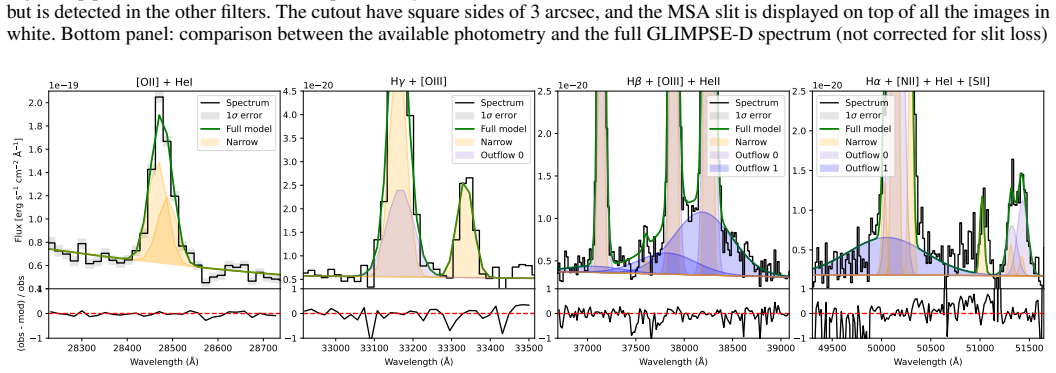
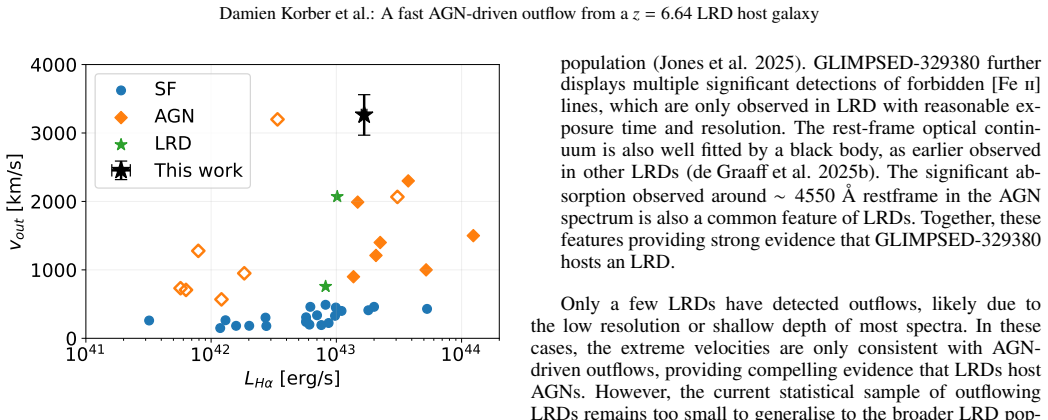
The authors identify GLIMPSED-329380 as a z=6.64 galaxy whose host shows an extreme ionized outflow traced by broad [O III] λ5008 and Hα lines with FWHM velocities of ~5500 km/s. The outflow gas is dusty while the narrow-line gas is not, and emission-line ratios yield an oxygen abundance of 12+log(O/H) ~7.95 together with log(N/O) ~-0.75. The separate AGN component matches the defining traits of little red dots, including the V-shape spectrum, exponential hydrogen-line profiles, [Fe II] lines, Balmer break, and a broad absorption near 4550 Å. The outflow's mass-loading factor is below 0.1 and its kinetic luminosity is ~10^43 erg/s, implying modest impact on star formation.
What carries the argument
The broad components of the [O III] λ5008 and Hα lines, which isolate the high-velocity outflowing gas from the narrow-line host emission.
If this is right
- AGN feedback operates in at least some little red dots at z~6.6 through fast ionized winds.
- The low mass-loading factor indicates these outflows leave star formation largely unaffected.
- Emission-line diagnostics can measure gas-phase abundances even in AGN-hosting little red dots.
- High-resolution grating spectra are required to detect outflows that low-resolution prism data miss.
- The dusty character of the outflowing gas distinguishes it from the unattenuated narrow-line gas.
Where Pith is reading between the lines
- Similar fast outflows may be common enough in little red dots to help explain their compact sizes and red colors.
- The detection raises the question of whether cumulative AGN winds at high redshift regulate the growth of the first galaxies.
- Future wide-field high-resolution surveys could measure the typical outflow incidence and total energy input from these objects.
- The nitrogen enrichment alongside low oxygen abundance may trace early chemical evolution patterns driven by the central AGN.
Load-bearing premise
The broad emission-line wings arise from an AGN-driven outflow instead of rotation, merging galaxies, or line-blending artifacts.
What would settle it
High-resolution spectra of additional little red dots that lack broad lines with velocities above a few hundred km/s or that show the broad components can be fit by non-AGN kinematics.
Figures




read the original abstract
We report the discovery of GLIMPSED-329380, a z=6.64 galaxy behind Abell S1063, which shows signs of an extreme ionised outflow driven by an active galactic nucleus (AGN). The deep JWST/NIRSpec medium grating observations show spatially resolved structures of a host galaxy containing the very fast outflow and an AGN, which we analyse separately. The outflow, mainly traced by broad [O III]{\lambda}5008 and H{\alpha} emissions in the host, reaches a full-width half-maximum velocity of ~5500km/s, velocities only observed in AGN-dominated systems. From the Balmer decrement, we observe that while the narrow emission lines show no dust attenuation, the outflowing gas is dusty. We use emission lines diagnostics to infer gas abundances within the host galaxy. The oxygen abundance is 12+log(O/H) ~ 7.95 (~18% solar) and the host is slightly nitrogen-enriched with log(N/O) ~ -0.75. Despite its extreme velocity, the mass loading factor (<0.1) and the kinematic energy of the outflow (~10^43 erg/s) suggest limited impact on star formation. The AGN component shows many similarities with little red dots (LRDs): a characteristic "V-shape", exponential profile in hydrogen lines, numerous detection of forbidden [Fe II] lines, a Balmer break, and a broad absorption feature at ~4550 {\AA}. This detection of a fast outflow in an LRD, rare in surveys dominated by low-resolution (e.g. PRISM) spectra, provides direct evidence of AGN activity in these systems.
Editorial analysis
A structured set of objections, weighed in public.
Referee Report
Summary. The manuscript reports the discovery of GLIMPSED-329380, a z=6.64 galaxy lensed by Abell S1063, featuring an AGN component with Little Red Dot (LRD) characteristics (V-shaped continuum, Balmer break, broad H lines, [Fe II] lines) and a spatially resolved host galaxy with a fast ionized outflow traced by broad [O III] λ5008 and Hα components reaching FWHM ~5500 km/s. Using deep JWST/NIRSpec medium-grating spectroscopy, the authors decompose AGN and host, measure a dusty outflow via Balmer decrement, derive host abundances (12+log(O/H) ~7.95, log(N/O) ~-0.75), and report a low mass-loading factor (<0.1) and outflow kinetic power (~10^43 erg/s), arguing this constitutes direct evidence for AGN-driven outflows in LRDs.
Significance. If the broad-line components are robustly shown to trace an AGN-driven outflow rather than alternative kinematics, the result would be significant for high-redshift galaxy evolution studies: it supplies one of the few medium-resolution, spatially resolved cases linking LRDs to AGN activity and outflows, contrasting with the low-resolution PRISM-dominated samples. The direct use of standard line diagnostics, Balmer decrement for dust, and abundance estimates from observed fluxes (without heavy modeling) is a strength, as is the finding of limited feedback impact despite extreme velocities. This could help constrain whether LRDs are AGN-dominated or composite systems.
major comments (2)
- [Emission-line analysis and outflow characterization (abstract and §3–4)] The central claim that the ~5500 km/s FWHM broad [O III] λ5008 and Hα components (after AGN/host decomposition) represent an AGN-driven outflow in the host galaxy is load-bearing for the 'direct evidence' conclusion, yet the manuscript provides insufficient quantitative details on the decomposition: the number of Gaussian components fitted, the spatial extent and mapping of broad versus narrow emission, and explicit model comparisons (e.g., χ² or BIC) rejecting beam-smearing of a rotating disk or multiple unresolved narrow components within the PSF. Without these, alternative kinematic interpretations remain viable and undermine the outflow attribution.
- [AGN component extraction and LRD comparison (abstract and §5)] The LRD classification of the AGN component (V-shape, Balmer break, broad absorption at ~4550 Å) depends on clean separation from the outflowing gas; the paper should demonstrate that the extracted AGN spectrum is robust to variations in the broad-component subtraction, as contamination could affect the continuum shape and line diagnostics used to link this source to the LRD population.
minor comments (2)
- [Abstract] The abstract states key results (FWHM, abundances, mass-loading factor) without uncertainties or fitting details; these should be added or cross-referenced to the main text for completeness.
- [Outflow velocity discussion] The statement that such velocities are 'only observed in AGN-dominated systems' would benefit from a brief comparison sample or citation to the relevant literature on high-z outflows.
Simulated Author's Rebuttal
We thank the referee for their thorough review and valuable feedback on our manuscript. Their comments have prompted us to enhance the presentation of our kinematic analysis and robustness checks. We address each major comment below and have made revisions to the manuscript accordingly.
read point-by-point responses
-
Referee: [Emission-line analysis and outflow characterization (abstract and §3–4)] The central claim that the ~5500 km/s FWHM broad [O III] λ5008 and Hα components (after AGN/host decomposition) represent an AGN-driven outflow in the host galaxy is load-bearing for the 'direct evidence' conclusion, yet the manuscript provides insufficient quantitative details on the decomposition: the number of Gaussian components fitted, the spatial extent and mapping of broad versus narrow emission, and explicit model comparisons (e.g., χ² or BIC) rejecting beam-smearing of a rotating disk or multiple unresolved narrow components within the PSF. Without these, alternative kinematic interpretations remain viable and undermine the outflow attribution.
Authors: We appreciate the referee's emphasis on the need for rigorous quantitative support for the kinematic decomposition. In our analysis, we fitted two Gaussian components per line: a narrow component (FWHM ~200-300 km/s) for the host galaxy and a broad component (FWHM ~5500 km/s) for the outflow, with the broad components tied across [O III] and Hα for consistency. The spatial mapping shows the broad emission is resolved and extends beyond the PSF, unlike what would be expected from beam-smearing of a compact rotating disk. We have now included in the revised manuscript the specific number of components, the spatial extent maps, and model comparison metrics (ΔBIC > 10 favoring the outflow model over disk or multi-narrow models). These additions confirm that alternative interpretations are disfavored by the data. revision: yes
-
Referee: [AGN component extraction and LRD comparison (abstract and §5)] The LRD classification of the AGN component (V-shape, Balmer break, broad absorption at ~4550 Å) depends on clean separation from the outflowing gas; the paper should demonstrate that the extracted AGN spectrum is robust to variations in the broad-component subtraction, as contamination could affect the continuum shape and line diagnostics used to link this source to the LRD population.
Authors: We agree that demonstrating the robustness of the AGN spectrum extraction is important. The broad components were subtracted using the best-fit parameters from the kinematic modeling, and we performed additional tests by varying the broad line parameters within their 1σ uncertainties and re-extracting the AGN continuum. The V-shaped continuum, Balmer break, [Fe II] lines, and broad absorption feature at ~4550 Å remain consistent across these variations. We have added a new subsection in §5 detailing these sensitivity tests, including figures showing the range of extracted spectra. revision: yes
Circularity Check
No significant circularity; derivation is self-contained observational analysis
full rationale
The paper reports direct JWST/NIRSpec medium-grating spectroscopy of emission lines, spatially resolved structures, Balmer decrement, and line ratios in GLIMPSED-329380. Velocities (FWHM ~5500 km/s), abundances (12+log(O/H) ~7.95), mass-loading factor (<0.1), and LRD classification (V-shape, Balmer break, [Fe II] lines) are extracted from measured spectra using standard diagnostics and comparisons to known AGN systems. No equations, fitted parameters, or self-citations reduce the central claim (outflow as AGN evidence in LRDs) to its own inputs by construction; the attribution rests on external empirical patterns rather than internal redefinition or prediction from fitted subsets.
Axiom & Free-Parameter Ledger
free parameters (1)
- line-fitting parameters for broad-component FWHM
axioms (1)
- domain assumption Standard optical emission-line diagnostics (Balmer decrement, [O III]/Hβ, N2) remain valid at z=6.64 for inferring dust attenuation and gas-phase abundances.
Forward citations
Cited by 2 Pith papers
-
A Glimpse of the Low-Mass End of the Direct Mass-Metallicity Relation at $z\sim6-8$
Direct [OIII]4364-based metallicities show that galaxies with stellar masses 10^6.7-9 solar masses at z~6-8 are 0.3-0.5 dex more metal-poor than local galaxies of the same mass, with slope 0.25 and 0.2 dex scatter.
-
Testing the BH$^*$ Model: a UV-to-Optical Spectral Fitting of The Cliff
Spectral fitting of The Cliff LRD with Bagpipes yields a BH*-like solution with a low-mass metal-poor host, moderate dust, smooth star formation history, and high BH-to-stellar mass ratio.
Reference graph
Works this paper leans on
-
[1]
2021, A&A, 647, A133 Amorín, R., Vílchez, J
Álvarez-Márquez, J., Marques-Chaves, R., Colina, L., & Pérez-Fournon, I. 2021, A&A, 647, A133 Amorín, R., Vílchez, J. M., Hägele, G. F., et al. 2012, ApJ, 754, L22 Amorín, R. O., Rodríguez-Henríquez, M., Fernández, V ., et al. 2024, A&A, 682, L25
2021
-
[2]
2014, A&A, 568, A14
Arribas, S., Colina, L., Bellocchi, E., Maiolino, R., & Villar-Martín, M. 2014, A&A, 568, A14
2014
-
[3]
JWST’s GLIMPSE: an overview of the deep- est probe of early galaxy formation and cosmic reionization
Atek, H., Chisholm, J., Kokorev, V ., et al. 2025, arXiv e-prints, arXiv:2511.07542
-
[4]
A., Phillips, M
Baldwin, J. A., Phillips, M. M., & Terlevich, R. 1981, PASP, 93, 5
1981
-
[5]
A., Chisholm, J., Erb, D
Berg, D. A., Chisholm, J., Erb, D. K., et al. 2021, ApJ, 922, 170
2021
-
[6]
2025, A&A, 699, A220
Bertola, E., Cresci, G., Venturi, G., et al. 2025, A&A, 699, A220
2025
-
[7]
2023, msaexp: NIRSpec analyis tools
Brammer, G. 2023, msaexp: NIRSpec analyis tools
2023
-
[8]
B., Marchesini, D., Labbé, I., et al
Brammer, G. B., Marchesini, D., Labbé, I., et al. 2016, ApJS, 226, 6
2016
-
[9]
Brazzini, M., D’Eugenio, F., Maiolino, R., et al. 2026, arXiv e-prints, arXiv:2601.22214
-
[10]
A., Clayton, G
Cardelli, J. A., Clayton, G. C., & Mathis, J. S. 1989, ApJ, 345, 245
1989
-
[11]
M., Akins, H
Casey, C. M., Akins, H. B., Finkelstein, S. L., et al. 2025, ApJ, 990, L61
2025
-
[12]
2026, MNRAS, 545, staf2131
Chang, S.-J., Gronke, M., Matthee, J., & Mason, C. 2026, MNRAS, 545, staf2131
2026
-
[13]
2024, ApJ, 976, L15
Chemerynska, I., Atek, H., Dayal, P., et al. 2024, ApJ, 976, L15
2024
-
[14]
2026, ApJ, 999, 30
Chen, X., Ichikawa, K., Akiyama, M., et al. 2026, ApJ, 999, 30
2026
-
[15]
B., & Macchetto, F
Colina, L., Sparks, W. B., & Macchetto, F. 1991, ApJ, 370, 102
1991
-
[16]
M., Lim, P
Collaboration, A., Price-Whelan, A. M., Lim, P. L., et al. 2022, ApJ, 935, 167
2022
-
[17]
Cooper, R. A., Caputi, K. I., Iani, E., et al. 2025, ApJ, 994, 102 Crespo Gómez, A., Tamura, Y ., Colina, L., et al. 2025, arXiv e-prints, arXiv:2511.14658 de Graaff, A., Brammer, G., Weibel, A., et al. 2025a, A&A, 697, A189 de Graaff, A., Hviding, R. E., Naidu, R. P., et al. 2025b, arXiv e-prints, arXiv:2511.21820 D’Eugenio, F., Juodžbalis, I., Ji, X., e...
-
[18]
P., Whitler, L., et al
Endsley, R., Stark, D. P., Whitler, L., et al. 2024, MNRAS, 533, 1111
2024
-
[19]
2026, arXiv e-prints, arXiv:2602.12325
Fei, Q., Fujimoto, S., Brammer, G., et al. 2026, arXiv e-prints, arXiv:2602.12325 Förster Schreiber, N. M., Übler, H., Davies, R. L., et al. 2019, ApJ, 875, 21 Article number, page 11 A&A proofs:manuscript no. aanda
- [20]
-
[21]
J., Labbé, I., Zitrin, A., et al
Furtak, L. J., Labbé, I., Zitrin, A., et al. 2024, Nature, 628, 57
2024
-
[22]
E., Labbe, I., Goulding, A
Greene, J. E., Labbe, I., Goulding, A. D., et al. 2024, ApJ, 964, 39
2024
-
[23]
R., Millman, K
Harris, C. R., Millman, K. J., van der Walt, S. J., et al. 2020, Nature, 585, 357
2020
-
[24]
F., Kereš, D., Oñorbe, J., et al
Hopkins, P. F., Kereš, D., Oñorbe, J., et al. 2014, MNRAS, 445, 581
2014
-
[25]
Hunter, J. D. 2007, Computing in Science & Engineering, 9, 90
2007
-
[26]
& Maiolino, R
Inayoshi, K. & Maiolino, R. 2025, ApJ, 980, L27
2025
-
[27]
I., Stasi´nska, G., Meynet, G., Guseva, N
Izotov, Y . I., Stasi´nska, G., Meynet, G., Guseva, N. G., & Thuan, T. X. 2006, A&A, 448, 955
2006
-
[28]
2026, MNRAS, 545, staf2235
Ji, X., D’Eugenio, F., Juodžbalis, I., et al. 2026, MNRAS, 545, staf2235
2026
-
[29]
2025, MNRAS, 544, 3900
Ji, X., Maiolino, R., Übler, H., et al. 2025, MNRAS, 544, 3900
2025
-
[30]
Jones, B. L., Kocevski, D. D., Pacucci, F., et al. 2025, arXiv e-prints, arXiv:2510.07376 Juodžbalis, I., Ji, X., Maiolino, R., et al. 2024, MNRAS, 535, 853
-
[31]
Kennicutt, R. C. & Evans, N. J. 2012, ARA&A, 50, 531
2012
-
[32]
J., Dopita, M
Kewley, L. J., Dopita, M. A., Sutherland, R. S., Heisler, C. A., & Trevena, J. 2001, ApJ, 556, 121
2001
-
[33]
J., Nicholls, D
Kewley, L. J., Nicholls, D. C., Sutherland, R., et al. 2019, ApJ, 880, 16
2019
-
[34]
Kido, D., Ioka, K., Hotokezaka, K., Inayoshi, K., & Irwin, C. M. 2025, MNRAS, 544, 3407
2025
-
[35]
& Pounds, K
King, A. & Pounds, K. 2015, ARA&A, 53, 115
2015
-
[36]
D., Onoue, M., Inayoshi, K., et al
Kocevski, D. D., Onoue, M., Inayoshi, K., et al. 2023, ApJ, 954, L4
2023
-
[37]
Kokorev, V ., Chisholm, J., Naidu, R. P., et al. 2025, arXiv e-prints, arXiv:2511.07515 Kovaˇcevi´c, J., Popovi´c, L. ˇC., & Dimitrijevi´c, M. S. 2010, ApJS, 189, 15 Kovaˇcevi´c-Dojˇcinovi´c, J., Dojˇcinovi´c, I., Laki´cevi´c, M., & Popovi´c, L. ˇC. 2025, A&A, 694, A289
-
[38]
Lambrides, E., Larson, R., Hutchison, T., et al. 2025, arXiv e-prints, arXiv:2509.09607
-
[39]
2026, ApJ, 997, 364
Lin, X., Fan, X., Cai, Z., et al. 2026, ApJ, 997, 364
2026
-
[40]
2023, A&A, 676, A53
Llerena, M., Amorín, R., Pentericci, L., et al. 2023, A&A, 676, A53
2023
-
[41]
Luridiana, V ., Morisset, C., & Shaw, R. A. 2015, A&A, 573, A42
2015
-
[42]
2020, A&A, 633, A134
Lutz, D., Sturm, E., Janssen, A., et al. 2020, A&A, 633, A134
2020
-
[43]
M., Canalizo, G., & Sales, L
Manzano-King, C. M., Canalizo, G., & Sales, L. V . 2019, ApJ, 884, 54
2019
-
[44]
2025, arXiv e-prints, arXiv:2510.12411
Marques-Chaves, R., Schaerer, D., Dessauges-Zavadsky, M., et al. 2025, arXiv e-prints, arXiv:2510.12411
-
[45]
2024, A&A, 681, A30
Marques-Chaves, R., Schaerer, D., Kuruvanthodi, A., et al. 2024, A&A, 681, A30
2024
-
[46]
P., Brammer, G., et al
Matthee, J., Naidu, R. P., Brammer, G., et al. 2024, ApJ, 963, 129
2024
-
[47]
2024, A&A, 691, A345
Mazzolari, G., Übler, H., Maiolino, R., et al. 2024, A&A, 691, A345
2024
-
[48]
Morel, I., Schaerer, D., Marques-Chaves, R., et al. 2025, arXiv e-prints, arXiv:2511.20484
-
[49]
P., Matthee, J., Katz, H., et al
Naidu, R. P., Matthee, J., Katz, H., et al. 2025, arXiv e-prints, arXiv:2503.16596
- [50]
-
[51]
2025, LMFIT: Non-Linear Least- Squares Minimization and Curve-Fitting for Python
Newville, M., Otten, R., Nelson, A., et al. 2025, LMFIT: Non-Linear Least- Squares Minimization and Curve-Fitting for Python
2025
- [52]
-
[53]
E., Greene, J
Reines, A. E., Greene, J. E., & Geha, M. 2013, ApJ, 775, 116
2013
-
[54]
Reines, A. E. & V olonteri, M. 2015, ApJ, 813, 82
2015
-
[55]
H., et al
Rinaldi, P., Bonaventura, N., Rieke, G. H., et al. 2025, ApJ, 992, 71
2025
-
[56]
Roberts-Borsani, G. W., Saintonge, A., Masters, K. L., & Stark, D. V . 2020, MNRAS, 493, 3081 Rodríguez Del Pino, B., Arribas, S., Perna, M., et al. 2026, arXiv e-prints, arXiv:2601.06255
-
[57]
P., et al
Rusakov, V ., Watson, D., Nikopoulos, G. P., et al. 2026, Nature, 649, 574
2026
-
[58]
2025, MNRAS, 544, 132
Saldana-Lopez, A., Chisholm, J., Gazagnes, S., et al. 2025, MNRAS, 544, 132
2025
-
[59]
Sanders, R. L., Shapley, A. E., Topping, M. W., et al. 2025, arXiv e-prints, arXiv:2508.10099
-
[60]
2026, arXiv e-prints, arXiv:2603.22277
Scholtz, J., D’Eugenio, F., Maiolino, R., et al. 2026, arXiv e-prints, arXiv:2603.22277
-
[61]
J., Greene, J
Setton, D. J., Greene, J. E., Spilker, J. S., et al. 2025, ApJ, 991, L10
2025
-
[62]
L., Jauzac, M., Acebron, A., et al
Steinhardt, C. L., Jauzac, M., Acebron, A., et al. 2020, ApJS, 247, 64
2020
-
[63]
Storey, P. J. & Zeippen, C. J. 2000, MNRAS, 312, 813
2000
-
[64]
Sun, W. Q., Naidu, R. P., Matthee, J., et al. 2026, arXiv e-prints, arXiv:2601.20929
-
[65]
J., Kokorev, V ., Kocevski, D
Taylor, A. J., Kokorev, V ., Kocevski, D. D., et al. 2025, ApJ, 989, L7
2025
-
[66]
Taylor, E., Carnall, A. C., Maltby, D., et al. 2026, arXiv e-prints, arXiv:2601.02269
work page internal anchor Pith review arXiv 2026
-
[67]
2025, arXiv e-prints, arXiv:2510.00103
Torralba, A., Matthee, J., Pezzulli, G., et al. 2025, arXiv e-prints, arXiv:2510.00103 Übler, H., Maiolino, R., Curtis-Lake, E., et al. 2023, A&A, 677, A145
-
[68]
D., & Aalto, S
Veilleux, S., Maiolino, R., Bolatto, A. D., & Aalto, S. 2020, A&A Rev., 28, 2
2020
-
[69]
E., et al
Virtanen, P., Gommers, R., Oliphant, T. E., et al. 2020, Nature Medicine, 17, 261
2020
-
[70]
The Missing Hard Photons of Little Red Dots: Their Incident Ionizing Spectra Resemble Massive Stars
Wang, B., Leja, J., Katz, H., et al. 2025, arXiv e-prints, arXiv:2508.18358
work page internal anchor Pith review Pith/arXiv arXiv 2025
-
[71]
I., Terlevich, R., Terlevich, E., & Amorín, R
Zamora, S., Díaz, A. I., Terlevich, R., Terlevich, E., & Amorín, R. 2025, A&A, 696, A22 Article number, page 12 Damien Korber et al.: A fast AGN-driven outflow from az=6.64 LRD host galaxy Appendix A: Tables of emission lines In this appendix, we report the tables of emission lines measured in GLIMPSED-329380. In the following table, the first column prov...
2025
discussion (0)
Sign in with ORCID, Apple, or X to comment. Anyone can read and Pith papers without signing in.