Comparison of the standard and dressed-picture master equations for the quantum Rabi model in the ultrastrong coupling regime
Pith reviewed 2026-05-10 18:15 UTC · model grok-4.3
The pith
The standard master equation for the quantum Rabi model becomes inaccurate once coupling strength reaches the ultrastrong regime because hybridization mixes bare states and invalidates dissipation in the uncoupled basis.
A machine-rendered reading of the paper's core claim, the machinery that carries it, and where it could break.
Core claim
In the ultrastrong coupling regime the standard GKSL master equation becomes inaccurate because strong light-matter interaction hybridizes the bare atom and field states, so dissipation cannot be consistently described in the uncoupled basis. A consistent treatment incorporates this hybridization directly into the dissipative terms via the dressed-picture Markovian master equation, in which the qubit-field interaction is explicitly included in the construction of the system-bath coupling operators. Numerical solutions of both equations for various initial states and spectral densities show that the two approaches yield different predictions for physical observables.
What carries the argument
The dressed-picture Markovian master equation, which rewrites the system-bath coupling operators to include the qubit-field interaction and thereby accounts for state hybridization.
If this is right
- Accurate modeling of photon generation from vacuum under time-dependent qubit modulation requires the dressed operators.
- Multiphoton Rabi oscillations starting from an excited qubit will exhibit different frequencies and damping depending on which master equation is used.
- For both white and Ohmic reservoirs the choice of master equation changes the predicted evolution of squeezed and cat states.
Where Pith is reading between the lines
- Circuit-QED experiments that reach the ultrastrong regime should recalibrate their dissipation models with dressed operators to interpret measured decay rates.
- The numerical differences identified here can serve as benchmarks for future non-Markovian or multimode extensions of the quantum Rabi model.
Load-bearing premise
The dressed master equation derived by Beaudoin, Gambetta, and Blais supplies a consistent Markovian description of dissipation once hybridization is built into the coupling operators.
What would settle it
A measurement of steady-state photon number or qubit decay rate in a circuit-QED device with g greater than or equal to 0.1 omega, under controlled relaxation, that matches the standard GKSL prediction rather than the dressed prediction.
Figures




read the original abstract
The goal of this chapter is to investigate the effects of relaxation and dephasing on the quantum Rabi model in the ultrastrong coupling regime, and to provide explicit formulas to implement and numerically solve the resulting nonunitary dynamics from first principles. The quantum Rabi model constitutes the most fundamental description of light-matter interaction, describing a single two-level system coupled to a single mode of a quantized cavity field. The ultrastrong coupling regime is typically defined by $g \gtrsim 0.1\omega$, where $\omega$ denotes the cavity-mode frequency. In this regime, the standard master equation of quantum optics -- commonly referred to as the Gorini-Kossakowski-Sudarshan-Lindblad (GKSL) master equation -- becomes inaccurate. The reason is that strong light-matter interaction hybridizes the bare atom and field states, so that dissipation cannot be consistently described in the uncoupled basis. A consistent treatment must therefore incorporate this hybridization directly into the dissipative terms. One such approach is the dressed-picture Markovian master equation derived by Beaudoin, Gambetta, and Blais, in which the qubit-field interaction is explicitly included in the construction of the system-bath coupling operators. In this chapter, we numerically solve both the GKSL master equation and the dressed master equation (DME) for various initial field states, including coherent, odd Schr\"{o}dinger cat, squeezed vacuum, squeezed coherent, and thermal states. We also examine photon generation from the vacuum induced by external time-dependent modulation of the qubit parameters, as well as multiphoton Rabi oscillations for an initially excited qubit. Two reservoir spectral densities are considered: white and Ohmic noise. The differences between the two approaches are illustrated through numerical results for several physical observables.
Editorial analysis
A structured set of objections, weighed in public.
Referee Report
Summary. The manuscript compares the standard GKSL master equation with the dressed-picture master equation (DME) of Beaudoin et al. for the quantum Rabi model in the ultrastrong-coupling regime (g ≳ 0.1ω). It states that hybridization of bare states renders the uncoupled-basis GKSL inconsistent, provides explicit formulas for the nonunitary dynamics, and presents numerical solutions for coherent, odd cat, squeezed-vacuum, squeezed-coherent, and thermal initial states under both white and Ohmic baths, together with photon generation from vacuum and multiphoton Rabi oscillations, illustrating quantitative differences in photon number and qubit excitation.
Significance. If the DME is accepted as the appropriate Markovian description, the work supplies concrete numerical benchmarks and implementation details for open-system Rabi dynamics in the USC regime, which is directly relevant to circuit-QED experiments. The provision of explicit formulas for both master equations and the systematic comparison across multiple states and spectral densities constitute a practical contribution.
major comments (3)
- [Abstract and DME introduction] Abstract and the section introducing the DME: the central claim that the GKSL equation 'becomes inaccurate' because of state hybridization rests on the assertion that the DME supplies a consistent Markovian treatment. The manuscript adopts the DME without re-deriving its jump operators from the microscopic system-bath Hamiltonian or verifying that the Markovian and secular approximations remain valid once the Rabi eigenstates are used as the basis. This assumption is load-bearing for interpreting any observed differences as evidence of GKSL inaccuracy rather than shared limitations of both perturbative treatments.
- [Numerical results] Numerical results sections: the abstract and subsequent numerical comparisons report differences in observables but supply no error bars, Hilbert-space truncation details, integrator tolerances, or convergence tests. Without these, it is impossible to determine whether the reported quantitative discrepancies (e.g., in photon number or qubit excitation) exceed numerical uncertainty.
- [Results for various initial states] Results for coherent, cat, squeezed, and thermal states: the manuscript demonstrates differences between the two equations but does not benchmark either against an exact or non-perturbative reference (e.g., hierarchical equations of motion or numerically exact path-integral methods). Consequently the claim that the GKSL equation is inaccurate cannot be quantitatively substantiated from the presented data alone.
minor comments (1)
- [Abstract] The repeated reference to 'this chapter' suggests the text may be excerpted from a thesis or monograph; for journal publication the standalone context and any overlap with prior literature should be clarified.
Simulated Author's Rebuttal
We thank the referee for the careful reading and constructive feedback on our manuscript. We address each major comment point by point below, indicating where revisions will be made.
read point-by-point responses
-
Referee: [Abstract and DME introduction] Abstract and the section introducing the DME: the central claim that the GKSL equation 'becomes inaccurate' because of state hybridization rests on the assertion that the DME supplies a consistent Markovian treatment. The manuscript adopts the DME without re-deriving its jump operators from the microscopic system-bath Hamiltonian or verifying that the Markovian and secular approximations remain valid once the Rabi eigenstates are used as the basis. This assumption is load-bearing for interpreting any observed differences as evidence of GKSL inaccuracy rather than shared limitations of both perturbative treatments.
Authors: We agree that the validity of the DME is central. The DME jump operators and rates are taken directly from the established derivation in Beaudoin et al. (Phys. Rev. A 84, 043806, 2011), which starts from the microscopic system-bath Hamiltonian and transforms to the Rabi eigenbasis before applying the Born-Markov and secular approximations. Our manuscript cites this work and focuses on numerical implementation rather than re-derivation. To address the concern, we will add a short paragraph in the introduction summarizing the key steps of that derivation and noting literature (e.g., subsequent validations for g/ω ≲ 0.3) confirming the approximations remain reasonable in the USC regime. The claim of GKSL inaccuracy follows from the standard argument that bare-basis dissipators violate the secular condition under strong hybridization; the numerics then illustrate the resulting quantitative discrepancies. revision: partial
-
Referee: [Numerical results] Numerical results sections: the abstract and subsequent numerical comparisons report differences in observables but supply no error bars, Hilbert-space truncation details, integrator tolerances, or convergence tests. Without these, it is impossible to determine whether the reported quantitative discrepancies (e.g., in photon number or qubit excitation) exceed numerical uncertainty.
Authors: The referee is correct that these technical details were omitted. In the revised manuscript we will specify: (i) photon-number cutoffs (N=25 for most runs, increased to N=40 for convergence checks with <0.5% change in observables), (ii) QuTiP mesolve settings (atol=1e-8, rtol=1e-6), and (iii) explicit verification that GKSL-DME differences in photon number and excitation exceed numerical truncation and integrator errors by more than an order of magnitude. We will also add a supplementary convergence figure. revision: yes
-
Referee: [Results for various initial states] Results for coherent, cat, squeezed, and thermal states: the manuscript demonstrates differences between the two equations but does not benchmark either against an exact or non-perturbative reference (e.g., hierarchical equations of motion or numerically exact path-integral methods). Consequently the claim that the GKSL equation is inaccurate cannot be quantitatively substantiated from the presented data alone.
Authors: We acknowledge that an exact non-perturbative benchmark would be ideal for quantitative validation. Such methods remain computationally prohibitive for the driven and multi-state cases examined here. Our primary aim is a controlled comparison of the two Markovian treatments, grounded in the theoretical inconsistency of the bare-basis GKSL under hybridization. We will revise the abstract and conclusions to replace 'inaccurate' with 'inconsistent with the dressed eigenbasis' and to clarify that the work demonstrates the practical consequences of this inconsistency rather than a definitive proof of superiority. This keeps the claims aligned with the data presented. revision: partial
Circularity Check
No significant circularity; independent numerical comparison of distinct master equations
full rationale
The paper numerically solves the standard GKSL master equation alongside the dressed master equation (DME) from the independent citation to Beaudoin et al. for coherent, cat, squeezed, and thermal states under white and Ohmic baths. It presents explicit formulas for implementation and compares observables such as photon number and qubit excitation without fitting parameters to target results or reducing any prediction to its own inputs by construction. The DME is adopted as an external reference rather than derived within the manuscript, and the work's contribution is the side-by-side evaluation rather than a self-referential derivation chain. No self-citations, ansatzes smuggled via prior work, or renamings of known results occur in the load-bearing steps.
Axiom & Free-Parameter Ledger
Lean theorems connected to this paper
-
IndisputableMonolith/Foundation/RealityFromDistinction.leanreality_from_one_distinction unclear?
unclearRelation between the paper passage and the cited Recognition theorem.
In the USC regime... strong light-matter interaction hybridizes the bare atom and field states, so that dissipation cannot be consistently described in the uncoupled basis. One such approach is the dressed-picture Markovian master equation derived by Beaudoin, Gambetta, and Blais
-
IndisputableMonolith/Cost/FunctionalEquation.leanwashburn_uniqueness_aczel unclear?
unclearRelation between the paper passage and the cited Recognition theorem.
The dressed master equation (DME) ... L_DME ρ = D[∑ Φ_j |j⟩⟨j|] ρ + ∑ Γ_jk D[|j⟩⟨k|] ρ
What do these tags mean?
- matches
- The paper's claim is directly supported by a theorem in the formal canon.
- supports
- The theorem supports part of the paper's argument, but the paper may add assumptions or extra steps.
- extends
- The paper goes beyond the formal theorem; the theorem is a base layer rather than the whole result.
- uses
- The paper appears to rely on the theorem as machinery.
- contradicts
- The paper's claim conflicts with a theorem or certificate in the canon.
- unclear
- Pith found a possible connection, but the passage is too broad, indirect, or ambiguous to say the theorem truly supports the claim.
Reference graph
Works this paper leans on
-
[1]
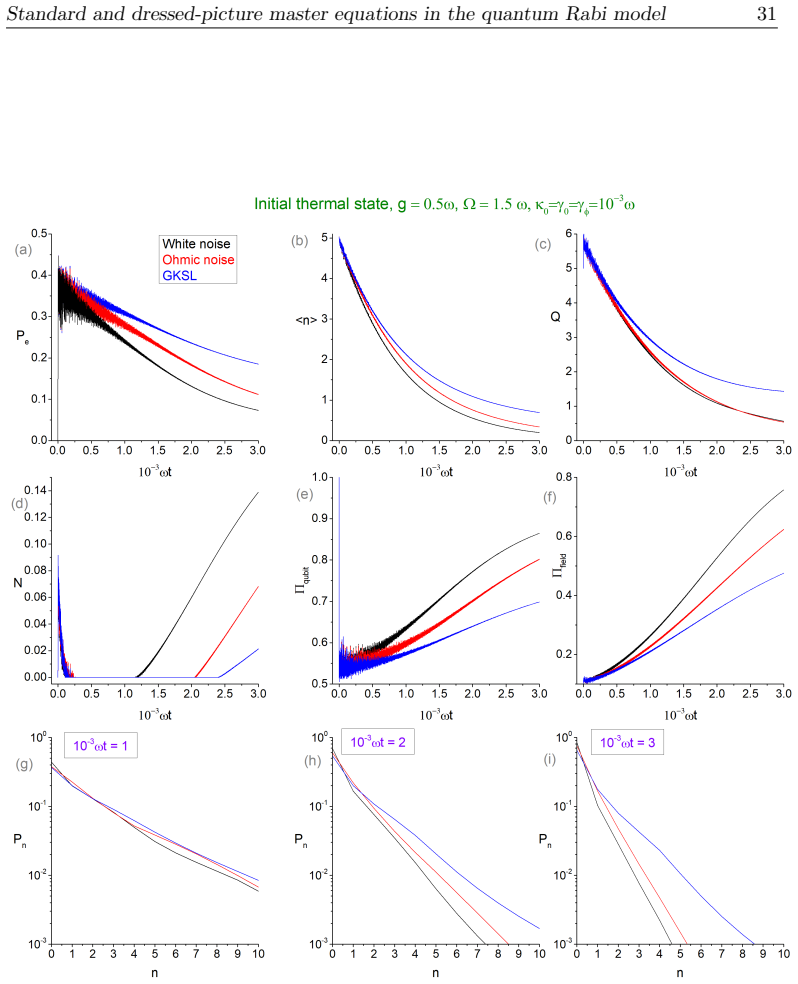
that in the dispersive regime DME overestimates the effects of relaxation. Moreover, the predictions of the three models forP e,⟨n⟩andQdo not coincide for large times, gt≫1, meaning that the accurate description of the system requires a precise knowledge of the spectral density in order to use an appropriate master equation. 1.6 Odd Schr¨ odinger cat stat...
work page 2023
-
[2]
M. O. Scully and M. S. Zubairy,Quantum Optics(Cambridge University Press, Cambridge, 1997)
work page 1997
-
[3]
Carmichael,An Open System Approach to Quantum Optics(Springer, Berlin, 1993)
H. Carmichael,An Open System Approach to Quantum Optics(Springer, Berlin, 1993)
work page 1993
- [4]
-
[5]
H. -P. Breuer and F. Petruccione,The theory of open quantum systems(Oxford University Press, Oxford, 2002)
work page 2002
-
[6]
Orszag,Quantum Optics(Springer, Berlin, 2nd Edition, 2008)
M. Orszag,Quantum Optics(Springer, Berlin, 2nd Edition, 2008). 18A. P. Costa, H. S. Rego de Oliveira and A. Dodonov
work page 2008
-
[7]
C. Gonzalez-Ballestero, Tutorial: projector approach to master equations for open quantum systems, Quantum8, 1454 (2024)
work page 2024
-
[8]
I. de Vega and D. Alonso, Dynamics of non-Markovian open quantum systems, Rev. Mod. Phys.89, 015001 (2017)
work page 2017
-
[9]
T. Niemczyk, F. Deppe, H. Huebl, E. P. Menzel, F. Hocke, M. J. Schwarz, J. J. Garcia-Ripoll, D. Zueco, T. H¨ ummer, E. Solano, A. Marx, and R. Gross, Cir- cuit quantum electrodynamics in the ultrastrong-coupling regime, Nat. Phys.6, 772 (2010)
work page 2010
-
[10]
A. F. Kockum, A. Miranowicz, S. De Liberato, S. Savasta, and F. Nori, Ultrastrong coupling between light and matter, Nat. Rev. Phys.1, 19 (2019)
work page 2019
-
[11]
P. Forn-D´ ıaz, L. Lamata, E. Rico, J. Kono, and E. Solano, Ultrastrong coupling regimes of light-matter interaction, Rev. Mod. Phys.91, 025005 (2019)
work page 2019
-
[12]
T. Werlang, A. V. Dodonov, E. I. Duzzioni, and C. J. Villas Boas, Rabi model be- yond the rotating-wave approximation: Generation of photons from vacuum through decoherence, Phys. Rev. A78, 053805 (2008)
work page 2008
-
[13]
S. De Liberato, D. Gerace, I. Carusotto, and C. Ciuti, Extracavity quantum vacuum radiation from a single qubit, Phys. Rev. A80, 053810 (2009)
work page 2009
-
[14]
F. Beaudoin, J. M. Gambetta and A. Blais, Dissipation and ultrastrong coupling in circuit QED, Phys. Rev. A84, 043832 (2011)
work page 2011
-
[15]
I. I. Rabi. On the Process of Space Quantization. Phys. Rev.49, 324 (1936)
work page 1936
-
[16]
I. I. Rabi. Space quantization in a gyrating magnetic field. Phys. Rev.51, 652 (1937)
work page 1937
-
[17]
D. Braak. Integrability of the Rabi model. Phys. Rev. Lett.107, 100401 (2011)
work page 2011
-
[18]
Q. Xie, H. Zhong, M. T Batchelor and C. Lee, The quantum Rabi model: solution and dynamics. J. Phys. A.: Math. Theor.50, 113001 (2017)
work page 2017
-
[19]
J. Larson and Th. K. Mavrogordatos,The Jaynes-Cummings Model and Its Descen- dants(IOP Publishing, Bristol, 2021). https://arxiv.org/abs/2202.00330 (2024)
-
[20]
S. Agarwal, S. M. Hashemi Rafsanjani and J. H. Eberly, Dissipation of the Rabi model beyond the Jaynes–Cummings approximation: quasi-degenerate qubit and ultra-strong coupling, J. Phys. B: At. Mol. Opt. Phys.46, 224017 (2013)
work page 2013
-
[21]
M. Bamba and T. Ogawa, Recipe for the Hamiltonian of system-environment cou- pling applicable to the ultrastrong-light-matter-interaction regime, Phys. Rev. A89, 023817 (2014)
work page 2014
-
[22]
A. Settineri, V. Macr` ı, A. Ridolfo, O. Di Stefano, A. F. Kockum, F. Nori, and S. Savasta, Dissipation and thermal noise in hybrid quantum systems in the ultrastrong-coupling regime, Phys. Rev. A98, 053834 (2018)
work page 2018
- [23]
-
[24]
A. Trushechkin, Quantum master equations and steady states for the ultrastrong- coupling limit and the strong-decoherence limit, Phys. Rev. A106, 042209 (2022)
work page 2022
- [25]
-
[26]
Y. Tanimura, Numerically “exact” approach to open quantum dynamics: The hier- archical equations of motion (HEOM), J. Chem. Phys.153, 020901 (2020)
work page 2020
-
[27]
G. Vidal and R.F. Werner, Computable measure of entanglement, Phys. Rev. A65, Standard and dressed-picture master equations in the quantum Rabi model19 032314 (2002)
work page 2002
-
[28]
A. Ridolfo, M. Leib, S. Savasta, and M. J. Hartmann, Photon Blockade in the Ul- trastrong Coupling Regime, Phys. Rev. Lett.109, 193602 (2012)
work page 2012
-
[29]
A. Marinho, M.V.S. de Paula and A.V. Dodonov, Approximate analytic solution of the dissipative semiclassical Rabi model near the three-photon resonance and comparison with the quantum behavior, Phys. Lett. A513, 129608 (2024)
work page 2024
-
[30]
M. V. S. de Paula, M. A. Damasceno Faustino and A. V. Dodonov, A Comparison of Quantum and Semiclassical Rabi Models Near Multiphoton Resonances in the Presence of Parametric Modulation, Physics7, 42 (2025)
work page 2025
-
[31]
A. P. Costa and A. Dodonov, Quantum Rabi oscillations in the semiclassical limit: backreaction on the cavity field and entanglement, in A. Dodonov and L. C. C´ eleri (Eds.), Proceedings – QNS III International Workshop on Quantum Nonstationary Systems, pp. 71-88 (LF Editorial, S˜ ao Paulo, 2025). DOI: 10.29327/5559166
-
[32]
A. P. Costa and A. Dodonov, One- and multiphoton resonances in the light-atom interaction, Revista Brasileira de Ensino de F´ ısica47, e20250251 (2025)
work page 2025
-
[33]
C. C. Gerry and P. L. Knight,Introductory Quantum Optics(Cambridge University Press, Cambridge, 2005)
work page 2005
- [34]
-
[35]
K.K.W. Ma, C.K. Law, Three-photon resonance and adiabatic passage in the large- detuning Rabi model, Phys. Rev. A92, 023842 (2015)
work page 2015
-
[36]
L. Garziano, R. Stassi, V. Macr` ı, A.F. Kockum, S. Savasta, F. Nori, Multiphoton quantum Rabi oscillations in ultrastrong cavity QED, Phys. Rev. A92, 063830 (2015)
work page 2015
-
[37]
L. Cong, S. Felicetti, J. Casanova, L. Lamata, E. Solano, I. Arrazola, Selective inter- actions in the quantum Rabi model, Phys. Rev. A101, 032350 (2020)
work page 2020
-
[38]
H. R. Schelb, A. P. Costa and A. V. Dodonov, Metrological power of single-qubit dynamical Casimir effect in circuit QED, Phys. Lett. A566, 131163 (2026)
work page 2026
-
[39]
D. Petz and C. Ghinea, Introduction to Quantum Fisher Information, Quantum Probability and Related Topics, 261-281 (2011). DOI: 10.1142/9789814338745 0015
-
[40]
G. T´ oth and I. Apellaniz, Quantum metrology from a quantum information science perspective, J. Phys. A: Math. Theor.47, 424006 (2014)
work page 2014
- [41]
-
[42]
J.S. Sidhu and P. Kok, A Geometric Perspective on Quantum Parameter Estimation, AVS Quantum Sci.2, 014701 (2020). 20A. P. Costa, H. S. Rego de Oliveira and A. Dodonov Figure 1.1: Behavior of the quantum Rabi model under dissipation for the initial coherent state, Eq. (1.63), and parametersα= √ 50,g= 0.1ω, Ω = 2.9699ωandκ 0 =γ 0 =γ ϕ = 2×10 −4ω. In all the...
work page 2020
discussion (0)
Sign in with ORCID, Apple, or X to comment. Anyone can read and Pith papers without signing in.