Self-similar Dynamics in Percolation and Sandpile
Pith reviewed 2026-05-10 17:57 UTC · model grok-4.3
The pith
Percolation processes display temporal self-similarity in cluster size increments during bond addition.
A machine-rendered reading of the paper's core claim, the machinery that carries it, and where it could break.
Core claim
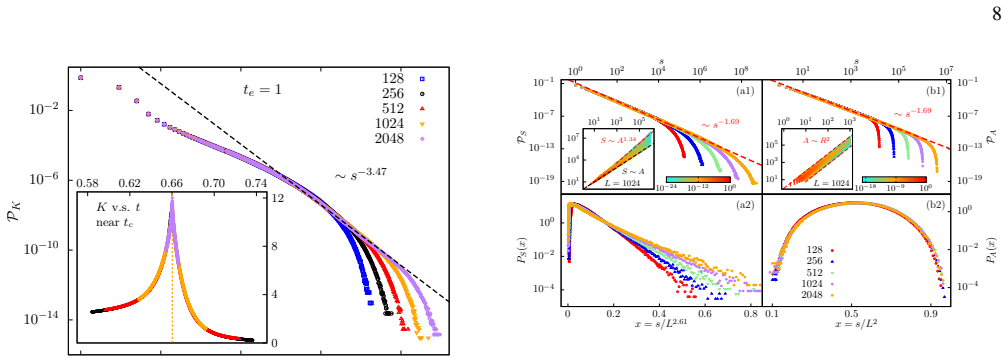
By tracking the gap, the size increment of clusters upon bond addition, and the corresponding merged cluster, we identify scale-invariant temporal patterns in both quantities throughout a large portion of the percolation process. This reveals a form of temporal self-similarity that has not been reported before. We further establish quantitative relations between the dynamic scaling exponents and the conventional static critical exponents, which enable the determination of critical behavior without prior knowledge of the critical point. The same self-similar dynamics is observed in both bond and site percolation on lattices and networks, and extends to other systems such as explosive and rigi
What carries the argument
The gap, defined as the size increment of clusters upon each bond addition, and the merged cluster, which together produce scale-invariant temporal patterns used to relate dynamic and static exponents.
If this is right
- Dynamic scaling exponents become directly computable from observed temporal patterns and match static critical exponents.
- Critical behavior can be extracted in systems where the location of the critical point is not known beforehand.
- The same temporal scaling extends to explosive percolation, rigidity percolation, and the initial nonequilibrium phase of the Bak-Tang-Wiesenfeld sandpile.
- A unified dynamic description applies across lattices, networks, and avalanche models.
Where Pith is reading between the lines
- The method offers a route to monitor criticality in real-time growing systems such as networks or materials without preset thresholds.
- It could be applied to other nonequilibrium models with avalanches to test whether temporal self-similarity is a general feature of dynamic criticality.
- This temporal analysis supplies an independent route to exponent values that can be cross-checked against traditional static scaling.
Load-bearing premise
The temporal patterns in gaps and merged clusters stay scale-invariant across a large portion of the bond-addition process, and the exponent relations hold generally for the listed models without needing the critical point known in advance.
What would settle it
Rescaling the time series of gap sizes and merged-cluster identities against bond fraction or time fails to produce data collapse onto a single curve, or the extracted dynamic exponents deviate from known static percolation exponents on the square lattice.
Figures


read the original abstract
Spatial self-similarity is a hallmark of critical phenomena. We study the dynamic process of percolation, in which bonds are incrementally added to an initially empty lattice until the system becomes fully occupied. By tracking the gap -- the size increment of clusters upon bond addition -- and the corresponding merged cluster, we identify scale-invariant temporal patterns in both quantities throughout a large portion of the process. This reveals a form of temporal self-similarity that has not been reported before. We further establish quantitative relations between the dynamic scaling exponents and the conventional static critical exponents, which enable the determination of critical behavior without prior knowledge of the critical point. The same self-similar dynamics is observed in both bond and site percolation on lattices and networks, and extends to other systems such as explosive and rigidity percolation. Moreover, similar temporal scaling is found in the initial nonequilibrium evolution of the Bak-Tang-Wiesenfeld sandpile model, suggesting a dynamic critical behavior distinct from its equilibrium state. These results provide a unified framework for understanding critical dynamics and may find applications in a broad range of complex systems.
Editorial analysis
A structured set of objections, weighed in public.
Referee Report
Summary. The manuscript claims that by tracking the 'gap' (the size increment of clusters upon incremental bond addition) and the corresponding merged cluster during percolation, scale-invariant temporal patterns emerge throughout a large portion of the process, revealing a new form of temporal self-similarity. Quantitative relations are established between newly defined dynamic scaling exponents and conventional static critical exponents; these relations purportedly allow extraction of critical behavior without prior knowledge of the critical point pc. The same patterns and relations are reported for bond/site percolation on lattices and networks, explosive and rigidity percolation, and the early-time nonequilibrium evolution of the Bak-Tang-Wiesenfeld sandpile model.
Significance. If the dynamic-static exponent relations can be shown to be non-circular and to hold parameter-free across the claimed range of models, the work would supply a unified dynamical framework for critical phenomena that complements static scaling theory and could be useful in systems where pc is difficult to locate a priori. The extension to sandpile dynamics is potentially interesting as a bridge between percolation and self-organized criticality, but the overall significance depends on whether the temporal self-similarity is independently measurable rather than an artifact of operating inside statically identified critical windows.
major comments (2)
- [Results on dynamic scaling exponents] The central claim that the dynamic-static exponent relations enable determination of critical behavior without any prior knowledge of pc (abstract and results sections) is load-bearing. The relations appear to be obtained by numerical fitting inside regimes whose location is already known from conventional static analysis; no explicit parameter-free derivation from the definitions of gap and merged-cluster size is supplied that would guarantee the same exponents emerge when pc is truly unknown a priori. This raises the possibility that the observed scale invariance is an artifact of the critical window rather than a self-contained method.
- [§5] §5 (extensions to explosive/rigidity percolation and sandpile): the adaptation of the gap concept to these models is not derived from first principles, and the exponent-matching tests are performed on systems whose critical points or driving rates are already known from prior literature. A concrete test on a lattice or network with deliberately unknown pc (or on sandpile with unknown driving rate) is needed to substantiate the generality asserted in the abstract.
minor comments (2)
- [Abstract] The abstract asserts 'quantitative relations' but does not state their explicit functional form or name the dynamic exponents; adding one or two equations would improve clarity.
- [Figures and Methods] Figure captions and methods should specify the fitting procedure for the temporal scaling (e.g., range of bond-addition steps used, error estimation on exponents) and confirm that the same scaling window is used for both dynamic and static quantities.
Simulated Author's Rebuttal
We thank the referee for the careful reading and constructive comments on our manuscript. We address the major comments point by point below, providing clarifications and indicating the revisions we will make to strengthen the presentation and address the concerns about independence from prior knowledge of pc and the generality of the extensions.
read point-by-point responses
-
Referee: [Results on dynamic scaling exponents] The central claim that the dynamic-static exponent relations enable determination of critical behavior without any prior knowledge of pc (abstract and results sections) is load-bearing. The relations appear to be obtained by numerical fitting inside regimes whose location is already known from conventional static analysis; no explicit parameter-free derivation from the definitions of gap and merged-cluster size is supplied that would guarantee the same exponents emerge when pc is truly unknown a priori. This raises the possibility that the observed scale invariance is an artifact of the critical window rather than a self-contained method.
Authors: We acknowledge that demonstrating independence from prior knowledge of pc is essential for the central claim. The gap is defined directly as the size increment of the merged cluster upon each incremental bond addition, and the temporal self-similarity manifests as power-law scaling in the distributions of these quantities over extended intervals of the process. The dynamic exponents are extracted from these observed scalings, after which the relations to static exponents are applied. While known pc values are used for validation and to highlight the critical regime, the scale-invariant patterns can be identified by searching for the broadest power-law regimes in the gap time series without presupposing pc. We will add a new subsection and example in the revised manuscript that details a parameter-free procedure: scan possible temporal windows to maximize the scaling range and fit quality for the gap and merged-cluster quantities, then apply the exponent relations to obtain static exponents. This will be illustrated with a figure showing the extraction process and subsequent verification against known values, clarifying that the method is self-contained once the dynamic patterns are detected. revision: partial
-
Referee: [§5] §5 (extensions to explosive/rigidity percolation and sandpile): the adaptation of the gap concept to these models is not derived from first principles, and the exponent-matching tests are performed on systems whose critical points or driving rates are already known from prior literature. A concrete test on a lattice or network with deliberately unknown pc (or on sandpile with unknown driving rate) is needed to substantiate the generality asserted in the abstract.
Authors: We agree that the adaptations in §5 would benefit from clearer motivation and a direct test with unknown parameters. The gap is generalized by tracking the relevant size increment during the incremental process: for explosive percolation, the change in the largest cluster under the product rule; for rigidity percolation, the merger of rigid clusters upon constraint addition; and for the sandpile, the increments in avalanche sizes during early-time driving. In the revision, we will expand the text to derive these definitions more explicitly from the shared incremental dynamics. To provide the requested concrete test, we will include new results for a random network where pc is not used a priori: the dynamic exponents are extracted solely from the observed temporal scaling of the gap, the relations are applied to predict static exponents, and these are then compared to independently determined literature values. For the sandpile, we will add an analysis treating the driving rate as unknown and showing its inference from the temporal scaling exponents. These additions will be placed in an updated §5 to support the generality. revision: yes
Circularity Check
No significant circularity detected in derivation chain
full rationale
The paper's core contribution is the numerical identification of scale-invariant temporal patterns in the gap (cluster size increment) and merged-cluster size during bond/site addition, followed by empirical observation of quantitative links between the resulting dynamic scaling exponents and known static percolation exponents. These links are presented as observed relations rather than a closed-form derivation or first-principles prediction; the method is shown to operate across a broad temporal window without explicit dependence on pre-known pc in the reported simulations. No self-definitional loops, fitted inputs renamed as predictions, or load-bearing self-citations appear in the provided text. The derivation remains self-contained as an empirical unification of dynamic and static scaling, with the generality to other models (explosive percolation, sandpiles) asserted via direct observation rather than reduction to prior inputs.
Axiom & Free-Parameter Ledger
axioms (2)
- domain assumption Percolation proceeds by incremental addition of bonds or sites, producing clusters whose size increments (gaps) and merges can be tracked over time.
- domain assumption Static critical exponents of percolation are well-defined and conventional.
Lean theorems connected to this paper
-
IndisputableMonolith/Cost/FunctionalEquation.leanwashburn_uniqueness_aczel unclear?
unclearRelation between the paper passage and the cited Recognition theorem.
We further establish quantitative relations between the dynamic scaling exponents and the conventional static critical exponents... τ'_G=τ and τ'_S=τ+σ−1
-
IndisputableMonolith/Foundation/DimensionForcing.leanalexander_duality_circle_linking unclear?
unclearRelation between the paper passage and the cited Recognition theorem.
both the gap-size distribution P_G(s,L) and the cluster-size distribution P_S(s,L) conform to the scaling form of Eq. (1)
What do these tags mean?
- matches
- The paper's claim is directly supported by a theorem in the formal canon.
- supports
- The theorem supports part of the paper's argument, but the paper may add assumptions or extra steps.
- extends
- The paper goes beyond the formal theorem; the theorem is a base layer rather than the whole result.
- uses
- The paper appears to rely on the theorem as machinery.
- contradicts
- The paper's claim conflicts with a theorem or certificate in the canon.
- unclear
- Pith found a possible connection, but the passage is too broad, indirect, or ambiguous to say the theorem truly supports the claim.
Reference graph
Works this paper leans on
-
[1]
Universal dynamic scaling of finite clusters We begin by considering the process that terminates near the critical point (t e ≈t c). In the thermodynamic limit (L→ ∞), the bond- (or site-) addition dynamics can be viewed as a continuous realization of the growth of the correlation length ξ(t). The dynamic distributionP X(s) can therefore be re- garded as ...
-
[2]
Dynamic contribution of the giant cluster When the dynamic process proceeds into the supercritical regime (te >t c), a macroscopic (giant) cluster emerges and continues to grow. As a result, the overall dynamic cluster- size distributionP S (s) inevitably acquires contributions from this giant cluster when the dynamic statistics are accumulated over the b...
work page 2048
-
[3]
Ma,Modern Theory Of Critical Phenomena(Routledge, 2018)
S.-K. Ma,Modern Theory Of Critical Phenomena(Routledge, 2018)
work page 2018
-
[4]
D. Stauffer and A. Aharony,Introduction to percolation theory, 2nd ed. (Taylor & Francis, London, 1991)
work page 1991
-
[5]
B. Nienhuis, E. K. Riedel, and M. Schick, Magnetic exponents of the two-dimensional q-state Potts model, J. Phys. A: Math. Gen.13, L189 (1980)
work page 1980
-
[6]
B. Nienhuis, Critical behavior of two-dimensional spin models and charge asymmetry in the Coulomb gas, J. Stat. Phys.34, 731 (1984)
work page 1984
-
[7]
Phase transition and critical phenomena
B. Nienhuis,Coulomb gas formulation of 2D phase transition, in “Phase transition and critical phenomena”, edited by J. C. Domb (Academic Press London, London, 1987) vol. 11
work page 1987
-
[8]
Phase transition and critical phenomena
J. L. Cardy,Conformal Invariance, in “Phase transition and critical phenomena”, edited by J. C. Domb, V ol. 11, p.55 (Aca- demic Press, London, 1987)
work page 1987
-
[9]
S. Smirnov and W. Werner, Critical exponents for two- dimensional percolation, Math. Res. Lett.8, 729 (2001)
work page 2001
-
[10]
D. Achlioptas, R. M. D’Souza, and J. Spencer, Explosive per- colation in random networks, Science323, 1453 (2009)
work page 2009
-
[11]
O. Riordan and L. Warnke, Explosive percolation is continuous, Science333, 322 (2011)
work page 2011
-
[12]
D. J. Jacobs and M. F. Thorpe, Generic rigidity percolation: The pebble game, Phys. Rev. Lett.75, 4051 (1995)
work page 1995
-
[13]
D. J. Jacobs and M. F. Thorpe, Generic rigidity percolation in two dimensions, Phys. Rev. E53, 3682 (1996)
work page 1996
-
[14]
C. Moukarzel and P. M. Duxbury, Comparison of rigidity and connectivity percolation in two dimensions, Phys. Rev. E59, 2614 (1999)
work page 1999
-
[15]
M.-A. Bri `ere, M. V . Chubynsky, and N. Mousseau, Self- organized criticality in the intermediate phase of rigidity per- colation, Phys. Rev. E75, 056108 (2007). 10
work page 2007
-
[16]
E. J. Friedman and A. S. Landsberg, Construction and analysis of random networks with explosive percolation, Phys. Rev. Lett. 103, 255701 (2009)
work page 2009
-
[17]
R. M. Ziff, Explosive growth in biased dynamic percolation on two-dimensional regular lattice networks, Phys. Rev. Lett.103, 045701 (2009)
work page 2009
-
[18]
R. M. D’Souza and M. Mitzenmacher, Local cluster aggre- gation models of explosive percolation, Phys. Rev. Lett.104, 195702 (2010)
work page 2010
-
[19]
F. Radicchi and S. Fortunato, Explosive percolation: A numer- ical analysis, Phys. Rev. E81, 036110 (2010)
work page 2010
-
[20]
P. Grassberger, C. Christensen, G. Bizhani, S.-W. Son, and M. Paczuski, Explosive percolation is continuous, but with un- usual finite size behavior, Phys. Rev. Lett.106, 225701 (2011)
work page 2011
-
[21]
R. M. D’Souza and J. Nagler, Anomalous critical and super- critical phenomena in explosive percolation, Nat. Phys.11, 531 (2015)
work page 2015
-
[22]
S. Feng and P. N. Sen, Percolation on elastic networks: New exponent and threshold, Phys. Rev. Lett.52, 216 (1984)
work page 1984
-
[23]
Y . Kantor and I. Webman, Elastic properties of random perco- lating systems, Phys. Rev. Lett.52, 1891 (1984)
work page 1984
-
[24]
A. Hansen and S. Roux, Universality class of central-force per- colation, Phys. Rev. B40, 749 (1989)
work page 1989
-
[25]
Plischke, Rigidity of disordered networks with bond- bending forces, Phys
M. Plischke, Rigidity of disordered networks with bond- bending forces, Phys. Rev. E76, 021401 (2007)
work page 2007
- [26]
-
[27]
W. G. Ellenbroek, V . F. Hagh, A. Kumar, M. Thorpe, and M. van Hecke, Rigidity loss in disordered systems: Three sce- narios, Phys. Rev. Lett.114, 135501 (2015)
work page 2015
- [28]
-
[29]
S. V . Buldyrev, R. Parshani, G. Paul, H. E. Stanley, and S. Havlin, Catastrophic cascade of failures in interdependent networks, Nature464, 1025 (2010)
work page 2010
-
[30]
J. Fan, J. Meng, Y . Ashkenazy, S. Havlin, and H. J. Schellnhu- ber, Climate network percolation reveals the expansion and weakening of the tropical component under global warming, Proc. Natl. Acad. Sci.115, E12128 (2018)
work page 2018
-
[31]
D. Li, B. Fu, Y . Wang, G. Lu, Y . Berezin, H. E. Stanley, and S. Havlin, Percolation transition in dynamical traffic network with evolving critical bottlenecks, Proc. Natl. Acad. Sci.112, 669 (2014)
work page 2014
-
[32]
J. Xie, F. Meng, J. Sun, X. Ma, G. Yan, and Y . Hu, Detecting and modelling real percolation and phase transitions of infor- mation on social media, Nat. Hum. Behav.5, 1161 (2021)
work page 2021
- [33]
-
[34]
P. Bak, C. Tang, and K. Wiesenfeld, Self-organized criticality: An explanation of the 1/f noise, Phys. Rev. Lett.59, 381 (1987)
work page 1987
-
[35]
C. Tang and P. Bak, Critical exponents and scaling relations for self-organized critical phenomena, Phys. Rev. Lett.60, 2347 (1988)
work page 1988
-
[36]
M. Engsig and K. Sneppen, Fractals in the critical attractor of the classical sandpile model, Phys. Rev. Lett.134, 187201 (2025)
work page 2025
-
[37]
S. S. Manna, Describing self-organized criticality as a continu- ous phase transition, Phys. Rev. E111, 024111 (2025)
work page 2025
-
[38]
C. Tebaldi, M. De Menech, and A. L. Stella, Multifractal scaling in the Bak-Tang-Wiesenfeld sandpile and edge events, Phys. Rev. Lett.83, 3952 (1999)
work page 1999
-
[39]
M. E. J. Newman and R. M. Ziff, Fast Monte Carlo algorithm for site or bond percolation, Phys. Rev. E64, 016706 (2001)
work page 2001
-
[40]
S. N. Dorogovtsev, J. F. F. Mendes, and A. N. Samukhin, Anomalous percolation properties of growing networks, Phys. Rev. E64, 066110 (2001)
work page 2001
-
[41]
B. Bollob ´as, S. Janson, and O. Riordan, The phase transition in the uniformly grown random graph has infinite order, Random Struct. Algor.26, 1 (2004)
work page 2004
-
[42]
M. Li, J. Wang, and Y . Deng, Explosive percolation obeys stan- dard finite-size scaling in an event-based ensemble, Phys. Rev. Lett.130, 147101 (2023)
work page 2023
-
[43]
M. Li, J. Wang, and Y . Deng, Explosive percolation in finite dimensions, Phys. Rev. Res.6, 033319 (2024)
work page 2024
- [44]
-
[45]
J. Fan, J. Meng, Y . Liu, A. A. Saberi, J. Kurths, and J. Nagler, Universal gap scaling in percolation, Nat. Phys.16, 455 (2020)
work page 2020
-
[46]
Y . Deng, W. Zhang, T. M. Garoni, A. D. Sokal, and A. Sportiello, Some geometric critical exponents for percola- tion and the random-cluster model, Phys. Rev. E81, 020102 (2010)
work page 2010
- [47]
- [48]
-
[49]
L. Cirigliano, G. Tim ´ar, and C. Castellano, Scaling and univer- sality for percolation in random networks: A unified view, Phys. Rev. E110, 064303 (2024)
work page 2024
-
[50]
Z. Wu, C. Lagorio, L. A. Braunstein, R. Cohen, S. Havlin, and H. E. Stanley, Numerical evaluation of the upper critical di- mension of percolation in scale-free networks, Phys. Rev. E75, 066110 (2007)
work page 2007
-
[51]
X. Zhao, L. Yang, D. Peng, R.-R. Liu, and M. Li, Finite-size scaling of percolation on scale-free networks, Chaos Soliton Fract.200, 117076 (2025)
work page 2025
-
[52]
M. Molloy and B. Reed, A critical point for random graphs with a given degree sequence, Random Struct. Algor.6, 161 (1995)
work page 1995
-
[53]
M. E. J. Newman, S. H. Strogatz, and D. J. Watts, Random graphs with arbitrary degree distributions and their applications, Phys. Rev. E64, 026118 (2001)
work page 2001
-
[54]
R. M. D’Souza, J. G ´omez-Garde˜nes, J. Nagler, and A. Arenas, Explosive phenomena in complex networks, Adv. Phys.68, 123 (2019)
work page 2019
-
[55]
M. F. Thorpe, D. J. Jacobs, M. V . Chubynsky, and J. C. Phillips, Self-organization in network glasses, J. Non-Cryst. Solids266–269, 859 (2000)
work page 2000
-
[56]
C. P. Broedersz, X. Mao, T. C. Lubensky, and F. C. MacKintosh, Criticality and isostaticity in fibre networks, Nat. Phys.7, 983 (2011)
work page 2011
- [57]
-
[58]
J. Rouwhorst, C. Ness, S. Stoyanov, A. Zaccone, and P. Schall, Nonequilibrium continuous phase transition in colloidal gela- tion with short-range attraction, Nat. Commun.11, 3558 (2020)
work page 2020
-
[59]
J. Rouwhorst, P. Schall, C. Ness, T. Blijdenstein, and A. Zac- cone, Nonequilibrium master kinetic equation modeling of col- loidal gelation, Phys. Rev. E102, 022602 (2020)
work page 2020
-
[60]
A. Zaccone and E. Scossa-Romano, Approximate analytical de- scription of the nonaffine response of amorphous solids, Phys. 11 Rev. B83, 184205 (2011)
work page 2011
- [61]
- [62]
-
[63]
H. A. Vinutha, F. D. Diaz Ruiz, X. Mao, B. Chakraborty, and E. Del Gado, Stress–stress correlations reveal force chains in gels, J. Chem. Phys.158, 114104 (2023)
work page 2023
-
[64]
N. I. Petridou, B. Corominas-Murtra, C.-P. Heisenberg, and E. Hannezo, Rigidity percolation uncovers a structural basis for embryonic tissue phase transitions, Cell184, 1914 (2021)
work page 1914
- [65]
-
[66]
S. L ¨ubeck and K. D. Usadel, Numerical determination of the avalanche exponents of the Bak-Tang-Wiesenfeld model, Phys. Rev. E55, 4095 (1997)
work page 1997
-
[67]
L. P. Kadanoff, S. R. Nagel, L. Wu, and S.-M. Zhou, Scaling and universality in avalanches, Phys. Rev. A39, 6524 (1989)
work page 1989
-
[68]
Manna, Critical exponents of the sandpile models in two di- mensions, Physica A179, 249 (1991)
S. Manna, Critical exponents of the sandpile models in two di- mensions, Physica A179, 249 (1991)
work page 1991
-
[69]
E. Milshtein, O. Biham, and S. Solomon, Universality classes in isotropic, Abelian, and non-Abelian sandpile models, Phys. Rev. E58, 303 (1998)
work page 1998
- [70]
-
[71]
L. Yang and M. Li, Emergence of biconnected clusters in ex- plosive percolation, Phys. Rev. E110, 014122 (2024)
work page 2024
- [72]
discussion (0)
Sign in with ORCID, Apple, or X to comment. Anyone can read and Pith papers without signing in.