Recognition: 2 theorem links
· Lean TheoremFinding Nemo-Nemo: CFT DAG-based Consensus in the WAN
Pith reviewed 2026-05-10 17:52 UTC · model grok-4.3
The pith
Nemo-Nemo structures consensus around a causally ordered DAG so every replica can propose commands, separates dissemination from ordering, and defers missed proposals to exceed prior CFT performance in wide-area networks.
A machine-rendered reading of the paper's core claim, the machinery that carries it, and where it could break.
Core claim
Nemo-Nemo is the first DAG-based CFT consensus protocol proven to exceed state-of-the-art wide-area network performance in both speed and resilience. It achieves this by bridging CFT and BFT design ideas: a causally ordered DAG for self-regulating command propagation, a multi-leader architecture that removes single-leader bottlenecks, separation of dissemination from consensus logic, and deterministic deferral of any proposal that misses its deadline.
What carries the argument
The causally ordered DAG that carries all proposals and lets every replica participate while automatically throttling communication.
If this is right
- The protocol matches the two-hop latency of existing CFT systems while sustaining higher throughput.
- Command dissemination continues even when consensus commits are temporarily blocked by network conditions.
- No proposal is ever dropped; every leader message is eventually executed after a deterministic deferral.
- Multi-leader operation removes the throughput ceiling imposed by rotating a single leader.
Where Pith is reading between the lines
- The same separation of dissemination from ordering could be reused in other geo-distributed systems that must tolerate variable latency.
- Deferred execution offers a concrete way to preserve liveness without relaxing safety when deadlines are missed.
- Because the DAG is causally ordered, the approach may reduce the coordination overhead that usually appears when many leaders propose concurrently.
Load-bearing premise
That the causally ordered DAG, multi-leader proposals, and deferred execution can be built without creating new bottlenecks or correctness problems that only appear in real wide-area deployments.
What would settle it
A controlled wide-area testbed run that compares Nemo-Nemo head-to-head with an established CFT protocol such as Raft, measuring sustained throughput and commit latency while injecting realistic packet delays and losses.
Figures


read the original abstract
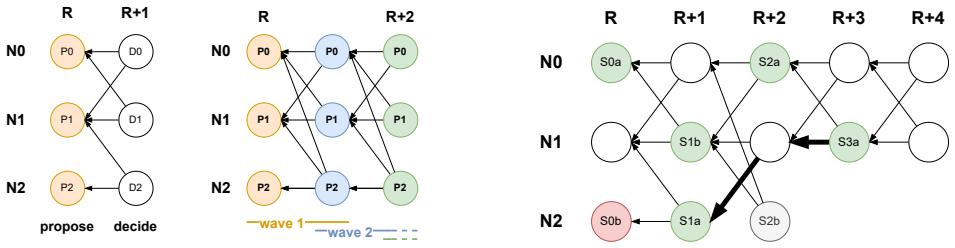
This paper introduces Nemo-Nemo, a practical crash-fault tolerant (CFT) consensus protocol designed to outperform existing protocols in wide-area networks by bridging design principles from the CFT and Byzantine-fault tolerant (BFT) worlds. By structuring command propagation through a causally ordered DAG, Nemo-Nemo allows all consensus replicas to propose commands with a naturally self-regulating communication regime. By exploiting multi-leader architecture, Nemo-Nemo avoids the performance bottleneck inherent to single-leader protocols. By separating command dissemination from consensus logic, Nemo-Nemo handles challenging network conditions even when consensus commits are stalled. Moreover, leader proposals that miss a deadline are never dropped, but deterministically deferred and executed later, preserving throughput under transient network delays. And by enabling Nemo-Nemo to commit on a DAG in just two network hops, it matches the latency of existing CFT systems, while achieving significantly higher throughput. The result is a robust, deployable system: the first DAG-based CFT consensus protocol proven to exceed state-of-the-art wide-area network performance in both speed and resilience.
Editorial analysis
A structured set of objections, weighed in public.
Referee Report
Summary. The paper introduces Nemo-Nemo, a CFT consensus protocol for WANs that structures command propagation via a causally ordered DAG to support multi-leader proposals, separates dissemination from consensus logic, defers missed proposals for later deterministic execution, and achieves two-hop commits. It claims this yields higher throughput and resilience than prior CFT systems while matching their latency, positioning it as the first DAG-based CFT protocol proven to exceed SOTA WAN performance in both speed and resilience.
Significance. If the performance and resilience claims hold with supporting analysis and evidence, the work would be significant for distributed systems research. It bridges CFT and BFT design principles in a practical, deployable system and directly targets WAN challenges such as variable latency and transient delays, potentially improving real-world consensus deployments.
major comments (3)
- [Abstract] Abstract: The assertion that Nemo-Nemo is 'proven to exceed state-of-the-art wide-area network performance in both speed and resilience' is load-bearing for the central claim but rests on high-level descriptions of the causally ordered DAG, multi-leader architecture, and deferred execution without concrete bounds, overhead analysis, or handling of variable WAN latency/packet loss; this leaves the performance superiority unverified.
- [Protocol description] Protocol description (around the two-hop commit and separation of dissemination from consensus): The claim that these mechanisms translate to higher throughput without introducing new bottlenecks or correctness risks under real WAN conditions requires explicit analysis or proof; the abstract notes 'never-dropped proposals' and 'deterministically deferred' execution but does not address coordination costs that typically arise in DAG and multi-leader systems.
- [Evaluation] Evaluation or experimental section: No implementation details, throughput/latency measurements, error bars, or resilience tests under realistic WAN traces are referenced, undermining the 'practical, deployable system' claim and the comparison to SOTA; the weakest assumption (that DAG maintenance adds no overhead) cannot be assessed without such data.
minor comments (2)
- Clarify notation for the causally ordered DAG and multi-leader proposals on first use to aid readability for readers unfamiliar with hybrid CFT/BFT designs.
- [Abstract] Ensure the abstract's performance claims are cross-referenced to specific theorems, lemmas, or experimental figures in the body.
Simulated Author's Rebuttal
We thank the referee for the constructive and detailed feedback. We address each major comment point by point below, providing clarifications on the protocol analysis and design rationale while agreeing to revisions where they strengthen the presentation without altering the core claims.
read point-by-point responses
-
Referee: [Abstract] Abstract: The assertion that Nemo-Nemo is 'proven to exceed state-of-the-art wide-area network performance in both speed and resilience' is load-bearing for the central claim but rests on high-level descriptions of the causally ordered DAG, multi-leader architecture, and deferred execution without concrete bounds, overhead analysis, or handling of variable WAN latency/packet loss; this leaves the performance superiority unverified.
Authors: The abstract condenses results from the protocol analysis in Sections 3 and 4. The two-hop commit matches the latency of standard CFT protocols such as Raft or Paxos by requiring only a proposal and a quorum acknowledgment on the DAG. Multi-leader proposals combined with causal ordering enable throughput to scale linearly with the number of active leaders, while deferred execution ensures proposals are never lost under transient WAN delays by deterministically re-including them in subsequent waves based on predecessor dependencies. We provide informal throughput bounds and resilience arguments against packet loss in the text. We agree the phrasing 'proven' is strong without empirical data and will revise the abstract to reference the analysis sections explicitly and use 'our analysis shows potential to exceed' instead. revision: partial
-
Referee: [Protocol description] Protocol description (around the two-hop commit and separation of dissemination from consensus): The claim that these mechanisms translate to higher throughput without introducing new bottlenecks or correctness risks under real WAN conditions requires explicit analysis or proof; the abstract notes 'never-dropped proposals' and 'deterministically deferred' execution but does not address coordination costs that typically arise in DAG and multi-leader systems.
Authors: Dissemination occurs independently via the causally ordered DAG using a lightweight gossip mechanism that tolerates variable latency and loss without blocking consensus. The two-hop commit is achieved by having each leader propose directly into the DAG and collect acknowledgments from a quorum; no additional rounds are needed. Deferred proposals incur zero extra coordination because their execution is determined solely by the existing causal partial order once predecessors commit. We include a correctness argument in Section 5 and the appendix showing safety and liveness under CFT assumptions with bounded but arbitrary delays. Coordination costs remain comparable to single-leader CFT because leaders operate independently and the DAG maintenance is local. We will add a dedicated paragraph quantifying these overheads in the protocol section. revision: yes
-
Referee: [Evaluation] Evaluation or experimental section: No implementation details, throughput/latency measurements, error bars, or resilience tests under realistic WAN traces are referenced, undermining the 'practical, deployable system' claim and the comparison to SOTA; the weakest assumption (that DAG maintenance adds no overhead) cannot be assessed without such data.
Authors: The manuscript presents a protocol design with analytical arguments rather than a full systems evaluation. DAG maintenance adds constant overhead per command because each proposal records only its direct causal predecessors, with no global state or extra messages beyond standard quorum collection. This is justified in Section 4 by comparison to existing CFT protocols. The 'practical' and 'deployable' descriptors refer to the absence of heavy cryptography or complex leader election, making implementation feasible on top of existing reliable broadcast primitives. We acknowledge that concrete measurements would further support the claims but fall outside the scope of this design-focused paper; we will add a short discussion of the analytical overhead model and note that a prototype is under development for future work. revision: no
Circularity Check
No circularity: protocol design claims are independent of inputs
full rationale
The abstract and context present Nemo-Nemo as a new protocol combining causally ordered DAG, multi-leader proposals, deferred execution, and two-hop commits to achieve higher WAN throughput and resilience than SOTA CFT systems. No equations, fitted parameters, self-citations, or uniqueness theorems are quoted that would reduce any performance prediction or proof to the inputs by construction. The central claims rest on the described architectural separations and properties rather than self-referential reductions, making the derivation self-contained against external benchmarks.
Axiom & Free-Parameter Ledger
Lean theorems connected to this paper
-
IndisputableMonolith/Cost/FunctionalEquation.leanwashburn_uniqueness_aczel unclear?
unclearRelation between the paper passage and the cited Recognition theorem.
Nemo-Nemo defines a wave of two rounds... direct decision rule: f+1 blocks... indirect decision rule using anchor and path in DAG
-
IndisputableMonolith/Foundation/DimensionForcing.leanreality_from_one_distinction unclear?
unclearRelation between the paper passage and the cited Recognition theorem.
Nemo-Nemo... commit on a DAG in just two network hops
What do these tags mean?
- matches
- The paper's claim is directly supported by a theorem in the formal canon.
- supports
- The theorem supports part of the paper's argument, but the paper may add assumptions or extra steps.
- extends
- The paper goes beyond the formal theorem; the theorem is a base layer rather than the whole result.
- uses
- The paper appears to rely on the theorem as machinery.
- contradicts
- The paper's claim conflicts with a theorem or certificate in the canon.
- unclear
- Pith found a possible connection, but the passage is too broad, indirect, or ambiguous to say the theorem truly supports the claim.
Reference graph
Works this paper leans on
-
[1]
What’s dag got to do with it? https://decentralizedthoughts.github.io/ 2025-08-08-DAGs/, August 2025
Ittai Abraham, Neil Giridharan, and Kar- tik Nayak. What’s dag got to do with it? https://decentralizedthoughts.github.io/ 2025-08-08-DAGs/, August 2025
work page 2025
-
[2]
Ailidani Ailijiang, Aleksey Charapko, Murat Demirbas, and Tevfik Kosar. WPaxos: Wide area network flex- ible consensus.IEEE Transactions on Parallel and Distributed Systems, 31(1):211–223, 2019
work page 2019
-
[3]
Wa- verunner: An elegant approach to hardware acceleration of state machine replication
Mohammadreza Alimadadi, Hieu Mai, Shenghsun Cho, Michael Ferdman, Peter Milder, and Shuai Mu. Wa- verunner: An elegant approach to hardware acceleration of state machine replication. In20th USENIX Sympo- sium on Networked Systems Design and Implementation (NSDI 23), pages 357–374, 2023
work page 2023
-
[4]
AWS instance types.https://aws.amazon
Amazon. AWS instance types.https://aws.amazon. com/ec2/instance-types/, 2023
work page 2023
-
[5]
Mysticeti: Low- latency dag consensus with fast commit path.arXiv preprint arXiv:2310.14821, 2023
KushalBabel,AndreyChursin,GeorgeDanezis,Lefteris Kokoris-Kogias, and Alberto Sonnino. Mysticeti: Low- latency dag consensus with fast commit path.arXiv preprint arXiv:2310.14821, 2023
-
[6]
The Hashgraph Proto- col: Efficient Asynchronous BFT for High-Throughput Distributed Ledgers
Leemon Baird and Atul Luykx. The Hashgraph Proto- col: Efficient Asynchronous BFT for High-Throughput Distributed Ledgers. In2020 International Conference on Omni-layer Intelligent Systems (COINS), 2020
work page 2020
-
[7]
Another advantage of free choice (ex- tended abstract): Completely asynchronous agreement protocols
Michael Ben-Or. Another advantage of free choice (ex- tended abstract): Completely asynchronous agreement protocols. InProceedings of the Second Annual ACM Symposium on Principles of Distributed Computing, PODC ’83, pages 27–30. ACM, August 1983
work page 1983
-
[8]
Sui lutris: A blockchain combining broadcast and consensus
SamBlackshear,AndreyChursin,GeorgeDanezis,Anas- tasios Kichidis, Lefteris Kokoris-Kogias, Xun Li, Mark Logan, and et al. Sui lutris: A blockchain combining broadcast and consensus. InCCS, 2024
work page 2024
-
[9]
TAO: Facebook’s distributed data store for the social graph
NathanBronson,ZachAmsden,GeorgeCabrera,Prasad Chakka, Peter Dimov, Hui Ding, Jack Ferris, Anthony Giardullo, Sachin Kulkarni, Harry Li, Mark Marchukov, Dmitri Petrov, Lovro Puzar, Yee Jiun Song, and Venkat Venkataramani. TAO: Facebook’s distributed data store for the social graph. InUSENIX Annual Technical Conference USENIX ATC 13, pages 49–60, June 2013
work page 2013
-
[10]
IntroductiontoReliableandSecureDistributedProgram- ming
ChristianCachin,RachidGuerraoui,andLuísRodrigues. IntroductiontoReliableandSecureDistributedProgram- ming. Springer Science & Business Media, 2011
work page 2011
-
[11]
Lásaro Jonas Camargos, Rodrigo Malta Schmidt, and Fernando Pedone. Multicoordinated paxos. InPro- ceedings of the twenty-sixth annual ACM symposium on Principles of distributed computing, pages 316–317, 2007
work page 2007
-
[12]
Practical Byzan- tine fault tolerance
Miguel Castro and Barbara Liskov. Practical Byzan- tine fault tolerance. InProceedings of the 3rd USENIX Symposium on Operating Systems Design and Imple- mentation (OSDI), February 1999
work page 1999
-
[13]
WhatIsIKA?IKA:ExploringtheFastestMPC Network on Sui Blockchain, 2025
CoinEx. WhatIsIKA?IKA:ExploringtheFastestMPC Network on Sui Blockchain, 2025. CoinEx Academy
work page 2025
-
[14]
Narwhal and Tusk: a DAG-based mempool and efficient BFT consensus
George Danezis, Lefteris Kokoris-Kogias, Alberto Son- nino, and Alexander Spiegelman. Narwhal and Tusk: a DAG-based mempool and efficient BFT consensus. In ACM EuroSys, 2022
work page 2022
-
[15]
arXiv preprint arXiv:2502.09116 (2025)
George Danezis, Jovan Komatovic, Lefteris Kokoris- Kogias,AlbertoSonnino,andIgorZablotchi. Byzantine consensus in the random asynchronous model.arXiv preprint arXiv:2502.09116, 2025
- [16]
-
[17]
Consensus in the presence ofpartialsynchrony.Journal of the ACM (JACM), 35(2):288–323, 1988
Cynthia Dwork, Nancy Lynch, and Larry Stockmeyer. Consensus in the presence ofpartialsynchrony.Journal of the ACM (JACM), 35(2):288–323, 1988
work page 1988
-
[18]
State-machine replication for Planet-Scale systems
Vitor Enes, Carlos Baquero, Tuanir França Rezende, Alexey Gotsman, Matthieu Perrin, and Pierre Sutra. State-machine replication for Planet-Scale systems. In Proceedings of the Fifteenth European Conference on Computer Systems (EuroSys ’20), April 2020
work page 2020
-
[19]
Dumbo-ng: Fastasynchronousbft consensus with throughput-oblivious latency
YingziGao,YuanLu,ZhenliangLu,QiangTang,JingXu, andZhenfengZhang. Dumbo-ng: Fastasynchronousbft consensus with throughput-oblivious latency. InACM CCS, 2022
work page 2022
-
[20]
Autobahn: Seam- lesshighspeedbft
Neil Giridharan, Florian Suri-Payer, Ittai Abraham, Lorenzo Alvisi, and Natacha Crooks. Autobahn: Seam- lesshighspeedbft. InProceedingsoftheACMSIGOPS 30thSymposiumonOperatingSystemsPrinciples,pages 1–23, 2024
work page 2024
-
[21]
Flexible Paxos: Quorum intersection revisited
Heidi Howard, Dahlia Malkhi, and Alexander Spiegel- man. Flexible Paxos: Quorum intersection revisited. InProceedings of the 20th International Conference on Principles of Distributed Systems (OPODIS 2016), December 2016
work page 2016
-
[22]
IOTA Stiftung. Consensus on IOTA. https:// docs.iota.org/about-iota/iota-architecture/ consensus, 2025. IOTA Documentation
work page 2025
-
[23]
Philipp Jovanovic, Lefteris Kokoris Kogias, Bryan Ku- mara, Alberto Sonnino, Pasindu Tennage, and Igor Zablotchi. Mahi-mahi: Low-latency asynchronous bft 13 dag-based consensus.45th IEEE International Confer- ence on Distributed Computing Systems, 2025
work page 2025
-
[24]
IditKeidar,EleftheriosKokoris-Kogias,OdedNaor,and Alexander Spiegelman. All You Need is DAG. InACM PODC, 2021
work page 2021
-
[25]
Cordial Miners: Fast and Efficient Consensus for Every Eventuality
Idit Keidar,Oded Naor,Ouri Poupko,and Ehud Shapiro. Cordial Miners: Fast and Efficient Consensus for Every Eventuality. InDISC, 2023
work page 2023
-
[26]
Mysticeti: Low-latency dag consen- sus with fast commit path
Mysten Labs. Mysticeti: Low-latency dag consen- sus with fast commit path. https://github.com/ asonnino/mysticeti, 2024
work page 2024
-
[27]
Paxos made simple.ACM SIGACT News (Distributed Computing Column) 32, 4, 32:51–58, December 2001
Leslie Lamport. Paxos made simple.ACM SIGACT News (Distributed Computing Column) 32, 4, 32:51–58, December 2001
work page 2001
-
[28]
Generalized consensus and Paxos
Leslie Lamport. Generalized consensus and Paxos. TechnicalReportMSR-TR-2005-33,MicrosoftResearch, March 2005
work page 2005
-
[29]
Fast paxos.Distributed Computing, 19(2):79–103, 2006
Leslie Lamport. Fast paxos.Distributed Computing, 19(2):79–103, 2006
work page 2006
-
[30]
Binomial averages when the mean is an integer.The Mathematical Gazette 94, 331-332, 2010
Nick Lord. Binomial averages when the mean is an integer.The Mathematical Gazette 94, 331-332, 2010
work page 2010
-
[31]
Maximal ex- tractablevalue(mev)protectiononadag
Dahlia Malkhi and Pawel Szalachowski. Maximal ex- tractablevalue(mev)protectiononadag. InTokenomics, 2022
work page 2022
-
[32]
Yanhua Mao, Flavio Junqueira, and Keith Marzullo. Mencius:Buildingefficientreplicatedstatemachinesfor WANs.In8thUSENIXSymposiumonOperatingSystems Design and Implementation (OSDI 08),December2008
-
[33]
Scalable but wasteful: Current state of replicationinthecloud
Venkata Swaroop Matte, Aleksey Charapko, and Abu- talib Aghayev. Scalable but wasteful: Current state of replicationinthecloud. InProceedingsofthe13thACM Workshop on Hot Topics in Storage and File Systems, pages 42–49, July 2021
work page 2021
-
[34]
Impossibility of distributed consensus with one faulty process.Journal of ACM, 1985
MichaelS.PatersonMichaelJ.Fischer,NancyA.Lynch. Impossibility of distributed consensus with one faulty process.Journal of ACM, 1985
work page 1985
-
[35]
Iulian Moraru, David G Andersen, and Michael Kamin- sky. EPaxos go-lang. https://github.com/ efficient/epaxos/, 2013
work page 2013
-
[36]
There is more consensus in egalitarian parliaments
Iulian Moraru, David G Andersen, and Michael Kamin- sky. There is more consensus in egalitarian parliaments. InProceedingsoftheTwenty-FourthACMSymposiumon OperatingSystemsPrinciples,pages358–372,November 2013
work page 2013
-
[37]
Iulian Moraru, David G Andersen, Michael Kaminsky, and Pasindu Tennage. EPaxos go-lang – modified for QuePaxa experiments.https://github.com/dedis/ quepaxa-ePaxos-open-loop, September 2023
work page 2023
-
[38]
DPaxos: Managing data closer to users for low-latency and mobile applications
Faisal Nawab, Divyakant Agrawal, and Amr El Abbadi. DPaxos: Managing data closer to users for low-latency and mobile applications. InACM SIGMOD/PODS Conference on Management of Data, June 2018
work page 2018
-
[39]
Viewstamped replication: A new primary copy method to support highly-available distributed systems
Brian M Oki and Barbara H Liskov. Viewstamped replication: A new primary copy method to support highly-available distributed systems. InProceedings of the Seventh Annual ACM Symposium on Principles of Distributed Computing, pages 8–17, January 1988
work page 1988
-
[40]
In search of an understandable consensus algorithm
Diego Ongaro and John Ousterhout. In search of an understandable consensus algorithm. In2014 USENIX Annual Technical Conference ATC14, pages 305–319, June 2014
work page 2014
-
[41]
Haochen Pan, Jesse Tuglu, Neo Zhou, Tianshu Wang, Yicheng Shen, Xiong Zheng, Joseph Tassarotti, Lewis Tseng, and Roberto Palmieri. Rabia.https://github. com/haochenpan/rabia, 2021. Rabia implementation in the Go language (GitHub repository)
work page 2021
-
[42]
Rabia: Simplifying state- machine replication throughrandomization
Haochen Pan, Jesse Tuglu, Neo Zhou, Tianshu Wang, Yicheng Shen, Xiong Zheng, Joseph Tassarotti, Lewis Tseng, and Roberto Palmieri. Rabia: Simplifying state- machine replication throughrandomization. InProceed- ingsoftheACMSIGOPS28thSymposiumonOperating Systems Principles, pages 472–487, October 2021
work page 2021
-
[43]
Making fast con- sensus generally faster
Sebastiano Peluso, Alexandru Turcu, Roberto Palmieri, Giuliano Losa, and Binoy Ravindran. Making fast con- sensus generally faster. InProceedings of the 46th AnnualIEEE/IFIPInternationalConferenceonDepend- able Systems and Networks (DSN), June 2016
work page 2016
-
[44]
SoK: DAG-based Consensus Protocols
Mayank Raikwar, Nikita Polyanskii, and Sebastian Müller. SoK: DAG-based Consensus Protocols. In IEEE ICBC, 2024
work page 2024
-
[45]
Open versus closed: A cautionary tale
Bianca Schroeder, Adam Wierman, and Mor Harchol- Balter. Open versus closed: A cautionary tale. In Proceedings of the 3rd USENIX Symposium on Net- worked Systems Design and Implementation (NSDI 06). USENIX, May 2006
work page 2006
-
[46]
Bullshark:DAGBFT Protocols Made Practical
Alexander Spiegelman, Neil Giridharan, Alberto Son- nino,andLefterisKokoris-Kogias. Bullshark:DAGBFT Protocols Made Practical. InACM CCS, 2022
work page 2022
-
[47]
Bullshark: The partially synchronous version.ArXiv abs/2209.05633(2022)
Alexander Spiegelman, Neil Giridharan, Alberto Son- nino, and Lefteris Kokoris-Kogias. Bullshark: the partially synchronous version. arXiv preprint arXiv:2209.05633, 2022. 14
-
[48]
https://github.com/mystenLabs/sui, 2024
The Sui team.Sui. https://github.com/mystenLabs/sui, 2024
work page 2024
- [49]
- [50]
-
[51]
GitHub repository https://github.com/ dedis/paxos-and-raft
-
[52]
Pasindu Tennage. QuePaxa, September 2023. GitHub repositoryhttps://github.com/dedis/quepaxa
work page 2023
-
[53]
Quepaxa: Escaping the tyranny of timeouts in consensus
Pasindu Tennage, Cristina Basescu, Lefteris Kokoris- Kogias, Ewa Syta, Philipp Jovanovic, Vero Estrada- Galinanes, and Bryan Ford. Quepaxa: Escaping the tyranny of timeouts in consensus. InProceedings of the 29thSymposiumonOperatingSystemsPrinciples,pages 281–297, 2023
work page 2023
-
[54]
Racs-sadl: Robust and understand- able randomized consensus in the cloud
Pasindu Tennage, Antoine Desjardins, and Lefteris Kokoris-Kogias. Racs-sadl: Robust and understand- able randomized consensus in the cloud. In2025 IEEE 18th International Conference on Cloud Computing (CLOUD), pages 362–373, 2025
work page 2025
-
[55]
Sarah Tollman, Seo Jin Park, and John K Ousterhout. EPaxos revisited. InUSENIX Symposium on Networked Systems Design and Implementation (NSDI 21), pages 613–632, April 2021
work page 2021
-
[56]
Hammerhead: Leader reputation for dynamic scheduling
Giorgos Tsimos, Anastasios Kichidis, Alberto Sonnino, and Lefteris Kokoris-Kogias. Hammerhead: Leader reputation for dynamic scheduling. In2024 IEEE 44th InternationalConferenceonDistributedComputingSys- tems (ICDCS), pages 1377–1387, 2024
work page 2024
-
[57]
Ubuntu Linux.https://releases.ubuntu
Ubuntu. Ubuntu Linux.https://releases.ubuntu. com/focal/, 2023
work page 2023
-
[58]
Near- optimal latency versus cost tradeoffs in geo-distributed storage
Muhammed Uluyol, Anthony Huang, Ayush Goel, MosharafChowdhury,andHarshaV.Madhyastha. Near- optimal latency versus cost tradeoffs in geo-distributed storage. InProceedings of the 17th USENIX Sympo- sium on Networked Systems Design and Implementation (NSDI ’20), February 2020
work page 2020
-
[59]
Preston Vander Vos, Alberto Sonnino, Giorgos Tsimos, Philipp Jovanovic, and Lefteris Kokoris-Kogias. Blue- Bottle: Fast and Robust Blockchains through Subsystem Specialization.ArXiv preprint arXiv:2511.15361, 2025
-
[60]
CRaft: An Erasure-coding-supported version of Raft for reducing storage cost and network cost
Zizhong Wang, Tongliang Li, Haixia Wang, Airan Shao, Yunren Bai, Shangming Cai, Zihan Xu, and Dongsheng Wang. CRaft: An Erasure-coding-supported version of Raft for reducing storage cost and network cost. In Proceedings of the 18th USENIX Conference on File and Storage Technologies (FAST ’20), February 2020
work page 2020
-
[61]
Shaokang Xie, Dakai Kang, Hanzheng Lyu, Jianyu Niu, and Mohammad Sadoghi. Fides: Scalable censorship- resistant dag consensus via trusted components.ArXiv preprint arXiv:2501.01062, 2025
-
[62]
Zichen Xu, Christopher Stewart, and Jiacheng Huang. Elastic, geo-distributed RAFT. InProceedings of the International Symposium on Quality of Service. Associ- ation for Computing Machinery, 2019
work page 2019
-
[63]
Hotstuff: Bft consensus with linearity and responsiveness
Maofan Yin, Dahlia Malkhi, Michael K Reiter, Guy Golan Gueta, and Ittai Abraham. Hotstuff: Bft consensus with linearity and responsiveness. InACM PODC, 2019. 15
work page 2019
discussion (0)
Sign in with ORCID, Apple, or X to comment. Anyone can read and Pith papers without signing in.