Giant resonant nonlinear THz valley Hall effect in 2D Dirac semiconductors
Pith reviewed 2026-05-10 17:51 UTC · model grok-4.3
The pith
Inversion-asymmetric 2D semiconductors display a giant cyclotron resonance in the nonlinear valley Hall response under crossed THz and magnetic fields.
A machine-rendered reading of the paper's core claim, the machinery that carries it, and where it could break.
Core claim
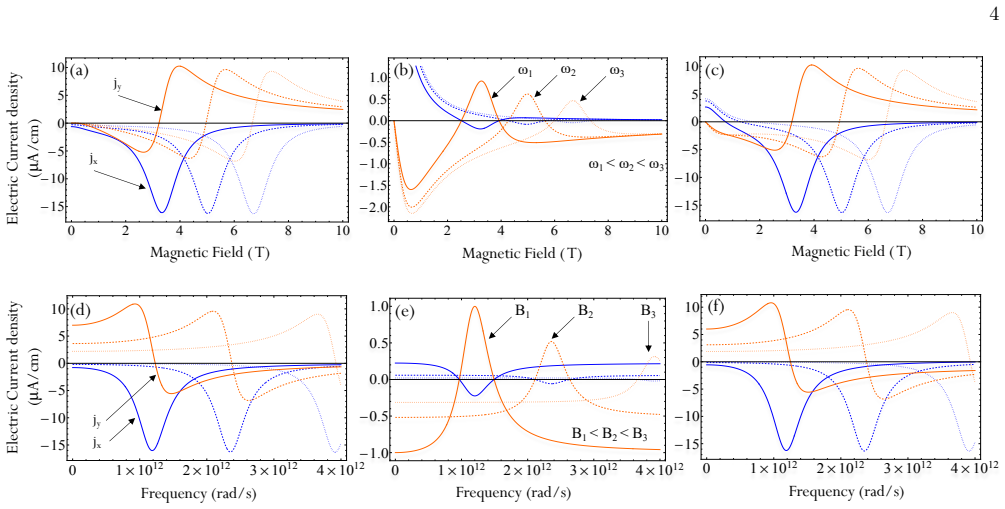
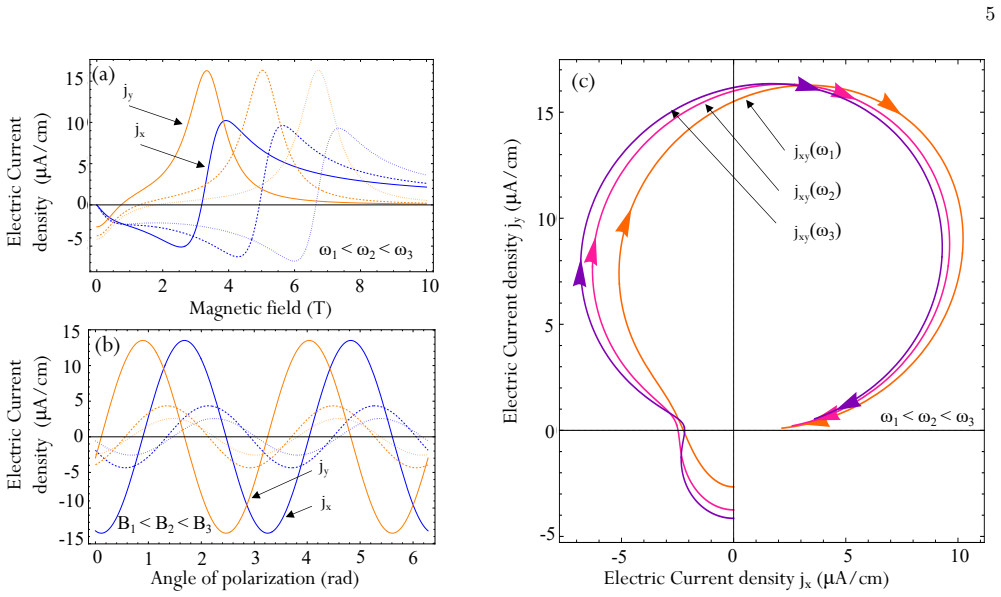
We predict a giant cyclotron resonance in the nonlinear valley Hall response of inversion-asymmetric two-dimensional semiconductors subjected to crossed terahertz electric and static magnetic fields. By employing a two-band Hamiltonian that incorporates both linear and quadratic in momentum terms, thereby capturing the essential orbital texture and broken inversion symmetry, we develop a kinetic theory that accounts for antisymmetric skew scattering from impurities. Solving the Boltzmann transport equation we uncover resonant photocurrents that exhibit a sharp, polarity-switching cyclotron peak and a nontrivial polarization response dictated by the underlying D3h crystal symmetry.
What carries the argument
Two-band Hamiltonian with linear and quadratic momentum terms combined with antisymmetric skew scattering in the solution of the Boltzmann transport equation
If this is right
- The position of the cyclotron resonance peak scales with the magnetic field strength, allowing frequency tuning.
- The photocurrent polarity reverses upon reversal of the magnetic field direction.
- The polarization dependence of the response is governed by the D3h symmetry of the crystal.
- The mechanism is universal for inversion-asymmetric 2D Dirac semiconductors and directly testable in monolayer TMDs.
Where Pith is reading between the lines
- This resonant effect could enable the design of magnetically tunable terahertz valley current generators or detectors.
- Similar skew-scattering resonances might be observable in other nonlinear transport coefficients in 2D materials with broken inversion symmetry.
- Extending the model to include electron-electron interactions could reveal additional many-body contributions to the resonance.
Load-bearing premise
The essential physics of the orbital texture and the nonlinear response is captured by the two-band Hamiltonian with linear and quadratic terms and by impurity skew scattering as the dominant mechanism.
What would settle it
A measurement showing a sharp peak in the valley Hall current whose frequency position is proportional to the applied magnetic field, and whose sign flips with the direction of the magnetic field, in an experiment on a monolayer transition metal dichalcogenide under crossed terahertz and static magnetic fields.
Figures

read the original abstract
We predict a giant cyclotron resonance in the nonlinear valley Hall response of inversion-asymmetric two-dimensional semiconductors subjected to crossed terahertz electric and static magnetic fields. By employing a two-band Hamiltonian that incorporates both linear and quadratic in momentum terms, thereby capturing the essential orbital texture and broken inversion symmetry, we develop a kinetic theory that accounts for antisymmetric skew scattering from impurities. Solving the Boltzmann transport equation we uncover resonant photocurrents that exhibit a sharp, polarity-switching cyclotron peak and a nontrivial polarization response dictated by the underlying D3h crystal symmetry. Our results establish a universal mechanism for frequency-selective, phase-sensitive valley current control, directly accessible in monolayer transition metal dichalcogenides. This work provides a pathway for harnessing resonant nonlinear transport in valleytronic and terahertz optoelectronic devices.
Editorial analysis
A structured set of objections, weighed in public.
Referee Report
Summary. The manuscript predicts a giant cyclotron resonance in the nonlinear valley Hall response of inversion-asymmetric two-dimensional Dirac semiconductors under crossed terahertz electric and static magnetic fields. A two-band k·p Hamiltonian incorporating linear and quadratic momentum terms is used to capture orbital texture and broken inversion symmetry. A kinetic theory based on the Boltzmann transport equation with antisymmetric skew scattering from impurities is solved, yielding resonant photocurrents that exhibit a sharp, polarity-switching peak at the cyclotron frequency together with a nontrivial polarization dependence enforced by D3h crystal symmetry. The results are framed as a universal mechanism for frequency-selective, phase-sensitive valley-current control, with direct relevance to monolayer transition-metal dichalcogenides.
Significance. If the central derivation holds, the work identifies a resonant nonlinear transport channel that combines magnetic-field tuning with THz driving to produce polarity-switchable valley currents. This supplies a concrete, symmetry-constrained prediction that could be tested in TMD monolayers and offers a pathway toward frequency-selective valleytronic elements in the THz range. The approach rests on standard tools (two-band k·p + Boltzmann kinetics) yet produces a nontrivial resonance that is not obvious a priori.
minor comments (3)
- [Abstract] The abstract and introduction repeatedly describe the resonance as 'giant' without a quantitative benchmark (e.g., ratio to the linear-response valley Hall conductivity or to the scale set by the Fermi velocity and scattering time). Adding such a comparison, even in a single sentence or figure, would make the claim more precise.
- The polarization dependence is stated to follow from D3h symmetry, but the explicit form of the allowed tensor components (or the corresponding selection rules for the nonlinear current) is not summarized in the main text. A short table or equation listing the non-zero elements would improve readability.
- Numerical plots of the photocurrent versus frequency and magnetic field are presumably present; the figure captions should explicitly state the values of the effective mass, impurity density, and relaxation time used so that readers can reproduce the resonance position and width.
Simulated Author's Rebuttal
We thank the referee for their supportive summary and recommendation of minor revision. The referee's description accurately reflects the central prediction of a giant cyclotron resonance in the nonlinear valley Hall photocurrent arising from skew scattering in our two-band model. No specific major comments were provided in the report.
Circularity Check
No significant circularity; derivation is forward from Hamiltonian via Boltzmann equation
full rationale
The paper's central claim is a theoretical prediction obtained by starting from an explicit two-band k·p Hamiltonian (linear plus quadratic momentum terms) that encodes the orbital texture and inversion asymmetry, then solving the Boltzmann transport equation with antisymmetric impurity skew scattering under crossed THz E and static B fields. This produces resonant photocurrents whose cyclotron peak and D3h polarization dependence follow directly from the stated model and scattering asymmetry. No step reduces by construction to a fitted parameter renamed as prediction, no self-citation supplies a uniqueness theorem or ansatz, and the result is not equivalent to its inputs. The chain is a standard, self-contained forward calculation whose output (resonant valley Hall current) is not presupposed by the inputs.
Axiom & Free-Parameter Ledger
axioms (2)
- domain assumption Two-band Hamiltonian with linear and quadratic momentum terms captures essential orbital texture and broken inversion symmetry
- domain assumption Antisymmetric skew scattering from impurities dominates the nonlinear valley Hall response
Lean theorems connected to this paper
-
IndisputableMonolith/Cost/FunctionalEquation.leanwashburn_uniqueness_aczel unclear?
unclearRelation between the paper passage and the cited Recognition theorem.
two-band Hamiltonian ... hp = v p_- + (1/m) p_+² ... skew scattering ... Boltzmann transport equation ... cyclotron resonance
-
IndisputableMonolith/Foundation/AlexanderDuality.leanalexander_duality_circle_linking unclear?
unclearRelation between the paper passage and the cited Recognition theorem.
D3h symmetry ... nonlinear valley Hall ... skew scattering W^a_p',p
What do these tags mean?
- matches
- The paper's claim is directly supported by a theorem in the formal canon.
- supports
- The theorem supports part of the paper's argument, but the paper may add assumptions or extra steps.
- extends
- The paper goes beyond the formal theorem; the theorem is a base layer rather than the whole result.
- uses
- The paper appears to rely on the theorem as machinery.
- contradicts
- The paper's claim conflicts with a theorem or certificate in the canon.
- unclear
- Pith found a possible connection, but the passage is too broad, indirect, or ambiguous to say the theorem truly supports the claim.
Reference graph
Works this paper leans on
-
[1]
B. I. Sturman and V. M. Fridkin,The Photovoltaic and Photorefractive Effects in Non-centrosymmetric Materi- als(Gordon and Breach, New York, 1992)
work page 1992
-
[2]
E. L. Ivchenko,Optical Spectroscopy of Semiconductor Nanostructures(Alpha Science International, Harrow, UK, 2005)
work page 2005
-
[3]
S. D. Ganichev and W. Prettl,Intense Terahertz Ex- citation of Semiconductors(Oxford University Press, Oxford, 2006)
work page 2006
-
[4]
K. Das, K. Ghorai, D. Culcer, and A. Agarwal, Phys. Rev. Lett.132, 096302 (2024)
work page 2024
-
[5]
S. Wang, W. Niu, and Y.-W. Fang, Microstructures5, 10.20517/microstructures.2024.129 (2025)
-
[6]
A. Bandyopadhyay, N. B. Joseph, and A. Narayan, Ma- terials Today Electronics8, 100101 (2024)
work page 2024
- [7]
-
[8]
M. M. Glazov and L. E. Golub, Phys. Rev. B102, 155302 (2020)
work page 2020
- [9]
-
[10]
L. Min, H. Tan, Z. Xie, L. Miao, R. Zhang, S. H. Lee, V. Gopalan, C.-X. Liu, N. Alem, B. Yan, and Z. Mao, Nature Communications14, 364 (2023)
work page 2023
- [11]
-
[12]
K. F. Mak, K. L. McGill, J. Park, and P. L. McEuen, Science344, 1489 (2014)
work page 2014
-
[13]
I. Wojciechowska and A. Dyrda l, Scientific Reports14, 23808 (2024)
work page 2024
- [14]
-
[15]
M. M. Glazov and L. E. Golub, Phys. Rev. Lett.125, 157403 (2020)
work page 2020
-
[16]
Z. Z. Du, C. M. Wang, S. Li, H.-Z. Lu, and X. C. Xie, Nature Communications10, 3047 (2019)
work page 2019
-
[17]
Z. Z. Du, C. M. Wang, H.-P. Sun, H.-Z. Lu, and X. C. Xie, Nature Communications12, 5038 (2021)
work page 2021
-
[18]
M. S. Okyay, M. Choi, Q. Xu, A. P. Di´ eguez, M. Del Ben, K. Z. Ibrahim, and B. M. Wong, npj 2D Materials and Applications9, 1 (2025)
work page 2025
- [19]
-
[20]
J. Lee, W. Heo, M. Cha, K. Watanabe, T. Taniguchi, J. Kim, S. Cha, D. Kim, M.-H. Jo, and H. Choi, Nature Communications12, 1635 (2021)
work page 2021
-
[21]
J. Yin, C. Tan, D. Barcons-Ruiz, I. Torre, K. Watanabe, T. Taniguchi, J. C. W. Song, J. Hone, and F. H. L. Koppens, Science375, 1398 (2022)
work page 2022
-
[22]
M. D. Blokh and L. I. Magarill, Soviet Physics - Solid State22(1980)
work page 1980
-
[23]
E. L. Ivchenko, Y. B. Lyanda-Geller, G. E. Pikus, and R. Y. Rasulov, Soviet Physics Semiconductors - USSR 18, 55 (1984)
work page 1984
-
[24]
E. Deyo, L. E. Golub, E. L. Ivchenko, and B. Spivak, Semiclassical theory of the photogalvanic effect in non- centrosymmetric systems (2009), arXiv:0904.1917 [cond- mat.mes-hall]
work page Pith review arXiv 2009
-
[25]
P. Olbrich, J. Allerdings, V. V. Belkov, S. A. Tarasenko, D. Schuh, W. Wegscheider, T. Korn, C. Schuller, D. Weiss, and S. D. Ganichev, Physical Review B79, 10.1103/physrevb.79.245329 (2009)
- [26]
-
[27]
V. V. Belkov, S. D. Ganichev, E. L. Ivchenko, S. A. Tarasenko, W. Weber, S. Giglberger, M. Olteanu, H.-P. Tranitz, S. N. Danilov, P. Schneider, W. Wegscheider, D. Weiss, and W. Prettl, Journal of Physics: Condensed Matter17, 3405 (2005)
work page 2005
-
[28]
See Supplemental Material at [URL] for details of the analysis of all the relevant contributions
-
[29]
J. Liu, Y. Ma, F. Chi, L. Chao, and J. Niu, Optics Express31, 12026 (2023)
work page 2023
-
[30]
V. M. Kovalev, A. V. Parafilo, O. V. Kibis, and I. G. Savenko, Phys. Rev. B109, 245414 (2024)
work page 2024
discussion (0)
Sign in with ORCID, Apple, or X to comment. Anyone can read and Pith papers without signing in.