Hagenberg Risk Management Process (Part 3): Operationalization, Probabilities, and Causal Analysis
Pith reviewed 2026-05-10 17:33 UTC · model grok-4.3
The pith
Bowtie risk diagrams convert into probabilistic DAGs that support Bayesian inference and causal interventions.
A machine-rendered reading of the paper's core claim, the machinery that carries it, and where it could break.
Core claim
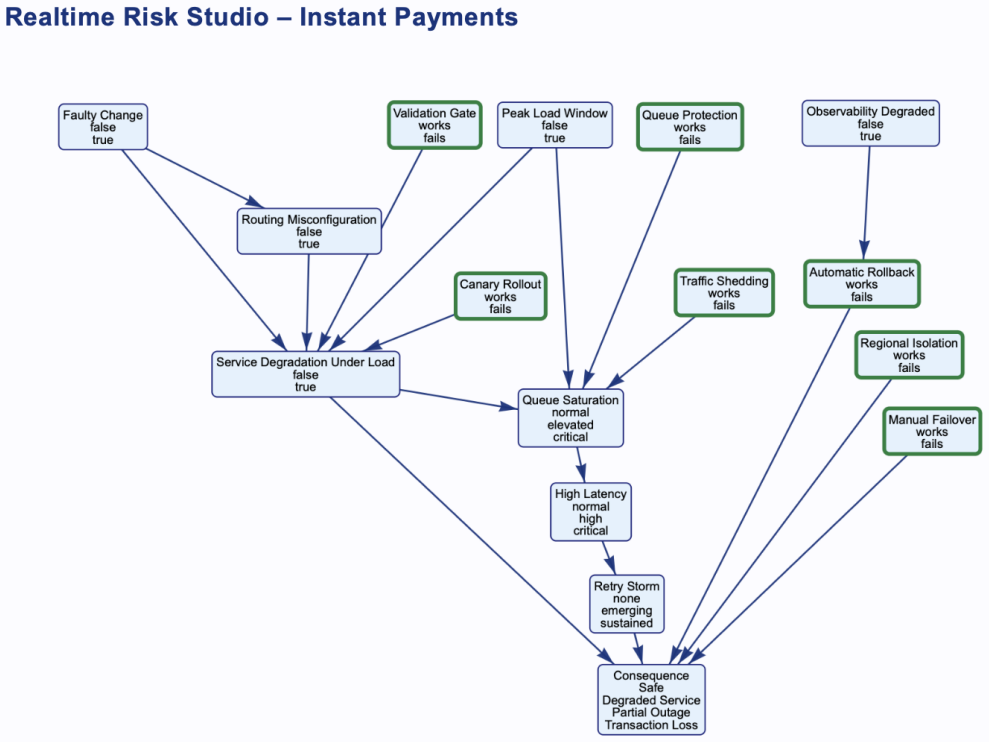
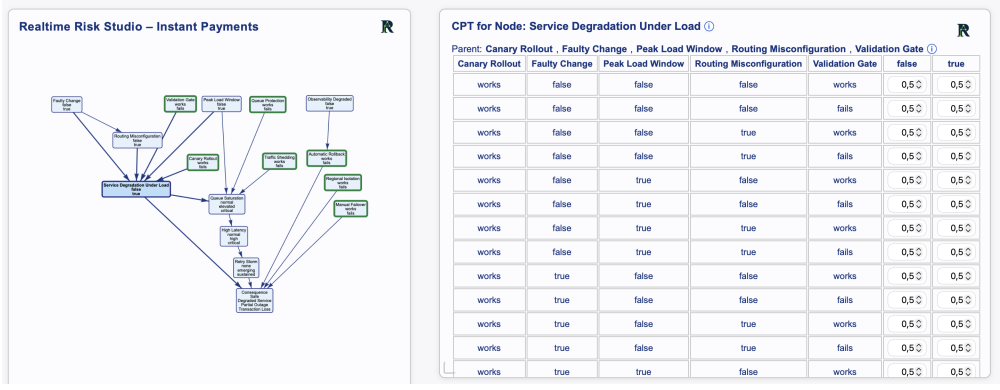
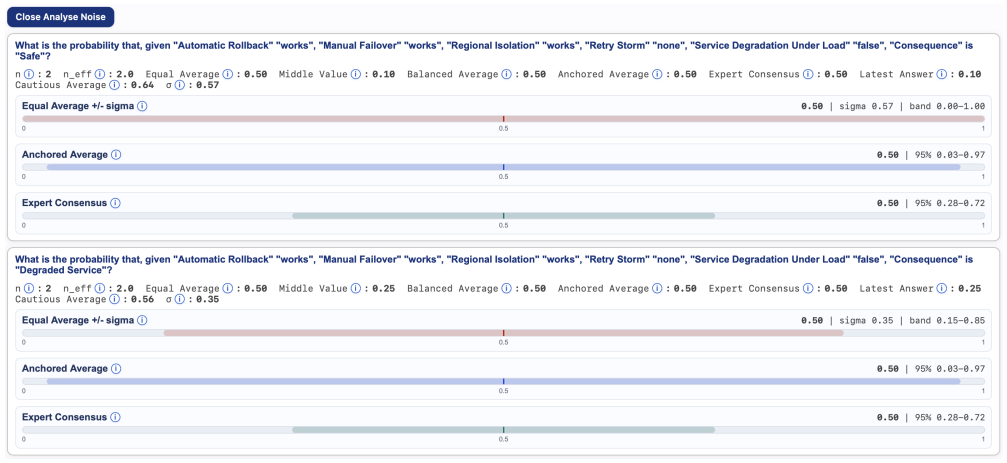
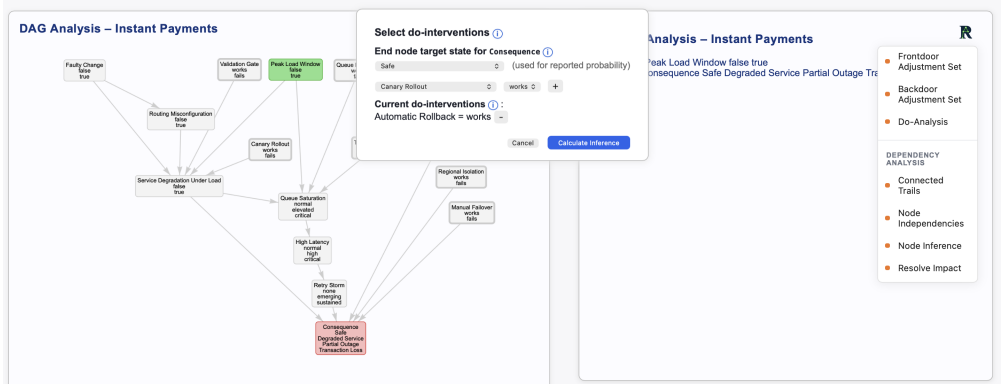
The Hagenberg Risk Management Process transforms Bowtie structures of causes, top events, barriers, and consequences into a DAG suitable for Bayesian inference. Realtime Risk Studio adds explicit safe-state semantics and designates Activation Nodes as intervention points. Probability Capture generates expert questionnaires, aggregates conditional probabilities despite disagreement using descriptive and prior-regularized methods, and enables causal analysis via d-separation, adjustment sets, do-calculus, and impact searches. The workflow is shown on a payments gateway without statistical validation, positioning the contribution as a method and prototype system.
What carries the argument
Bowtie-to-DAG transformation in Realtime Risk Studio, which converts qualitative structures into Bayesian networks while preserving risk elements and adding safe-state and activation-node semantics.
If this is right
- Risks that cannot be accepted or mitigated become continuously observable through runtime probabilistic models.
- Expert disagreements on probabilities become quantifiable and manageable via dispersion analysis and regularization.
- Causal what-if analysis using do-calculus identifies effective interventions at Activation Nodes.
- Models distinguish safe states explicitly from risk states for clearer operational decisions.
Where Pith is reading between the lines
- The approach could support live data integration to update probabilities automatically beyond expert input alone.
- It opens pathways for combining the method with observed incident data to refine causal estimates over time.
- Similar transformations might apply to Bowtie use in safety-critical engineering fields outside cybersecurity.
Load-bearing premise
Qualitative Bowtie structures can be turned into DAGs that retain essential risk meaning for Bayesian use, and expert probability estimates can be aggregated reliably even when experts disagree.
What would settle it
Apply the full workflow to a risk scenario with independently measured outcome probabilities and check whether the model's Bayesian inferences and recommended interventions align with the observed data.
Figures
read the original abstract
For risks that cannot be accepted, sufficiently mitigated, or eliminated, continuous observation is a viable approach but requires a model that can be operationalized. The Hagenberg Risk Management Process bridges this gap between qualitative risk analysis, using contextualized polar heatmaps (triage), and realtime risk management by extending Bowtie diagrams into a formal probabilistic runtime model. We introduce Realtime Risk Studio, a domain-specific modeling tool that (i) transforms Bowtie structures (causes, top event, barriers, consequences) into a directed acyclic graph (DAG) suitable for Bayesian inference, (ii) adds explicit safe-state semantics, and (iii) designates Activation Nodes as intervention points. Bowtie models are qualitative; however, Bayesian inference requires actual probabilities. As a second contribution, we present Probability Capture, a tool that complements our Realtime Risk Studio by automatically generating questionnaires from a DAG model so experts can provide estimates. The tool analyzes disagreement and aggregates conditional-probability assessments using both descriptive dispersion analysis and prior-regularized methods. Causal analysis can then provide insights into the DAG model, for example, via d-separation, adjustment-set inspection, do-calculus for what-if analysis, local independence checks, evidence updating, and impact-oriented searches for effective interventions. This workflow is illustrated with an instant-payments gateway scenario, demonstrating (a) explicit safe-state semantics, (b) Bowtie-to-DAG operationalization, (c) probability capture with visible expert noise, and (d) causal what-if analysis on a transformed and enriched model. Rather than presenting a statistical validation, the paper contributes a method and prototype system that transforms partially mitigated risks into observable, probabilistic, and intervention-ready models.
Editorial analysis
A structured set of objections, weighed in public.
Referee Report
Summary. The paper presents the Hagenberg Risk Management Process as a method to operationalize qualitative Bowtie risk diagrams into formal probabilistic runtime models. It introduces Realtime Risk Studio, which transforms Bowtie elements (causes, top event, barriers, consequences) into DAGs for Bayesian inference while adding safe-state semantics and Activation Nodes as intervention points. A complementary Probability Capture tool generates expert questionnaires from the DAG, analyzes disagreement via dispersion and prior-regularized aggregation, and supports causal analysis (d-separation, do-calculus, adjustment sets). The workflow is illustrated with an instant-payments gateway scenario demonstrating explicit safe states, Bowtie-to-DAG conversion, visible expert noise, and what-if interventions. The contribution is explicitly methodological and prototype-based, without statistical validation.
Significance. If the Bowtie-to-DAG mapping preserves barrier logic and independence structure, and if expert aggregation proves reliable, the approach could provide a practical bridge from static qualitative risk assessment to observable, intervention-ready probabilistic models in operational settings such as financial gateways. The explicit inclusion of safe-state semantics and Activation Nodes, together with integrated causal tools, strengthens the potential utility for real-time risk monitoring.
major comments (1)
- [Abstract and Realtime Risk Studio] Abstract and Realtime Risk Studio section: The central claim requires that Bowtie structures can be converted into a DAG whose CPTs and d-separation structure support valid Bayesian inference and do-calculus. No explicit mapping algorithm, parent-child rules for barriers, or CPT construction procedure is supplied; the instant-payments example demonstrates the result but does not show how AND/OR barrier combinations or multi-pathway logic are encoded. Without these rules it is impossible to confirm that the resulting network recovers the original risk-pathway independencies or that interventions remain semantically faithful.
Simulated Author's Rebuttal
We thank the referee for the constructive feedback and for recognizing the methodological focus of the work. We address the single major comment below and will revise the manuscript to provide the requested formal details.
read point-by-point responses
-
Referee: [Abstract and Realtime Risk Studio] Abstract and Realtime Risk Studio section: The central claim requires that Bowtie structures can be converted into a DAG whose CPTs and d-separation structure support valid Bayesian inference and do-calculus. No explicit mapping algorithm, parent-child rules for barriers, or CPT construction procedure is supplied; the instant-payments example demonstrates the result but does not show how AND/OR barrier combinations or multi-pathway logic are encoded. Without these rules it is impossible to confirm that the resulting network recovers the original risk-pathway independencies or that interventions remain semantically faithful.
Authors: We agree that an explicit, step-by-step mapping algorithm is needed to allow readers to verify preservation of barrier logic, independence structure, and intervention semantics. The current Realtime Risk Studio section and the instant-payments example describe the conceptual transformation and resulting DAG but do not supply formal parent-child rules or a CPT-construction procedure for AND/OR combinations and multi-pathway logic. In the revised manuscript we will insert a new subsection that (i) states the parent-child assignment rules for each Bowtie element, (ii) provides pseudocode for encoding barrier logic (including how AND/OR gates become deterministic or noisy-OR CPTs), (iii) shows how d-separation in the resulting DAG corresponds to the original risk-pathway independencies, and (iv) confirms that do-calculus interventions on Activation Nodes remain faithful to the safe-state semantics. These additions will make the conversion reproducible and the causal claims verifiable. revision: yes
Circularity Check
No circularity: methodological extension of standard techniques
full rationale
The paper introduces a new workflow and prototype tools (Realtime Risk Studio, Probability Capture) for transforming qualitative Bowtie diagrams into DAGs, adding safe-state semantics and Activation Nodes, then applying standard Bayesian inference, d-separation, do-calculus, and expert aggregation methods. No equations, fitted parameters, or predictions are defined in terms of themselves. The central claims rest on the explicit description of the transformation process and its illustration in the instant-payments example rather than on self-referential derivations or load-bearing self-citations. Prior parts of the Hagenberg process are referenced only for context; the operationalization, probability capture, and causal analysis steps are presented as independent contributions built on external standards (Bowtie diagrams, Bayesian networks, Pearl's causal framework). This is a self-contained method paper with no reduction of results to inputs by construction.
Axiom & Free-Parameter Ledger
axioms (2)
- domain assumption Bowtie diagrams can be represented as directed acyclic graphs suitable for Bayesian inference
- domain assumption Expert estimates of conditional probabilities can be reliably elicited via questionnaires and aggregated despite disagreement
invented entities (3)
-
Activation Nodes
no independent evidence
-
Realtime Risk Studio
no independent evidence
-
Probability Capture
no independent evidence
Reference graph
Works this paper leans on
-
[1]
E. Hermann and H. Lampesberger, “Hagenberg Risk Management Process (Part 1): Multidimensional Polar Heatmaps for Context-Sensitive Risk Analysis,”arXiv:2601.07644, 2026
-
[2]
E. Hermann and H. Lampesberger, “Hagenberg Risk Management Process (Part 2): From Context-Sensitive Triage to Case Analysis With Bowtie and Bayesian Networks,”arXiv:2602.19270, 2026
-
[3]
European Union, “Regulation (EU) 2022/2554 of the European Parlia- ment and of the Council of 14 December 2022 on digital operational resilience for the financial sector (DORA),”Official Journal L 333, 2022
work page 2022
-
[4]
Information Security Continuous Monitoring (ISCM) for Federal Information Systems and Organizations,
K. L. Dempsey, N. S. Chawla, L. A. Johnson, R. Johnston, A. C. Jones, A. D. Orebaugh, M. A. Scholl, and K. M. Stine, “Information Security Continuous Monitoring (ISCM) for Federal Information Systems and Organizations,” NIST Special Publication 800-137, 2011
work page 2011
-
[5]
A. de Ruijter and F. Guldenmund, “The bowtie method: A review,” Safety Science, vol. 88, pp. 211–218, 2016
work page 2016
-
[6]
IEC 31010:2019 Risk management—Risk assessment techniques,
International Electrotechnical Commission, “IEC 31010:2019 Risk management—Risk assessment techniques,” IEC Standard, 2019
work page 2019
-
[7]
Dynamic safety analysis of process systems by mapping bow-tie into Bayesian network,
N. Khakzad, F. Khan, and P. Amyotte, “Dynamic safety analysis of process systems by mapping bow-tie into Bayesian network,”Process Safety and Environmental Protection, vol. 91, no. 1–2, pp. 46–53, 2013
work page 2013
-
[8]
Dynamic risk analysis using bow-tie approach,
N. Khakzad, F. Khan, and P. Amyotte, “Dynamic risk analysis using bow-tie approach,”Reliability Engineering & System Safety, vol. 104, pp. 36–44, 2012
work page 2012
-
[9]
pyBNBowtie: Python library for Bow-Tie Analysis based on Bayesian Networks,
F. T. Zurheide, E. Hermann, and H. Lampesberger, “pyBNBowtie: Python library for Bow-Tie Analysis based on Bayesian Networks,” Procedia Computer Science, vol. 180, pp. 344–351, 2021
work page 2021
-
[10]
D. Koller and N. Friedman,Probabilistic Graphical Models: Principles and Techniques. Cambridge, MA, USA: MIT Press, 2009
work page 2009
-
[11]
N. Fenton and M. Neil,Risk Assessment and Decision Analysis with Bayesian Networks, 2nd ed. Boca Raton, FL, USA: CRC Press, 2018
work page 2018
-
[12]
Pearl,Causality: Models, Reasoning, and Inference, 2nd ed
J. Pearl,Causality: Models, Reasoning, and Inference, 2nd ed. Cam- bridge, U.K.: Cambridge Univ. Press, 2009
work page 2009
-
[13]
Robust causal inference using directed acyclic graphs: the R package ‘dagitty’,
J. Textor, B. van der Zander, M. S. Gilthorpe, M. Li ´skiewicz, and G. T. H. Ellison, “Robust causal inference using directed acyclic graphs: the R package ‘dagitty’,”International Journal of Epidemiology, vol. 45, no. 6, pp. 1887–1894, 2016
work page 2016
-
[14]
pgmpy: A Python Toolkit for Bayesian Networks,
A. Ankan and J. Textor, “pgmpy: A Python Toolkit for Bayesian Networks,”Journal of Machine Learning Research, vol. 25, no. 265, pp. 1–8, 2024
work page 2024
-
[15]
Learning Bayesian Networks with the bnlearn R Package,
M. Scutari, “Learning Bayesian Networks with the bnlearn R Package,” Journal of Statistical Software, vol. 35, no. 3, pp. 1–22, 2010
work page 2010
-
[16]
M. J. Druzdzel, “SMILE: Structural Modeling, Inference, and Learn- ing Engine and GeNIe: A Development Environment for Graphical Decision-Theoretic Models,” inProc. AAAI/IAAI, 1999, pp. 902–903
work page 1999
-
[17]
The Hugin Tool for Learning Bayesian Networks,
A. L. Madsen, M. Lang, U. B. Kjærulff, and F. Jensen, “The Hugin Tool for Learning Bayesian Networks,” inSymbolic and Quantitative Ap- proaches to Reasoning with Uncertainty, T. D. Nielsen and N. L. Zhang, Eds. Berlin, Germany: Springer, 2003, pp. 594–605
work page 2003
-
[18]
ISO 31000:2018 Risk management—Guidelines,
International Organization for Standardization, “ISO 31000:2018 Risk management—Guidelines,” ISO Standard, 2018
work page 2018
-
[19]
A Bayesian approach to construct bow tie diagrams for risk evaluation,
A. Badreddine and N. Ben Amor, “A Bayesian approach to construct bow tie diagrams for risk evaluation,”Process Safety and Environmental Protection, vol. 91, no. 3, pp. 159–171, 2013
work page 2013
-
[20]
T. Vairo, A. C. Benvenuto, A. Tedeschi, A. P. Reverberi, and B. Fabiano, “Make Bow-tie Dynamic by Rethinking It as a Hierarchical Bayesian Network: Dynamic Risk Assessment of an LNG Bunkering Operation,” Chemical Engineering Transactions, vol. 91, pp. 277–282, 2022
work page 2022
-
[21]
A situation risk awareness approach for process systems safety,
M. Naderpour, J. Lu, and G. Zhang, “A situation risk awareness approach for process systems safety,”Safety Science, vol. 64, pp. 173–189, 2014
work page 2014
-
[22]
A framework for dynamic risk assess- ment with condition monitoring data and inspection data,
J. Xing, Z. Zeng, and E. Zio, “A framework for dynamic risk assess- ment with condition monitoring data and inspection data,”Reliability Engineering & System Safety, vol. 191, p. 106552, 2019
work page 2019
-
[23]
R. Moradi, S. Cofre-Martel, E. Lopez Droguett, M. Modarres, and K. M. Groth, “Integration of deep learning and Bayesian networks for condition and operation risk monitoring of complex engineering systems,”Reliability Engineering & System Safety, vol. 222, p. 108433, 2022
work page 2022
-
[24]
R. Moradi, A. Ruiz-Tagle Palazuelos, E. Lopez Droguett, and K. M. Groth, “Toward a framework for risk monitoring of complex engineering systems with online operational data: A deep learning-based solution,”Proceedings of the Institution of Mechanical Engineers, Part O: Journal of Risk and Reliability, vol. 237, no. 5, pp. 910–921, 2023
work page 2023
-
[25]
The future of risk assessment,
E. Zio, “The future of risk assessment,”Reliability Engineering & System Safety, vol. 177, pp. 176–190, 2018
work page 2018
-
[26]
Overview on Bayesian networks applications for dependability, risk analysis and maintenance areas,
P. Weber, G. Medina-Oliva, C. Simon, and B. Iung, “Overview on Bayesian networks applications for dependability, risk analysis and maintenance areas,”Engineering Applications of Artificial Intelligence, vol. 25, no. 4, pp. 671–682, 2012
work page 2012
-
[27]
Bayesian networks in reliability,
H. Langseth and L. Portinale, “Bayesian networks in reliability,”Relia- bility Engineering & System Safety, vol. 92, no. 1, pp. 92–108, 2007
work page 2007
-
[28]
S. Kabir and Y . Papadopoulos, “Applications of Bayesian networks and Petri nets in safety, reliability, and risk assessments: A review,”Safety Science, vol. 115, pp. 154–175, 2019
work page 2019
-
[29]
P. G. George and V . R. Renjith, “Evolution of Safety and Security Risk Assessment methodologies towards the use of Bayesian Networks in Process Industries,”Process Safety and Environmental Protection, vol. 149, pp. 758–775, 2021
work page 2021
-
[30]
B. Cai, Y . Liu, Z. Liu, X. Tian, Y . Zhang, and R. Ji, “Application of Bayesian Networks in Quantitative Risk Assessment of Subsea Blowout Preventer Operations,”Risk Analysis, vol. 33, no. 7, pp. 1293–1311, 2013
work page 2013
-
[31]
A Bayesian Networks approach to Operational Risk,
V . Aquaro, M. Bardoscia, R. Bellotti, A. Consiglio, F. De Carlo, and G. Ferri, “A Bayesian Networks approach to Operational Risk,”Physica A: Statistical Mechanics and its Applications, vol. 389, no. 8, pp. 1721– 1728, 2010
work page 2010
-
[32]
N. Cornwell, C. Bilson, A. Gepp, S. Stern, and B. J. Vanstone, “Modernising operational risk management in financial institutions via data-driven causal factors analysis: A pre-registered study,”Pacific-Basin Finance Journal, vol. 79, p. 102011, 2023
work page 2023
-
[33]
A. O’Hagan, C. E. Buck, A. Daneshkhah, J. R. Eiser, P. H. Garthwaite, D. J. Jenkinson, J. E. Oakley, and T. Rakow,Uncertain Judgements: Eliciting Experts’ Probabilities. Chichester, U.K.: Wiley, 2006
work page 2006
-
[34]
C. Werner, T. Bedford, R. M. Cooke, A. M. Hanea, and O. Morales- Nápoles, “Expert judgement for dependence in probabilistic modelling: A systematic literature review and future research directions,”European Journal of Operational Research, vol. 258, no. 3, pp. 801–819, 2017
work page 2017
-
[35]
A proposed validation framework for expert elicited Bayesian Networks,
J. Pitchforth and K. Mengersen, “A proposed validation framework for expert elicited Bayesian Networks,”Expert Systems with Applications, vol. 40, no. 1, pp. 162–167, 2013
work page 2013
-
[36]
Sensitivity and ro- bustness analysis in Bayesian networks with the bnmonitor R package,
M. Leonelli, R. Ramanathan, and R. L. Wilkerson, “Sensitivity and ro- bustness analysis in Bayesian networks with the bnmonitor R package,” Knowledge-Based Systems, vol. 278, p. 110882, 2023
work page 2023
-
[37]
Pearl,Probabilistic Reasoning in Intelligent Systems: Networks of Plausible Inference
J. Pearl,Probabilistic Reasoning in Intelligent Systems: Networks of Plausible Inference. San Mateo, CA, USA: Morgan Kaufmann, 1988
work page 1988
-
[38]
Darwiche,Modeling and Reasoning with Bayesian Networks
A. Darwiche,Modeling and Reasoning with Bayesian Networks. Cam- bridge, U.K.: Cambridge Univ. Press, 2009
work page 2009
-
[39]
S. L. Lauritzen and D. J. Spiegelhalter, “Local computations with probabilities on graphical structures and their application to expert systems,”Journal of the Royal Statistical Society: Series B, vol. 50, no. 2, pp. 157–224, 1988
work page 1988
-
[40]
P. Spirtes, C. Glymour, and R. Scheines,Causation, Prediction, and Search, 2nd ed. Cambridge, MA, USA: MIT Press, 2000
work page 2000
-
[41]
Causal discovery and inference: concepts and recent methodological advances,
P. Spirtes and K. Zhang, “Causal discovery and inference: concepts and recent methodological advances,”Applied Informatics, vol. 3, Art. no. 3, 2016
work page 2016
-
[42]
Review of causal discovery methods based on graphical models,
C. Glymour, K. Zhang, and P. Spirtes, “Review of causal discovery methods based on graphical models,”Frontiers in Genetics, vol. 10, p. 524, 2019
work page 2019
-
[43]
Causal Inference Using Graphical Models with the R Package pcalg,
M. Kalisch, M. Mächler, D. Colombo, M. H. Maathuis, and P. Bühlmann, “Causal Inference Using Graphical Models with the R Package pcalg,”Journal of Statistical Software, vol. 47, no. 11, pp. 1– 26, 2012
work page 2012
-
[44]
Identifying Causal Effects with the R Package causaleffect,
S. Tikka and J. Karvanen, “Identifying Causal Effects with the R Package causaleffect,”Journal of Statistical Software, vol. 76, no. 12, pp. 1–30, 2017
work page 2017
-
[45]
Causal-learn: Causal Discovery in Python,
Y . Zheng, B. Huang, W. Chen, J. Ramsey, M. Gong, R. Cai, S. Shimizu, P. Spirtes, and K. Zhang, “Causal-learn: Causal Discovery in Python,” Journal of Machine Learning Research, vol. 25, no. 60, pp. 1–7, 2024
work page 2024
-
[46]
Causal Discovery Toolbox: Uncovering causal relationships in Python,
D. Kalainathan, O. Goudet, and R. Dutta, “Causal Discovery Toolbox: Uncovering causal relationships in Python,”Journal of Machine Learn- ing Research, vol. 21, no. 37, pp. 1–5, 2020
work page 2020
-
[47]
Python package for causal discovery based on LiNGAM,
T. Ikeuchi, M. Ide, Y . Zeng, T. N. Maeda, and S. Shimizu, “Python package for causal discovery based on LiNGAM,”Journal of Machine Learning Research, vol. 24, no. 14, pp. 1–8, 2023
work page 2023
-
[48]
Huntington-Klein,The Effect: An Introduction to Research Design and Causality
N. Huntington-Klein,The Effect: An Introduction to Research Design and Causality. Boca Raton, FL, USA: CRC Press, 2021
work page 2021
-
[49]
D. Kahneman, O. Sibony, and C. R. Sunstein,Noise: A Flaw in Human Judgment. New York, NY , USA: Little, Brown Spark, 2021
work page 2021
-
[50]
Black Swans and the Domains of Statistics,
N. N. Taleb, “Black Swans and the Domains of Statistics,”The American Statistician, vol. 61, no. 3, pp. 198–200, 2007
work page 2007
-
[51]
N. N. Taleb,The Black Swan: The Impact of the Highly Improbable, 2nd ed. New York, NY , USA: Random House Trade Paperbacks, 2010
work page 2010
discussion (0)
Sign in with ORCID, Apple, or X to comment. Anyone can read and Pith papers without signing in.