The causal relation between off-street parking and electric vehicle adoption in Scotland
Pith reviewed 2026-05-10 17:45 UTC · model grok-4.3
The pith
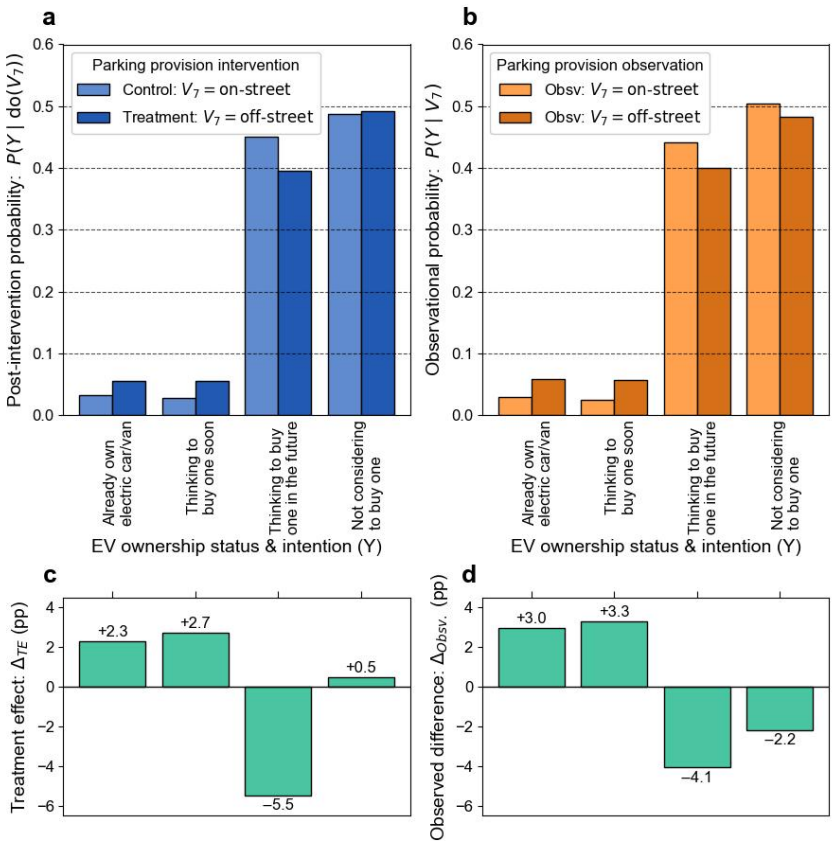
Access to private off-street parking raises the probability of electric vehicle ownership from 3.3% to 5.6%.
A machine-rendered reading of the paper's core claim, the machinery that carries it, and where it could break.
Core claim
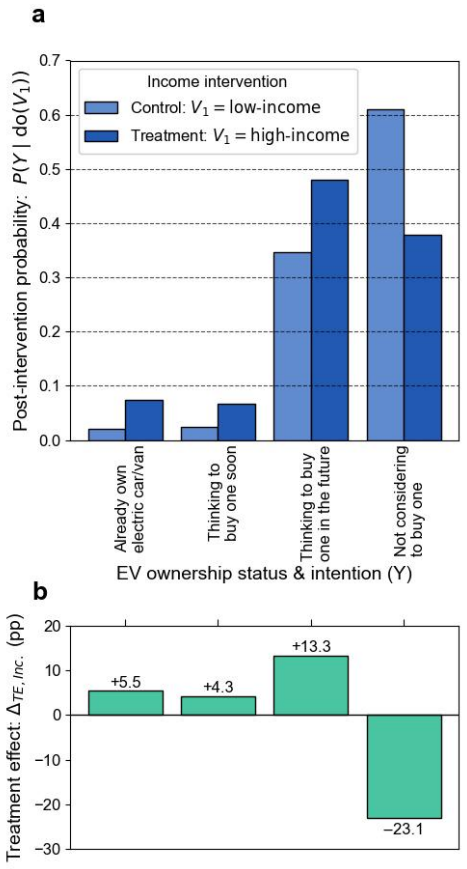
Private off-street parking functions as a conversion catalyst: enabling access to home-charging increases the probability of EV ownership from 3.3% to 5.6% (a 70% relative, 2.3 percentage point absolute increase). However, this effect primarily accelerates households already economically positioned to purchase an EV rather than recruiting new entrants. By contrast, household income operates as the fundamental affordability ceiling. A causal contrast between lower- and higher-income strata shows a reduction in market non-participation by 23.1 percentage points. The analysis demonstrates that standard observational models overstate the isolated effect of off-street parking infrastructure due 5
What carries the argument
Probabilistic causal framework that neutralizes confounding socio-economic factors to estimate the isolated effect of off-street parking access on EV ownership.
If this is right
- Financial instruments that lower the affordability ceiling can recruit new entrants into the EV market beyond what parking access alone achieves.
- Home-charging infrastructure policies should target the latent-intent cohort in high-density urban settings where off-street parking is scarce.
- Dual-track strategies are required: affordability support for non-participants paired with charging access for those ready to buy.
- Observational studies of infrastructure effects on adoption must apply causal adjustment to avoid overstating benefits.
Where Pith is reading between the lines
- The same causal separation of infrastructure access from income could be applied to public charging networks to test substitution effects.
- Longitudinal data tracking households before and after parking changes would confirm whether the conversion catalyst effect holds over time.
- The identified selection bias implies that correlational estimates in related mobility or energy-adoption domains may also require causal re-examination.
Load-bearing premise
The causal model successfully removes all relevant confounding influences and the household survey data contain no selection bias or measurement error that would alter the estimated effects.
What would settle it
A controlled comparison of EV purchase rates in households that gain or lose off-street parking while income and other measured traits stay fixed would show whether the 2.3-point lift persists or disappears.
Figures
read the original abstract
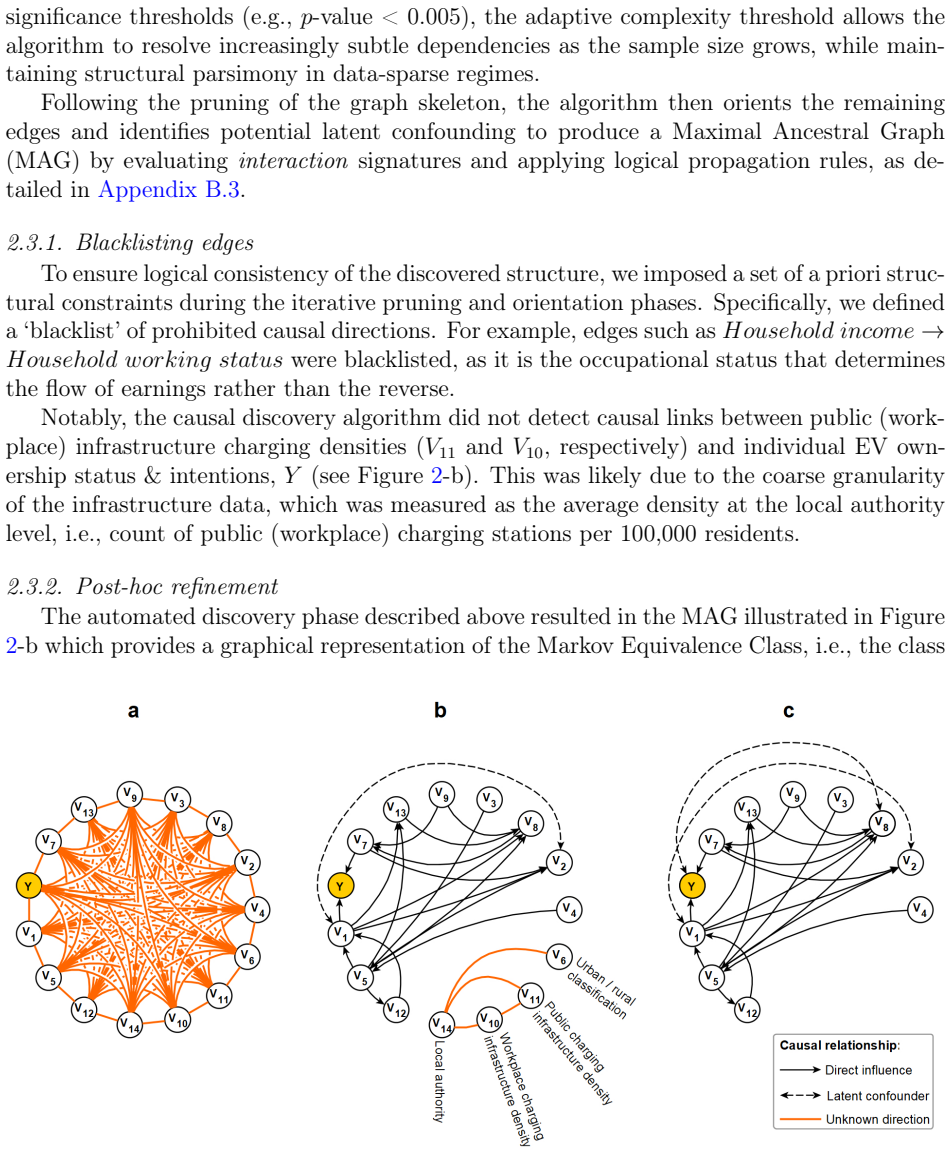
The transition to electric mobility hinges on maximising aggregate adoption while also facilitating equitable access. This study examines whether the 'charging divide' between households with and without off-street parking reflects a genuine infrastructure constraint or a by-product of socio-economic disparity. Moving beyond conventional predictive models, we apply a probabilistic causal framework to a nationally representative dataset of Scottish households, enabling estimation of policy interventions while explicitly neutralising the confounding effect of other causal factors. The results reveal a structural hierarchy in the EV adoption process. Private off-street parking functions as a conversion catalyst: enabling access to home-charging increases the probability of EV ownership from 3.3% to 5.6% (a 70% relative, 2.3 percentage point absolute increase). However, this effect primarily accelerates households already economically positioned to purchase an EV rather than recruiting new entrants. By contrast, household income operates as the fundamental affordability ceiling. A causal contrast between lower- and higher-income strata, shows a reduction in market non-participation by 23.1 percentage points, identifying financial capacity as the principal gatekeeper to entering the EV transition funnel. Crucially, the analysis demonstrates that standard observational models overstate the isolated effect of off-street parking infrastructure. The apparent effect emerges from selection bias: higher-income households are disproportionately likely to possess both private parking and the means to purchase EVs. These findings support a dual-track policy strategy: lowering the affordability ceiling for non-participants through financial instruments, while addressing EV home-charging access for the 'latent intent' cohort in high-density urban contexts.
Editorial analysis
A structured set of objections, weighed in public.
Referee Report
Summary. The manuscript applies a probabilistic causal framework to a nationally representative Scottish household dataset to estimate the causal effect of off-street parking access on electric vehicle (EV) ownership. It reports that private parking raises EV ownership probability from 3.3% to 5.6% (2.3 pp absolute increase), primarily accelerating adoption among higher-income households already positioned to buy, while household income acts as the fundamental barrier (23.1 pp reduction in non-participation for higher-income strata). The analysis claims standard observational models overstate the parking effect due to selection bias from socio-economic confounders.
Significance. If the causal identification holds, the results support a dual-track EV policy: financial instruments to address affordability for non-participants and targeted home-charging infrastructure for the latent-intent cohort in dense urban areas. The explicit contrast with observational models and use of causal methods to isolate infrastructure from disparity effects represent a methodological strength for policy-relevant inference in sustainable mobility.
major comments (2)
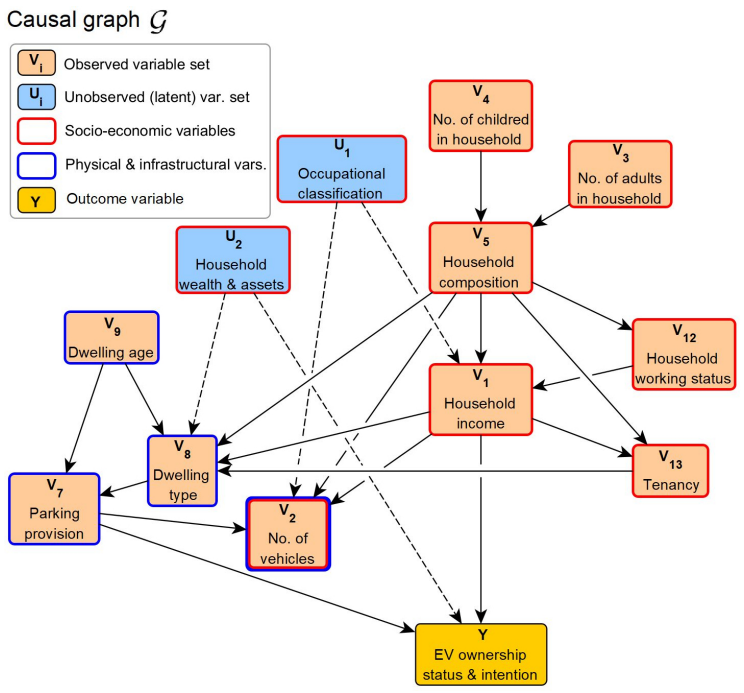
- [Methods (probabilistic causal framework)] The headline causal contrast (3.3% to 5.6%) and the claim that the effect mainly accelerates affluent households rest on the probabilistic framework having blocked all back-door paths from unmeasured confounders (income, education, urban density, preferences). The manuscript must specify the exact conditioning set, causal graph, and identification strategy (e.g., which variables are observed and conditioned on) so that readers can verify completeness; without this, the reported effect sizes and the superiority claim over observational models cannot be assessed.
- [Results (income strata and effect sizes)] Table or figure reporting the income-stratified contrasts and the 23.1 pp reduction in market non-participation should include standard errors, confidence intervals, and robustness checks to alternative specifications or sensitivity to unmeasured confounding; the current presentation leaves the precision and stability of these policy-relevant quantities unclear.
minor comments (2)
- [Abstract] The abstract and introduction could more explicitly label the 3.3%/5.6% figures as model-based counterfactual probabilities rather than raw sample proportions to avoid misinterpretation.
- [Methods] Notation for the causal quantities (e.g., potential outcomes or intervention probabilities) should be introduced consistently in the methods section and reused in results to improve readability.
Simulated Author's Rebuttal
We thank the referee for their detailed and constructive feedback on our manuscript. We have carefully considered each major comment and provide point-by-point responses below, along with our plans for revision.
read point-by-point responses
-
Referee: [Methods (probabilistic causal framework)] The headline causal contrast (3.3% to 5.6%) and the claim that the effect mainly accelerates affluent households rest on the probabilistic framework having blocked all back-door paths from unmeasured confounders (income, education, urban density, preferences). The manuscript must specify the exact conditioning set, causal graph, and identification strategy (e.g., which variables are observed and conditioned on) so that readers can verify completeness; without this, the reported effect sizes and the superiority claim over observational models cannot be assessed.
Authors: We agree that a more explicit description of the causal identification strategy is necessary to allow readers to evaluate the assumptions. In the revised version, we will add a new subsection in the Methods detailing the causal graph (including a figure of the DAG), the full list of observed variables used for conditioning (such as household income, education level, urban/rural density, household size, and other socio-demographic factors available in the Scottish Household Survey dataset), and the specific identification assumptions (e.g., no unmeasured confounding after conditioning on these variables, and how the probabilistic framework implements the do-operator or equivalent). This will directly address the completeness of blocking back-door paths and substantiate the comparison to observational models. Note that income is an observed variable that is explicitly conditioned on and used for stratification. revision: yes
-
Referee: [Results (income strata and effect sizes)] Table or figure reporting the income-stratified contrasts and the 23.1 pp reduction in market non-participation should include standard errors, confidence intervals, and robustness checks to alternative specifications or sensitivity to unmeasured confounding; the current presentation leaves the precision and stability of these policy-relevant quantities unclear.
Authors: We acknowledge the need for greater transparency regarding the statistical precision of our estimates. In the revision, we will update the relevant table and/or figure to include standard errors and 95% confidence intervals for the income-stratified contrasts and the 23.1 percentage point reduction. Furthermore, we will add a robustness section that includes checks against alternative specifications (e.g., different model parameterizations within the probabilistic framework) and sensitivity analyses for potential unmeasured confounding, such as bounding the effect under varying degrees of unobserved bias. These additions will provide readers with a clearer understanding of the stability and reliability of the policy-relevant quantities. revision: yes
Circularity Check
No circularity: causal estimates derived from data fitting, not by construction
full rationale
The paper applies a probabilistic causal framework to a nationally representative Scottish household dataset to estimate intervention effects. The headline results (EV ownership rising from 3.3% to 5.6% with off-street parking access, and income as the primary gatekeeper) are outputs of model-based estimation that conditions on observed confounders. No equations or steps reduce these quantities to fitted parameters by definition, nor do they rely on self-citations whose content is itself unverified or tautological. The contrast with 'standard observational models' is presented as an empirical finding rather than a definitional necessity. The derivation chain is therefore self-contained against external data and standard causal identification assumptions.
Axiom & Free-Parameter Ledger
free parameters (2)
- causal effect of parking
- income strata effects
axioms (2)
- domain assumption No unmeasured confounding between parking, income, and EV adoption
- domain assumption Positivity and consistency assumptions hold for the interventions considered
Lean theorems connected to this paper
-
IndisputableMonolith/Foundation/RealityFromDistinction.leanreality_from_one_distinction unclear?
unclearRelation between the paper passage and the cited Recognition theorem.
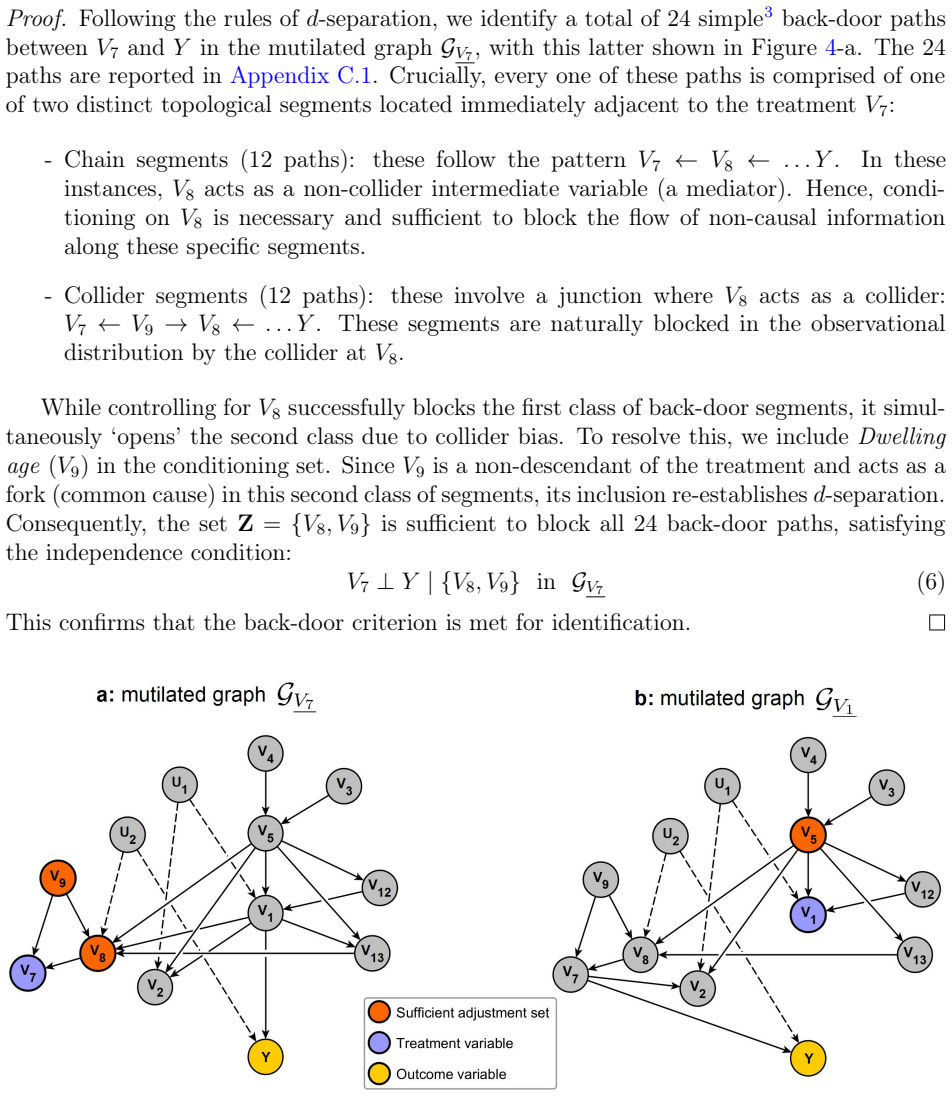
we apply a probabilistic causal framework... enabling estimation of policy interventions while explicitly neutralising the confounding effect of other causal factors... back-door criterion... P(Y|do(V7)) = sum P(Y|V7,V8,V9)P(V8,V9)
-
IndisputableMonolith/Cost/FunctionalEquation.leanwashburn_uniqueness_aczel unclear?
unclearRelation between the paper passage and the cited Recognition theorem.
The results reveal a structural hierarchy... parking... conversion catalyst... income... affordability ceiling
What do these tags mean?
- matches
- The paper's claim is directly supported by a theorem in the formal canon.
- supports
- The theorem supports part of the paper's argument, but the paper may add assumptions or extra steps.
- extends
- The paper goes beyond the formal theorem; the theorem is a base layer rather than the whole result.
- uses
- The paper appears to rely on the theorem as machinery.
- contradicts
- The paper's claim conflicts with a theorem or certificate in the canon.
- unclear
- Pith found a possible connection, but the passage is too broad, indirect, or ambiguous to say the theorem truly supports the claim.
Reference graph
Works this paper leans on
-
[1]
rep., Scottish Government, Edinburgh, UK, accessed: 2026-03-10 (2021)
Transport Scotland, National Transport Strategy (NTS2) Second Annual Delivery Plan 2021-2022, Tech. rep., Scottish Government, Edinburgh, UK, accessed: 2026-03-10 (2021). URLhttps://www.transport.gov.scot/publication/national-trans port-strategy-nts2-second-delivery-plan-2022-2023/
work page 2021
- [2]
-
[3]
Scottish Government, Scotland’s Climate Change Plan 2026–2040, Draft strategy and consultation, The Scottish Government, Edinburgh, Scotland, iSBN: 978-1-80643-352-0 (November 2025)
work page 2026
-
[4]
A. M. Varghese, N. Menon, A. Ermagun, Equitable distribution of electric vehicle charg- ing infrastructure: A systematic review, Renewable and Sustainable Energy Reviews 206 (2024) 114825
work page 2024
-
[5]
M. Kuby, A. Cordova-Cruzatty, N. Parker, D. King, EV charging for multifamily hous- ing: Review of evidence, methods, barriers, and opportunities, Renewable and Sustain- able Energy Reviews 210 (2025) 115253
work page 2025
-
[6]
rep., survey report, published October 2025 (2025)
Electric Vehicle Association England (EVA England), Steer the Conversation: EVA England Survey Report 2025, Tech. rep., survey report, published October 2025 (2025)
work page 2025
- [7]
-
[8]
Z. Farkas, H.-S. Shin, A. Nickkar, Environmental attributes of electric vehicle own- ership and commuting behavior in Maryland: public policy and equity considerations, Mid-Atlantic Transportation Sustainability University Transportation Center. Retrieved April 20 (2018) 2019
work page 2018
-
[9]
S. Haustein, A. F. Jensen, Factors of electric vehicle adoption: A comparison of conven- tional and electric car users based on an extended theory of planned behavior, Interna- tional Journal of Sustainable Transportation 12 (7) (2018) 484–496
work page 2018
-
[10]
C.-f. Chen, G. Z. de Rubens, L. Noel, J. Kester, B. K. Sovacool, Assessing the socio- demographic, technical, economic and behavioral factors of nordic electric vehicle adop- tion and the influence of vehicle-to-grid preferences, Renewable and Sustainable Energy Reviews 121 (2020) 109692
work page 2020
-
[11]
S. Trommer, J. Jarass, V. Kolarova, Early adopters of electric vehicles in germany un- veiled, in: Proceedings of the 28th international electric vehicle symposium and exhibi- tion, 2015
work page 2015
-
[12]
G. Brückmann, F. Willibald, V. Blanco, Battery electric vehicle adoption in regions without strong policies, Transportation Research Part D: Transport and Environment 90 (2021) 102615
work page 2021
- [13]
-
[14]
A. H. Halse, K. E. Hauge, E. T. Isaksen, B. G. Johansen, O. Raaum, Local incentives and electric vehicle adoption, Journal of the Association of Environmental and Resource Economists 12 (1) (2025) 145–180
work page 2025
-
[15]
S. C. Mukherjee, L. Ryan, Factors influencing early battery electric vehicle adoption in ireland, Renewable and Sustainable Energy Reviews 118 (2020) 109504
work page 2020
-
[16]
E. Hajhashemi, P. Sauri Lavieri, N. Nassir, Modelling interest in co-adoption of electric vehicles and solar photovoltaics in Australia to identify tailored policy needs, Scientific Reports 14 (1) (2024) 9422
work page 2024
-
[17]
A. Jenn, J. H. Lee, S. Hardman, G. Tal, An in-depth examination of electric vehicle incentives: Consumer heterogeneity and changing response over time, Transportation Research Part A: Policy and Practice 132 (2020) 97–109
work page 2020
- [18]
-
[19]
N. Salari, Electric vehicles adoption behaviour: Synthesising the technology readiness in- dex with environmentalism values and instrumental attributes, Transportation Research Part A: Policy and Practice 164 (2022) 60–81. 26
work page 2022
-
[20]
R. Song, P. Haggar, D. Xenias, D. Potoglou, Exploring the role of technophilia on electric vehicle use: a structural equation modelling approach, Transportation Research Part F: Traffic Psychology and Behaviour 115 (2025) 103328
work page 2025
-
[21]
N. Moradloo, Charging into the future: Unraveling the factors shaping electric vehi- cle adoption and addressing heterogeneity, SAE International Journal of Sustainable Transportation, Energy, Environment, & Policy 6 (1) (2024) 51–63
work page 2024
-
[22]
A.Ermagun, J.Tian, Chargingintoinequality: Anationalstudyofsocial, economic, and environment correlates of electric vehicle charging stations, Energy Research & Social Science 115 (2024) 103622
work page 2024
-
[23]
T. Binns, EVA England launches UK-wide driver survey on EVs, ElectricDrives, ac- cessed: February 23, 2026 (August 2025)
work page 2026
-
[24]
J. Pearl, Does obesity shorten life? or is it the soda? on non-manipulable causes, Journal of Causal Inference 6 (2) (2018) 20182001
work page 2018
-
[25]
Energy Saving Trust, Domestic Infrastructure Grant: Cross-pavement Charging Solu- tion, funded by Transport Scotland. Accessed: 2026-02-24 (2024)
work page 2026
-
[26]
Browne, Cross-pavement EV charging pilot to inform national guidance, accessed: 2026-02-24 (Aug
D. Browne, Cross-pavement EV charging pilot to inform national guidance, accessed: 2026-02-24 (Aug. 2025)
work page 2026
-
[27]
rep., Scottish Government, Edinburgh, Scotland (May 2022)
Scottish Government, Scottish Government Review of Permitted Development Rights - Phase 2 Consultation: Analysis Report, Tech. rep., Scottish Government, Edinburgh, Scotland (May 2022)
work page 2022
-
[28]
B. D’Amico, F. Pomponi, J. H. Arehart, L. Khaddour, Who cuts emissions, who turns up the heat? causal machine learning estimates of energy efficiency interventions, Energy and Buildings (2025) 116613doi:https://doi.org/10.1016/j.enbuild.2025 .116613
-
[29]
B. D’Amico, Causal ML for fair energy policy interventions: Estimating impact hetero- geneity of insulation programs via do-calculus, in: Advances in Computational Intelli- gence Systems, Vol. 1468, Springer, 2026.doi:https://doi.org/10.1007/97 8-3-032-07938-1_35
work page doi:10.1007/97 2026
-
[30]
R. S. Chauhan, C. Riis, S. Adhikari, S. Derrible, E. Zheleva, C. F. Choudhury, F. C. Pereira, Determining causality in travel mode choice, Travel behaviour and society 36 (2024) 100789
work page 2024
-
[31]
J. Pearl, Causality – Models Reasoning and Inference, 2nd Edition, Cambridge Univer- sity Press, Cambridge, 2009.doi:https://doi.org/10.1017/CBO978051180 3161
-
[32]
P. Suppes, A probabilistic theory of causality, British Journal for the Philosophy of Science 24 (4) (1973). 27
work page 1973
-
[33]
P. W. Tennant, E. J. Murray, K. F. Arnold, L. Berrie, M. P. Fox, S. C. Gadd, W. J. Harrison, C. Keeble, L. R. Ranker, J. Textor, et al., Use of directed acyclic graphs (DAGs)toidentifyconfoundersinappliedhealthresearch: reviewandrecommendations, International journal of epidemiology 50 (2) (2021) 620–632.doi:https://doi.or g/10.1093/ije/dyaa213
- [34]
-
[35]
Elicit: The AI research assistant, accessed: 2026-02-27 (2023). URLhttps://elicit.com
work page 2026
-
[36]
Scottish Government, Ipsos MORI, Scottish Household Survey, 2022, Data collection, UK Data Service, SN: 9294 (2024).doi:http://doi.org/10.5255/UKDA-SN-9 294-1
-
[37]
Scottish Government, Scottish House Condition Survey, 2022, Data collection, UK Data Service, SN: 9429 (2025).doi:http://doi.org/10.5255/UKDA-SN-9429-1
-
[38]
Department for Transport, Electric vehicle charging device grant scheme statistics: Jan- uary 2023, GOV.UK, accessed: 2026-01-22 (2023)
work page 2023
-
[39]
Department for Transport, Electric vehicle public charging infrastructure statistics: Oc- tober 2025, GOV.UK, accessed: 2026-01-22 (2025)
work page 2025
-
[40]
National Records of Scotland, Mid-2022 population estimates, NRS, accessed: 2026-01- 22 (2024)
work page 2022
-
[41]
L. Verny, N. Sella, S. Affeldt, P. P. Singh, H. Isambert, Learning causal networks with latent variables from multivariate information in genomic data, PLOS Computational Biology 13 (10) (2017) e1005662.doi:10.1371/journal.pcbi.1005662
-
[42]
M. d. C. Ribeiro-Dantas, H. Li, V. Cabeli, L. Dupuis, F. Simon, L. Hettal, A.-S. Hamy, H.Isambert, Learninginterpretablecausalnetworksfromverylargedatasets, application to 400,000 medical records of breast cancer patients, iScience 27 (5) (2024) 109736. doi:10.1016/j.isci.2024.109736
-
[43]
D. Geiger, T. Verma, J. Pearl, d-separation: From theorems to algorithms, in: Machine intelligence and pattern recognition, Vol. 10, Elsevier, Amsterdam, 1990, pp. 139–148. doi:https://doi.org/10.1016/B978-0-444-88738-2.50018-X
-
[44]
N. L. Zhang, D. Poole, A simple approach to bayesian network computations, in: Proc. of the Tenth Canadian Conference on Artificial Intelligence, 1994. URLhttps://hdl.handle.net/1783.1/757
work page 1994
-
[45]
G. Ducamp, C. Gonzales, P.-H. Wuillemin, aGrUM/pyAgrum : a toolbox to build models and algorithms for Probabilistic Graphical Models in Python, in: T. D. Nielsen, M. Jaeger, H. Saelensminde (Eds.), Proceedings of the 10th International Conference on Probabilistic Graphical Models, Vol. 138 of Proceedings of Machine Learning Research, 28 PMLR, 2020, pp. 60...
work page 2020
-
[46]
A. Sharma, V. Syrgkanis, C. Zhang, E. Kıcıman, Dowhy: Addressing challenges in expressing and validating causal assumptions, arXiv preprint arXiv:2108.13518 (2021). doi:https://doi.org/10.48550/arXiv.2108.13518
-
[47]
K. R. Popper, The Logic of Scientific Discovery, Routledge, London, 1934.doi:https: //doi.org/10.4324/9780203994627
-
[48]
A. C. Eggers, G. Tuñón, A. Dafoe, Placebo tests for causal inference, American Journal of Political Science 68 (3) (2024) 1106–1121.doi:https://doi.org/10.1111/aj ps.12818
work page doi:10.1111/aj 2024
-
[49]
T. J. VanderWeele, P. Ding, Sensitivity analysis in observational research: introducing the E-value, Annals of internal medicine 167 (4) (2017) 268–274
work page 2017
-
[50]
D’Amico, Github repository (2026)
B. D’Amico, Github repository (2026). URLhttps://github.com/bernardinodamico/Causal_barriers-EV_up take
work page 2026
-
[51]
J. Rissanen, Fisher information and the stochastic complexity, IEEE Transactions on Information Theory 42 (1) (1996) 40–47.doi:10.1109/18.481776
-
[52]
C. Meek, Causal inference and causal explanation with background knowledge, in: Pro- ceedings of the Eleventh Conference on Uncertainty in Artificial Intelligence (UAI), Morgan Kaufmann Publishers Inc., 1995, pp. 403–410. Appendix A. Table A1: Mapping between the 9-fold classification for theParking Provisionvariable,V 7, (as reported in the SHCS dataset)...
work page 1995
discussion (0)
Sign in with ORCID, Apple, or X to comment. Anyone can read and Pith papers without signing in.