Recognition: unknown
Region-Constrained Group Relative Policy Optimization for Flow-Based Image Editing
Pith reviewed 2026-05-10 16:51 UTC · model grok-4.3
The pith
Region-constrained GRPO reduces background variance in flow-based image editing by localizing noise perturbations and rewarding attention focus within the target area.
A machine-rendered reading of the paper's core claim, the machinery that carries it, and where it could break.
Core claim
RC-GRPO-Editing is a region-constrained variant of GRPO post-training for flow-based models that suppresses background-induced nuisance variance through region-decoupled initial noise perturbations and an attention concentration reward; the result is cleaner localized credit assignment that improves editing-region instruction adherence while preserving non-target content.
What carries the argument
Region-constrained GRPO that localizes exploration via region-decoupled initial noise perturbations and aligns cross-attention via an attention concentration reward throughout the rollout.
If this is right
- Editing-region instruction adherence improves while non-target regions remain unchanged.
- GRPO advantages become less noisy because within-group reward variance drops after background perturbations are removed.
- The framework works with deterministic ODE sampling paths of flow-based models.
- Both the noise decoupling and attention reward can be added on top of existing GRPO pipelines for image editing.
Where Pith is reading between the lines
- The same localization idea could be tested on multi-step editing instructions where different regions are edited sequentially without mutual interference.
- If the attention reward proves robust to approximate masks, the method might reduce reliance on pixel-perfect segmentation at training time.
- The variance-reduction effect might transfer to other policy-gradient methods that currently suffer from global exploration noise in visual domains.
Load-bearing premise
That reliable region masks exist during training so the decoupled noise and attention reward can be applied without creating new artifacts or requiring perfect masks.
What would settle it
Training and evaluating the method on a dataset of images whose editing regions have ambiguous or noisy masks; if instruction adherence and background preservation do not improve over baseline GRPO, the region-constraint benefit is falsified.
Figures




read the original abstract
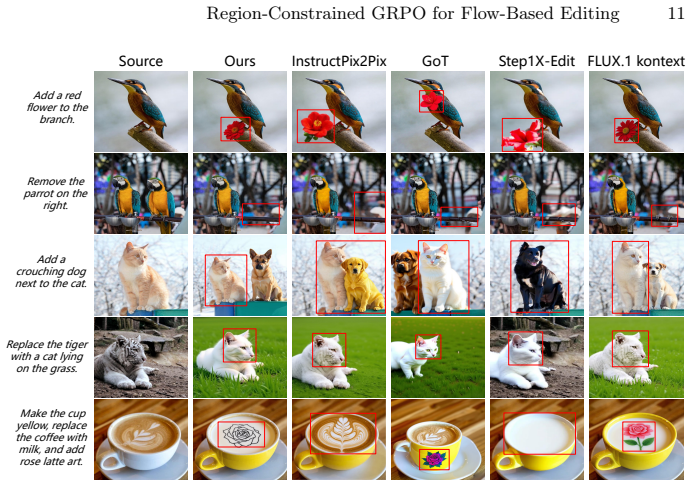
Instruction-guided image editing requires balancing target modification with non-target preservation. Recently, flow-based models have emerged as a strong and increasingly adopted backbone for instruction-guided image editing, thanks to their high fidelity and efficient deterministic ODE sampling. Building on this foundation, GRPO-based reward-driven post-training has been explored to directly optimize editing-specific rewards, improving instruction following and editing consistency. However, existing methods often suffer from noisy credit assignment: global exploration also perturbs non-target regions, inflating within-group reward variance and yielding noisy GRPO advantages. To address this, we propose RC-GRPO-Editing, a region-constrained GRPO post-training framework for flow-based image editing under deterministic ODE sampling. It suppresses background-induced nuisance variance to enable cleaner localized credit assignment, improving editing region instruction adherence while preserving non-target content. Concretely, we localize exploration via region-decoupled initial noise perturbations to reduce background-induced reward variance and stabilize GRPO advantages, and introduce an attention concentration reward that aligns cross-attention with the intended editing region throughout the rollout, reducing unintended changes in non-target regions. Experiments on CompBench show consistent improvements in editing region instruction adherence and non-target preservation.
Editorial analysis
A structured set of objections, weighed in public.
Referee Report
Summary. The paper proposes RC-GRPO-Editing, a region-constrained Group Relative Policy Optimization post-training method for flow-based instruction-guided image editing. It introduces region-decoupled initial noise perturbations to localize exploration and reduce background nuisance variance in GRPO advantages, plus an attention concentration reward to align cross-attention maps with the target editing region during ODE rollouts. The central claim is that these components enable cleaner localized credit assignment, yielding improved editing-region instruction adherence and non-target content preservation, with consistent gains reported on CompBench.
Significance. If the localization mechanism holds, the approach could meaningfully advance reward-driven fine-tuning for editing by mitigating a known source of variance in global exploration methods, particularly for deterministic flow models. The focus on ODE sampling and explicit region constraints is a timely contribution given the rise of flow-based backbones, but the absence of quantitative metrics, ablations, or verification of the variance-reduction premise currently limits the assessed impact.
major comments (3)
- [§3.2] §3.2 (region-decoupled perturbations): The claim that spatially masked initial noise at t=0 produces localized credit assignment relies on the assumption that the learned vector field preserves spatial decoupling during ODE integration. No derivation, Lipschitz analysis, or ablation is supplied showing that within-group reward variance is actually reduced (rather than redistributed) by the global coupling inherent to the flow ODE; this is load-bearing for the central premise of cleaner GRPO advantages.
- [Results section] Results section / Table 1: The manuscript states 'consistent improvements' on CompBench in editing-region adherence and non-target preservation but supplies no numerical values, baseline comparisons (e.g., standard GRPO or other editing methods), error bars, or statistical tests. Without these, the magnitude and reliability of the claimed gains cannot be verified.
- [§3.3] §3.3 (attention concentration reward): The reward is defined to concentrate cross-attention on the editing mask, yet no analysis or experiment addresses potential side-effects such as over-concentration artifacts, reduced diversity, or unintended changes outside the mask when the mask is imperfect during training.
minor comments (2)
- [Abstract] The abstract would be strengthened by including at least one key quantitative result (e.g., a delta on CompBench) to support the improvement claims.
- [Figures] Figure captions and method diagrams should explicitly label the region mask input and how it is applied at each timestep to improve reproducibility.
Simulated Author's Rebuttal
Thank you for the constructive feedback on our manuscript. We address each major comment point by point below. We will revise the manuscript to incorporate additional analysis, quantitative results, and experiments where the comments identify gaps.
read point-by-point responses
-
Referee: [§3.2] §3.2 (region-decoupled perturbations): The claim that spatially masked initial noise at t=0 produces localized credit assignment relies on the assumption that the learned vector field preserves spatial decoupling during ODE integration. No derivation, Lipschitz analysis, or ablation is supplied showing that within-group reward variance is actually reduced (rather than redistributed) by the global coupling inherent to the flow ODE; this is load-bearing for the central premise of cleaner GRPO advantages.
Authors: We acknowledge that a formal derivation or Lipschitz analysis of spatial decoupling under the flow ODE would provide stronger theoretical grounding. While the deterministic sampling and t=0 localization intuitively constrain noise propagation, we agree that direct verification of variance reduction is essential. In the revised manuscript, we will add an ablation quantifying within-group reward variance with and without the region-decoupled perturbations to demonstrate the effect on GRPO advantages. revision: yes
-
Referee: [Results section] Results section / Table 1: The manuscript states 'consistent improvements' on CompBench in editing-region adherence and non-target preservation but supplies no numerical values, baseline comparisons (e.g., standard GRPO or other editing methods), error bars, or statistical tests. Without these, the magnitude and reliability of the claimed gains cannot be verified.
Authors: We will expand the results section and Table 1 to include the specific numerical metrics from CompBench experiments, direct comparisons against standard GRPO and other editing baselines, error bars from multiple runs, and statistical significance tests to clearly establish the magnitude and reliability of the reported gains. revision: yes
-
Referee: [§3.3] §3.3 (attention concentration reward): The reward is defined to concentrate cross-attention on the editing mask, yet no analysis or experiment addresses potential side-effects such as over-concentration artifacts, reduced diversity, or unintended changes outside the mask when the mask is imperfect during training.
Authors: We agree that side-effects of the attention concentration reward require explicit examination. The revised manuscript will include new experiments and analysis evaluating over-concentration artifacts, effects on generation diversity, and robustness to imperfect masks, supported by quantitative metrics and qualitative examples of any unintended changes. revision: yes
Circularity Check
No significant circularity; new components introduced without definitional reduction
full rationale
The paper's core proposal—region-decoupled initial noise perturbations plus an attention concentration reward for RC-GRPO-Editing—is presented as a novel engineering intervention on top of existing GRPO and flow-ODE sampling. No equations, fitted parameters, or self-citations are shown in the provided text that would make the claimed variance reduction or cleaner credit assignment equivalent to the inputs by construction. The derivation chain therefore remains self-contained and externally falsifiable via the reported CompBench experiments.
Axiom & Free-Parameter Ledger
Reference graph
Works this paper leans on
-
[1]
Building Normalizing Flows with Stochastic Interpolants
Albergo, M.S., Vanden-Eijnden, E.: Building normalizing flows with stochastic interpolants. arXiv preprint arXiv:2209.15571 (2022) 1, 4
work page internal anchor Pith review arXiv 2022
-
[2]
Proceedings of the IEEE/CVF Conference on Computer Vision and Pattern Recognition pp
Avrahami, O., Lischinski, D., Fried, O.: Blended diffusion for text-driven editing of natural images. Proceedings of the IEEE/CVF Conference on Computer Vision and Pattern Recognition pp. 18208–18218 (2022) 3
2022
-
[3]
Training Diffusion Models with Reinforcement Learning
Black, K., Janner, M., Du, Y., Kostrikov, I., Levine, S.: Training diffusion models with reinforcement learning. arXiv preprint arXiv:2305.13301 (2023) 4
work page internal anchor Pith review arXiv 2023
-
[4]
In: Proceedings of the IEEE/CVF conference on computer vision and pattern recognition
Brooks, T., Holynski, A., Efros, A.A.: Instructpix2pix: Learning to follow image editing instructions. In: Proceedings of the IEEE/CVF conference on computer vision and pattern recognition. pp. 18392–18402 (2023) 1, 3, 11, 12
2023
-
[5]
ACM trans- actions on Graphics (TOG)42(4), 1–10 (2023) 3, 6
Chefer, H., Alaluf, Y., Vinker, Y., Wolf, L., Cohen-Or, D.: Attend-and-excite: Attention-based semantic guidance for text-to-image diffusion models. ACM trans- actions on Graphics (TOG)42(4), 1–10 (2023) 3, 6
2023
-
[6]
Advances in neural information processing systems31(2018) 4
Chen, R.T., Rubanova, Y., Bettencourt, J., Duvenaud, D.K.: Neural ordinary differential equations. Advances in neural information processing systems31(2018) 4
2018
-
[7]
In: International Conference on Learning Representations (2023) 3
Couairon, G., Verbeek, J., Schwenk, H., Cord, M.: Diffedit: Diffusion-based seman- tic image editing with mask guidance. In: International Conference on Learning Representations (2023) 3
2023
-
[8]
arXiv preprint arXiv:2503.01234 (2025) 3, 11, 12
Fang, J., et al.: Got: Generalized optical trajectories for image editing. arXiv preprint arXiv:2503.01234 (2025) 3, 11, 12
-
[9]
FFJORD: Free-form Continuous Dynamics for Scalable Reversible Generative Models
Grathwohl, W., Chen, R.T., Bettencourt, J., Sutskever, I., Duvenaud, D.: Ffjord: Free-form continuous dynamics for scalable reversible generative models. arXiv preprint arXiv:1810.01367 (2018) 4
work page Pith review arXiv 2018
-
[10]
Journal of Machine Learning Research5(Nov), 1471–1530 (2004) 5
Greensmith, E., Bartlett, P.L., Baxter, J.: Variance reduction techniques for gradient estimates in reinforcement learning. Journal of Machine Learning Research5(Nov), 1471–1530 (2004) 5
2004
-
[11]
In: Proceedings of the IEEE/CVF Conference on Computer Vision and Pattern Recognition
Guo, Q., Lin, T.: Focus on your instruction: Fine-grained and multi-instruction im- age editing by attention modulation. In: Proceedings of the IEEE/CVF Conference on Computer Vision and Pattern Recognition. pp. 6986–6996 (2024) 3
2024
-
[12]
arXiv preprint arXiv:2511.16955 (2025)
He, D., Feng, G., Ge, X., Niu, Y., Zhang, Y., Ma, B., Song, G., Liu, Y., Li, H.: Neighbor grpo: Contrastive ode policy optimization aligns flow models. arXiv preprint arXiv:2511.16955 (2025) 2, 4, 5, 9
-
[13]
Prompt-to-Prompt Image Editing with Cross Attention Control
Hertz, A., Mokady, R., Tenenbaum, J., Aberman, K., Pritch, Y., Cohen-Or, D.: Prompt-to-prompt image editing with cross attention control. In: arXiv preprint arXiv:2208.01626 (2022) 1, 3, 6
work page internal anchor Pith review arXiv 2022
-
[14]
Iclr1(2), 3 (2022) 11
Hu, E.J., Shen, Y., Wallis, P., Allen-Zhu, Z., Li, Y., Wang, S., Wang, L., Chen, W., et al.: Lora: Low-rank adaptation of large language models. Iclr1(2), 3 (2022) 11
2022
-
[15]
arXiv preprint arXiv:2505.12200 (2025)
Jia, B., Huang, W., Tang, Y., Qiao, J., Liao, J., Cao, S., Zhao, F., Feng, Z., Gu, Z., Yin, Z., et al.: Compbench: Benchmarking complex instruction-guided image editing. arXiv preprint arXiv:2505.12200 (2025) 10
-
[16]
In: Proceedings of the IEEE/CVF Conference on Computer Vision and Pattern Recognition
Kawar, B., Zada, S., Lang, O., Omer, O., Aberman, K., Cohen-Or, D., Irani, M.: Imagic: Text-based real image editing with diffusion models. In: Proceedings of the IEEE/CVF Conference on Computer Vision and Pattern Recognition. pp. 6007–6017 (2023) 3
2023
-
[17]
FLUX.1 Kontext: Flow Matching for In-Context Image Generation and Editing in Latent Space
Labs, B.F., Batifol, S., Blattmann, A., Boesel, F., Consul, S., Diagne, C., Dock- horn, T., English, J., English, Z., Esser, P., et al.: Flux. 1 kontext: Flow match- ing for in-context image generation and editing in latent space. arXiv preprint arXiv:2506.15742 (2025) 1, 10, 12 16 Z. Ouyang et al
work page internal anchor Pith review Pith/arXiv arXiv 2025
-
[18]
MixGRPO: Unlocking Flow-based GRPO Efficiency with Mixed ODE-SDE
Li, J., Cui, Y., Huang, T., Ma, Y., Fan, C., Yang, M., Zhong, Z.: Mixgrpo: Unlocking flow-based grpo efficiency with mixed ode-sde. arXiv preprint arXiv:2507.21802 (2025) 2, 4
work page internal anchor Pith review arXiv 2025
-
[19]
Flow Matching for Generative Modeling
Lipman, Y., Chen, R.T., Ben-Hamu, H., Nickel, M., Le, M.: Flow matching for generative modeling. arXiv preprint arXiv:2210.02747 (2022) 1, 2, 4
work page internal anchor Pith review Pith/arXiv arXiv 2022
-
[20]
Flow-GRPO: Training Flow Matching Models via Online RL
Liu, J., Liu, G., Liang, J., Li, Y., Liu, J., Wang, X., Wan, P., Zhang, D., Ouyang, W.: Flow-grpo: Training flow matching models via online rl. arXiv preprint arXiv:2505.05470 (2025) 2, 4
work page internal anchor Pith review arXiv 2025
-
[21]
Flow Straight and Fast: Learning to Generate and Transfer Data with Rectified Flow
Liu, X., Gong, C., Liu, Q.: Flow straight and fast: Learning to generate and transfer data with rectified flow. arXiv preprint arXiv:2209.03003 (2022) 1, 4
work page internal anchor Pith review Pith/arXiv arXiv 2022
-
[22]
arXiv preprint arXiv:2512.08643 (2025) 2, 4
Liu, Y., Ouyang, Z., Lou, S., Song, Y.: Omnirefiner: Reinforcement-guided local diffusion refinement. arXiv preprint arXiv:2512.08643 (2025) 2, 4
- [23]
-
[24]
Advances in neural information processing systems35, 5775–5787 (2022) 2
Lu, C., Zhou, Y., Bao, F., Chen, J., Li, C., Zhu, J.: Dpm-solver: A fast ode solver for diffusion probabilistic model sampling in around 10 steps. Advances in neural information processing systems35, 5775–5787 (2022) 2
2022
-
[25]
Luo, F., Zhao, Z., Wang, M., Li, D., Qian, Z., Tuo, J., Zhou, C., Ma, Y.: Geometric prior-guided federated prompt calibration (2025),https://arxiv.org/abs/2512. 072082
2025
-
[26]
arXiv preprint arXiv:2509.23909 (2025)
Luo, X., Wang, J., Wu, C., Xiao, S., Jiang, X., Lian, D., Zhang, J., Liu, D., et al.: Editscore: Unlocking online rl for image editing via high-fidelity reward modeling. arXiv preprint arXiv:2509.23909 (2025) 11
-
[27]
In: International Conference on Learning Representations (2022) 1, 3
Meng, C., He, Y., Song, Y., Song, J., Wu, J., Zhu, J.Y., Ermon, S.: Sdedit: Guided image synthesis and editing with stochastic differential equations. In: International Conference on Learning Representations (2022) 1, 3
2022
-
[28]
In: Proceedings of the IEEE/CVF Conference on Computer Vision and Pattern Recognition
Mokady, R., Hertz, A., Aberman, K., Pritch, Y., Cohen-Or, D.: Null-text inver- sion for editing real images using guided diffusion models. In: Proceedings of the IEEE/CVF Conference on Computer Vision and Pattern Recognition. pp. 6038–6047 (2023) 3
2023
-
[29]
In: ACM SIGGRAPH 2023 Conference Proceedings
Parmar, G., Kumar Singh, K., Zhang, R., Anyi, R., Lu, J., Zhu, J.Y.: Zero-shot image-to-image translation. In: ACM SIGGRAPH 2023 Conference Proceedings. pp. 1–11 (2023) 3
2023
-
[30]
In: International conference on machine learning
Radford, A., Kim, J.W., Hallacy, C., Ramesh, A., Goh, G., Agarwal, S., Sastry, G., Askell, A., Mishkin, P., Clark, J., et al.: Learning transferable visual models from natural language supervision. In: International conference on machine learning. pp. 8748–8763. PmLR (2021) 10
2021
-
[31]
Proximal Policy Optimization Algorithms
Schulman, J., Wolski, F., Dhariwal, P., Radford, A., Klimov, O.: Proximal policy optimization algorithms. arXiv preprint arXiv:1707.06347 (2017) 2, 5
work page internal anchor Pith review Pith/arXiv arXiv 2017
-
[32]
DeepSeekMath: Pushing the Limits of Mathematical Reasoning in Open Language Models
Shao, Z., Wang, P., Zhu, Q., Xu, R., Song, J., Bi, X., Zhang, H., Zhang, M., Li, Y., Wu, Y., et al.: Deepseekmath: Pushing the limits of mathematical reasoning in open language models. arXiv preprint arXiv:2402.03300 (2024) 2, 4, 5
work page internal anchor Pith review Pith/arXiv arXiv 2024
-
[33]
Score-Based Generative Modeling through Stochastic Differential Equations
Song, Y., Sohl-Dickstein, J., Kingma, D.P., Kumar, A., Ermon, S., Poole, B.: Score- based generative modeling through stochastic differential equations. arXiv preprint arXiv:2011.13456 (2020) 1, 2, 4
work page internal anchor Pith review Pith/arXiv arXiv 2011
-
[34]
Advances in neural information processing systems12(1999) 2, 5
Sutton, R.S., McAllester, D., Singh, S., Mansour, Y.: Policy gradient methods for reinforcement learning with function approximation. Advances in neural information processing systems12(1999) 2, 5
1999
-
[35]
arXiv preprint arXiv:2601.02356 (2026) 2, 4 Region-Constrained GRPO for Flow-Based Editing 17
Tan, J., Zhang, Z., Shen, Y., Cai, J., Yang, S., Wu, J., Xia, W., Tu, Z., Soatto, S.: Talk2move: Reinforcement learning for text-instructed object-level geometric transformation in scenes. arXiv preprint arXiv:2601.02356 (2026) 2, 4 Region-Constrained GRPO for Flow-Based Editing 17
-
[36]
In: Proceedings of the IEEE/CVF Conference on Computer Vision and Pattern Recognition
Wallace, B., Dang, M., Rafailov, R., Zhou, L., Lou, A., Purushwalkam, S., Ermon, S., Xiong, C., Joty, S., Naik, N.: Diffusion model alignment using direct preference optimization. In: Proceedings of the IEEE/CVF Conference on Computer Vision and Pattern Recognition. pp. 8228–8238 (2024) 4
2024
-
[37]
IEEE transactions on image processing 13(4), 600–612 (2004) 10
Wang, Z., Bovik, A.C., Sheikh, H.R., Simoncelli, E.P.: Image quality assessment: from error visibility to structural similarity. IEEE transactions on image processing 13(4), 600–612 (2004) 10
2004
-
[38]
Machine learning8(3), 229–256 (1992) 2, 5
Williams, R.J.: Simple statistical gradient-following algorithms for connectionist reinforcement learning. Machine learning8(3), 229–256 (1992) 2, 5
1992
-
[39]
Xu, Z., Wang, Z., Qian, Z., Shi, D., Tang, F., Hu, M., Su, S., Zou, X., Feng, W., Mahapatra, D., Peng, Y., Lin, M., Ge, Z.: Thinking in uncertainty: Mitigating hallucinations in mlrms with latent entropy-aware decoding (2026),https://arxiv. org/abs/2603.133661
-
[40]
In: Proceedings of the IEEE/CVF Conference on Computer Vision and Pattern Recognition
Yang, B., Gu, S., Zhang, B., Zhang, T., Chen, X., Liao, J., Chen, D.: Paint-by- example: Exemplar-conditioned image editing with diffusion models. In: Proceedings of the IEEE/CVF Conference on Computer Vision and Pattern Recognition. pp. 18381–18391 (2023) 3
2023
-
[41]
In: Proceedings of the IEEE/CVF Conference on Computer Vision and Pattern Recognition
Yang, K., Tao, J., Lyu, J., Ge, C., Chen, J., Shen, W., Zhu, X., Li, X.: Using human feedback to fine-tune diffusion models without any reward model. In: Proceedings of the IEEE/CVF Conference on Computer Vision and Pattern Recognition. pp. 8941–8951 (2024) 4
2024
-
[42]
In: Advances in Neural Information Processing Systems
Zhang, K., Xie, L., Jing, B., et al.: Magicbrush: A large-scale dataset for instruction- guided real image editing. In: Advances in Neural Information Processing Systems. vol. 36, pp. 55181–55198 (2023) 3
2023
-
[43]
In: Proceedings of the IEEE/CVF international conference on computer vision
Zhang, L., Rao, A., Agrawala, M.: Adding conditional control to text-to-image diffusion models. In: Proceedings of the IEEE/CVF international conference on computer vision. pp. 3836–3847 (2023) 3
2023
-
[44]
In: Proceedings of the IEEE conference on computer vision and pattern recognition
Zhang, R., Isola, P., Efros, A.A., Shechtman, E., Wang, O.: The unreasonable effectiveness of deep features as a perceptual metric. In: Proceedings of the IEEE conference on computer vision and pattern recognition. pp. 586–595 (2018) 10
2018
-
[46]
Zhou, C., Wang, M., Ma, Y., Wu, C., Chen, W., Qian, Z., Liu, X., Zhang, Y., Wang, J., Xu, H., et al.: From perception to cognition: A survey of vision-language interac- tive reasoning in multimodal large language models. arXiv preprint arXiv:2509.25373 (2025) 3
discussion (0)
Sign in with ORCID, Apple, or X to comment. Anyone can read and Pith papers without signing in.