Heat and thermal travelling wave solutions of a nonlinear Maxwell-Cattaneo-Vernotte equation
Pith reviewed 2026-05-10 16:12 UTC · model grok-4.3
The pith
Exact soliton solutions exist for the nonlinear Maxwell-Cattaneo-Vernotte equation when thermal conductivity and relaxation time are chosen as specific polynomials in temperature.
A machine-rendered reading of the paper's core claim, the machinery that carries it, and where it could break.
Core claim
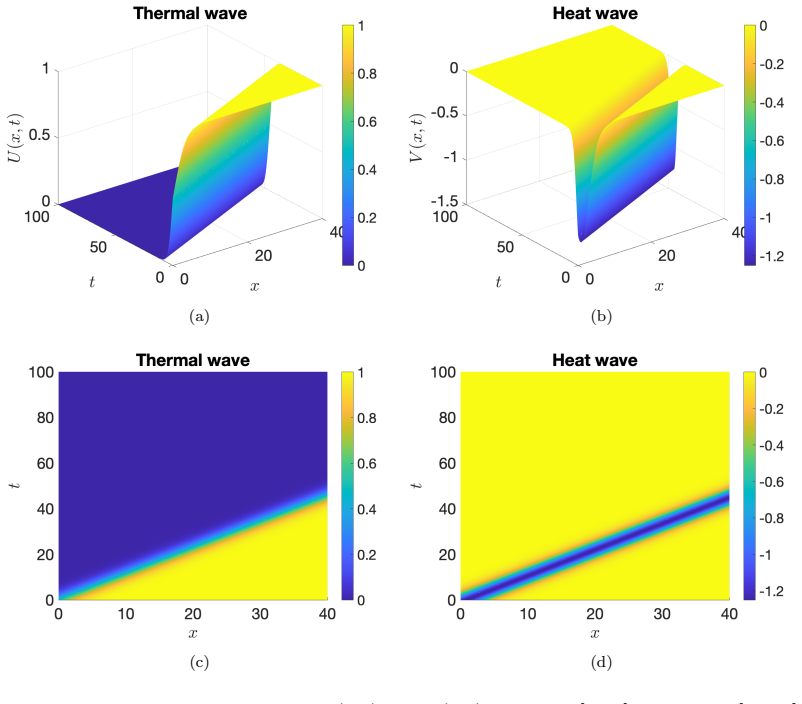
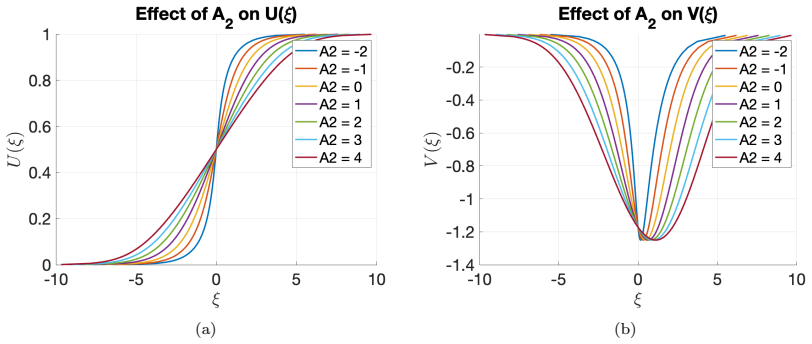
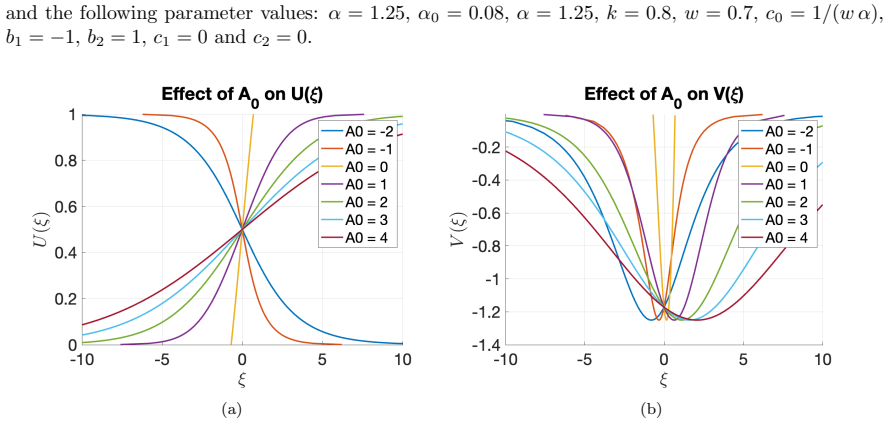
By expressing the thermal conductivity and the relaxation time as polynomial functions of the temperature, exact wave solutions including solitons are obtained for the nonlinear Maxwell-Cattaneo-Vernotte equation. This approach enables the identification of suitable degrees of nonlinearity that give rise to soliton solutions, with the resulting profiles shown through plots for chosen parameter values.
What carries the argument
Nonlinear Maxwell-Cattaneo-Vernotte equation with thermal conductivity and relaxation time expressed as polynomial functions of temperature, which reduces the PDE to an ordinary differential equation integrable to travelling-wave soliton forms.
If this is right
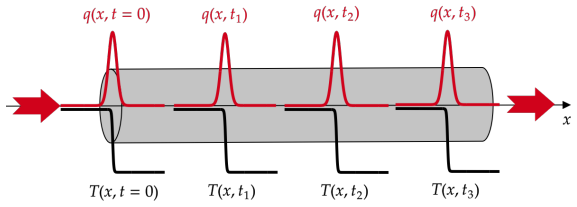
- Heat signals propagate at finite speeds with persistent soliton profiles instead of instantaneous diffusion.
- Material properties can be selected via the polynomial forms to produce desired non-dissipative thermal waves.
- Analytical expressions allow direct computation of wave speed and shape without numerical approximation.
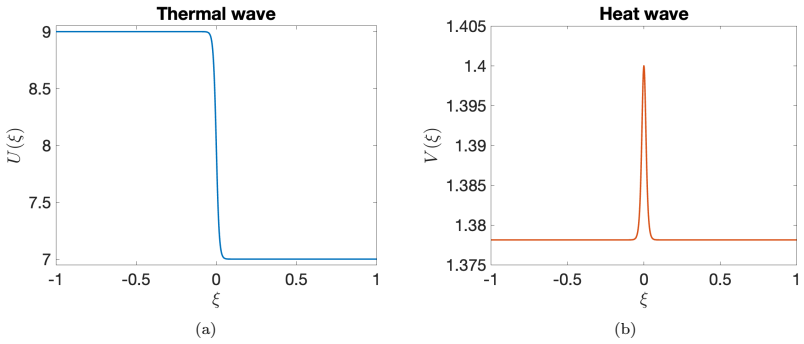
- Plots confirm the soliton character for concrete choices of the polynomial coefficients and wave parameters.
Where Pith is reading between the lines
- The polynomial assumption could be tested by measuring conductivity curves in candidate materials and checking whether observed heat pulses match the predicted soliton shapes.
- Similar reductions might apply to other hyperbolic transport equations in contexts such as relativistic fluids or viscoelastic media.
- If the method succeeds, it supplies benchmark solutions for validating numerical schemes that simulate nonlinear heat conduction in higher dimensions.
Load-bearing premise
Thermal conductivity and relaxation time can be expressed as polynomial functions of temperature with degrees that permit exact integration to bounded soliton solutions.
What would settle it
A direct integration attempt showing that no polynomial degrees produce solutions satisfying the boundary conditions of localization at infinity and constant propagation speed would disprove the existence of such solitons under this construction.
Figures
read the original abstract
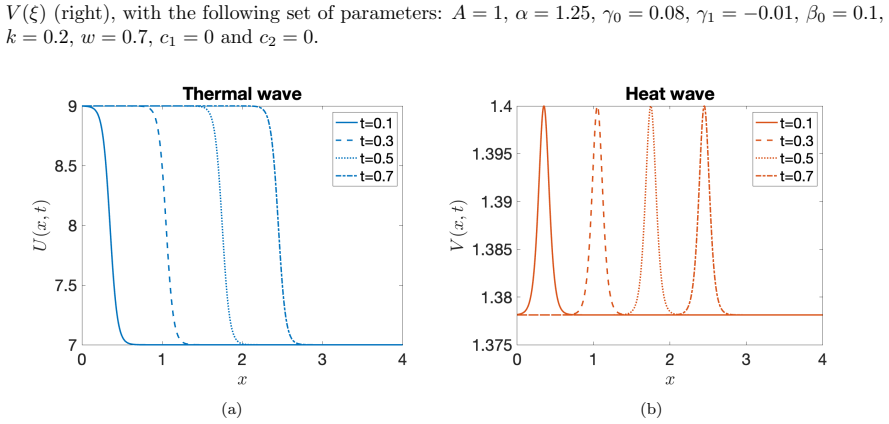
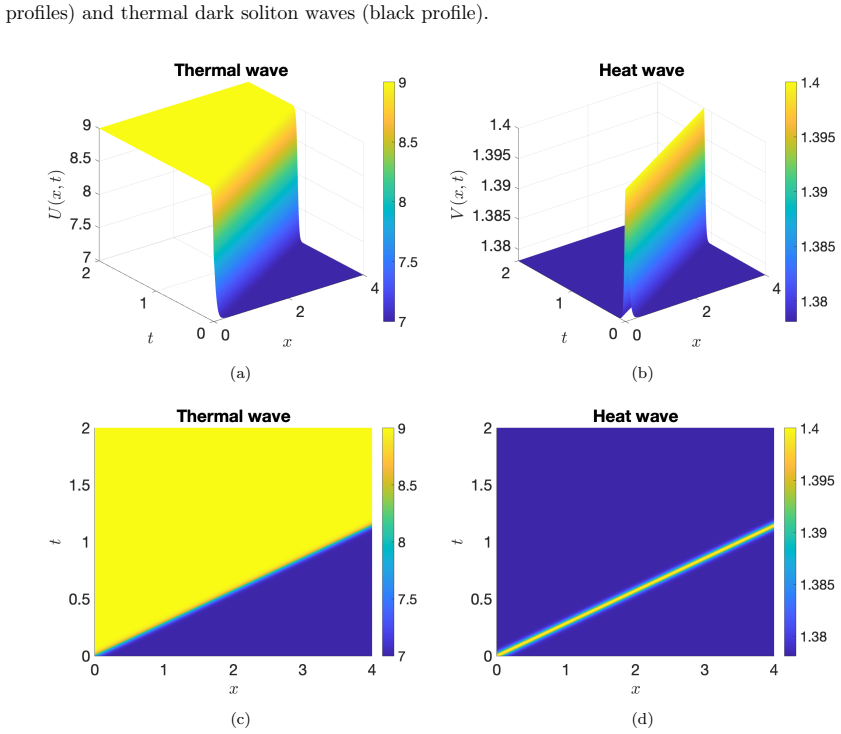
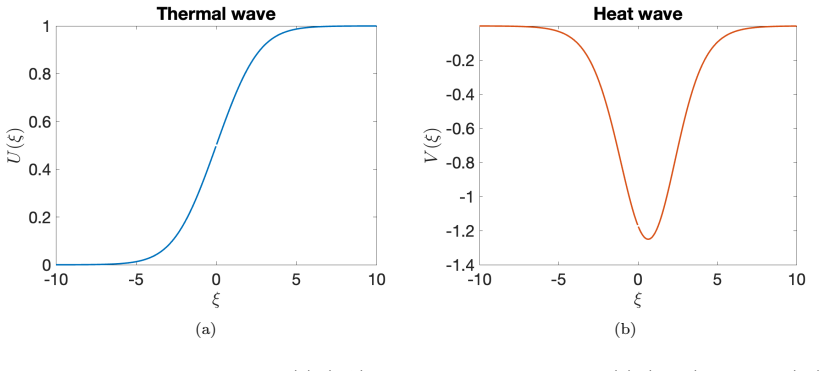
The propagation of heat and thermal signals in the form of travelling waves is investigated for a nonlinear Maxwell-Cattaneo-Vernotte equation. The exact wave solutions are derived by expressing the thermal conductivity and the relaxation time as polynomial functions of the temperature. This approach enables the identification of suitable degrees of nonlinearity that give rise to soliton solutions. Finally, exact solutions are shown through plots for the values of the selected parameters.
Editorial analysis
A structured set of objections, weighed in public.
Referee Report
Summary. The paper claims that exact travelling wave solutions, including solitons, for the nonlinear Maxwell-Cattaneo-Vernotte equation can be obtained by expressing the thermal conductivity k(T) and relaxation time τ(T) as polynomial functions of temperature T. Suitable polynomial degrees are identified to permit closed-form integration after a travelling-wave reduction, and the resulting solutions are illustrated via plots for selected parameter values.
Significance. If the derivations and verifications hold, the work supplies closed-form soliton solutions for a nonlinear hyperbolic heat-conduction model under specific constitutive assumptions. Such exact solutions are useful as benchmarks for numerical schemes and for qualitative insight into finite-speed thermal waves when material properties depend on temperature. The polynomial-ansatz technique itself is standard, but its concrete application here adds to the catalogue of solvable cases in nonlinear heat equations.
major comments (2)
- [Abstract] Abstract: the claim that 'exact wave solutions are derived' by polynomial expressions for k(T) and τ(T) is not accompanied by any derivation steps, substitution back into the original PDE, or error analysis confirming consistency for the full parameter range. This verification is load-bearing for the central claim of exactness.
- [Travelling-wave reduction / solution construction] The reduction and integration steps (presumably in the main text following the model statement) must explicitly show how the chosen polynomial degrees close the ODE and produce the reported soliton profiles; without this, the post-hoc selection of degrees to enable solitons cannot be assessed for internal consistency.
minor comments (1)
- Plots should explicitly state the polynomial degrees chosen for k(T) and τ(T) together with the numerical values of all integration constants and wave speeds used.
Simulated Author's Rebuttal
We thank the referee for the positive evaluation of the significance of our work and for the constructive comments on presentation. We address each major comment below and have revised the manuscript accordingly to improve clarity and explicitness of the derivations and verifications.
read point-by-point responses
-
Referee: [Abstract] Abstract: the claim that 'exact wave solutions are derived' by polynomial expressions for k(T) and τ(T) is not accompanied by any derivation steps, substitution back into the original PDE, or error analysis confirming consistency for the full parameter range. This verification is load-bearing for the central claim of exactness.
Authors: We agree that the abstract, being a concise summary, does not contain derivation steps or explicit verification. The full travelling-wave reduction, choice of polynomial degrees, integration, and direct substitution of the resulting solutions back into the original PDE (confirming consistency for the selected parameter values) are provided in Sections 3 and 4 of the manuscript. To address the concern, we have revised the abstract to include a brief reference to the verification process and have added an explicit consistency check subsection in the main text highlighting substitution for the reported solutions. revision: yes
-
Referee: [Travelling-wave reduction / solution construction] The reduction and integration steps (presumably in the main text following the model statement) must explicitly show how the chosen polynomial degrees close the ODE and produce the reported soliton profiles; without this, the post-hoc selection of degrees to enable solitons cannot be assessed for internal consistency.
Authors: The manuscript presents the travelling-wave ansatz leading to the reduced ODE, followed by the specific polynomial forms for k(T) and τ(T) that permit exact integration to the soliton profiles. The degrees are chosen to balance the nonlinear terms and close the equation under integration. We acknowledge that the steps could be presented more explicitly. In the revised version, we have expanded the relevant sections to display the reduced ODE before and after polynomial substitution, detail the integration procedure, and include direct substitution of the closed-form solutions into the original PDE to verify they hold identically. revision: yes
Circularity Check
No significant circularity in derivation chain
full rationale
The paper constructs exact travelling-wave and soliton solutions for the nonlinear Maxwell-Cattaneo-Vernotte equation by assuming polynomial forms (of chosen degrees) for thermal conductivity and relaxation time as functions of temperature. This is a standard ansatz technique that reduces the PDE to an ODE and tunes coefficients for closed-form integration; the result is a set of particular solutions under those assumptions rather than a general derivation or prediction. No quoted step reduces by construction to a self-definition, a fitted input renamed as output, or a load-bearing self-citation chain. The derivation remains self-contained within its explicit modelling choices and does not invoke uniqueness theorems or external results that presuppose the target solutions.
Axiom & Free-Parameter Ledger
free parameters (1)
- polynomial degrees for thermal conductivity and relaxation time
axioms (2)
- standard math A travelling-wave ansatz of the form T(x,t) = f(x - c t) reduces the PDE to an ODE
- ad hoc to paper Thermal conductivity k(T) and relaxation time tau(T) are polynomial functions of temperature
Reference graph
Works this paper leans on
- [1]
-
[2]
I. M¨ uller and T. Ruggeri.Rational Extended Thermodynamics. Springer, 1998
work page 1998
-
[3]
D. Jou, J. Casas-V´ azquez, and G. Lebon. Extended irreversible thermodynamics of heat trans- port: A brief introduction.Proceedings of the Estonian Academy of Sciences, 57(3), 2008
work page 2008
-
[4]
D. Jou, G. Lebon, and J. Casas-V´ azquez.Extended irreversible thermodynamics: non-equilibrium equations of state. Springer, 2010
work page 2010
-
[5]
P. Rogolino, R. Kov´ acs, P. V´ an, and V. A. Cimmelli. Generalized heat-transport equations: parabolic and hyperbolic models.Continuum Mechanics and Thermodynamics, 30(6):1245–1258, 2018
work page 2018
-
[6]
C.F. Munaf` o, P. Rogolino, and D. Jou. Comparison of two nonlinear formulations of the maxwell- cattaneo equation in heat pulse transmission.Applied Mathematical Modelling, 137:115684, 2025
work page 2025
- [7]
-
[8]
M. Sciacca, F. X. Alvarez, D. Jou, and J. Bafaluy. Heat solitons and thermal transfer of infor- mation along thin wires.International Journal of Heat and Mass Transfer, 155:119809, 2020
work page 2020
-
[9]
M. Sciacca and D. Jou. Nonlinear thermal transport with inertia in thin wires: thermal fronts and steady states.Journal of Non-Equilibrium Thermodynamics, 47(2):187–194, 2022
work page 2022
-
[10]
M. Sciacca. Two relaxation times and thermal nonlinear waves along wires with lateral heat exchange.Physica D: Nonlinear Phenomena, 423:132912, 2021
work page 2021
-
[11]
M. Sciacca, X.F. Alvarez, D. Jou, and J. Bafaluy. Thermal solitons along wires with flux-limited lateral exchange.Journal of Mathematical Physics, 62(10), 2021
work page 2021
-
[12]
M. Sciacca, I. Carlomagno, and A. Sellitto. Thermal solitons in nanotubes.Wave Motion, page 102967, 2022
work page 2022
-
[13]
P. L. Kapitza. Heat transfer and superfluidity of helium ii.Physical Review, 60(4):354, 1941
work page 1941
-
[14]
L. Dresner. Transient heat transfer in superfluid helium—part ii. InAdvances in Cryogenic Engineering: Volume 29, pages 323–333. Springer, 1984
work page 1984
-
[15]
M.S. Mongiov` ı, D. Jou, and M. Sciacca.Non-Equilibrium Thermodynamics of Superfluid Helium and Quantum Turbulence. Springer, 2025
work page 2025
-
[16]
McNelly.Second sound and anharmonic processes in isotopically pure alkali-halides
T.F. McNelly.Second sound and anharmonic processes in isotopically pure alkali-halides. PhD thesis, Cornell University, 1974
work page 1974
-
[17]
H.E. Jackson and C.T. Walker. Thermal conductivity, second sound, and phonon-phonon inter- actions in naf.Physical Review B, 3(4):1428–1439, 1971. 23
work page 1971
-
[18]
K.R. Atkins and D.V. Osborne. The velocity of second sound below 1 k.The London, Edinburgh, and Dublin Philosophical Magazine and Journal of Science, 41(321):1078–1081, 1950
work page 1950
-
[19]
C.T. Lane, H. A. Fairbank, and W.M. Fairbank. Second sound in liquid helium ii.Physical Review, 71(9):600, 1947
work page 1947
-
[20]
R. Kov´ acs and P. Rogolino. Numerical treatment of nonlinear fourier and maxwell-cattaneo- vernotte heat transport equations.International Journal of Heat and Mass Transfer, 150:119281, 2020
work page 2020
- [21]
-
[22]
B. Toth. A unified mixed hp-finite element framework for modeling laser pulse heating processes in the refined thermodynamics.International Journal of Heat and Mass Transfer, 238:126456, 2025
work page 2025
-
[23]
L. Onsager. Reciprocal relations in irreversible processes. i.Physical review, 37(4):405, 1931
work page 1931
-
[24]
C.F. Munaf` o, P. Rogolino, and R. Kov´ acs. Nonlinear thermal analysis of two-dimensional mate- rials with memory.International Journal of Heat and Mass Transfer, 219:124847, 2024
work page 2024
-
[25]
Munaf` o.Non-linear heat transfer beyond Fourier’s Law: analytical and numerical investi- gations
C.F. Munaf` o.Non-linear heat transfer beyond Fourier’s Law: analytical and numerical investi- gations. PhD thesis, Universit` a degli Studi di Palermo, 2024
work page 2024
-
[26]
G. P. Agrawal.Nonlinear Fiber Optics. Academic Press, 2001
work page 2001
-
[27]
A. Hasegawa and Y. Kodama.Solitons in Optical Communications. Oxford University Press, New York, 1995
work page 1995
-
[28]
Y.S. Kivshar and B. Luther-Davies. Dark optical solitons: physics and applications.Physics reports, 298(2-3):81–197, 1998
work page 1998
-
[29]
D.J. Frantzeskakis. Dark solitons in atomic bose–einstein condensates: from theory to experi- ments.Journal of Physics A: Mathematical and Theoretical, 43(21):213001, 2010. 24
work page 2010
discussion (0)
Sign in with ORCID, Apple, or X to comment. Anyone can read and Pith papers without signing in.