Recognition: unknown
Explicit Block Encoding of Difference-of-Gaussian Operators on a Periodic Grid
Pith reviewed 2026-05-10 16:36 UTC · model grok-4.3
The pith
The difference-of-Gaussian operator on periodic grids admits an explicit quantum block encoding with subnormalization factor exactly 2, independent of grid size and dimension.
A machine-rendered reading of the paper's core claim, the machinery that carries it, and where it could break.
Core claim
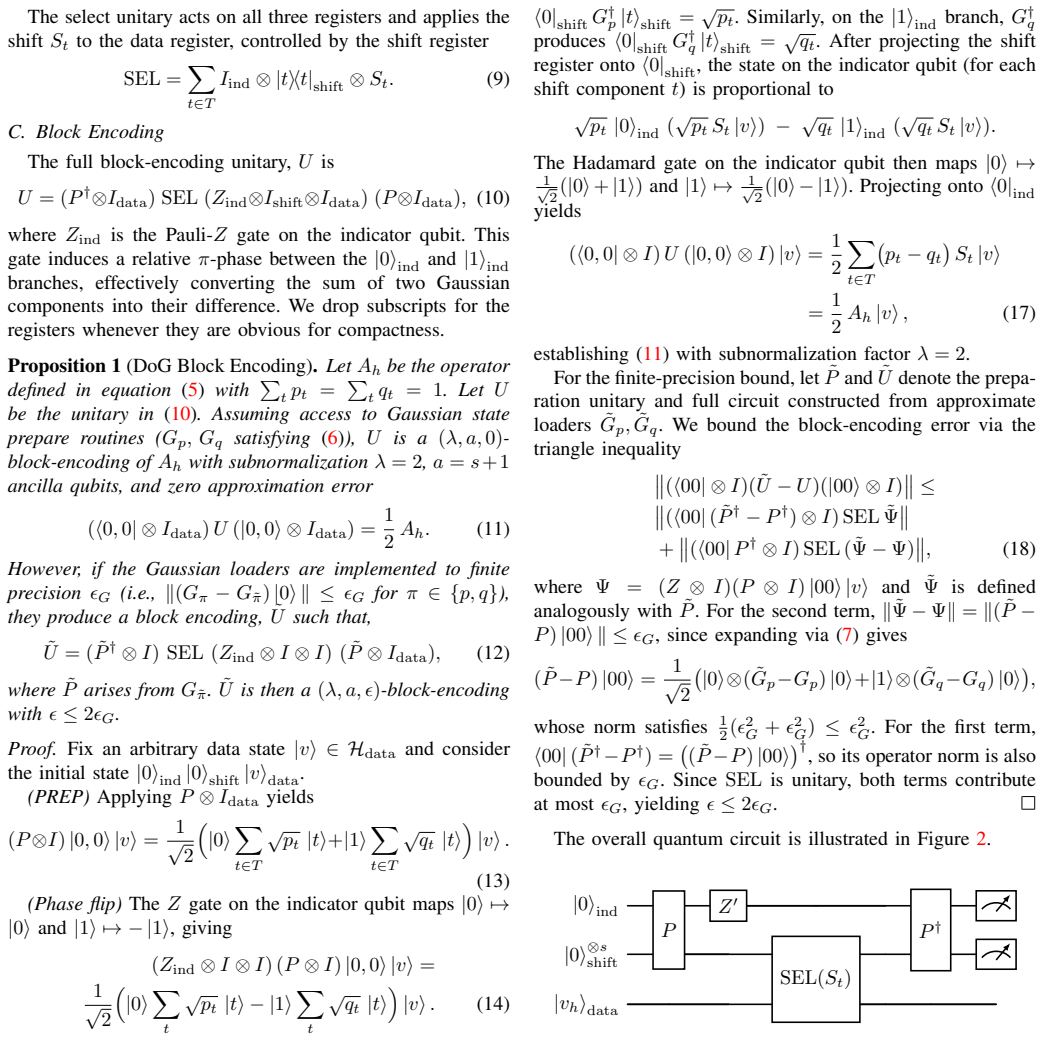
The DoG operator on a periodic grid admits a block encoding constructed from the linear combination of two unitaries, each preparing a normalized Gaussian state, with the difference realized by a Pauli-Z gate on a branch-indicator qubit. This produces a subnormalization factor λ exactly equal to 2. Because the operator is diagonalized by the discrete Fourier basis, the construction yields a closed-form expression for the block-encoding success probability in terms of the input signal's power spectrum weighted by the operator's transfer function, and this expression reduces to O(h^4) scaling with respect to grid spacing h in the fine-grid limit.
What carries the argument
Decomposition of the DoG into a linear combination of two normalized Gaussian state preparations on the periodic grid, with the subtraction encoded by a controlled Pauli-Z on an ancillary branch qubit, realized inside the linear combination of unitaries framework.
If this is right
- The quantum circuit implementing the block encoding has depth and gate count independent of grid size N, dimension D, and stencil width.
- The exact success probability of the encoding can be computed from the input signal's Fourier power spectrum multiplied by the DoG transfer function.
- As the grid spacing h approaches zero, the effective approximation error of the encoded operator scales as O(h^4).
- The two Gaussian scale parameters can be varied to tune the bandpass response without altering the block-encoding circuit structure.
Where Pith is reading between the lines
- The same decomposition technique could be applied to other kernel-based operators that separate into positive and negative parts with known state-preparation circuits.
- In quantum image processing pipelines the explicit encoding removes the need for quantum random-access memory when applying multi-scale filters to grid-encoded data.
- Combining the block encoding with a quantum Fourier transform would allow the entire filtering step to occur in the frequency domain with controlled error.
- Hardware verification on small periodic grids could measure the observed success probability against the closed-form Fourier expression to confirm the O(h^4) scaling.
Load-bearing premise
The two normalized Gaussian distributions on the periodic grid can be prepared by explicit quantum circuits whose resource cost remains efficient and independent of grid size and dimension.
What would settle it
Direct matrix comparison, on a small periodic grid, of the operator recovered by unblocking the constructed circuit against the classically computed DoG matrix elements applied to the same test vector.
Figures



read the original abstract
The Difference-of-Gaussian (DoG) is a widely used operator across applications, including image processing (feature and edge detection), quantum machine learning, and finite-difference methods (approximations of the Laplacian-of-Gaussian). In this paper, we construct an explicit quantum block encoding of the DoG operator on a periodic grid, exploiting its natural probabilistic structure. The central observation is that the DoG admits a natural decomposition to two normalized Gaussian distributions, each preparable by explicit and efficient circuits, with the negation encoded using a single Pauli-$Z$ gate on a branch-indicator qubit. This enables the operator's block encoding to be directly mapped to the Linear Combination of Unitaries framework without requiring signed amplitude loading, quantum random-access memory, or any other black-box oracles. The proposed method achieves a constant subnormalization factor $\lambda = 2$ independent of the grid size $N$, the spatial dimension $D$, and the stencil width. Additionally, we show that the DoG operator is diagonalized by the discrete Fourier basis, which allows us to derive an exact closed-form expression for the block-encoding success probability in terms of the input signal's power spectrum, weighted by the operator's transfer function. Finally, we prove that the expression reduces to $O(h^4)$ scaling with respect to grid spacing $h$ as the periodic grid becomes finer. This implementation provides an explicit construction method for a tunable, wide-stencil bandpass filter whose frequency response is controlled by two Gaussian scale parameters.
Editorial analysis
A structured set of objections, weighed in public.
Referee Report
Summary. The paper claims to construct an explicit quantum block encoding of the Difference-of-Gaussian (DoG) operator on a periodic grid by decomposing it as a difference of two normalized Gaussian distributions (each a convex combination of shift unitaries), implementing the construction via the LCU framework with a branch qubit and Pauli-Z for the sign, yielding constant subnormalization λ=2 independent of N, D and stencil width. It further derives an exact closed-form success probability via the Fourier representation of the operator and input power spectrum, and proves that this probability scales as O(h^4) for fixed physical signals as grid spacing h→0.
Significance. If the central claims hold, the work supplies a practical, oracle-free block encoding for a tunable bandpass filter with constant overhead, explicit Gaussian state-preparation circuits, and an analyzable success probability. These features are valuable for quantum image processing, QML, and finite-difference methods; the parameter-free λ=2 and the exact Fourier-derived probability formula are particular strengths that enable concrete resource estimates.
minor comments (2)
- [Abstract] The abstract states that the two normalized Gaussians 'admit explicit and efficient quantum state-preparation circuits'; the main text should include the explicit circuit (or a clear reference to its construction) together with a gate-count or depth bound that confirms independence from N and D.
- The O(h^4) scaling proof relies on the small-ω expansion of the DoG transfer function; a one-paragraph outline of this expansion (with the leading-order term) would improve readability without lengthening the manuscript.
Simulated Author's Rebuttal
We thank the referee for their positive summary of the manuscript, recognition of its potential value for quantum image processing and related applications, and recommendation of minor revision. The referee's description of the central claims (constant λ=2, explicit LCU construction without oracles, and the Fourier-derived O(h^4) success probability) is accurate.
Circularity Check
No significant circularity
full rationale
The derivation begins from the explicit decomposition of the circulant DoG operator as a difference of two normalized Gaussians G1 − G2, each expressed as a convex combination of shift unitaries. The LCU block-encoding unitary is assembled directly from controlled shifts, branch-qubit preparation in |±⟩, and controlled Gaussian state preparation, yielding λ = 2 by construction from the normalizations without any fitted parameters. The success probability is obtained exactly from the Fourier representation of the circulant operator and the input power spectrum; the O(h^4) scaling then follows from the standard small-ω Taylor expansion of the DoG transfer function. No step invokes self-citation for uniqueness, smuggles an ansatz, renames a known result, or reduces a prediction to a fitted input. The Gaussian preparation circuits are stated as an external assumption rather than derived within the paper. The entire chain is self-contained and independent of the target claims.
Axiom & Free-Parameter Ledger
free parameters (1)
- Gaussian scale parameters
axioms (2)
- domain assumption Normalized Gaussian distributions on a periodic grid admit explicit, efficient quantum state-preparation circuits whose depth is independent of grid size N and dimension D.
- domain assumption The DoG operator is exactly diagonalized by the discrete Fourier basis on a periodic grid.
Reference graph
Works this paper leans on
-
[1]
A generalized laplacian of gaussian filter for blob detection and its applications.IEEE transactions on cybernetics, 43(6):1719–1733, 2013
Hui Kong, Hatice Cinar Akakin, and Sanjay E Sarma. A generalized laplacian of gaussian filter for blob detection and its applications.IEEE transactions on cybernetics, 43(6):1719–1733, 2013
2013
-
[2]
William E Polakowski, Donald A Cournoyer, Steven K Rogers, Martin P DeSimio, Dennis W Ruck, Jeffrey W Hoffmeister, and Richard A Raines. Computer-aided breast cancer detection and diagnosis of masses using difference of gaussians and derivative-based feature saliency.IEEE transactions on medical imaging, 16(6):811–819, 1997
1997
-
[3]
Multiscale edge fusion for vehicle detection based on difference of gaussian.Optik, 127(11):4794–4798, 2016
Kenan Mu, Fei Hui, Xiangmo Zhao, and Christian Prehofer. Multiscale edge fusion for vehicle detection based on difference of gaussian.Optik, 127(11):4794–4798, 2016
2016
-
[4]
Performing edge detection by difference of gaussians using q-gaussian kernels
Lucas Assirati, N ´ubia Rosa da Silva, Lilian Berton, Alneu de A Lopes, and Odemir M Bruno. Performing edge detection by difference of gaussians using q-gaussian kernels. InJournal of Physics: Conference Series, volume 490, page 012020. IOP Publishing, 2014
2014
-
[5]
Theory of edge detection.Proceed- ings of the Royal Society of London
David Marr and Ellen Hildreth. Theory of edge detection.Proceed- ings of the Royal Society of London. Series B. Biological Sciences, 207(1167):187–217, 1980
1980
-
[6]
Finite difference methods for differential equations
Randall J LeVeque. Finite difference methods for differential equations. Draft version for use in AMath, 585(6):112, 1998
1998
-
[7]
The finite difference method at arbitrary irregular grids and its application in applied mechanics
Tadeusz Liszka and Janusz Orkisz. The finite difference method at arbitrary irregular grids and its application in applied mechanics. Computers & Structures, 11(1-2):83–95, 1980
1980
-
[8]
Oxford university press, 1985
Gordon D Smith.Numerical solution of partial differential equations: finite difference methods. Oxford university press, 1985
1985
-
[9]
TU Delft Open Publishing, 2023
Kees Vuik, Fred Vermolen, Martin van Gijzen, and Thea Vuik.Nu- merical methods for ordinary differential equations. TU Delft Open Publishing, 2023
2023
-
[10]
Farshid Mirzaee, Shadi Rezaei, and Nasrin Samadyar. Solution of time- fractional stochastic nonlinear sine-gordon equation via finite difference and meshfree techniques.Mathematical Methods in the Applied Sci- ences, 45(7):3426–3438, 2022
2022
-
[11]
George E Sotak Jr and Kim L Boyer. The laplacian-of-gaussian kernel: a formal analysis and design procedure for fast, accurate convolution and full-frame output.Computer vision, graphics, and image processing, 48(2):147–189, 1989
1989
-
[12]
Contrast enhancement using the laplacian-of-a- gaussian filter.CVGIP: Graphical Models and Image Processing, 55(6):447–463, 1993
Franck Neycenssac. Contrast enhancement using the laplacian-of-a- gaussian filter.CVGIP: Graphical Models and Image Processing, 55(6):447–463, 1993
1993
-
[13]
Sparse grids.Acta numerica, 13:147–269, 2004
Hans-Joachim Bungartz and Michael Griebel. Sparse grids.Acta numerica, 13:147–269, 2004
2004
-
[14]
Krylov subspace methods for linear systems.Springer Series in Computational Mathematics, 2022
Tomohiro Sogabe. Krylov subspace methods for linear systems.Springer Series in Computational Mathematics, 2022
2022
-
[15]
Quantum susan edge detection based on double chains quantum genetic algorithm
Chenyi Wu, Fei Huang, Jingyi Dai, and Nanrun Zhou. Quantum susan edge detection based on double chains quantum genetic algorithm. Physica A: Statistical Mechanics and its Applications, 605:128017, 2022
2022
-
[16]
Identification of image edge using quantum canny edge detection algorithm.Journal of ICT research and applications, 13(2):133–144, 2019
Dini Sundani, Sigit Widiyanto, Yuli Karyanti, and Dini Tri Wardani. Identification of image edge using quantum canny edge detection algorithm.Journal of ICT research and applications, 13(2):133–144, 2019
2019
-
[17]
Quantum implemen- tation of classical marr–hildreth edge detection.Quantum Information Processing, 19(2), 2020
Panchi Li, Tong Shi, Aiping Lu, and Bing Wang. Quantum implemen- tation of classical marr–hildreth edge detection.Quantum Information Processing, 19(2), 2020
2020
-
[18]
Quantum image processing and its application to edge detection: Theory and experiment.Physical Review X, 7(3):031041, 2017
Xi-Wei Yao, Hengyan Wang, Zeyang Liao, Ming-Cheng Chen, Jian Pan, Jun Li, Kechao Zhang, Xingcheng Lin, Zhehui Wang, Zhihuang Luo, et al. Quantum image processing and its application to edge detection: Theory and experiment.Physical Review X, 7(3):031041, 2017
2017
-
[19]
Quantum image edge detection using improved sobel mask based on neqr.Quantum Information Processing, 20(1), 2021
Rajib Chetia, SMB Boruah, and PP Sahu. Quantum image edge detection using improved sobel mask based on neqr.Quantum Information Processing, 20(1), 2021
2021
-
[20]
Wenjie Liu and Lu Wang. Quantum image edge detection based on eight-direction sobel operator for neqr.arXiv preprint arXiv:2310.03037, 2023
-
[21]
Quantum image edge extraction based on improved prewitt operator.Quantum Information Processing, 18(9), 2019
Ri-Gui Zhou, Han Yu, Yu Cheng, and Feng-Xin Li. Quantum image edge extraction based on improved prewitt operator.Quantum Information Processing, 18(9), 2019
2019
-
[22]
Fast laplacian of gaussian edge detection algorithm for quantum images
Suzhen Yuan, Salvador E Venegas-Andraca, Chaoping Zhu, Yan Wang, Xuefeng Mao, and Yuan Luo. Fast laplacian of gaussian edge detection algorithm for quantum images. In2019 IEEE International Confer- ences on Ubiquitous Computing & Communications (IUCC) and Data Science and Computational Intelligence (DSCI) and Smart Computing, Networking and Services (Smar...
2019
-
[23]
Quantum image edge detection based on laplacian of gaussian operator.Quantum information processing, 23(5):178, 2024
Suzhen Yuan, Wenhao Zhao, Jeremiah D Deng, Shuyin Xia, and Xianli Li. Quantum image edge detection based on laplacian of gaussian operator.Quantum information processing, 23(5):178, 2024
2024
-
[24]
Quantum image edge extraction based on difference of gaussian operator.Quantum Information Processing, 22(1), 2023
Ping Fan and Ke Xiao. Quantum image edge extraction based on difference of gaussian operator.Quantum Information Processing, 22(1), 2023
2023
-
[25]
Quantum singular value transformation and beyond: exponential improvements for quantum matrix arithmetics
Andr ´as Gily´en, Yuan Su, Guang Hao Low, and Nathan Wiebe. Quantum singular value transformation and beyond: exponential improvements for quantum matrix arithmetics. InProceedings of the 51st annual ACM SIGACT symposium on theory of computing, pages 193–204, 2019
2019
-
[26]
Efficient quantum algorithms for simulating sparse hamiltonians.Com- munications in Mathematical Physics, 270(2):359–371, 2007
Dominic W Berry, Graeme Ahokas, Richard Cleve, and Barry C Sanders. Efficient quantum algorithms for simulating sparse hamiltonians.Com- munications in Mathematical Physics, 270(2):359–371, 2007
2007
-
[27]
Quantum algorithm for systems of linear equations with exponentially improved dependence on precision.SIAM Journal on Computing, 46(6):1920– 1950, 2017
Andrew M Childs, Robin Kothari, and Rolando D Somma. Quantum algorithm for systems of linear equations with exponentially improved dependence on precision.SIAM Journal on Computing, 46(6):1920– 1950, 2017
1920
-
[28]
Qubitization of arbitrary basis quantum chemistry leveraging sparsity and low rank factorization.Quantum, 3:208, 2019
Dominic W Berry, Craig Gidney, Mario Motta, Jarrod R McClean, and Ryan Babbush. Qubitization of arbitrary basis quantum chemistry leveraging sparsity and low rank factorization.Quantum, 3:208, 2019
2019
-
[29]
En- coding electronic spectra in quantum circuits with linear t complexity
Ryan Babbush, Craig Gidney, Dominic W Berry, Nathan Wiebe, Jarrod McClean, Alexandru Paler, Austin Fowler, and Hartmut Neven. En- coding electronic spectra in quantum circuits with linear t complexity. Physical Review X, 8(4):041015, 2018
2018
-
[30]
Efficient block- encodings require structure
Parker Kuklinski, Benjamin Rempfer, Justin Elenewski, and Kevin Obenland. Efficient block-encodings require structure.arXiv preprint arXiv:2509.19667, 2025
-
[31]
Alessandro Andrea Zecchi, Claudio Sanavio, Luca Cappelli, Simona Perotto, Alessandro Roggero, and Sauro Succi. Block encoding of sparse matrices with a periodic diagonal structure.arXiv preprint arXiv:2602.10589, 2026
-
[32]
Explicit quantum circuits for block encodings of certain sparse matrices.SIAM Journal on Matrix Analysis and Applications, 45(1):801–827, 2024
Daan Camps, Lin Lin, Roel Van Beeumen, and Chao Yang. Explicit quantum circuits for block encodings of certain sparse matrices.SIAM Journal on Matrix Analysis and Applications, 45(1):801–827, 2024
2024
-
[33]
Explicit block encodings of boundary value problems for many-body elliptic operators.Quantum, 9:1764, 2025
Tyler Kharazi, Ahmad M Alkadri, Jin-Peng Liu, Kranthi K Mandadapu, and K Birgitta Whaley. Explicit block encodings of boundary value problems for many-body elliptic operators.Quantum, 9:1764, 2025
2025
-
[34]
Efficient and explicit block encoding of finite difference discretizations of the laplacian
Andreas Sturm and Niclas Schillo. Efficient and explicit block encoding of finite difference discretizations of the laplacian.arXiv preprint arXiv:2509.02429, 2025
-
[35]
Simulating hamiltonian dynamics with a truncated taylor series.Physical review letters, 114(9):090502, 2015
Dominic W Berry, Andrew M Childs, Richard Cleve, Robin Kothari, and Rolando D Somma. Simulating hamiltonian dynamics with a truncated taylor series.Physical review letters, 114(9):090502, 2015
2015
-
[36]
Hamiltonian Simulation Using Linear Com- binations of Unitary Operations
Andrew M Childs and Nathan Wiebe. Hamiltonian simulation using lin- ear combinations of unitary operations.arXiv preprint arXiv:1202.5822, 2012
-
[37]
Quantum-state preparation with universal gate decompositions.Physical Review A—Atomic, Molecular, and Optical Physics, 83(3):032302, 2011
Martin Plesch and ˇCaslav Brukner. Quantum-state preparation with universal gate decompositions.Physical Review A—Atomic, Molecular, and Optical Physics, 83(3):032302, 2011
2011
-
[38]
A simpler gaussian state-preparation.arXiv preprint arXiv:2508.03987, 2025
Parker Kuklinski, Benjamin Rempfer, Kevin Obenland, and Justin Elenewski. A simpler gaussian state-preparation.arXiv preprint arXiv:2508.03987, 2025
-
[39]
A logarithmic-depth quantum carry-lookahead adder
Thomas G Draper, Samuel A Kutin, Eric M Rains, and Krysta M Svore. A logarithmic-depth quantum carry-lookahead adder.arXiv preprint quant-ph/0406142, 2004
work page Pith review arXiv 2004
-
[40]
Efficient synthesis of universal repeat-until-success quantum circuits.Physical review letters, 114(8):080502, 2015
Alex Bocharov, Martin Roetteler, and Krysta M Svore. Efficient synthesis of universal repeat-until-success quantum circuits.Physical review letters, 114(8):080502, 2015
2015
-
[41]
Expressing and Analyzing Quantum Algorithms with Qualtran
Matthew P Harrigan, Tanuj Khattar, Charles Yuan, Anurudh Peduri, Noureldin Yosri, Fionn D Malone, Ryan Babbush, and Nicholas C Rubin. Expressing and analyzing quantum algorithms with qualtran. arXiv preprint arXiv:2409.04643, 2024
discussion (0)
Sign in with ORCID, Apple, or X to comment. Anyone can read and Pith papers without signing in.