Recognition: no theorem link
Human-AI Interaction Traces as Blackout Poetry: Reframing AI-Supported Writing as Found-Text Creativity
Pith reviewed 2026-05-15 13:20 UTC · model grok-4.3
The pith
Framing AI writing interaction traces as blackout poetry highlights human creative curation over mere disclosure.
A machine-rendered reading of the paper's core claim, the machinery that carries it, and where it could break.
Core claim
By drawing inspiration from blackout poetry, the paper argues that human-AI interaction traces can function as expressive artifacts in which writers' acts of curation and reinterpretation are inscribed atop AI-generated text, thereby foregrounding the meaning-making inherent in human-AI collaboration instead of reducing it to quantifiable disclosures of provenance.
What carries the argument
The blackout poetry framing of interaction traces, treating AI output as found material and human edits as inscriptions of interpretive curation.
Load-bearing premise
Readers will interpret aesthetic traces as evidence of meaningful human curation and creativity rather than as decorative or evasive presentation.
What would settle it
A reader study comparing reported trust and appreciation levels for AI-assisted texts presented with blackout-poetry-style aesthetic traces versus standard quantitative disclosure statements; no increase or a decrease in trust would challenge the claim.
Figures
read the original abstract
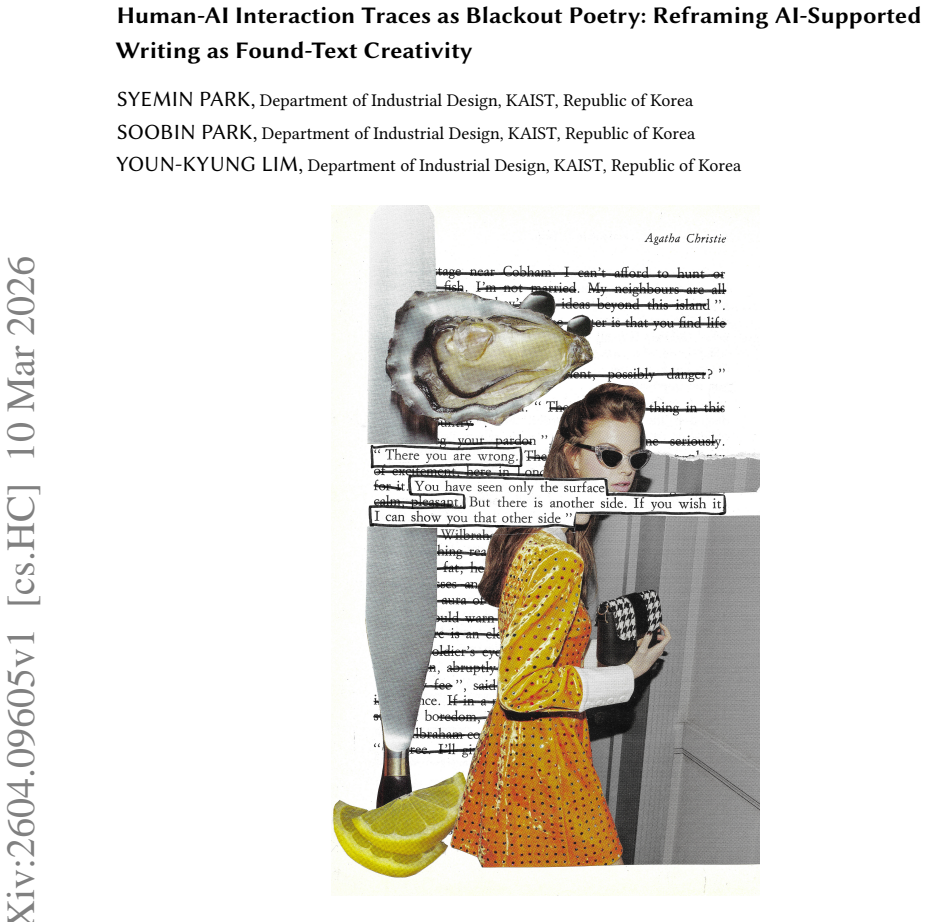
LLMs offer new creative possibilities for writers but also raise concerns about authenticity and reader trust, particularly when AI involvement is disclosed. Prior research has largely framed this as an issue of transparency and provenance, emphasizing the disclosure of human-AI interaction traces that account for how much the AI wrote and what the human did. Yet such audit-oriented disclosures may risk reducing creative collaboration to quantification and surveillance. In this position paper, we argue for a different lens by exploring how human-AI interaction traces might instead function as expressive artifacts that foreground the meaning-making inherent in human-AI collaboration. Drawing inspiration from blackout poetry, we frame AI-generated text as found material through which writers' acts of curation and reinterpretation become inscribed atop the AI's original output. In this way, we suggest that designing interaction traces as aesthetic artifacts may help readers better appreciate and trust writers' creative contributions in AI-assisted writing.
Editorial analysis
A structured set of objections, weighed in public.
Referee Report
Summary. The paper proposes reframing human-AI interaction traces in AI-supported writing as aesthetic artifacts inspired by blackout poetry, treating AI-generated text as 'found material' upon which writers inscribe acts of curation and reinterpretation. This is positioned as an alternative to audit-oriented disclosures of provenance and quantification, with the suggestion that such aesthetic design may increase readers' appreciation and trust in the human writer's creative contributions.
Significance. If the conceptual reframing holds, the work could shift HCI and creative-AI discourse from surveillance-style transparency toward expressive, artistic modes of disclosure, potentially informing the design of interaction tools that foreground meaning-making. As a purely position paper, however, its significance remains speculative pending any empirical test of the reader-response claims.
major comments (1)
- [Abstract] Abstract: The load-bearing claim that aesthetic traces 'may help readers better appreciate and trust writers' creative contributions' rests on the unexamined assumption that readers will interpret stylized traces as evidence of substantive human curation rather than as decoration or performative evasion; the manuscript supplies neither a mechanism for this interpretation nor discussion of counter-possibilities.
minor comments (1)
- [Abstract] The abstract would be strengthened by a brief, concrete illustration of a blackout-poetry-style trace (e.g., a short excerpt showing redacted AI text with human annotations) to ground the analogy for readers unfamiliar with the form.
Simulated Author's Rebuttal
We thank the referee for their constructive feedback on our position paper. The comments correctly identify the speculative character of our core claim and the absence of detailed interpretive mechanisms. We will revise the manuscript to address these points directly while preserving the conceptual focus of the work.
read point-by-point responses
-
Referee: [Abstract] Abstract: The load-bearing claim that aesthetic traces 'may help readers better appreciate and trust writers' creative contributions' rests on the unexamined assumption that readers will interpret stylized traces as evidence of substantive human curation rather than as decoration or performative evasion; the manuscript supplies neither a mechanism for this interpretation nor discussion of counter-possibilities.
Authors: We accept this assessment. As a position paper, the manuscript advances a conceptual reframing rather than an empirically validated model, and therefore does not supply a cognitive or semiotic mechanism explaining reader interpretation. We will revise the abstract to emphasize the tentative nature of the claim (retaining the qualifier 'may') and add a dedicated paragraph in the Discussion section that explicitly enumerates counter-possibilities, including the risk that aesthetic traces could be read as ornamental or as strategic evasion of provenance disclosure. These changes will make the paper's assumptions and limitations more transparent without altering its position-paper genre. revision: yes
Circularity Check
No circularity: conceptual reframing draws from external literary tradition without self-referential reductions
full rationale
The paper is a position paper that proposes reframing AI interaction traces as blackout poetry to foreground human curation. It contains no equations, fitted parameters, predictions, or derivations that could reduce to inputs by construction. The central suggestion draws inspiration from the established external practice of blackout poetry rather than from any self-citation or internal definition. No load-bearing step relies on a self-citation chain, uniqueness theorem, or ansatz smuggled via prior work by the same authors. The argument is therefore self-contained as a conceptual proposal and exhibits none of the enumerated circularity patterns.
Axiom & Free-Parameter Ledger
axioms (2)
- domain assumption Aesthetic presentation of traces will foreground meaning-making and increase reader appreciation and trust
- domain assumption Readers respond more positively to artistic disclosures than to quantitative audit logs
Reference graph
Works this paper leans on
-
[1]
Alex Calderwood, John Joon Young Chung, Yuqian Sun, Melissa Roemmele, and Max Kreminski. 2025. Phraselette: A Poet’s Procedural Palette. InProceedings of the 2025 ACM Designing Interactive Systems Conference (DIS ’25). Association for Computing Machinery, New York, NY, USA, 2701–2717. doi:10.1145/3715336.3735832
-
[2]
1999.Art and interpretation: an anthology of readings in aesthetics and the philosophy of art
Eric Dayton. 1999.Art and interpretation: an anthology of readings in aesthetics and the philosophy of art. Broadview Press
work page 1999
-
[3]
Katy Ilonka Gero, Tao Long, and Lydia B Chilton. 2023. Social Dynamics of AI Support in Creative Writing. InProceedings of the 2023 CHI Conference on Human Factors in Computing Systems(Hamburg, Germany)(CHI ’23). Association for Computing Machinery, New York, NY, USA, Article 245, 15 pages. doi:10.1145/3544548.3580782
-
[4]
Shelton, Fanny Chevalier, Kari Kraus, and Niklas Elmqvist
Md Naimul Hoque, Tasfia Mashiat, Bhavya Ghai, Cecilia D. Shelton, Fanny Chevalier, Kari Kraus, and Niklas Elmqvist. 2024. The HaLLMark Effect: Supporting Provenance and Transparent Use of Large Language Models in Writing with Interactive Visualization. InProceedings of the 2024 CHI Conference on Human Factors in Computing Systems(Honolulu, HI, USA)(CHI ’2...
-
[5]
Vera Liao, Su Lin Blodgett, Alexandra Olteanu, and Adam Trischler
Angel Hsing-Chi Hwang, Q. Vera Liao, Su Lin Blodgett, Alexandra Olteanu, and Adam Trischler. 2025. ’It was 80% me, 20% AI’: Seeking Authenticity in Co-Writing with Large Language Models.Proc. ACM Hum.-Comput. Interact.9, 2, Article CSCW122 (May 2025), 41 pages. doi:10.1145/3711020 Manuscript submitted to ACM 4 Park et al
- [6]
- [7]
- [8]
-
[9]
Syemin Park, Soobin Park, and Youn-kyung Lim. 2026. Constella: Supporting Storywriters’ Interconnected Character Creation through LLM-based Multi-Agents.ACM Trans. Comput.-Hum. Interact.(Feb. 2026). doi:10.1145/3796234 Just Accepted
-
[10]
Santa Clara County Library District. 2023.What is Blackout Poetry?https://sccld.org/blogs/post/what-is-blackout-poetry/ Accessed: 2026-02-08
work page 2023
-
[11]
Oliver Schilke and Martin Reimann. 2025. The transparency dilemma: How AI disclosure erodes trust.Organizational Behavior and Human Decision Processes188 (2025), 104405
work page 2025
- [12]
-
[13]
Nikhil Singh, Guillermo Bernal, Daria Savchenko, and Elena L. Glassman. 2023. Where to Hide a Stolen Elephant: Leaps in Creative Writing with Multimodal Machine Intelligence.ACM Trans. Comput.-Hum. Interact.30, 5, Article 68 (Sept. 2023), 57 pages. doi:10.1145/3511599
-
[14]
1970.Art from Found Materials: Discarded and Natural
Mary Lou Stribling. 1970.Art from Found Materials: Discarded and Natural. Crown Publishers, New York, NY
work page 1970
-
[15]
2009.Found Art: Discovering Beauty in Foreign Places
Leeana Tankersley. 2009.Found Art: Discovering Beauty in Foreign Places. Zondervan, Grand Rapids, MI
work page 2009
-
[16]
David Zhou and Sarah Sterman. 2024. Ai.llude: Investigating Rewriting AI-Generated Text to Support Creative Expression. InProceedings of the 16th Conference on Creativity & Cognition(Chicago, IL, USA)(C&C ’24). Association for Computing Machinery, New York, NY, USA, 241–254. doi:10.1145/3635636.3656187 Manuscript submitted to ACM
discussion (0)
Sign in with ORCID, Apple, or X to comment. Anyone can read and Pith papers without signing in.